
The most recent monthly update is on top, followed by archives going back to the first monthly update in December of 2011. Please join 5,457,627 visitors from 196 countries (speaking 154 languages) including 50 US States and visit our new website at www.financialecononomicupdate.com.
All-time visits to our financial and socio-economic blog since 2011 have come from the People’s Republic of China (54%), the USA (23%), Singapore (16%), Japan (1%), Germany (1%), the Philippines (1%), India (1%) and 189 other countries and territories combined (3%).
Financial, Economic and Social Mood Update (October 1, 2026)
There is much so-called news or information about the worldwide distribution of wealth today so I decided to quantify this by wealth category to give us a much better or clearer picture of where we stand as a global community. This is quantified into categories for global Dollar billionaires, centimillionaires (people and/or families worth at least USD $100 million but less than USD $billion), decamillionaires (those worth from USD $10 to $100 million), millionaires (individuals and/or families worth from USD $1 to $10 million), those worth more than USD $100,000 but less than one million Dollars, those worth more than USD $10,000 but less than USD $100,000 and those with no net worth at all:
AOL Yahoo AI search as of 09/01/2026 Total Dollar amount
Worldwide population top percentage in Billions share of global wealth
1 Billionaires 3,795 0.00005% $3,100,000,000 $11,765 1.37% Billionaires
2 Centimillionaires 29,350 33,145 0.00043% $500,000,000 $14,675 1.71% Centimillionaires
3 Decamillionaires 2,636 35,781 0.00047% $50,000,000 $132 0.02% Decamillionaires
4 Millionaires 80,000,000 80,035,781 1.04186% $2,300,000 $184,000 21.44% Millionaires
5 $100,000 1,100,000,000 1,180,035,781 15.36105% $500,000 $550,000 64.10% $100,000
6 $10,000 1,620,000,000 2,800,035,781 36.44931% $50,000 $81,000 9.44% $10,000
7 below $10,000 3,300,000,000 6,100,035,781 79.40687% $5,000 $16,500 1.92% below $10,000
8 not counted by AI 1,581,964,219 7,682,000,000 100.00000% $0 $0 0.00% not counted by AI
7,682,000,000 $858,071 100.00%
$224,189 20.71% Public & nonprofit owned
$1,082,260
The global human population illustrated here is 7.7 Billion. The total amount of all global wealth represented in US Dollar values equals about USD $858 Trillion – all privately held wealth which equals 79 percent of the wealth on the planet. The remaining 21 percent can be thought of as public and nonprofit wealth, such as national parks and legal charities. The social class with the greatest share of overall wealth is what one would call the middle class in more developed economies with 64 percent of the global wealth. Next comes the class of Dollar millionaires with 21 percent of the global wealth and in third place is what one might name the lower middle class with 9 percent of the global wealth.
The column highlighted in yellow shows the “mean average” net worth in each category. For instance, the “average” Dollar billionaire has a net worth equivalent to USD $3.1 billion, the average centimillionaire USD $500 million, the average decamillionaire USD $50 million, the average millionaire USD $2.3 million and so forth.
Public policy everywhere (regardless of country or political jurisdiction) must determine how to address the problems of debt which lead to deficit spending, public borrowing crowding out the private sector credit market and the decimation of the spending power of paper fiat currencies caused by inflation. In addition to this is the very unequal distribution of wealth, income and overall unequal opportunity for a decent quality of life. There is a global underclass comprising 64 percent of the human race which translates into the potential for political instability, social unrest and inadequate opportunities for social betterment. Beyond this we have all issues related to political, economic and financial corruption (dishonesty) and the destruction of and/or harm to our natural environment – the world in which we all live, breathe, eat and sleep.
After the Great economic and financial Depression of 1929 (nominal monetary values returned to the levels of 1929 only by 1954) public policy in most of the world sought to address the problems of the lack of industrial regulation, the lack of adequate social insurance, and the lack of progressive rates of taxation – much of this has been rolled back over the past 45 years in the name of so-called freedom and free enterprise.
Today we stand at a juncture where much of the global political center-left is calling for asset taxes upon the world’s wealthiest citizens in an effort to address the very serious problems mentioned in the previous paragraphs of this month’s update. The idea is not a bad one and lawmakers from across the moderate and normal political spectrum must work with each other to address these issues and to begin to repair the damage in our common social and economic home.
Update on the Global Auto Industry
The global auto industry continues its relentless movement away from the internal combustion engine, from the use of fossil fuels – especially away from the use of gasoline. As of today there are about 250,000 gasoline stations in the world compared to about 7 million BEV (battery electric vehicle) charging stations. In terms of annual new vehicle unit sales, gasoline powered cars and trucks have finally fallen below half at 42 percent of the current worldwide total. The remainder of new sales are 28 percent plug in electric, 18 percent diesel, 12 percent hybrid and less than one percent hydrogen.
Sam Evins of Australia has a YouTube channel called “The Electric Viking” and here are some recent videos on the changes upon us. This video looks at the demise of the value of internal combustion engine cars: https://www.youtube.com/watch?v=OmQPocDe4a8.
This recent video looks at the increasing dominance of Chinese automotive manufacturers in Uruguay, which has automotive market free from counterproductive import restrictions and nonsensical tariffs: https://www.youtube.com/watch?v=lblrZYoyOPU.
Financial, Economic and Social Mood Update (September 1, 2026)
I traveled for six weeks in the Philippines (Cebu, Bohol, Panglao, Manila and Makati), Hong Kong, Macao, and Taiwan and in the San Francisco, California Bay Area and made a number of observations.
China is a fully developed country and its massive southeast megalopolis including Hong Kong, Macao and Zhuhai are every much as affluent as North America and Europe. While in Macao I saw one (1) person who could be classified as “homeless.” Most people work at average jobs to make ends meet as do most people all over the entire world. There are also a (not small) number of people who are very affluent or even wealthy. Most of these are business people from the rest of mainland China – the People’s Republic of China (PRC). Life is not much different than in North America or in Europe. The Internet was not blocked where I visited and people lead normal lives. Macao is the most densely populated territory on earth which means that space (real property) sells at an absolute premium. Most people in Macao and in all large cities all over the world reside in “dense” housing such as apartments, condominiums and townhomes. Only a few people or families have the financial means to afford single family homes which are more often than not more like mansions or palaces – huge in size and with at least three floors. In Macao such homes sell for more than the equivalent of USD $100 million or nine (9) figures.
Moving down the ladder or pyramid one finds high rise glass structures where “units” are similar in living space to large single family homes (say more than 3,000 square feet) and these dwellings sell for more than the equivalent of USD $10 million or eight (8) figures in Macao. Most people cannot afford to own and thus rent (as in the rest of the world). The smallest dwellings for purchase are “studio” or one-bedroom units located in much older, less desirable midrise buildings where there are no elevators. These units start around the equivalent of USD $300,000, $400,000 and $500,000 each.
Mansions (large single family homes) in the “Forbes Park” village or subdivision of Makati City in the Philippines sell for roughly USD $16 to $17 million each. More modest or average single family homes in the same neighborhood are not as pricey. The situation in the expanded San Francisco-Oakland-San Jose, California Bay Area is not too different (this has been and remains the most expensive metropolitan region in the entire USA which has been the case for more than a century).
The Golden State of California started to boom with the “Gold Rush” of 1848 after the region was taken away from Mexico due to the Mexican-American War (1846-1848). The “Gold” of today happens to be the IPO initial public corporate stock offering often in the areas of high technology and biotechnology. Urban sprawl now reaches into “central” California because employees who must work closer to the core cities such as San Francisco, Oakland, San Jose and the expanded Silicon Valley cannot afford to live either there or in nearby older suburbs in counties such as San Mateo, Marin, Alameda and Contra Costa. This expanded urban sprawl reaches all the way to cities such as Stockton, Tracy, Manteca, Merced, Livermore, Pleasanton and Dublin (there is overlap here in terms of county boundaries). The roughly 900,000 net loss in population since 2020 can be attributed to the contracting (upper middle level) of the US labor market. Whereas lower compensation service and retail employment beg for applicants, middle and upper mid-level professional employment is contracting. People who much more recently purchased much newer tract homes in residential subdivisions in central California fit into this latter demographic. When people lose their jobs and cannot replace those jobs soon enough with comparable compensation they often choose to relocate to less affluent and less expensive parts of the USA such as Texas, Florida and beyond.
On the other hand there are very positive signs in a strained American economy. The port of Oakland, California is extremely active and busy and it is nowhere near as large as the ports in much more populated southern California due to metropolitan Los Angeles and San Diego having more population compared to northern California.
Electric and hybrid vehicles are much more common in larger cities and metro regions compared to in the interior of the USA and the former will continue to gain overall market share worldwide which now stands at 28 percent of all new unit sales in the world. Economies of scale in production have been achieved and charging has improved as has driving range. The insanity of the war in the Middle East and the Persian Gulf motivate ever more people worldwide to go electric. An excellent case in point is Denmark which had very few electric vehicles as recently as six years ago. Most recent sales and registration statistics show that one third of all vehicles in use are now electric and in sales of new vehicles this reached 97 percent in July 2026.
Financial, Economic and Social Mood Update (August 2, 2026)
The demographic situation in the world today with respect to race is not unlike that in southern Africa when it moved from white minority rule to majority rule based upon one person, one vote (universal suffrage). The Republic of South Africa was about 29.02 percent white / Caucasian / Indo-European from 1797 until the census of 1897 and in the 2022 census this was down to 7.3 percent of the population – the figure for 2026 is likely closer to 6.3 percent of the entire population of the country.
Majority rule in the Republic of South Africa under the leadership of the African National Congress (ANC) since 1994 has seen evolutionary as opposed to revolutionary change. Both South Africa and Namibia chose a moderate way to achieve change whereas Zimbabwe (formerly southern Rhodesia) destroyed its economy due to radical change plagued with kleptocracy. Ownership of land and assets in South Africa due to rule by the former National Party (1948 to 1994) was 87 percent white in 1994 and remains 72 percent white today.
Globally, the entire planet was about 35 percent white / Caucasian / Indo-European in the year 1900 when European colonial power was at its peak. Today, that figure is down to no more than 8 percent of the earth’s human population.
The geopolitical, socio-economic and financial changes now underway are influenced by this reality. European colonial power (which includes major powers “mimicking” Europe such as the USA and Japan) reached a peak in 1914 before the onset of World War One (1914-1918). World Wars One (1914-1918) and Two (1939-1945) can be seen as a European “civil war” or also as the “30 Years War” of the 20th Century – the original 30 Years War took place mostly on the territory of the Holy Roman Empire of the German Nation from 1618-1648 and involved the major powers of that time including France, Denmark and Sweden all of whom invaded and heavily damaged Germany. Both Switzerland and the Netherlands had their political independence recognized due to losses suffered by the German Empire.
The British Empire was the number one global empire in terms of both territory and population from 1588 (the English defeat of the Spanish Naval Armada) and 1945 (the end of World War 2 in both Europe and Asia with the defeat of both Germany and Japan). The US Empire has been dominant since 1945 but this is now ending. The last and most recent reason for this demise is the defeat of the USA and Israel at the hands of Islamic Republic of Iran and her BRICS, SCO and BRI allies which includes most of humanity.
A new multi-polar international order is emerging led by the largest economies on earth including those of the People’s Republic of China (PRC) and to a lesser extent the European Union (EU). Already 160 nations are on board agreeing to the concept of global economic planning with goal of peace, prosperity, inclusion, diversity, and environmental ecology representing 82 percent of the membership of the United Nations (UN).
The social-economic, political and demographic changes occurring globally right now reflect a changed reality which must address past inequities with respect to 1) the distribution of wealth, income & opportunity, 2) political representation (legislative, executive and judicial) and 3) racial, ethnic, linguistic, national and gender equality-parity.
My most recent monthly blogs have discussed the concept of monetizing the assets of the earth to halt environmental destruction, to back fiat currencies with real wealth (thus attempting to halt inflation, the erosion of purchasing power and the rise in the cost of living) and to fund basic services including food security, income security, universal healthcare and public education. Every country or state / province with an active sovereign wealth fund has already moved toward this concept to a certain degree. The number of active sovereign wealth funds today stands at 95 which are almost 49 percent of the membership of the United Nations (UN).
Financial, Economic and Social Mood Update (July 1, 2026)
The USA and almost all countries on earth are faced with similar existential problems which include the precarious predicament of fiat currencies (collapsing purchasing power and the skyrocketing cost of living due to deficit spending and soaring levels of debt), environmental tribulation due to the demands of swollen human population numbers and pollution due to fossil fuel usage – not to mention endless wars, political corruption on steroids and an economic pyramid in which the global middle class has all but disappeared. The human population on earth is now divided into roughly 2 percent “haves” versus 98 percent “have nots.” Not only is this unacceptable from a moral standpoint but it also leads to extreme social instability which threatens peace, stability and democracy.
Wealth and income distribution have become so severely uneven for the simple reason that corporate income tax has become so miniscule. Corporations are owned by their shareholders, and corporate shareholding is very heavily concentrated at the top of the economic population pyramid. In the USA annual corporate profits now run at USD $13.87 TRILLION of which a paltry 0.94 percent is paid to the IRS.
Individual income taxes (your form 1040) comprise 54 percent of IRS receipts. Social Security and Medicare taxes (since the Presidential Administrations of Franklin Delano Roosevelt and Lyndon Baines Johnson, respectively) currently comprise an additional 32 percent of IRS receipts. All of this is very good and necessary to maintain a decent standard of living. Beyond this we get into the much smaller portions of IRS revenue. Tariffs (which do much more harm than good to the overall domestic and global economy) comprise 8 percent of current IRS revenue. Tariffs depress consumer demand which makes up 70 percent of GDP. Tariffs are levied upon all consumer good sales both new and used. Tariffs contribute to price inflation especially visible in the automotive market. Tariffs also make domestic manufacturers “lazy” and harm their ability to compete globally both in the short and long term.
As referenced above, corporate income taxes are miniscule and comprise a paltry 4 percent of current IRS annual revenue. Excise taxes (on items such as alcohol, tobacco and fuel) comprise one percent of IRS revenue as do Estate and Gift (i.e., inheritance) taxes.
The big problem with government revenue (not merely in the USA but globally) is that corporate income taxes are so low. Spending is far too high (largely due to endless wars which enriches shareholders who own the defense / war / killing industry) which translates into massive annual deficits (not just in the USA but globally) which decimates fiat currency value and spending power thus raising the cost of living due to price inflation.
Massive debt necessitates lower bond prices = higher interest rates which is a zero sum game and cannot be avoided. Arguing against this is moronic – it is akin to saying that you are not in favor of gravity. Even attempting to go against this would lead to ultra-massive severe hyperinflation. The entire planet would be like the end of the Weimar Republic in 1933 or the disaster of Mugabe’s Zimbabwe in 1980.
The issue of corporate taxation must be addressed on an all-inclusive global level and must address the top level of “estate” planning. This means offshore holding companies and offshore trusts located in so-called global tax havens which allow multinational corporations to legally avoid paying corporate income taxes by legally moving their profits across borders which must be stopped once and for all.
As discussed in my most recent monthly blogs, monetizing all of the earth’s assets (real estate, fossil fuels, precious metals, corporate stock, fiat currencies and crypto-currencies) will enable us to address and begin to fix the issues of environmental degradation and climate change. It will also enable governments to better address the needs of the “have nots” of the earth by funding basic income for nutrition, income security, pensions, health insurance & care, education, child care and transportation infrastructure & operation all of which are infinitely more important than the travesty of “defense” which translates into endless wars and which is directly responsible for no less than 36 percent of current US national debt. The issue of the lack of corporate income taxation discussed above is directly responsible for an additional 33 percent of current US national debt. US Dollar billionaires and millionaires (such people in all countries) own 47 percent of the world’s wealth today. The lack of adequate taxation upon this elite social class is directly responsible for the remaining 31 percent of public sector debt.
Here are some recent videos which are informative and pertinent. This one by “Electric Viking” Sam Evins from Australia quotes senior management of the VW Group (the second largest auto group in the world after Toyota in terms of annual unit sales of passenger cars, SUVs and light trucks) that ICE (internal combustion engine) vehicles will comprise no more than 5 percent of new global unit sales by 2035: https://www.youtube.com/watch?v=xky4Gtw9eso.
Yet another recent video by “Electric Viking” Sam Evins from Australia on how sales of new ICE (internal combustion engine) vehicles are actually starting to be banned in this case in both Ethiopia and Laos: https://www.youtube.com/watch?v=mR94B_JyhNI.
CNN on how Donald Trump and MAGA are now losing their all-critical rural white base. FYI, right wing parties all over the planet rely on rural voters for their solid core support. Most urban and suburban areas worldwide which tend to be far more affluent and better educated than rural areas vote the opposite of rural areas. The USA with only red states is a third world country: https://www.youtube.com/watch?v=W0x1NHmuPN0.
More from David Pakman on the decline of MAGA – the economic “haves” of the world had better pay attention to issues I have addressed in my most recent monthly blogs. Members of “Generation Z” (emerging younger people born from 2003 to 2012) already favor both what they see as socialism and communism by a combined 90 percent or more. No surprise – it is ever harder to make an honest living and to make financial ends meet: https://www.youtube.com/watch?v=OTqUvHO8Pq4.
Financial, Economic and Social Mood Update (June 1, 2026)
In last month’s blog I discussed the historical background for representative government on earth going back to its beginnings in the modern era. We also discussed supra-national and world government entities which are necessary to tackle all-important issues which affect all life on earth – to reach a more just distribution & use of income and wealth, to address the real issue of environmental degradation and to use our resources more wisely to improve the overall standard of living for everyone with no exceptions. The goal here is more fairness, more inclusion, more equity, more sanity, more stability, mutual respect, prosperity for all and for a final end to war and armed conflict.
The main global governmental body since 1945 is the United Nations (UN) which is based in New York City. The UN has 193 member and 2 observer nations – some of these nations in turn have dependent territories (formerly called “colonies”).
The supra-national regional entity which has evolved the furthest to date is the European Union (EU). The EU was formally established in 1952 and today has 27 member nations with a combined human population of 451 million. The EU has its administrative base in Brussels, its central bank in Frankfurt, its judiciary in Luxembourg and its parliament in Strasbourg. The United Kingdom (UK) may soon seek to rejoin the EU. Greenland (an autonomous country within the Danish Realm) may also seek to join the EU. There are a number of other countries now applying for EU membership. These include Montenegro, Albania, Serbia, Moldova, North Macedonia, Ukraine, Bosnia-Herzegovina, Georgia, Kosovo and Turkey. Beyond this are countries contemplating possible application to the EU including Norway, Iceland, Armenia, Belarus, Canada, Russia, San Marino, Switzerland, the Faroe Islands (part of the Danish Realm), the Dutch Caribbean Territories (the ABC Islands plus Sint Maarten) and New Caledonia (a Pacific Ocean overseas territory of France). All of these countries would increase the combined population of the EU to almost 873 million.
Aside from the EU is the “Group of 77” – an organization with 134 member countries first established in 1964 with its headquarters in Geneva, Switzerland. The Group of 77 includes the “global south” comprising Central America, the Caribbean, South America (Mercosur), Africa (the African Union), the Middle East / Persian Gulf, part of Central Asia, the Indian subcontinent (South Asia), East Asia (includes China) and Southeast Asia (ASEAN). The estimated combined population of the Group of 77 is 6.194 BILLION people.
The Commonwealth of Independent States (CIS) represents most but not all of the former Soviet Union. It is based in both Moscow and Minsk and has 9 member countries, one associate country and a combined population of 252 million.
The only remaining regions of the earth outside of those listed above include the USA (342 million people), Mexico (132 million people) and Oceania (Australia plus the island nations of the world with 44 million inhabitants). The combined total human population of the world is thus about 7.682 BILLION.
The concept of monetizing the earth’s assets with the goals of a more equitable distribution of income & wealth, environmental conservation and expanded formal education is now in the process of building a monetary framework. This proposal has been shared with the United Nations plus with the governments of the Philippines, Australia, Papua New Guinea and Bougainville. These countries have a combined population of at least 162 million.
Here are some informative videos from the past month. The Trump Administration effort to avoid the onset of battery electric vehicle (BEV) technology is 1) hampering automakers in the west in general and in the USA in particular while 2) the auto industry in mainland China charges forward. Chinese vehicles are a big hit in many countries including in Canada and Mexico. American consumers on our borders see those vehicles and wish they were sold here: https://www.instagram.com/p/DAGlsz4tKIB/.
Mexico is emerging as even more of an important investment hub to supply the American consumer market. Many of the companies setting up shop in Mexico are of course Chinese, which is normal and expected: https://www.youtube.com/watch?v=UBNp7mP68M0.
Here is an excellent interview with Andrew Yang, who ran for President of the USA in the Democratic primaries in 2024. He says that 80 to 90 percent of Americans have already been left behind by “crony capitalism” and encourages his fellow billionaires to support wealth sharing efforts similar to those I have highlighted in my most recent monthly blogs. This must be done for common decency and to preserve the social peace. The middle class worldwide is effectively gone, with planet earth having about 98 percent of its people in the lower classes and the former middle classes: https://www.youtube.com/watch?v=E0HjYVX6EFU&t=3s.
Here is a very good video analyzing the American political landscape. Donald Trump and MAGA are effectively killing the GOP. What emerges after 2026 and 2028 will likely be a political landscape more similar to that of Canada – a large liberal or left party competing with a smaller mainstream moderate party: https://www.youtube.com/watch?v=Eltr9Qo8E-A&t=5s.
Financial, Economic and Social Mood Update (May 1, 2026)
My most recent monthly blogs have tackled the all-important issues of global wealth and income inequality and how to address this problem by taking on the top level of estate planning (offshore trusts and holding companies which allow multinational corporations to legally avoid taxation) and by monetizing the asset base of planet earth which will address the issues of not only unequal wealth and income distribution but of environmental degradation (also called “climate change” and/or “global warming”).
These issues affect everyone and even all forms of life (not merely human life) on this planet. In order for these issues to be addressed effectively, this must be done on a global scale. As we saw during the long Depression era in the 1920s to 1940s, authoritarianism and extremism left unchecked (or checked too late) affects the entire world in the worst way. A similar specter of extremism has raised its head in our time but we appear to be addressing this issue earlier than our forefathers did: https://www.youtube.com/shorts/3b8zpcHfnv8.
The primary focus of this month’s blog is the history of representative government on earth. As we shall see, even so-called “democratic” forms of government have historically limited enfranchisement (the “voter franchise”) to this day. Extremist political groups on the far-right wing seek to limit voter franchise because they realize that in any test of the entire population they are demographically doomed to be nothing more than a tiny minority. The demographic situation on the entire planet earth today is not unlike how things were when (white) minority political rule came to an end in southern Africa in particular in Zimbabwe-Rhodesia in 1980, in Namibia in 1990 and in the Republic of South Africa in 1994.
The most developed form of a supra-national state today is the European Union which does have a popularly elected parliament – lower house of the legislative branch of government located in Strasbourg in the Alsace. The rest of the world has similar organizations / entities by geographic region but none of these bodies are as advanced as the EU. Recent news about the EU: https://www.youtube.com/watch?v=T9lCArg48rg.
The form of global government we have is the United Nations (since it was launched in San Francisco in 1945 at the end of World War Two) and this was a continuation of the League of Nations which emerged after the end of World War One (1914-1918). The UN has merely one legislative branch which is more similar to an upper house of parliament or even a legislative body of ambassadors where every nation state or country has one representative appointed by its own national government.
The idea for the League of Nations (1920-1946) was born out of the Concert of Europe (1814-1914) which emerged after the end of the Napoleonic Wars (1789-1815 which eventually became not just European but global in nature). Almost the entire planet was under European colonial or imperialist influence and the nation-states of Europe met in a legislative body located in Frankfurt (the “Reichstag” of that time), Germany known as the Germanic Confederation (1815-1866). The reason for this was clear: most European countries were constitutional monarchies and their heads of state were “nobles” or “blue bloods.” All of these noble families were (and are) ultimately of German ancestry due to the fact that they all emerged from the end of the old Roman Empire in A.D. 476. All of the modern nation-states of Europe and even North Africa are descended from these proto-states formed from former Romans and the then Indo-Germanic (Indo-European and Barbarian) tribes who migrated all over Europe and North Africa. For example, modern Iberia (Spain and Portugal) were founded by the Visigoth Germanic tribe (western Goths). Modern Italy was settled by the Ostrogoth Germanic tribe (eastern Goths). The Goths originally lived along the Baltic coast near West Prussia. Modern day France was founded by the Frankish Germanic tribe (Franconia is a region in modern day Bavaria in southern Germany). Modern day England was founded by the Angles, Saxons and Jutes – all Germanic tribes. Saxony covers much of historical northwestern and south central Germany. The Jutes came from the Jutland peninsula in modern day Denmark and Schleswig in northern Germany.
The Germanic Confederation (1815-1866) was itself a descendant of the Holy Roman Empire of the German Nation (800-1806) which was dissolved due to Napoleonic conquest and aggression. The old German “Reichstag” was much like the “Reichstag” of the Germanic Confederation and of the UN today – it was basically a stand-alone upper house of parliament where each state had its own ambassador. For instance, the modern day descendant of the former British Empire (the Commonwealth of Nations) is ruled by the British Royal Family – the House of Windsor. “Windsor” is an artificial name adopted during World War One due to anti-German sentiment at the time. Their real surname is “Saxe-Coburg-Gotha” which is a small duchy located in the modern day German state of Thuringia.
The “Reichstag” of the Holy Roman Empire of the German Nation (800-1806) met at times in the German cities of Augsburg, Speyer and Regensburg. The “Reichstag” of the Germanic Confederation (1815-1866) met in the German city of Frankfurt on the river Main. The “Reichstag” of modern day Germany has existed in the German city of Berlin since 1871. The Holy Roman Empire of the German Nation is the political ancestor of modern day Germany, Austria, Switzerland, Liechtenstein, Luxembourg, Italy, San Marino, the Vatican, the Netherlands, Belgium, France, Andorra, the Czech Republic, Slovakia, Slovenia, Croatia, Bosnia-Herzegovina, Hungary, Poland and Romania. When one includes every nation-state represented in the older versions of the German “Reichstag” this expands to modern day Spain, Portugal, the United Kingdom, Ireland, Norway, Sweden, Iceland, Denmark, Greenland, Lithuania, Latvia, Estonia, Serbia, Kosovo, Albania, Malta, North Macedonia, Bulgaria, Russia, Ukraine, Belarus and beyond. Prior to World War One in 1914 almost the entire planet was ruled either by Europe or by colonialist and imperialist powers who imitated the Europeans in the USA and Japan.
In 1900 up to 35 percent of the human population on earth was white, European and/or Caucasian. That figure is now down to 8 percent. From 1797 to 1897 (the peak of European demography in South Africa), modern day South Africa was up to 29 percent white. Now that figure is down to just 7 percent. Right wing claims that majority rule by the ANC (African National Congress) in South Africa is extreme are simply not true. At the end of white minority rule in South Africa in 1994 whites owned 87 percent of the land – today this figure still stands at 72 percent. This is merely normal evolution of ownership – not state sponsored socialism.
Representative government in the English-speaking world traces its original roots to the “Charter of Liberties” in 1100 and to the document known as the Magna Carta in 1215. The first “election” in England took place in 1264 and the first political parties in England were established in 1658 with seats being awarded by party in 1661. One must keep in mind that the percentage of the entire English population represented here was below one percent. The only “enfranchised” individuals were Caucasian male members of the nobility above a certain age who owned a certain amount of property on which they thus paid a property tax.
This “Westminster” parliamentary system was eventually exported to places such as the American Colonies (which became the USA), Canada, Australia and New Zealand. Even with the growth of “democracy” the percentage of the population who chose the actual national and state (provincial) political leaders has remained low. In the USA it exceeded one percent of the entire population for the first time in 1804, two percent in 1808, six percent in 1828, 7 percent in 1840, 9 percent in 1868 (after the American Civil War which “ended” slavery which continued to exist in de facto form for up to 100 more years in the former old Confederacy), 15 percent in 1920 (after the female vote became law in much of North America and Europe), 17 percent in 1928, 18 percent in 1932, 21 percent in 1936 (think about the legal empowerment of trade labor unions), 22 percent in 1964 (think about the civil rights laws due to the likes of JFK, RFK, MLK and Lyndon Johnson), 23 percent in 1984 and 24 percent in 2020 (Biden/ Harris).
The Electoral College gives the USA an indirect way of electing a President and it has also given more enduring political stability compared to continental Europe which follows the format of the French Revolution of 1789. One problem which needs correction is that there have been US national elections where the popular vote loser has won more electoral votes due to a system designed to protect the rights of smaller population states going back to the present US Constitution in place since 1788. If current “gerrymander” trends in the USA continue (where one party seeks to disenfranchise everyone who does not vote for them) then the entire American system may have to be replaced with continental European style “proportional representation.” An informative video by Heather Cox Richardson: https://www.youtube.com/watch?v=So8G_E-a6ws.
If the United Nations were expanded with a much larger (and popularly elected) lower house of parliament the issues of the inequality of wealth and income, environment degradation and keeping world peace could be addressed more effectively than they are today. The number of registered voters in the world today is in excess of 4.9 BILLION. Laws vary by jurisdiction (by country) as they do in the USA by state and locality. Some jurisdictions have no legal vote (such as Saudi Arabia, Niger and Somalia), some countries have as many registered voters as they do inhabitants (such as Syria) and some countries have more registered voters than they do inhabitants (such as Ukraine likely due to the Ukrainian diaspora since 2022). Note that the Kingdom of Saudi Arabia is still an absolute monarchy, which is very rare.
An informative video forecasting a possible global famine due to the war of aggression against Iran started by Donald Trump and Benjamin Netanyahu: https://www.youtube.com/shorts/ywU3SECzBh4.
Financial, Economic and Social Mood Update (April 2, 2026)
The subject of this month’s blog is housing, which has become too expensive for most people to afford and where high quality in new construction has all but disappeared. Housing and other real property comprise the biggest piece of the entire financially quantifiable asset base on planet earth and is continuing to change for reasons beyond what most people comprehend and certainly beyond our control.
Much of the change is due (as always) to evolving human demographic change. Put simply, the population of the earth is continuing to age which translates into an increasing median age, lower fertility (fewer and fewer children being born), smaller family size, smaller household size, less of a need for primary education staff (school district employees), fewer working people and more retired people. The older the population, the less vibrant, the less active and the less mobile it becomes. This is the reason why the average age of owner occupied housing is now no less than 16 years or more than double what it was during the seven decades immediately after the end of the Second World War in 1945.
Decades of asset inflation due to credit inflation caused by governments continuing to create credit (people often inaccurately refer to this as “printing money”) have made asset prices artificially high. At the same time purchasing power has continued to fall with declining real wages in particular in much of the so-called industrialized world. Much of the so-called developing world is no longer under so-called “imperial” or “colonial” authority which means that they are no longer as subservient to the so-called developed world. This means that more of the world has become more “competitive” in the modern industrial sense and that developed countries and their peoples no longer have as much of an artificial advantage which has existed for much of recorded modern human history or since the end of the Middle Ages.
Simply put, much of the world (and its resources) were stolen from indigenous populations which gave the mostly western or industrialized world a grossly unfair advantage. This was especially pronounced in the Western Hemisphere (North and South America), Australia & Oceania, Africa and Asia. It even took place in Europe where smaller and older indigenous cultures were overtaken by the much larger Indo-European or Indo-Germanic cultures.
Now back to the crux of housing or real property. The housing / real property stock is older than it has been in at least two hundred years. This translates into a never-ending need for repairs and renovation which have become very expensive. Furthermore much of the old forest stock of trees have been depleted which means that new lumber is of very young and poor quality. Add to this the ageing human demographic which means that there are not enough skilled laborers to build the necessary housing. It is not so much “new” housing that is needed as much as “repaired” or “renovated” housing. The existing stock of vacant or unused housing is actually very high. There is no shortage of housing – quite the opposite.
The factors of 1) the advanced age of the housing stock, 2) the related need to repair and renovate these homes and 3) the very low quality and durability of brand new construction mean that there is no real appreciation in value – the high prices are very closely related to the high cost of renovation and repair that went into these properties. Similar properties with little or no renovation and repair are thus markedly less expensive to buy because the new owners must bear the needed cost of renovation and repair which take both much time and money.
Due to high material costs and the shortage of construction labor it will make more sense to increase both manufactured and modular home construction. Site built homes now take years instead of months to complete, and quality is often so low that new homes do not last more than 15 years. The advantage of manufactured and modular home construction is that there are more regular quality controls in factories, costs are reduced and construction time is much shorter or faster.
The stock of vacant or unused housing in the USA is no less than 16 million units or 12 to 13 percent of the total. This is because many more affluent people own more than one home and because most existing properties are too expensive for people to afford. Note this is due to high price and NOT due to interest rates. Interest rates are actually historically quite low. And given the overall debt situation, lowering interest rates would be both artificial and moronic.
Many extended families live in more than one residence and as we have seen human mobility is actually in decline which translates into weaker economic demand. When this is taken into account something like 23 percent of the housing stock is either vacant or seldom used. Simply put we DO NOT need more new houses – we need better quality and more affordable repair and renovation for the existing stock of housing. Which leads us to two (2) very important and critical factors often left out of the public discussion: property tax and homeowner’s insurance both of which are skyrocketing in cost.
Property tax will not go away. Property taxes fund things such as schools, daycare, colleges, universities, police & fire departments, libraries, hospitals, roads and other infrastructure. Furthermore, when local bond measures pass by popular vote, guess what – property taxes go up. Homeowner’s insurance is the other big variable and these costs are driven primarily by CLIMATE such as flooding, wildfire, extreme heat, damaging winds and air pollution.
The average (mean and NOT median) property tax in the USA is now USD $5,255.73 per year. The median midpoint property tax among all 50 states and the District of Columbia ranges from USD $1,135.63 per year to USD $9,375.83. And remember that if one type of cost is relatively low in a particular area (say property tax) this will likely be balanced with higher income taxes. As I have said the many services funded by these taxes will never disappear.
The average homeowner’s insurance in the USA is USD $2,329 per year and there are big differences here as well due to the climate related issued mentioned above. The state with the most expensive homeowner’s insurance cost is Florida at USD $5,409 per year. And this is IF one can get insurance at all, because many name brand insurance companies are abandoning such high risk markets for obvious reasons. The Florida county with the highest homeowner’s insurance is Miami-Dade at USD $13,362 per year and this is not a small county – the population exceeds 2.8 million people. There is no way that most of these people are affluent. All 50 states and the District of Columbia are divided into four (4) quadrants related to annual homeowner’s insurance cost. The most expensive (high climate risk) states are Florida, Texas, Colorado and Nebraska. States in the second most expensive quadrant for annual homeowner’s insurance include Louisiana, Oklahoma, Kansas, Wyoming, South Dakota and Connecticut. The least expensive states for homeowner’s insurance are Nevada, West Virginia and Maine: https://www.youtube.com/watch?v=OOzkt04nhBE.
If it isn’t one thing it will be another. Many states with relatively lower property tax and/or homeowner’s insurance cost have very high housing prices and vice versa: many states with relatively low housing prices have very high property taxes and/or homeowner’s insurance cost. And all of these items tend to be balanced with state income taxes: in other words, lower property taxes tend to be balanced with higher income taxes and vice versa.
Geopolitical chaos caused by the Trump Administration
The suicidal decision of the USA and Israel to wage armed aggression against Iran is forever changing the entire world and we will never return to the “old world” of American dominance (since 1945) and a Zionist Apartheid state (since 1948). The changes heading our way are all closely interconnected with the topics covered in my most recent monthly financial and economic blogs. Namely, that our world is one big community which cannot be divided – our actions affect all of our neighbors on this globe. The issues of the gross inequality of the distribution of wealth, income and resources must be addressed and corrected. Environmental destruction must stop and resources must be monetized and place under global oversight. Furthermore, the ideal of “one person, one vote” must be met. The political change coming to the entire planet will not be unlike what happened in southern Africa – to Zimbabwe (formerly southern Rhodesia) in 1980, to Namibia (formerly Southwest Africa before 1990) and to the Republic of South Africa in 1994 when F.W. de Klerk agreed to free Nelson Mandela and thus concur that he become the first black President of a more modern South Africa. Voting franchises must be expanded instead of being restricted. Societies must become more inclusive and not exclusive. The so-called early democracies of the western world have a very long history of enforcing a very small and privileged electorate where the overwhelming majority of population groups have been excluded due to so-called “citizenship,” race, ethnicity, religious affiliation, age, property ownership, wealth, income and of course gender. The Anglo-Saxon model of representative government which grew out of the Magna Carta in England (June 15, 2015) and which spread from Great Britain to North America, Australia and New Zealand excluded more than 99 percent of the entire human population as recently as 1820, over 90 percent of humanity as recently as 1904 and more than 85 percent of the population as recently as 1924.
The end of “Pax Americana”: https://www.youtube.com/watch?v=Dt45p4wuNow&t=166s.
The final electoral bastion standing against this necessary change in the western world are the extreme or far-right wing near-fascist groups such as MAGA in the USA, Reform UK, the National Rally of France, the Brothers of Italy and Northern League in Italy, Vox of Spain, the AfD of Germany, the Freedom Party of Austria, the Swiss Peoples Party, Likud of Israel, Fidesz of Hungary, Law and Justice of Poland, the Finns Party of Finland, the Golden Dawn of Greece, the Sweden Democrats, the Flemish Movement in Belgium, the Azov group in Ukraine, the Libertarians of Argentina and the Party for Freedom in the Netherlands = the wished for fascist international being promoted by the likes of Steve Bannon. The end result (reality) of what they seek compares to what “United Russia” has given the Russian Federation since the demise of the former USSR – in other words, to replace the former status quo with right wing autocracy by appealing to the disgruntled population groups who feel “cheated” due to the collapse of an old order. They propose utterly simplistic (even infantile) solutions to utterly complex problems and always blame a needed “scapegoat” (“undesirable” population groups) for every single problem.
David Pakman on Trump’s imploding popularity: https://www.youtube.com/watch?v=icLt6xJ0d6U.
An excellent interview with Professor Richard Wolff: https://www.youtube.com/watch?v=9XziXtig9jE&t=1383s.
Financial, Economic and Social Mood Update (March 1, 2026)
The subject of this month’s blog builds upon my blogs from the most recent months. In other words, how are we to address long-standing issues related to the grossly unequal distribution of wealth, how are we to protect the natural environment and how are we to do this fairly while at the same time shoring up our cherished freedoms and democracy?
The concept I shared last month with respect to the very real life and real time proposal to the governments of Papua New Guinea, Bougainville (an autonomous province still within Papua New Guinea), the Philippines, Australia as well as the United Nations has been forming since 2016 or for the last ten years. It is being presented by individuals with solid credentials in the fields of business and government who are long standing voters with center-right leanings (entirely different from the “far right wing” now unfortunately visible in the USA, in parts of Europe and in certain other parts of the globe).
78 percent of the currently quantifiable financial and economic wealth on earth is now in the form of commodities including (in this order) real estate, crude oil, gold, copper, natural gas (methane), silver, platinum and palladium. The surface area of the earth is currently 25 percent land and 75 percent water. Of the surface land 12 percent is currently used for agriculture (crops), 25 percent for agriculture (meadow and pasture land for ranching and grazing), 31 percent consists of forest cover and the remaining 32 percent of the surface land on earth is a combination of deserts, glaciers, barren land and the smallest amount built-up for human habitation.
Much of the meadow and pasture land is now used for domestic herds of farm animals used for human consumption and/or other usage. This population includes 60 million horses, 709 million rabbits, 850 million goats, one billion pigs, 1.7 billion cattle, 2.2 billion sheep and 23.7 billion chickens. An additional 216 billion fish and sea creatures are currently farmed (compares to the wild fish population of 3.5 TRILLION). Many people in today’s world are concerned with both 1) methane emissions and 2) animal cruelty.
The domestic animal populations listed here are already on the decline due to new technology which is already in the process of replacing slaughtered farm animals with laboratory grown meat. As we move forward, more and more of the meat consumed by human beings and other non-human animals with thus be laboratory grown meat instead of slaughtered farm animal meat. Note that this is NOT “fake” meat. It is real meat but grown in laboratories specifically for this purpose. The primary motive here is cost because laboratory grown meat is much less expensive to manufacture. Slaughtered meat will still be available but it will be very expensive – say in very upscale restaurants and in very upscale grocery stores.
The new technology driving this massive global change comes from the same source pushing the world into battery electric vehicles. In other words, it comes largely from northern California’s Silicon Valley. Here is a very informative video on the subject matter which is already transforming global agriculture and putting very many farms (including the largest corporate farms) out of business: https://www.youtube.com/watch?v=NEENR7Ofc5s&list=WL&index=3&t=5s.
Financial, Economic and Social Mood Update (February 1, 2026)
The subject of this month’s blog is about how to address the (global) problem of the gross inequality of the distribution of both wealth and income, and how to tackle this issue while at the same time conserving the earth’s resources and halting the destruction of the natural environment. In my December 2025 monthly financial and economic blog I discussed the issue of “estate planning” – necessary for everyone but at its highest level a vehicle which allows multinational corporations to legally avoid taxation – not a good thing and the way in which wealth becomes ever more concentrated at the very top of society.
Note: this is based upon a real-life proposal which addresses both the grossly unequal distribution of wealth & income and which addresses climate related issues as well (environmental degradation / climate change / global warming). This requires a globally-concerted effort. If not, it will never succeed. This has nothing to do with “socialism” or “communism” as those on the extreme political and social right wing claim. This is in fact supported by a very broad political and economic spectrum including everyone else outside of the extreme right wing including interests such as mainstream conservatives, the center-right and interests in business, finance and politics. As we shall see, the global distribution of wealth is so grossly lopsided that those at the very top deserve tax brackets all their own – including the British Royal family (who own 21 percent of the earth’s surface land) and the likes of billionaires such as Elon Musk who as the earth’s wealthiest individual has a net worth almost 3 times as much as the second richest individual on earth.
We must first quantify in monetary terms the value of all global assets. This particular site does exactly this: https://assetmarketcap.com/. 78 percent of the earth’s financially quantifiable assets are in the form of “commodities” and these commodities in order of financial value are real estate, crude oil, gold, copper, natural gas (methane), silver, Bitcoin, platinum and palladium. 12 percent of the earth’s financial assets are in the form of currencies the most valuable of which are the Chinese Yuan, the US Dollar, the Euro, the Japanese Yen, the British Pound, the South Korean Won, the Hong Kong Dollar, the Australian Dollar, the Taiwan Dollar and the Canadian Dollar. The rest of the world’s wealth is in the form of corporate stock mostly in publicly held corporations traded on global stock exchanges. The most valuable of these corporations in terms of market capitalization are Nvidia, Apple, Google (Alphabet), Microsoft, Amazon, Facebook-Instagram (Meta) and Broadcom.
The biggest asset category above is in the form of real estate / real property. 25 percent of the earth is currently surface land and the remaining 75 percent is surface water in the form of oceans, seas, lakes and rivers. 12 percent of the surface land is used for crops, 25 percent for meadows and pasture land, 31 percent is forest cover and the remaining 32 percent is a combination of deserts, glaciers, barren land and built up land used for human habitation.
The largest landowner in the world is the British Royal family who own 21 percent of the earth’s surface land including 90 percent of Canada. The next largest landowners are the US Federal Government, the Roman Catholic Church and the Inuit people of Nunavut (an autonomous Canadian province / territory).
Since 2016 there has been a valid proposal for the governments of the Philippines, Papua New Guinea and Bougainville (an autonomous province of Papua New Guinea) which will address this most relevant issue facing planet earth and its population human and non-human alike. The proposal would place all resources under governmental oversight with the goal of limiting their extraction for financial profit. This will accomplish the goals of both helping to preserve the natural environment (to address the threat to the earth’s climate as well) and to monetize these assets preserved in their natural state to back national digital currencies. The financial resources generated by this plan will serve to fund governmental budgets as well as to provide the entire population with financial support which can be in many forms such as old age pensions, health insurance, as well as nutritional assistance.
This plan it its test form as proposed for the countries and provinces mentioned above will serve both to alleviate the severely inequitable current distribution of both wealth and income and it will increase the overall quantifiable asset value on earth by 2.8 fold.
Most people will agree that the current situation is not good and getting worse. If we continue down our current path we risk both the destruction of the earth’s natural environment and social unrest. These ideas require the cooperation of local, provincial, national and regional governments across the globe to address the needs and concerns of our entire planet earth and its inhabitants human and non-human alike.
Financial, Economic and Social Mood Update (January 2, 2026)
The subject of this month’s blog is about the political history of the United States going back to the time before the USA declared its independence from the British Empire in 1776. The USA is among a few modern day nation states which has a parliamentary system largely inherited from England. This system is called a “first past the post system” in the modern day UK where seats in parliament are contested by individual districts across the entire country and not awarded according to “proportional representation” as they are in much of the rest of the world. This latter system traces historical roots to the French Revolution of 1789. Many authoritarian governments around the world have representative parliaments with governments of “national unity” which do allow for multiple political parties – but these parties are not allowed to go against the will of the national government – examples here include the People’s Republic of China, North Korea and the former German Democratic Republic (1949 to 1990).
Modern democracies with a “first past the post” parliamentary electoral or voting system include the UK, the USA, Canada, Australia and New Zealand. Most democratic electoral and voting systems in the rest of Europe, Latin America, Africa and Asia use proportional representation or even a hybrid system using some of each of the two described systems. The political system of the modern day UK traces much of its parliamentary origins to the “Magna Carta” of 1215 in which the nobility obtained concessions from the ruling monarch (king).
It is much more difficult to have third or multiple political parties in a “first past the post” system whereas in a parliamentary system we often see many smaller political parties who are represented in parliament. The two large political parties in the USA trace their historical roots to the founding of the USA in 1776 and even before that. The modern day Republican Party or GOP (“Grand Old Party”) grew out of the former Whig Party (before the American Civil War), the National Republican Party of John Quincy Adams (the son of John Adams) and the Federalist Party of George Washington. The modern Day Democratic Party has used its current name since the time of Andrew Jackson. Before 1828 it was known as the Democratic-Republican Party and before that as the Anti-Federalist Party (both names used during the time of Thomas Jefferson. Federalists (such as George Washington, John Adams and Alexander Hamilton) or their predecessors ruled the USA for much of the time of the Continental Congress (1774 to 1781) and the Congress of the Confederation (1781 to 1789) which preceded the current Constitution of the United States (March 04, 1789). The colonial government of the 13 colonies which became the USA on July 04, 1776 can trace their history in North America to the settlement of Jamestown, Virginia in 1607. The largest number of American Presidents (8 in total) came from Virginia including George Washington, Thomas Jefferson, James Madison, James Monroe, William Henry Harrison, Zachary Taylor, John Tyler and Woodrow Wilson. 7 Presidents came from Ohio, 5 from New York, 4 from Massachusetts and two each came from North Carolina, Pennsylvania, Texas and Vermont.
Political loyalties and party affiliation go much deeper than national politics. Generational loyalties are more often than not formed on the State, local (County and City) and on even more local levels where people vote on issues related to school districts, police, fire, libraries, hospitals, judges and public infrastructure.
I chose this interesting subject for my first monthly blog of 2026 because there appears to be a major generational shift in process. This can be seen in the “small” midterm elections of late 2025 which nevertheless encompassed more than 57,000 races across America and in which the Democratic Party “flipped” 21 percent of GOP held seats to themselves due to shifting popular opinion. The shift in the popular vote in Miami, Florida’s mayoral election is massive. The GOP won 85.81 percent of the popular vote as recently as 2017 and they won just 40.54 percent in December 2025. Furthermore, the incoming mayor will be Miami’s first female mayor. She is not a Cuban-American – she was born in Dayton, Ohio and was raised in Albuquerque, New Mexico. The shift in the popular vote in 8 years is a massive 45.27 points away from the Republican Party. This comes upon the heels of the election for Tennessee’s district 7 for the US House of Representatives. The district includes part of suburban Nashville, TN in what was considered to be a “deep red” state. The GOP won just 53.9 percent of the popular vote in December 2025 which is down from 72.2 percent in 2016 – a net loss of 18.3 percentage points.
The Republican Party has been in the driver’s seat especially on the State and local levels of government across America due to the long coattails of Ronald Reagan going back to 1980. Before this the Democratic Party had been the majority party going back to the midterm election of 1930 in the midst of the Great Depression (Wall Street stock market crash of October 1929). The GOP had been in the driver’s seat for much of the period in between the American Civil War (1861 to 1865) and the Great Depression – one short exception was the time period when America entered the First World War on the side of the western Allies in 1917.
The modern day Democratic Party and its direct historical predecessors had been in the majority for much of the time since the election of 1800 (when Thomas Jefferson defeated the incumbent John Adams) and the start of the American Civil War in 1861.
George Washington and John Adams belonged to the Federalist Party, a predecessor of the much later Whig Party and ultimately the new Republican Party of John Frémont and Abraham Lincoln.
Trends have already appeared in public opinion polling for both the midterm election of 2026 and for the US Presidential election of 2028. With respect to the US Presidential election of 2028 the names which stand out on each respective side are those of Gavin Newsom (current Governor of the State of California) on the Democratic side and J.D. Vance on the Republican side with Gavin Newsom already having a lead of more than 7 percentage points in the general nationwide election – polling statistics going back to late 2024. Gavin Newsom is in his second term as Governor of the State of California and Proposition 50 which he backed in response to what is being attempted in Congressional redistricting in the State of Texas (Republican Governor Greg Abbott) won by a margin of 64.4 to 35.6 percent in California winning in all large metropolitan areas (Los Angeles, San Francisco-San Jose Bay Area, San Diego and Sacramento), almost all coastal counties and even in a good number of the inland counties in the southern and central parts of the state. The GOP had lopsided majorities only in the very remote and rural counties in the northeastern part of California largely bordering rural parts of Nevada and Oregon.
Financial, Economic and Social Mood Update (December 1, 2025)
The subject of this month’s blog has to do with how corporations legally avoid paying taxes worldwide. This is the reason why so much of the wealth in the world has been literally transferred from the middle classes not just to the upper classes but specifically to the oligarchy of the small but very powerful billionaire class of about 3,000 individuals and families around the globe.
This is the highest level of what one would call estate planning – something which concerns everyone on the planet. The most basic form of an estate plan is for someone to write and sign a last will and testament. Even if someone has no financial or physical wealth this person would need a last will and testament if they have children. They would state who would raise their minor children in the event of their incapacity or death – say siblings (aunts and uncles) or parents (grandparents of the children).
The second level of estate planning which also concerns everyone (even people with little or no financial or physical wealth) is something called a living will or medical power of attorney. In the even one becomes incapacitated or one has a terminal health condition a person should state if they do or do not want to kept “artificially” alive. Most people would say “no” but in any case this is a very necessary and important decision to make.
The third level of estate planning concerns everyone with financial and physical assets. In the event of a death if one only has a last will and testament these assets will go into legal probate – a very expensive and lengthy process which eats up too much money and time and leaves legal heirs in an unfavorable predicament. A basic credit shelter trust or living trust be it revocable or irrevocable will allow these assets to be transferred to a person’s legal heirs much more quickly and with little to no monetary expense when compared to not having a trust. In the USA this basic form of credit shelter trust will protect assets valued up to USD $30 million for an individual or up to USD $60 million for a couple.
The fourth level of estate planning applies to individuals and families with a net worth beyond the limits just mentioned. These additional trusts are known as charitable trusts in the USA and are meant not just to benefit heirs above and beyond the level of USD $30 million (for an individual) or USD $60 million (for a couple) but are also meant to benefit any qualified non-profit organization of someone’s choice. Everything mentioned thus far is positive in the sense of protecting the interests of heirs, families, family businesses and charitable organizations.
Where the problem lies is in the fifth level of estate planning – the so-called offshore trusts and holding companies. Most of these legal entities are based in very small countries and dependent territories all over the globe – in small island countries such as Mauritius and the Bahamas, in micro states such as Luxembourg and Liechtenstein, in dependent territories such as the British Channel Islands and the Cayman Islands and in some larger sovereign countries including the likes of Switzerland and the Netherlands. Even within countries such as the USA there are certain states which are considered as tax havens for corporate purposes such as Delaware and South Dakota: https://en.wikipedia.org/wiki/Tax_haven.
The representative governments of every single independent country and every single dependent territory on earth must work in unison to eliminate the legal loopholes in the fifth level of estate planning. This is the reason why the vast majority of people on earth fail to benefit from the fruits of their own labor and why a small number of powerful people at the top of the economic pyramid pay so little in taxes.
The reason why offshore trusts and holding companies exist is to avoid taxation across national and other borders. This example is about Nike, the sporting equipment company legally based in the Netherlands and its Bermuda-based subsidiary which owns the rights to the Nike logo and brand: https://www.instagram.com/reels/DQJtxvljx6d/.
Financial, Economic and Social Mood Update (November 1, 2025)
The fiscal predicament of the American federal government continued to deteriorate at an alarming rate in the month of September 2025. At least 60 percent of what the federal government now spends is money we do not have – brand new debt in the form of credit created out of thin air and backed by nothing. The amount of “new” debt issued in calendar year 2025 equals the following: US Treasuries = $5.657 TRILLION, federal agency securities = $1.6926 TRILLION and municipal bonds = $0.6762 TRILLION = a grand total of USD $8.0258 TRILLION. The federal government portion alone = USD $7.3496 TRILLION. Tax receipts in calendar year 2024 were USD $4.9 TRILLION and they are falling this year due to the collapsing economy and due to the “big beautiful” tax cuts plus a 40 percent staff cut at the IRS. Here is a 24-minute video detailing the upcoming collapse of the bond market featuring speakers such as Jamie Dimon and Ray Dalio: https://www.youtube.com/watch?v=dwOuTMa9iLs&t=1127s.
The reports in late October 2025 with respect to the increase in the national debt of the USA have gotten even worse. The national debt of the federal government has surpassed USD $38 TRILLION and it surpassed USD $37 TRILLION only two (2) months ago. If this is the case tax revenues have to be collapsing due to multiple reasons: the so-called tax cuts in the “Big Beautiful Bill,” tariff revenue in no way making up for these cuts, no taxpayer audits being done at the IRS (due to the government shutdown and due to reduced human resources / personnel), and on top of all this a collapse in consumer spending which leads to a collapse in economic activity which leads to a collapse in government tax revenue. We have to be near the end of the road because federal outlays (spending) equal about USD $7 TRILLION per year. If the debt is now increasing at an annual rate of USD $6 TRILLION this means our tax revenue is shrinking to almost nothing. This is an absolute disaster for the value of our currency and for our standard of living.
Note: a collapse in bond prices means that yields (interest rates) will skyrocket. Bond prices and yields have a perfect inverse relationship – there is no other mathematical possibility, period. The situation is so dire that the entire existing political class (both major parties) from the President on down should be permanently removed. Something in the form of a professionally educated and experienced management team needs to get our house in order and at the same time try to ensure that basic necessities such as Social Security, Medicare, Medicaid, SNAP (“food stamps”), TANF, WIC and the Affordable Care Act and other entitlement programs continue to function. We simply no longer have the resources to do anything else be it other programs including so-called national defense and the military.
The asset market is also continuing to collapse at an alarming rate, most noticeably for most people in the form of the real property market where the majority of people who own assets do so in the form of their primary residence or home (98 percent of people DO NOT have a net worth because their debt exceeds their total assets). This trend is now nationwide in all 50 states and 22 of the states are now officially in an economic “recession” according to official government data – the reality is likely much worse than this.
The two most expensive states in terms of cost of living and housing are consistently Hawaii and California in this order and values here are collapsing in real time as well. Average home price in Hawaii has dropped by 3 percent in the past year after a much larger drop in the year before this one – the cumulative 2-year decline is no less than 15 percent and likely closer to 20 percent. The average price decline in the state of California is even more severe – at least 13 percent over the last 12 months and a cumulative 2-year decline of at least 18 percent. For sale inventory and average time on the market has exploded across the USA and in many other countries as well especially in Europe and Asia. The US real estate market appears to be collapsing the most severely in the over-built sunbelt states such as Florida, Texas, Arizona, California and Nevada. An excellent source for accurate real-time information on the US real estate market is Nick Gerli’s Reventure Consulting: https://www.youtube.com/watch?v=jDpLCQijQMg&t=302s.
Financial, Economic and Social Mood Update (October 1, 2025)
The labor market is facing lethal headwinds not just due to the impending deflationary collapse (like the “Great Depression” from 1929 although it will be much more severe this time around) but due to the rise of “Artificial Intelligence” (AI). Here is a video with a chilling message – forecasting global unemployment of not merely 10 percent but of a staggering 99 percent: https://www.instagram.com/reel/DOK9DmVAFxC/?igsh=MTliNGVuOHB6NWV6Yg%3D%3D.
As I said in my September 2025 monthly blog, the so-called “Big Beautiful Bill” is a terrible mistake. Many people who voted for both of the two major American political parties feel this way – this is not strictly a political issue. Ideally the entire bill should be overturned, the tax cuts especially for corporations rescinded and the cuts in social programs restored to their previous levels. The majority of the population depends upon the major entitlement programs for their basis sustenance and here I refer to the likes of Social Security, Medicare, Medicaid, the Affordable Healthcare Act (“Obamacare”) and SNAP (“Food Stamps”). We are still at a point where the cost of living is rising and purchasing power is falling, so we are not yet at a point where these programs can be cut. Furthermore it is a huge mistake to increase the military budget to USD $1 TRILLION – this should be cut by at least 90 percent. We simply cannot afford this madness.
Artificial Intelligence (AI) is no longer a fantasy. It is real and it is already in the process of permanently displacing millions, tens of millions, hundreds of millions and eventually billions of workers all over the planet. It is also helping to make the centi-billionaire, the deca-billionaire, the billionaire, centi-millionaire and deca-millionaire class ever wealthier and more powerful. These are the people “benefiting” financially and economically from the nominal global stock markets and the investment banks, high-technology firms, defense contractors and big pharmaceutical companies publicly listed on the global stock exchanges. With his new Tesla pay plan (compensation package) Elon Musk stands on the threshold of becoming the world’s first official “trillionaire” – joining the likes of powerful banking families behind the global political facades such as the Rothschild, the Rockefeller and Wallenberg families.
It is high time for political parties – and not merely the communist, Marxist and socialist parties of the political left – to embrace the idea of a separate and much higher rate of confiscation of both income and assets of the ultra-rich and ultra-powerful classes at the top of the global human pyramid.
The fiscal predicament of the US federal government is continuing to deteriorate. Tax receipts are collapsing due to the collapsing level of economic activity. The monthly deficit in August 2025 when annualized to twelve full months now equals a staggering USD $4.14 TRILLION = 59 percent of federal spending thus comprised of “printed money” (actually credit created out of thin air) – money which we do not have and money which does not exist.
One of my alert subscribers pointed out that even the global equity market (i.e., the stock market) is not that great considering the “real” value of our money, i.e., factoring in inflation or the Consumer Price Index (CPI) – or better yet, the stock market valued in gold bullion. She is absolutely correct! In fact, the Dow Jones Industrial Index has made no “real” progress since May 1929 when valued in gold – since before the “Great Depression” which supposedly commenced on Black Friday in October of 1929 – almost 96 long years ago – almost one full century ago. That is reality and that is one very sobering thought for us to ponder.
Nicholas Gerli of “Reventure Consulting” (I strongly recommend him – I am one of his many satisfied clients) says that the mortgage default rate in the USA is now 12 percent and rising. This means that the entire banking system which works on very thin margins is already illiquid for all intents and purposes.
We are on a sinking ship. It is high time that we cease attacking each other, fighting each other and calling each other bad names – our language is powerful and we should stop using it in the wrong way. We need to find common ground for our common good and work together to salvage what we can and to fix this mess in which we find ourselves. Because of not, when we sink we will all sink and drown together.
Financial, Economic and Social Mood Update (September 1, 2025)
The recently passed so-called “big beautiful bill” has net interest payments on the national debt of the USA (federal government only – does not include state & local governments, nonprofit organizations or the so-called private economy of corporations and individuals) making up an incredible 18 percent of federal government revenues. What is the rest? Here it is: Social Security (31 percent), Medicare (18 percent), National Defense = War (17 percent), and Medicaid (13 percent). This equals 97 percent. There is actually much more in many smaller programs but we would go well over 100 percent due to the annual deficit = i.e., spending much more money than we have.
What does this mean? The Western Roman Empire fell in A.D. 476, the Eastern Roman Empire fell in 1453, the Aztec Empire fell in 1521, the Inca Empire fell in 1572, the Mexican Empire fell in 1867, the French Empire fell in 1870, the Korean Empire fell in 1910, the Tsarist Russian Empire fell in 1917, Austria-Hungary fell in 1918, the Prussian-German colonial empire fell in 1920, the Ottoman Turkish Empire fell in 1922, Nazi Germany fell in 1945, the Empire of Japan fell in 1947, the USSR collapsed in 1991 and the USA is not far off.
Everyone should ignore the mouthpieces of the Administration in Washington, D.C. and the mainstream media. This YouTube channel by Michael Bordenaro normally comes out of Florida where he lives. This particular episode was recorded in Marin County, California but what he says about the current economy, employment market and real property market is one hundred percent factual and true: https://www.youtube.com/watch?v=9rIXyAlkhRo&t=760s. Things are extremely bad (not just somewhat bad or a little bad) and they are about to get very much worse.
Yet another YouTube channel focused on the everyday plight of people struggling to make ends meet in today’s world is “A Homestead Journey.” Listen to these people describe their struggles in an unedited format: https://www.youtube.com/watch?v=wN2ZOAXshU0&t=11s. It is both dangerous and morally unacceptable for any society to have as many “have nots” as our society has today. It is a threat to the social order, to public safety, to the stability of government and to the freedoms we take for granted. Our priorities as a society need to be corrected.
Those who read this blog know that I do not like the idea of tariffs at all. Tariffs behave like sales taxes but as we know the rates are much worse (higher). Furthermore, those who say or believe that tariff revenue will somehow replace income tax revenue are simply wrong. The case in point is that the annual US federal deficit as of July 2025 is running at an annualized rate of USD $3.492 TRILLION per year (50 percent of total spending) – a complete disaster which merely adds to the already massive US federal debt. Another point is that increased levels of debt cause interest rates to increase and not to lower them – the greater level of debt raises risk which increases interest rates.
Tariffs now affect very many consumer goods but of course the most visible good are the biggest single ticket items such as passenger cars and light trucks. One “goal” behind implementing tariffs is to bring manufacturing activity back into the USA and/or to American-owned companies. The reality is showing this to be much like pie in the sky – something that will likely never happen. The only American carmakers left of any consequence (or size) are General Motors and Ford. They have about 30 percent of the retail vehicle market in the USA, Canada and Mexico, somewhat less in Central and South America and very much less in the rest of the world. Their global share is about 11 percent but when one includes three and two-wheelers which in the rest of the world serve as primary transportation the global market share of GM and Ford falls to merely 4 percent of the total.
American car companies reached their peak in 1947 (78 years ago) when they had 97 percent of the global market. General Motors alone had half the world market. This will never come back.
On top of this the entire global vehicle market is undergoing a massive transformation from the ICE (internal combustion engine powered by gasoline or diesel fuel) to alternative fuels mainly BEV (battery electric vehicles). BEV technology is most advanced in mainland China which is now by far the largest overall auto market on earth – as big as the USA and the European Union (EU) combined. More advanced BEV technology translates into longer range, lower production cost, lower retail prices and improved quality. Chinese domination in auto production is even more pronounced than their domination as a retail market – China manufactures as many vehicles as the USA, the European Union (EU) and Japan combined. Global BEV market share reached 25 percent in 2024 and is on track to reach 30 percent in 2025 – the forecast for 2030 is double that amount or 60 percent. Another excellent channel on YouTube which concentrates on the global auto market is “The Electric Viking” by Sam Evins out of Australia: https://www.youtube.com/watch?v=LfeHQmA8mNg.
Many of the very well-known “legacy” automakers in the USA, Europe, Japan and South Korea will likely not survive much longer – they are being passed up by manufacturers from mainland China (battery electric cars and light trucks) and India (three and two wheelers including motorized tricycles, motorcycles, scooters and bicycles).
Financial, Economic and Social Mood Update (August 1, 2025)
The peak of the global real estate market likely happened during the height of the Covid-19 pandemic in 2021. This was an entirely unnatural and unhealthy situation from many standpoints, especially the way it was handled by governments around the world. In hindsight, social distancing, face masks, remote work from home, vaccine mandates and “stimulus” (printed money which went mainly to those in the top tier of the population) were all terrible ideas. The stimulus and the remote work from home mandates in particular made people do things they never should have done. In the case of the real estate market, people moved to places they never should have moved to in the first place.
The payback time for these bad decisions is now upon us. Nicholas Gerli of the “Reventure Consulting” channel seen on YouTube says that the first phase of the crash is with us now and he is entirely correct. The property markets I follow specifically in New York, New Jersey, Virginia, Georgia, Arizona, New Mexico and California have already fallen by as much as 48 percent in value. These markets include metro areas such as greater New York, Hampton Roads-Tidewater, Atlanta, Phoenix, Tucson, Santa Fe and the San Francisco Bay Area. Keep in mind that we are merely in the first phase of this asset value collapse – we have yet to experience the second phase which will obliterate whatever happens to be left over.
Understand that the many real estate investment giants who “guestimate” values (such as Zillow, Realtor, Redfin, Xome, Trulia, etc.) already have so-called values over a very broad range – from pie-in-the-sky too high to rock bottom and below for cash on the barrel. The current state of the economy (pretty much worldwide and not confined to any one country) is already not good – we are in a huge asset bubble and the bubble is in the process of deflating due to far too much debt and collapsing human demographics. And then huge economies such as China (and other countries around China) that have been driving sky high prices in the USA (especially on the Pacific Coast) are experiencing an even more ferocious downturn. Real estate prices in China have fallen by as much as 79 percent and this has a direct cause & effect on their ability (or inability) to invest money elsewhere on the planet.
Perhaps an example of the least rational part of the “real estate” market lies within the sphere of cryptocurrency. Digital currency may not be a bad idea, but all cryptocurrencies are basically backed by nothing. They all have certain technological “attributes” such as types of advertising, virtual private networks (VPNs), some are tied to the price level of various national currencies or even to certain precious metals such as the price of gold or silver – but they are still backed by nothing. Some cryptocurrencies represent “virtual real estate.” That’s right – real estate that has no real physical existence. Real estate in a virtual, make-believe world of virtual but not real reality – and incredibly, there have been real live human beings who have spent millions of real Dollars to purchase virtual real estate that does not really exist. One such cryptocurrency launched in 2017 called “Decentraland” (MANA) has already lost an incredible 91.76 percent of its historical peak value from merely a few years ago.
Other cryptocurrencies (not necessarily having anything to do with virtual real estate) have lost even more value than MANA. One example is ZCash (ZEC) created in 2016 as a “privacy-based, anonymous” alternative to Bitcoin – keeping those who own it “anonymous.” This concept of giving owners more privacy doesn’t sound bad but ZEC has lost an incredible 98.14 percent of its peak value to date.
Financial, Economic and Social Mood Update (July 1, 2025)
Like it or not, the entire global financial system is now in the midst of a major multi-generational reset. The world’s financial weight or center of financial power has been and continues to shift toward Asia – Mainland China, India, the ASEAN nations of Southeast Asia, the Middle East / Persian Gulf and Russia / Central Asia / Siberia. A multipolar world is in the process of replacing the historical US dominance which goes back to 1944 when the USA replaced the UK as the number one global financial center of power. The global dominance of the UK endured from 1588 to 1944. The Royal Navy’s defeat of the Spanish Armada (navy) is the generally accepted milestone for this event. The Roman Catholic powers of the Kingdom of Spain, the Kingdom of Portugal and the Frankish Kingdom (which eventually became the “Holy Roman Empire of the German Nation” which included much of modern day Central Europe) was the primary financial power (in the western world) before the British Empire. This in no way minimizes the power or the accomplishments with great respect to the very advanced and even older civilizations / empires in Egypt and Mesopotamia / Iraq (the “Semites”), India, China (the great “Middle Kingdom”), the Inca Empire of South America and of course the great Aztec and Toltec Empires of Central America.
One very positive sign amidst the debt, deficit, liquidity problems and fiat currency problems especially in the USA, Europe and Mainland China is the fact that gold bullion now represents an impressive 3.95 percent of all global financial assets. This is happening in particular because gold reserves are being bolstered by Mainland China, Hong Kong (part of China), Dubai (part of the United Arab Emirates), Malaysia, Singapore, the ASEAN nation block of Southeast Asia, Taiwan, South Africa and Germany.
Safewealth Group of Switzerland (an ally of Elliott Wave International of Atlanta and a provider of precious metal and cash note storage services to many of the world’s wealthiest individuals and families) believes that the price of gold will reach as much as USD $12,500 per ounce by the end of this decade or so.
The financial problems of the US federal government have pushed 20-year yields on Treasury Bonds above 5.1 percent per annum. Insurance companies such as Gainbridge pay up to 5.8 percent on their annuities which run up to 10 years in maturity – keep in mind this is not a commercial bank and this type of product is not “guaranteed” by the FDIC. Whatever inflation still existing amidst an emerging global deflationary depression and human demographic collapse (declining fertility rates and declining birth rates) is now caused by underlying supply chain constraints (made worse by how the Covid-19 pandemic was handled globally with lockdowns, social distancing, remote work, economic stimulus masks and vaccine mandates) and trade tariffs. Corporate profit margins are being squeezed and real incomes adjusted for purchasing power continue to decline. Tax cuts and stimulus spending both risk making things worse instead of better due to the ill health of governments in the western world and China.
Following up on the themes discussed in my June 2025 blog, Safewealth Group of Switzerland believes that the stock market will likely bottom around 2031 or 2032. The two other primary precious metals (in addition to gold) likely to increase in value are silver and platinum. Silver both a major precious metal and an industrial metal – it may reach USD $70 per ounce by the end of the decade. Platinum has historically been even more valuable than gold but is today severely undervalued. It should reach at least USD $5,000 per ounce by the end of the decade or so.
Every single war on earth must stop (no exceptions whatsoever) and the US federal government is going from already very bad to even worse by growing its never-ending deficit spending and money printing. The entire system is hopelessly corrupt, bought off and must be replaced from the ground up.
Financial, Economic and Social Mood Update (June 1, 2025)
The tariffs on retail consumer goods from Mainland China for sale on Amazon have added 17.46 percent to the total purchase price compared to the end of March 2025 before any tariffs were in place. The tariffs were a sky-high 70 percent for a few weeks in April and May before the “agreement” with China. It looks like goods from Europe (the European Union) may now be subject to very high 50 percent tariffs – they have been postponed only until early July 2025 pending talks and negotiations.
The bond markets tell us that interest rates will rise largely because the US federal budget deficit continues to rise into the stratosphere as it has done for the past quarter century. Even the “balanced budget” of 25 years ago was not really balanced – it merely “removed” the major entitlement programs such as Social Security and Medicare from the official calculation which is not an honest representation of the truth. The last true “balanced budget” would take us back more than 50 years in time. In any case, we are in one hell of mess.
The geopolitical shenanigans of the American empire over the past years, decades and even centuries have finally motivated most of the rest of the world to move away from using the US Dollar as the primary means of monetary trade and from using the currency as the primary reserve currency just as the British Pound Sterling lost its status toward the end of World War Two with Bretton Woods in July 1944. The rest of the world led by the BRICS, the SCO (Shanghai Cooperation Organisation) and the Chinese BRI (Belt Road Initiative) are already well underway in abandoning the American Dollar. They represent about 86 percent of humanity. The European Union (EU) is of course a much smaller global player but they will likely follow suit. The parts of the world “solidly committed” to the US Dollar comprise no more than 5 percent of the entire global population.
Back to the real property market – rental income is finally falling in a noticeable way but these prices are still far too high. Real estate prices are indeed coming down in very major markets in the USA such as Florida, Texas and beyond (largely in the overly inflated Sunbelt) as was as in Asian countries which have been fueling the sky high prices in US states such as Hawaii and California.
Nicholas Gerli of Reventure Consulting on his YouTube channel does an absolutely excellent job of analyzing the US housing market and of the economy in general. He points out that there is now a bona-fide demographic decline in 15 out of 50 US states (more deaths than births). Globally we have finally reached zero or negative human population growth. The latest statistics I have seen imply that fertility rates are now below that necessary for basic replacement in every single country on earth. Regardless, human demographics are in a “natural” collapse for the first time in recorded history – more deaths than births not primarily due to something like plague or war. The economic ramifications of this fact are and will be nothing less than massive. This demographic collapse will come upon the emerging deflationary depression and should make it even more pronounced that it was in 1929. As mentioned last month asset prices crashed by 89 percent from 1929 to 1932 and nominal asset and service price values did not recover until 1954 – a span of 25 years or one-quarter century. This time around it should be even more severe. I expect prices to collapse at least until the year 2030 and the overall loss should reach a cumulative 98 to 99 percent of the bubble highs before the world starts to rebuild something much better from the ground up.
Collapsing human demographics mean that the demand for everything (with no exceptions – both goods and services) will fall to the ground. Nicholas Gerli recently pointed to the sales of brand new RVs (recreational vehicles) and SUVs (sport utility vehicles and off-road vehicles) collapsing from 50 to 60 percent – and we are still in the beginning stages of the collapse. Ditto with far fewer children in states such as Florida where deaths exceed births. This translates to far fewer children in the school systems of cities and counties, which means that far fewer teachers and other employees are needed compared to before – this translates into falling employment.
Collapsing demand for goods and services means that many governments will go bankrupt due to collapsing tax revenue (already happening in Mainland China on the local government level). It also means that many businesses will not survive. Businesses which do succeed will likely have to seek growth not out of overall economic growth (because there will be none) but out of the “hide” of their direct competitors who are not as lean and mean and tough as they are.
Here is more unpleasant news but necessary for all of us to hear and face: I have no doubt that all homeowners reading this blog have already seen their insurance rates skyrocket – say triple what we were paying before the Covid-19 pandemic in 2020. Things are now so bad that many large and well-known insurance companies are literally pulling out of major property markets – in other words, homeowners will even find it challenging to get insurance in the first place. And it they do get it, it will extremely expensive (and NOT cover the entire market value of the property). Toxic insurance markets losing insurance providers include Florida (AAA, Farmers, Bankers, Lexington), Texas (Farmers, Nationwide, Liberty Mutual, Progressive), California (Nationwide, Kemper, Merastar, Unitrin, Allstate, State Farm), Colorado, Connecticut (Allstate, Aetna, UPC, Narragansett Bay, Kemper and National Grange), New Mexico (Kemper), all coastal areas in the Pacific, Atlantic and Gulf of Mexico (Cincinnati Financial), Arkansas (Allstate), Louisiana, Minnesota, Oklahoma (Allstate), South Carolina (Allstate), South Dakota, Washington, Arizona (Allstate), Idaho (Allstate), Kansas (Allstate), Maine (Allstate), Michigan (Allstate), Montana (Allstate), North Carolina (Allstate), Oregon (Allstate), and Rhode Island (Allstate). High-end properties in the multi-million Dollar range of cost basis are now covered for a mere 50 percent of their replacement value and annual premiums in general (for all types of real property regardless of cost basis) are now averaging 0.33 percent of fair market value. Prices in “toxic” markets such as the “poster child” insurance markets in Florida and Texas are much, much higher.
Financial, Economic and Social Mood Update (May 1, 2025)
The estimate for federal government layoffs from January 20 to February 28, 2025 = 331,780, for March 2025 = 280,000, for April 2025 and then US Army active duty reduction in force (RIF) = 90,000 = 701,780 job cuts thus far. The pace of these cuts has slowed markedly during the month of April as they represent 27 percent of the full-time equivalent federal staff as of January 19, 2025. Certain agencies with very intensive “retail customer” contact such as the US Post Office and the Social Security Administration should not be cut at all as they are so critical to so many people.
About 75 percent of the federal budget is classified as “non-discretionary.” Such items include interest on the federal debt, social security, Medicare, Medicaid and other “entitlement” programs such as disability, worker’s compensation, SNAP (“food stamps”), WIC and TANF. The rest of the budget must come under scrutiny for massive reductions given the dire state of the finances of the USA – there is absolutely no room for “increase” in any other area.
The current goal to cut the national defense budget by 40 percent in five (5) years is absolutely necessary and this should be increased to 50, 60, 70, 80 or even 90 percent to be cut. America is broke and the American empire is falling – this is fact above any political party affiliation or preference. All historical empires have risen and fallen and the USA is no exception. At the end of the day, every empire should fall – they harm the interests of weaker and smaller peoples, cultures, ethnicities, races and countries worldwide (New world, Old world, Northern Hemisphere and Southern Hemisphere alike) and have done so for thousands of years of recorded human history. One can say that the American empire commenced with the first “permanent” European settlement in Jamestown, Virginia in 1607 and that this self-described (often religious, more often than not “Christian Manifest Destiny”) continued until all of the Native American nations were obliterated and then the American empire continued to cross the entire Pacific Ocean and to subjugate Latin America and the Caribbean. After the fall of the British Empire following the end of World War Two (upon which “the sun never set”) the American empire picked up the baton and continued to act as the world’s “policeman” until the present day. This must end.
The total cumulative number of Illegal immigrants deported or incarcerated thus far (during the last year of the former Biden-Harris Administration plus the 4 months of the Trump-Vance Administration = 525,000 individuals. Budget cuts coming from the USA have reduced illegal immigration worldwide as so many non-governmental and non-American entities (Churches included in particular the Roman Catholic Church led from the Vatican) were receiving printed American money – this gravy train of printed money must end as well.
There is nothing wrong with immigration and legal immigration worldwide is good, necessary and normal – this should have nothing to do with race, ethnicity, national origin or culture. Illegal immigration and the desire to displace, replace or “cleanse” populations is not good and must forever end. Another point to remember is that the source countries for immigrants are often losing so many of their own people because most countries on earth have had their economies deliberately ruined – this must stop as well. People everywhere need to be able to survive, thrive and prosper in peace wherever they are. This is yet another reason why every single war must forever end.
The US tariff policy has the supposed goal of returning manufacturing employment to the USA and to hopefully “replace” the income tax. The latter goal is simply not feasible. The most optimistic estimates have the tariffs comprising no more than 12 percent of current federal expenditures and in reality the number is in low single digits. The first goal is admirable (not merely for the USA but for all countries which have lost manufacturing jobs over the past decades) but it is far easier said than done. Resurrecting 90,000 factories closed in the USA over the last have century would be horrendously expensive. On top of this, factory workers will have to be both trained and paid. Wages in the countries to which factories have relocated are far lower than in the USA or other high-income countries. Simply put, corporate managers will not do this on such a massive scale due to reasons of basic economics and profitability. At the end of the day every single tariff or import / export duty worldwide should be eliminated forever.
Going back to what I said with respect to basic income “entitlement programs” the lower social classes worldwide do not pay much tax because they do not have the financial resources to do so. Furthermore, eliminating or cutting these benefits would lead to social unrest (riots in the streets) – not a good thing. People in the middle of the social structure (circa 25 percent of the population at most) are already being squeezed with both work and paying taxes.
People in the top tier who basically own the corporations of the world need to contribute more especially via the corporations they own – many of these entities paying little to no tax today. On top of this is the issue of so-called “nonprofit” organizations such as churches, organized religions, hospitals, charities and the like. These organizations need to start paying taxes as well as so many of them have such massive financial resources which until this time have been enjoying a free ride at the expense of everyone else.
So many people worldwide are or remain “indigent” because real asset prices are too high and because their real incomes are too low – they have too little purchasing power (the cost of living is too high). Asset prices are severely inflated and must come back down to earth. The asset market crash from January 2000 to October 2002 saw nominal prices drop by 41 percent. The market recovered to reach a new high but crashed again from October 2007 to March 2009 by an even more severe 63 percent. Prices once again recovered to reach a record nominal high by December 2024.
I believe that the employment market peaked no later than sometime in 2023 – in other words the entire world entered a deflationary depression sometime from 2022 to 2023 although most people were not aware of it. During the historical “Great Depression” the asset market lost 89 percent of its nominal value from October 1929 to July 1932. Nominal asset prices and even consumer prices such as monthly rental income did not recover their October 1929 levels until November 1954 – more than 9 years after end of World War Two.
This sounds bad but if we are to find a silver lining therein it would be that the crash in prices allowed many more people to eventually make their financial and economic ends meet. Only 22 percent of people today are “homeowners” and the majority of these are only so due to quasi-public “affordable housing” programs in more expensive jurisdictions. Interest rates are NOT the problem – high prices are the problem. If asset prices were to drop say 50 percent then hopefully 44 percent of people could afford to become homeowners. If asset prices were to crash by 75 percent then perhaps 88 percent of people will become homeowners. If asset prices collapse by 87.5 percent then more than 90 or 95 percent of people could become more financially independent than they are today. This is basically what transpired during the high growth period from 1945 to 1980.
Remember that debt (a bond) is an asset for someone who owns the bond. When asset prices collapse bond prices will drop. When bond prices drop then interest rates will rise – bond prices and interest rates have a zero sum inverse relationship. Furthermore, Central Banks do not control the direction of interest rates – they merely follow what the bond market does. Due to this reality it makes no sense to remove the Chairman of the Central Bank. And I suppose we can all thank the late Paul Volcker (1927-2019) for what he did from 1979 to 1987. Temporal inflation was nipped in the bud. Bank time deposits reached a peak of 22 percent interest in January 1981 and the brand new retail IRA deposits (then $2,000 per year) paid us from 40 to 50 percent interest from December 31, 1980 to April 15, 1981 (income tax day) – these were promotional “teaser” interest rates run by commercial banks and by former “Savings and Loan Associations” back in the day.
These are the hard realities of the world in which we live. We need to get our “house in order” if the future is ever going to look better than it does today.
Financial, Economic and Social Mood Update (April 2, 2025)
The USA has been effectively bankrupt for some time now – in other words, before the time of the current administration, its immediate predecessors, before the time of Barack Obama, and before the time of both Bush Presidencies. The national debt of the USA (USD $36.6 TRILLION) and especially the off-balance sheet items including unfunded liabilities for pensions, social security, healthcare, Medicare, Medicaid and the like (USD $281.5 TRILLION) cannot be paid off in any “normal” way. This will be done through a form of bankruptcy which must necessarily involve payment in the form of physical assets to the holders of debt.
Even financially healthy companies and entities “downsize” with short term staff reductions of 30 percent or so. What the US Department of Government Efficiency (D.O.G.E.) is doing is necessary and had to be done sooner or later – and better sooner rather than later. Employment at the US Federal Government reached an all-time high in 1990 with a FTE (full time equivalent) civilian staff of 3.4 million employees. The initial level of current reductions equal at least 331,780 individuals which include those not yet meeting one-year probation (200,000) and those accepting an early cash buyout – many of these people being already close to retirement (75,000 people). Of the remaining 2,260,000 employees a reduction of 30 to 40 percent of this total will be “downsized” in the coming years (this is the stated goal of D.O.G.E.). The ripple effect in the general US economy due to government contracts paid outside of the government is a multiplier of 8.4 which equals a total sum of circa 8.5 million to 10.4 million jobs to be downsized in the public and “near public” sector of the economy.
The entire US workforce of full-time and part-time employees (public and private sectors) is about 163.4 million people. Labor force statistics as of February 28, 2025 already showed a net decline in public sector employment (largely due to DOGE), a decline in foreign born people employed in the USA (due to the decline in net immigration) but corresponding increases in private sector employment (especially in the all-important manufacturing and in the automotive sectors) and a net increase in employment for people born in the USA.
In sum, the very necessary DOGE cuts equal less than 7 percent of the entire US labor force and this is currently being offset by employment growth in the private sector – which is the goal of DOGE. Furthermore, the global stock market “corrections” to date a mere 4.52 percent of all time high nominal value.
As mentioned in last month’s update, asset prices & service prices (the overall cost of living) are so high that most people can no longer afford to purchase either a new home (with a mortgage) or a new vehicle (with an auto loan). The problem here is NOT interest rates – is the inflated prices. If asset prices were to collapse by 50 percent only 44 percent of people could purchase a home with a mortgage (double the amount right now). If asset prices were to collapse by 75 percent this number would increase to 88 percent – much more in line with the historical average going back more than 250 years.
None of what I describe above is unusual. Recent asset market crashes did similarly. The crash of January 2000 to October 2002 crashed prices by 41 percent. The crash of October 2007 to March 2009 crashed prices by 63 percent. The “Great Depression” of 1929 to 1941 (beyond to 1949 when prices actually recovered) did even more – circa 90 percent.
Downsizing employment is never fun, but often necessary for long term maintenance of financial and economic health. Most of us (including myself) have been there more than once. What does one do? You pick yourself up, you improve your attitude and you move forward. It is all part of life which cannot (and should not) be avoided.
The legacy media is also making too much “noise” with respect to tariffs. The Trump Administration is merely “threatening” tariffs equal to what respective countries have been charging the USA. These countries can simply lower or eliminate their tariffs and then there will be no tariffs on either side.
Global Geopolitics
The “trade wars” in the news today will not (and should not) last long especially with the most major global players such as the USA and Mainland China. Smaller players such as the European Union and Canada need to wake up, smell the coffee, face the music and reach mutually acceptable deals so that the tariffs need not last.
Every single hot war must be ended – no exceptions. The noisiest ones right now are those in the Ukraine and in the Gaza Strip. Put your politics and all religion aside because all civilian human beings need to be treated with respect.
As Vice President J.D. Vance said, the European Union needs to wake up, be reasonable and accept reality. They must forever give up their idea of “rearming” (with money they don’t have) and confronting Russia, Eurasia and beyond. And for what purpose might I ask? They are good people over there and need to be lived with (and traded with) in peace and prosperity. Forget about your so-called political, religious, ideological or cultural differences – do not use your beliefs as instruments of conflict. This interview with retired U.S. Colonel Douglas MacGregor of “Our Country, Our Choice” by Glenn Diesen of Norway is excellent. It sums up the current global geopolitical situation excellently: https://www.youtube.com/watch?v=IWGhXB1uszI.
What the European Union has done to nullify free elections in Romania and very recently in France (in effect to “legally” ban their parliamentary opposition) is nothing less than tyranny. Europe and the so-called liberal west have no chance whatsoever to overcome the BRICS and Shanghai Cooperation Organisation countries who represent from 79 to 91 of the human race on planet earth. If the USA joins forces with the latter the west will merely be “defeated” that much sooner rather than later. If the USA changes its politics once again in January 2029 it looks to go very hard left (i.e., the far left wing of the Democratic Party championed by the likes of Bernie Sanders and AOC). This will merely send the USA into bankrupt oblivion harder and sooner than softer and later. This phenomenon is unfortunately part of the human condition which I will refer to as “affluenza.” It happens to countries, states, provinces, corporations, smaller businesses and families. It is much like the spoiled rich children squandering their inheritance.
Financial, Economic and Social Mood Update (March 1, 2025)
The remaining, left-over, rump, vestige, liberal left-wing socialist woke DEI alliance consists of the following national or autonomous territorial governments in the “lackey” west: Canada, Germany, South Korea, Poland, Portugal, Spain, the Ukraine, Albania, Norway, Denmark, Slovenia, Estonia, Australia, Taiwan, Romania (the left wing annulled a Presidential election here in December 2024 because they did not like how the Romanian people voted), Belgium, Switzerland, Puerto Rico, Moldova, Montenegro, Malta, the UK, France and Iceland = 24 governments = legal jurisdiction over 6.51 percent of the global population. 44.24 percent of the reported votes in these 24 jurisdictions are center or right-of-center.
And many of these countries are very small. The bigger “keys” here which will make the façade collapse include Canada, Germany (the CDU/CSU need to wake up and cease forming coalitions with the destructive Social Democrats and the ultra-destructive Greens), the Ukraine (the money to the corrupt dictator Zelensky and his side must end 100 percent), Taiwan (the west needs to stop this issue entirely and allow Taiwan and mainland China to work together as they choose), the UK (Keir Starmer was installed by Barack Hussein Obama before the latter’s power structure collapsed to the ground, and if the election were held today Nigel Farage & his Reform Party may likely succeed) and of course France (Emmanuel Macron stands a good chance of losing to Marine LePen in an honest electoral contest). Here is a good video released by George Galloway of the UK. George is a socialist, and I would never vote for socialism – but he an honest man with some good common sense: https://www.youtube.com/watch?v=acl_VTtWTXA.
If the radical left retains political power in these areas, the respective countries and jurisdictions will merely continue to fall to the ground economically, financially, socially and geopolitically. This is what has transpired in Germany for the last 4 years (since 2021) and it is what happened to the USA from 2021 to 2025. It looks like the incoming government in Germany will not be much better. Due to insane “green” policies, retail energy prices in Germany have increased by a crippling 9-fold in just 3 years. These policies include shutting both nuclear & coal power plants and replacing them with wind and solar plants which fail to work when there is not enough wind and/or not enough sunshine – something that does take place especially during the winter months when people need heat the most.
Germany – the heart of Central Europe (“Mitteleuropa”)
Europe is in desperate need of a brand new and comprehensive security arrangement to replace NATO once and for all. This brand new arrangement must include countries such as the Russian Federation and Belarus as equal partners, and acknowledge Russia as the number one and largest power in Europe. Germany is the largest nation in Central Europe, and the German economy (the “locomotive” of Europe) must return to good health not merely for the sake of the Germans but for all of their smaller European neighbors who do well when Germany prospers and who suffer when Germany suffers.
All German political parties across the political spectrum must abandon forever any effort for German rearmament – and the same holds true for every single nation in Europe now part of the European Union or the EFTA. There must never be any more conscription for military service – all militaries in Europe should be small, only for self-defense (no deployment outside of their own national borders) and no nuclear weaponry. War must never again take place. Remember, respect and honor the fallen of two world wars from 1914 to 1945 and ensure that war never happens again. If the fallen soldiers of all sides were to return to us today, they would all tell us that no war is worth it. Furthermore, many of them would become best of friends of they were to meet each other as individual civilians. “No more war” means “no more war” – no ifs, ands or buts. No exceptions, period.
Russia and the many countries in the vast Eurasian continent – including Central Asia, the Indian subcontinent and the Middle East represent to no threat whatsoever to Europe and the world. Peaceful relations must exist between all and everyone should seek to foster economic and financial trade for the benefit of all. Europeans must cease thinking of countries such as Russia, China, Iran and beyond as adversaries. Think of them instead as good neighbors, trading partners and friends. Respect their many diverse cultures, trade with them as equal business partners and visit them as friendly and respectful tourists.
Real Estate – Housing Market in the USA
In last month’s blog we discussed the un-affordability of modern housing especially in the USA, but this situation also exists in many other countries of the “lackey” west such as Canada, Australia, Germany, the UK and the Philippines. In short, nominal asset prices are absurdly high in relation to how much people can and do earn in their jobs. Regions with the highest asset prices are only “affordable” for the few people who have very much money (largely either inherited family money or people with equity interests in high technology, big pharma or the defense/war industry). These places tend to attract people based upon a mild climate, retirement communities (normally age 55 and above with no minor children) and they tend have what I will refer to as “island economies” – overly dependent upon tourism and not enough core industry or “real” industry such as manufacturing and making things which have any value. In other words, they are expensive places with too few good jobs and too many lousy jobs.
The least affordable US states in order from top to bottom are 1) Hawaii, 2) California, 3) Montana, 4) Idaho, 5) Washington, 6) Utah, 7) Oregon, 8) Arizona, 9) Colorado, 10) Nevada, 11) Massachusetts, 12) Florida, 13) New York, 14) Maine, 15) Rhode Island, 16) New Jersey, 17) New Mexico, 18) the District of Columbia, 19) New Hampshire, 20) North Carolina, 21) Vermont and 22) Tennessee. These states and Washington, D.C. are the least affordable parts of the USA. Hawaii is overly dependent upon tourism and is a magnet not just for tourists but for idle people with too much money. California used to be (past tense) very economically powerful but has been in a marked decline for some time now due to bad politics, too much crime and losing its economic base. Many of the other expensive states have become so due to so many newcomers (especially from California) moving to them. The Californians are attempting to run away from their problems, but in truth all they do is to take their problems with them and thereby burden these other areas with the exact same problems. These “new” residents also price local people out of their own areas.
Montana, Idaho, Washington, Utah, Oregon, Arizona, Colorado and Nevada definitely fall into this category. States such as Massachusetts, New York, Maine, Rhode Island, New Jersey, DC, New Hampshire and Vermont are “older” American states with historically better core economics and higher wages. Florida is an historical magnet for both tourists & retirees but is now burdened with the highest insurance rates and very high property taxes as well. New Mexico is one of the poorest states in the union and also ranks dead last in public education – it is a lesser example of the group of states to which Montana belongs. North Carolina and Tennessee are among the states in the old South which have been the most dramatically changed for the much the same reason as Montana and New Mexico – they have been overrun by newcomers from the coastal northern states and from more affluent states from which residents have been fleeing.
Financial, Economic and Social Mood Update (February 1, 2025)
The automotive industry has been one of the leading industries worldwide for almost 140 years. It is now experiencing the biggest and most significant changes since then due to market over-saturation and excess production capacity (largely due to human demographic changes resulting in an ageing population and due to the over-use or abuse of credit financing) and due to the change into new technologies beyond the traditional internal combustion engine powered by crude oil products such as gasoline and diesel fuel.
Companies based in mainland China and those selling their retail automotive products in China now comprise 35 percent of the global market with Chinese companies manufacturing and selling 80 percent of all electric vehicles in the world. The entire global automotive market is forecast to contract (or shrink) by half in less than one decade or less than 10 years from today – perhaps as soon as just five (5) years from now. A channel on YouTube which reports on this daily is called “the Electric Viking.”
All of the so-called “legacy” automakers based in the USA, Japan, South Korea, Germany, France and Italy may not survive these changes. The largest automakers in the UK (formerly MG-Rover) and in Sweden (Volvo Cars) are already owned by Chinese companies – by SAIC (Shanghai Automotive Industrial Corporation) and by Geely, respectively.
This alarming phenomenon is not limited to the automotive industry and is also affecting major motorcycle manufacturers such as Kawasaki of Japan (down 23 percent in annual unit sales volume since their record year of 2019). Suzuki of Japan manufactures passenger cars & trucks plus motorcycles – they have also experienced a sales decline although not as severe (down 4 percent since 2018). Even one very large Chinese automaker has experienced a market sales decline – SAIC is down 18 percent since 2018. In addition to purchasing the former MG-Rover of the UK SAIC is known for major joint ventures with Volkswagen of Germany and with General Motors of the USA (the Wuling brand name). Two automakers bucking this downward trend are Geely of China (they own Volvo of Sweden, Proton of Malaysia, Smart of Germany and Lotus of the UK among their many brands) and Tata Motors of India. Tata owns Land Rover and Jaguar of the UK. The latter brand is doing very poorly, but their main Tata brand continues robust growth. Geely is also a major minority shareholder in Aston-Martin of the UK (17 percent of equity).
The remaining 13 global “legacy” automakers have already collapsed in annual unit sales volume from their respective record sales volumes:
- General Motors Corporation (USA): down by 73 percent
- Nissan Motor Corporation (Japan): down by 45 percent
- Groupe Renault (France): down by 44 percent
- Mitsubishi Motors Corporation (Japan): down by 34 percent
- Ford Motor Company (USA): down by 34 percent
- Honda Motor Company (Japan): down by 29 percent
- Stellantis NV (Italy-France-USA): down by 27 percent
- Mazda Motor Corporation (Japan): down by 23 percent
- Volkswagen Group (Germany): down by 22 percent
- Mercedes-Benz Group AG (Germany): down by 17 percent
- BMW AG (Germany): down by 17 percent
- Hyundai Motor Group (South Korea): down by 15 percent
- Toyota Group (Japan): down by 11 percent
The next topic I would like to discuss is that of real estate, banking and homeowner’s insurance – all very closely related and not only relevant to locations recently targeted with destructive fires such as Maui, Georgia, North Carolina or Malibu. The world (especially mainland China but even more so in the USA) finds itself in the most massive “everything asset bubble” in history – this must and will soon burst and crash to the ground. Commercial banks, investment banks and insurance companies (all of which use a very similar “business model”) now hold a tremendous amount of bad assets (non-performing or poorly performing loans on real estate, motor vehicles and more) which have yet to be acknowledged and written off as bad. Real property asset prices are so overly insane that a conventional insurance policy covers no more than 57 percent of current maximum “fair market value.” In other words, if you are struck with tragedy (the loss of your home) – even if you are insured – you are still screwed. You will have lost that which cannot be replaced (perhaps life, pets, and family treasures) and your policy will only cover a part of your rebuilding cost. New construction costs in the San Francisco, Bay Area of California now run from USD $589 to $1,276 per square foot. Mainstream news media outlets reported that rebuilding costs in and around the Malibu area average USD $1,000 per square foot. Prices in urban Virginia range from USD $209 to $704 per square foot. In metropolitan New York-New Jersey they go from USD $522 to $939 per square foot. Costs in urban Arizona range from USD $271 to $566 per square foot and in New Mexico from USD $425 to more than $1,000 per square foot. These prices are simply not sustainable – the overwhelming majority of people (even in the most affluent locations with the highest median or average incomes) cannot afford this.
Furthermore, real estate values are so sky high and insurance costs have gone so sky high (due to valid market circumstances) that fully 35 percent of homeowners today have NO HOMEOWNER’S INSURANCE. And then consider that 78 percent of Americans are now renters because they simply cannot afford to purchase or mortgage a home. In certain areas insurance is so bloody expensive that real estate prices are finally falling due to this fact – this is now the case in Florida, Louisiana and Texas. Many “real” insurance companies will no longer even sell policies in these areas and have stopped doing so in parts of southern California – which makes perfect sane sense. Local governments in some of these areas including Florida and California have “created” this horrific predicaments by controlling how much insurers can charge. This socialist insanity has resulted in insurers leaving these areas altogether and the insurer of last resort being – guess what – the government. And needless to say, the government product “sucks” compared to the real product.
Real estate prices need to come down a good 45 percent overnight just to try to approach any level of supposed sanity and when the entire “everything asset bubble” collapses in the very near future they must fall by a cumulative more than 95 percent.
Back in more sane times, the once great former company of Sears Roebuck sold “Sears Modern Homes” from their famous catalog from 1908 to 1942. These 70,000 factory built kit homes were and are entirely good & high quality products very much a part of Americana. The 370 different designs started at prices from USD $360 to $2,890 in 1908. By 2023 these prices had increased by 269-fold. Not because those same homes were 269 times better than they were in 1908 (the opposite is the case – they would need to be repaired and refurbished today) but because the purchasing power of modern money has gone down the drain…………………….thanks to the central banking system.
Next month’s blog will discuss the ongoing and necessary collapse of so-called liberal, left wing, socialist, woke and green political parties in the so-called western world.
Financial, Economic and Social Mood Update (January 2, 2025)
Too many people today think or believe that severely elevated prices are here to stay forever. Remember that absolutely nothing ever moves indefinitely in the same direction. The world now finds itself in a situation where prices for pretty much everything are unnaturally high – some people refer to this phenomenon as the “everything bubble.” Here is a recent Elliott Wave International video which talks about this subject: https://www.elliottwave.com/articles/when-does-the-boom-bust-cycle-begin/?rcn=241221freeez&utm_source=com&utm_medium=eml&utm_campaign=ar-frup&utm_content=frupbwmkboombustgmp241216.
People also forget that following every hyperinflation in history comes deflation which tends to be even more traumatic than the hyperinflation which preceded it. But one area where all of us yearn for a return to lower prices is at the local grocery store. Elliott Wave International of Atlanta has a recent article about this as well: https://www.elliottwave.com/articles/food-for-thought-about-deflation/?rcn=241221freeez&utm_source=com&utm_medium=eml&utm_campaign=ar-frup&utm_content=frupbsfood2412011.
Elliott Wave International points out that the American stock market recently had its first 10-day losing streak in 50 years:
With December 18th’s 1100-point loss, the Dow experienced its first 10-day losing streak in 50 years! Is that what the latest Financial Forecast meant by “Grand Supercycle” proportions?
Fluorescence is a physical transformation in which a substance absorbs light at one wavelength and emits it at another, longer wavelength. The term is used extensively in the hard sciences, “generally to analyze or track” biological molecules (Wikipedia). But the concept is also metaphorically applied to the social sciences, in situations where something hidden suddenly becomes visible under specific conditions. Just as life scientists use various techniques to extract the properties of light, the socionomist uses the lens of the Wave Principle to track the culmination of a trend in social mood. At the end of a Grand Supercycle degree peak, we find a fabulous array of previously disparate social entities. The emergence of what we call the equity culture is probably the broadest example. In prior times, these were separate social trends. In the late stages of a 200-year bull market, however, the upward flights of numerous social trends become intertwined as the manifestation of an extreme socio-psychological condition.
An equity culture is what happens at the end of the very largest bull markets, when the magnetism of rising share prices inundates the beliefs and behavior of society outside the normal purview of Wall Street. In our generation, its first arrival came at the end of Primary wave 3 in the first quarter of 2000. In September 2000, EWFF noted that the emerging trend was epitomized by the sudden appearance of athletes as investment gurus (see “All-Star Investors,” September 2000). As long as there is breath in the bull, the cultural cache of the stock market and finance in general will be on bright display. EWFF observed a full-blown return of the equity culture in March 2021, at the forefront of that year’s peaking speculative fervor for stocks. In April 2021, the trend reached new heights as sports stars rose to the helm of ambitious investment companies such as Slam Corporation. With a former New York Yankee baseball star calling the shots, Slam, a blank-check company, planned to acquire firms in order to win big in “sports, media, entertainment, health” and/or “wellness and consumer technology” industries. It turns out, however, running an investment company is different from running the bases. Slam, along with a host of other first-quarter-of-2021 highflyers, quickly flamed out. After topping in July 2021, Slam’s share price is down 94%. The Grand Supercycle degree of the current peaking process is symbolized by the equity culture’s latest escalation—direct investment in sports stars. To see the full extent of this “market,” just Google “invest in sport players.”
Here is a link to a thorough article posted on prepareforchange.net on December 22, 2024 – the author claims that we are now in the final stage of the “everything bubble” which is about to burst and crash to the ground: https://prepareforchange.net/2024/12/21/crash-incoming-this-is-what-the-final-stage-of-the-everything-bubble-looks-like/.
With respect to our political situation, the “lame duck” period between November 05 and January 20 is too long – this needs to be shortened. So much work must be done. Domestically, the temporary “Department of Government Efficiency” (DOGE) led by both Elon Musk & Vivek Ramaswamy will seek to reduce the monstrosity of federal government agencies from the current 428 down to just 99. Incoming “Border Czar” Tom Homan will seek to deport millions of undocumented immigrants in the USA in an effort to reduce crime, to reduce the pressure on housing and to open employment opportunities for American citizens and legal immigrants alike. Yet another issue is the dire need for political office term limits beyond the Presidency, which may have to be imposed via executive order – the chance of Congress doing this on its own is slim at best. Beyond this Bobby Kennedy, Jr. has a huge and most important task to end the inflated power of the pharmaceutical industry and of the food processing industry both of whom continue to overly enrich themselves at the expense of public health and welfare.
On the international stage, war must end in both Eastern Europe and in the Middle East. Beyond this, war must never commence in East Asia. All war is bad and no war is good most especially for those military people killed in war and for civilians who reside in a war zone. It looks like Elon Musk (the wealthiest person on earth) has committed himself not merely to helping the Republican Party in the USA, but also the Reform Party in the UK and the Alternative for Germany Party all of whom need help to level the playing field in the face of the Deep State and the so-called mainstream media. Change will come as well in Canada (the Progressive Conservative Party to replace the Trudeau dynasty), Taiwan (reunification with mainland China for the first time since 1895) and Korea (reunification & and end to colonial rule for the first time since 1905).
Europe must wake up to the fact that Russia must not and cannot be seen as an enemy ever again. Russia and the Asian countries beyond her in Central, South and East Asia are necessary good neighbors and trading partners if Europe is ever to return to peace and prosperity. Ditto with the Middle East. Religious extremist of any brand is always bad, and the Holy Land and the Middle East must follow the example set by sub-Saharan & southern Africa of “one person, one vote” – the notable examples for Israel & Palestine being Kenya (British East Africa), Zambia (Northern Rhodesia), Mozambique (Portuguese East Africa), Angola (Portuguese West Africa), Zimbabwe-Rhodesia, Southwest Africa-Namibia and the Republic of South Africa.
The countries of East Asia & Southeast Asia must in turn see Mainland China as the countries of Europe must see Russia – as a good neighbor and as a necessary friend and trading partner in their effort to return to peace and prosperity.
Update on the Automotive Market
The “merger” between Honda (purchaser) and Nissan-Mitsubishi (being purchased) is nothing less than pressure from the Japanese government on the former (Honda) in an attempt to prevent the latter (Nissan-Mitsubishi) from going bankrupt. The hard truth is that all “legacy” automakers in Japan, South Korea (Hyundai-Kia), the USA (GM & Ford), Germany (VW, Mercedes & BMW), France (Renault) & Italy (Stellantis) are in a very marked decline. I do not mention the UK & Sweden because their largest auto brands are already owned by Chinese companies (MG-Rover and Volvo owned by SAIC and Geely, respectively). The news tells us that Nissan has had to cut global production by 25 percent, jobs by 8,000 employees and white collar compensation by a very significant amount – to “save” billions of Dollars which is still not enough to avert decline. Nissan’s global output & sales have contracted by 45 percent since 2017, Mitsubishi has declined by 34 percent since 2007 and even Honda has collapsed by 29 percent since their peak in 2018. This evolving picture reminds me so much of the history of the former American Motors Corporation and of the former Studebaker-Packard Corporation. Mainland China now comprises 35 percent of the worldwide motor vehicle market and 80 percent of all global electric vehicle production & sales – in which they dominate in technology, range and affordable retail pricing. The most accurate automotive industry observers / analysts now forecast that the entire global auto market (the entire pie) will shrink by half in less than one decade – in other words, struggling legacy automakers will likely no longer exist in less than ten short years from today………………….the millions of people they employ will have to seek alternative employment – ditto with the tens of millions of people who depend upon them in dealerships, distributorships, repair-maintenance shops, automotive parts stores, financing & supplier companies.
Financial, Economic and Social Mood Update (December 1, 2024)
The incoming administration in Washington, D.C. still has until January 20, 2025 to take office and so much work must be done. The forces behind the outgoing administration are hell-bent to start a Third World War in particular against the Russian Federation and her many global allies. All war is bad and no war is good – there are no exceptions in particular for those on all sides who lose their lives, their property, their homes, their homelands and their family members. The only “winners” in wars are the merchants of death – those who make money (more like steal money) off the production of armaments.
The war against Russia was truly instigated by NATO and the west after the collapse of the former Soviet Union due to the deliberate expansion of NATO toward the east – first into the former Warsaw Pact nations and then ultimately into the former republics of the USSR. The Ukraine was the final straw due to its size (second in size after Russia itself) and due to its common historical, linguistic, racial, ethnic, cultural and religious ties to Russia. It was the American CIA which instigated the so-called “orange revolution” in the Ukraine in 2014 by the overthrow of a democratically-elected government in Kiev which was officially neutral and cordial toward the Russian Federation. The trip wire was the current Zelensky dictatorship in Kiev which deliberately ended the cultural autonomy of its ethnic Russian citizens and which deliberately persecuted the same – hence what Russia calls its Special Military Operation which commenced in February of 2022. This madness must stop – the entire western world must step down and step back. The same must be said of the war in the Middle East. The Netanyahu government’s territorial expansion must end, it must return what is has taken and its ultimate goal of conflict with Iran must not happen. Iran is an ally of Russia and war with Iran will mean war with the behemoths of Russia, China and ultimately with the rest of the BRICS nations. This madness must end and it must end forever.
On the American home front much must be done to put America back to work. America’s borders must be secured and perhaps tens of millions of illegal immigrants must return to their respective home countries. Immigration is normal, good and necessary but only when it is legal and when the said immigrants have the desire to work for a living and the desire to become part of the cultural fabric of their adopted country.
America must once again develop, produce and manufacture its own home grown energy industry, agricultural industry and manufacturing industry – as each and every country on earth can and should.
The desire to reduce the size of government is also very necessary (the task headed by the likes of Elon Musk and Vivek Ramaswamy). Unnecessary departments must be eliminated and/or down-sized, the level of spending must be reduced and ultimately the endless spiral of deficit spending and ever increasing national debt must be reversed. It is for this reason that the currency has lost its value – not merely in America but worldwide. Elliott Wave International of Atlanta, Georgia wrote on November 12 that the entire global equity market = entire global stock market when adjusted for inflation has lost 5/6 of its real value (a purchasing power loss of 83 percent) since March 2000. There has in fact been no net real gain in the global stock market since 1984 – in other words, 40 years of no improvement.
In America alone 78 percent of people are now renters and not homeowners. Fully 50 percent of the population can no longer afford to purchase a new vehicle and are thus relegated to the used vehicle market – prices are too high and incomes are too low. The cost of credit or interest rates are not the problem – the problem is due to the lack of purchasing power = inflation which has been caused by too much credit creation on the part of the central banking system.
Bobby Kennedy’s job of reforming the health industry and the food industry is critical. The pharmaceutical industry is one of three (3) critical industries which thrive at the expense of the rest of the world. The other two (2) main culprits are the defense industry (war industry = merchants of death) and the investment banking industry personified by the likes of Blackrock, Vanguard and State Street of Boston – they have been instrumental in taking companies public and in promoting destructive woke policies.
Another issue to be tackled is that of electoral integrity. “Late counting” of ballots must have a strict time limit. In past decades elections in America were largely settled on the night of election day and perhaps on the day after – not endless weeks after an election as is the case today. This bad phenomenon has become pronounced over the last quarter century and must stop.
We thank the 115,394 people who read our three (3) most recent monthly issues in support of Donald J. Trump and his team including J.D. Vance, Bobby Kennedy, Tulsi Gabbard, Elon Musk, Vivek Ramaswamy, Ben Carson and so many others.
The Auto Industry
Now for a short update on the automotive industry. Nissan (part of the Renault-Nissan-Mitsubishi Alliance which as recently as 2017 was the largest auto group in the world) said on November 28, 2024 that unless it finds a major new investor other than Renault it will likely go bankrupt 12 to 14 months from today. There is a thought that Honda (which normally goes it alone) may absorb both Nissan and Mitsubishi Motors. Stellantis (which includes Peugeot-Citroën-DS-Opel-Vauxhall in Europe plus what used to be Fiat-Chrysler (Fiat, Lancia, Alfa-Romeo, Maserati, Ferrari, IVECO, Magirus-Deutz, Chrysler, Jeep, Ram, Dodge, Mopar) is likely a year behind Renault-Nissan-Mitsubishi in their fatal problems. The Volkswagen Group (Volkswagen, Audi, SEAT, Skoda, Bentley, Lamborghini, Bugatti, Porsche, Ducati, Scania, MAN, Rivian) is likely another year behind Stellantis in these same very serious problems. The Ford Motor Company (Ford and Lincoln) is next in line behind the Volkswagen Group. All of the “legacy” automakers from the USA, Germany, France, Italy, Japan and South Korea are facing the same ominous headwinds coming from the largest auto market on earth in Mainland China. Chinese automakers have finally come into their own in terms of volume production, sales network, product reliability and competitive pricing. In order to survive, the legacy automakers must return to basics – their original core business before the onset of luxury, before the onset of large trucks and SUVs and before the onset of the BEV (battery electric vehicle). They must return to basic, reliable and affordable transportation and they need to look at hydrogen fuel cell technology which can eventually replace the traditional internal combustion engine (gasoline and diesel). Toyota of Japan (Toyota, Lexus, Daihatsu, Hino, Subaru) is now the world leader in hydrogen fuel cell development for passenger cars followed to a much lesser extent by BMW of Germany (BMW, Mini and Rolls-Royce).
Financial, Economic and Social Mood Update (November 1, 2024)
Bobby Kennedy, Jr. tells us that a vote for Kamala Harris is a vote for nuclear war: https://www.youtube.com/watch?v=2Vw9g59kJSQ. He is correct. The Biden-Harris Administration has brought the world to the brink of World War 3 in both Europe (the Ukraine) and in the Middle East (Israel versus occupied Palestine, Lebanon and Iran). A third potential major front lurks against mainland China over the issue of the Chinese island of Taiwan.
And the fact that nominal asset prices for stocks (S&P 500 Index on October 17, Dow Jones 30 Industrials Index on October 18 and the NASDAQ Composite Index on October 30) and real estate are at a record high does not erase the much more real fact that the global banking system teeters (USD $750 BILLION in unrealized real estate loan losses at American banks alone), that inflation in western countries has driven our cost of living to a record high, that home ownership & affordability is at a record low, that retirement savings is going down due to people pulling money out to pay basic current expenses and that the governments & and the media in the western countries tell us almost no truth.
The so-called mainstream media actually used to like Donald J. Trump before he entered politics in 2016. They turned forever against him during one of the early Republican Presidential debates in 2016 when he correctly said that the Iraq war was a huge mistake. The American government lied to the world about alleged “weapons of mass destruction” in Iraq when in fact Iraq had no such weaponry. The ultra-corrupt Bush and Cheney families wanted war against Iraq and they lied to make that war happen. The biggest cost of the war was the death of more than one million Iraqi civilians – this is literally blood on the hands of the Bush and Cheney dynasties. Their goals have never changed. Liz Cheney (the daughter of Dick Cheney) supports Kamala Harris today due to their commonly insane “neo-conservative” goal of fomenting World War 3 against the likes of Russia, China and the Islamic world. Any and all war is bad. Nobody has the right to wage war against anyone else. Nobody has the right to destroy another person’s home. The world is made up of mostly normal and peaceful people who merely want to live their lives.
The lies, the hatred and the vitriol of this so-called political campaign must end. The forces of the Deep State call Donald J. Trump a criminal, a fascist, a Nazi, a racist, a feminist and more – these are all lies and telling these lies should be made criminal. Donald Trump’s opponents claim he supports an alleged “Project 2025” which would turn the American Presidency into a dictatorship. This is FALSE. They claim he would outlaw abortion. This is FALSE – his position is to allow each of the 50 states to decide in their own state legislatures. Government should not meddle such personal issues and if the state legislatures are more prudent they will push such personal issues further down to the county and city level.
His only “crime” is to oppose a criminal regime in Washington and the criminal players behind it. Unlike the modern-day Democratic Party, the Republican Party does NOT have litmus tests – diversity is allowed. Non-white or Caucasian voter support for the Republican Party is at an all-time high and for very good reason. It is the Democrats who act as race-baiters – not the Republicans. It is the Democrats who play the evil game of “identity politics” – not the Republicans.
The American national election on November 5, 2024 is of utter importance not merely to America but to the entire world. All war is bad – no war is good. There is no such thing as a just cause that can justify starting a war with anyone else. And if a war is started the very first goal must be to step back, offer to negotiate and to end the war as soon as possible.
For thousands of years of recorded human history war has resulted in the slaughter untold hundreds of millions of human beings and other creatures. War has destroyed homes, livelihoods, families and their dreams for a future. Are we better off today than we were 4 years ago? NO. We are choosing either a more affordable standard of living versus the total horror of a Third World War.
On Digital Currency or “Crypto-currency”
I recently shared the following with a friend: I was invested in cryptocurrency – in Bitcoin and other coins such as BAT (Basic Attention Token for advertising), Decentraland (a NFT or nonfungible token for “imaginary” real estate), Orchid (a VPN or virtual private network for the Internet), Litecoin, AMP, ZCash, Etherium, DAI (a US Dollar stablecoin), ETFMG (for legal marijuana) and PAXG (tied directly to the price of gold) from July 2017 until November 2022. Thankfully I sold most of this before the collapse of Sam Bankman-Fried’s FTX. The smaller amount of money I had in PAXG was frozen from November 2022 until it was finally returned to me with interest in May 2024. FTX collapsed the Genesis system, which was promoted much like a bank CD for investors in the Gemini Trust Company of New York – owned by the billionaire Winkelvoss twins. The important thing here is that the market mania for cryptocurrency is over. The people who made the biggest profits were those who invested starting in 2009 and who sold out before November 2020 – 4 years ago. Prices for crypto are now at a peak much like the rest of the asset market – stocks, bonds, real estate. This will soon collapse to the ground. The things that will boom going forward include gold, other precious metals, similar collectible items and commodities such as the commodities for which we drill and mine – crude oil, natural gas and hard minerals.
Financial, Economic and Social Mood Update (October 1, 2024)
Here is an excellent video by Bobby (RFK, Jr.) on why it is so important and critical for what we have left of our freedoms to vote for President Donald J. Trump on November 5: https://x.com/RobertKennedyJr/status/1833495327040803288. Bobby is honest, he is correct and he & former Democrats such as Tulsi Gabbard would make excellent GOP Presidential nominees in 2028, 2032 (Bobby), 2036 and 2040 (Tulsi Gabbard) to lead America into a freer, more prosperous and peaceful globe through 2045 and beyond that with a new and younger cadre of leaders.
Former Democratic Senator and unsuccessful Presidential candidate John Kerry of Massachusetts recently spoke at the World Economic Forum (WEF) in Switzerland – the ultra-powerful authoritarian organization led by Klaus Schwab and populated by the most powerful & sinister people on earth. Kerry said that the First Amendment to the United States Constitution (Freedom of Speech) is a hindrance and a barrier to what he and the other members of the WEF want to do not merely in the USA but in the world. In other words, they want to totally change, alter & forever destroy the country founded by the Declaration of Independence on July 4, 1776.
The worst tyrants of the world are not the leaders of sovereign nations such as Russia, China, Iran or North Korea. They are the willing stooges of the World Economic Forum (WEF). They are the lackeys of United States policy steered by the Central Intelligence Agency (CIA) and all of their willing co-conspirators in “uniparty” western governments, woke corporations, the mainstream media and the entertainment industry. They have impoverished and thereby decimated (all but eliminated) the middle class, they promote endless wars which decimate the civilian populations of countries such as the Ukraine, Syria and occupied Palestine today, they promote endless instability, rampant crime and mass human migration to undermine & destabilize especially the previously developed countries of the western world, they pit one group against another group via propaganda, lies and race-baiting, they poison us via pharmaceuticals (so-called legal drugs & vaccines), they poison us via over-processed & genetically modified food, they want to take away children from their parents, they want to destroy the traditional nuclear & extended human family, they want to replace traditional religion (which is overly used & abused as it is) with their own secular religion, they promote lies & scams such as “climate change” to transfer wealth & to enrich themselves even more and at the end of the day they tell the people of the world the truth about absolutely nothing.
Much and most of what the human race has been supposedly and allegedly “taught” about our own history, religious beliefs and science is simply not true. The world is at this moment in a stage of absolute change and flux. It is essential not merely for the USA but for the entire world that the government in the USA be better than what Kamala Harris, Tim Walz, Joe Biden, Barack Obama, Hillary Rodham-Clinton, Nancy Pelosi, Chuck Schumer and their handlers in the likes of Klaus Schwab, George Soros, Alex Soros and Bill Gates dish us today.
Donald J. Trump has been given a totally raw deal ever since he said he opposed endless war in a very early Presidential TV debate back in 2016 – 8 long years ago. Before that, the mainstream media actually liked him. Since that time, they have demonized him. Unlike most other people in so-called political life he has his own career and business. In other words, he does not need to be in politics. He chooses to be in politics because he wants to serve his country and the electorate. Most other politicians are in politics only to enrich themselves via corruption. Harris, Biden, Obama, Clinton and Pelosi are all perfect examples of people who were not originally very rich but who have enriched themselves at our expense.
The fact that Bobby Kennedy, Jr, Tulsi Gabbard and people like them are now on the Donald J. Trump bandwagon says much. RFK, Jr. is another example of a person who does not need to be in politics – he chooses to do so because he wishes to serve his country and the electorate. RFK, Jr. continues to carry the torch born by his uncle President John F. Kennedy by his father Robert F. Kennedy both of whom were murdered by the corrupt crony capitalist establishment – the same establishment that supports endless war, a “uniparty” setup where the big political parties are essentially the same, big pharma and the big investment banks such as Black Rock, State Street and Vanguard.
The election on November 5, 2024 is between 2 basic choices – either we can have a Third World War which will destroy our entire world or we can return to a better and more affordable standard of living with peace instead of war. The only sane and honest choice = Trump, Vance, Kennedy and Gabbard.
Financial, Economic and Social Mood Update (September 1, 2024)
The people at Elliott Wave International believe that a “generational” bear market began in July 2024 and that we are now in the early stages of an overall general financial, economic and social collapse. This recent video interview of Gerald Celente by Clayton Morris on the latter’s “Redacted” channel articulates better than I can the entire global financial, economic, social and political predicament we are in: https://www.youtube.com/watch?v=B_D9t0EE2lk.
We have corrupt political leadership in the western world. Here in the USA, pretty much the entire Democratic Party as well as a substantial majority of the Republican Party are doing the bidding of a “uniparty” which is controlled from behind the scenes – call it a “shadow government” and a “deep state.” They have given us hyperinflation which has destroyed the middle class. They have given us endless wars and now the very real prospect of World War 3 in Europe (the Ukraine), in the Middle East (Gaza, the West Bank of the Jordan River and Lebanon) and perhaps even against the massive colossus of Mainland China over the small island of Taiwan. They have lied to us, oppressed us, suppressed us, silenced us, coerced us and poisoned us with their “pandemic,” their drugs & vaccines and with their overly processed foods.
The “concession” speech that Robert Francis Kennedy, Jr. gave recently is the best speech I have heard from an American politician in decades for the simple reason that it was honest. No lies, no propaganda, no name-calling and no jokes – just the truth. Bobby’s running mate Nicole Shanahan and his allies such as Tulsi Gabbard & Dennis Kucinich are equally honest and courageous in the face of a corrupt and violent world. Bobby talked about how today’s media has little to do with real journalism and how they operate as the propaganda organ of the party in power – especially the Democratic Party in the USA and its lackeys abroad such as the Liberal Party in Canada, the Labour Party in the UK, the Social Democratic “traffic light coalition” in Germany and Emmanuel Macron’s liberal & socialist alliance in France. RFK, Jr. also talked about the crime endless war, the pharmaceutical industry and especially the poisoning of our youth and children.
Half of the American Navy and a good chunk of the navies of countries such as the UK (the Royal Navy), the German Navy and the Japanese Navy are now deployed in the Middle East on behalf of the criminal government of Benjamin Netanyahu. If this escalates we in the west are doomed. Russia, China and their global allies now have 159 members of the BRICS alliance which includes a military wing with 121 countries which absolutely dwarf NATO. And there is nothing “defensive” about NATO. The USA and its lackeys launched a failed “invasion” of Russia’s Kursk region. In July and August of 1943 the German Wehrmacht launched what was Germany’s final attempted offensive on the Eastern Front which ended in dismal failure and total defeat. The so-called “neo-conservative” goal today being orchestrated from the USA (very much inspired by the CIA and their so-called “non-profit think tank” the Rand Corporation) is not much different compared to what Adolf Hitler wanted to do with Europe – an empire from the Urals to the Atlantic which would basically rape, pillage & exterminate the Soviet Union, take its resources and divide it into many small and weak political entities. The Rand Corporation has much the same in mind for today’s Russian Federation, former Soviet Central Asia and the People’s Republic of China. Benjamin Netanyahu and his far right wing Likud Party coalition have much the same planned for the Gaza Strip, the West Bank of the Jordan River, the Syrian Golan Heights, Lebanon and beyond into the rest of the Islamic Muslim world. Russia’s so-called “invasion” of the Ukraine in February 2022 was nothing more than self-defense for self-preservation. NATO began this war by expanding toward the east after 1990, by instigating a coup d’etat in the Ukraine in 2014, by persecuting the ethnic Russian population in the Ukraine and by NATO’s duplicity in the Minsk Accords.
History appears to be repeating itself because the corrupt leaders in the west have not learned anything from the bloody lessons of the past.
One of my subscribers submitted an interesting proposal to end all war. The proposal is as follows: All persons, and their adult children, regardless of age for gender, holding elected or appointed office on the United States of America federal or 50 state levels shall, in the event of any armed conflict involving the United States of America military armed forces, serve in a ground combat unit of the United States Army or United States Marine Corps, for a period of not less than ninety (90) consecutive days, at least once every twelve (12) months, with a rank not higher than that of Corporal.
This interesting proposal should likely be extended to the corporate executives of defense contracting companies to include their family members as well – as well as to the politicians & appointed officials and defense contracting companies of all North Atlantic Treaty Organization (NATO) countries. Add to this the senior managerial officials and members of the World Economic Forum (WEF), the Council on Foreign Relations (CFR), the Trilateral Commission and the Bilderbergers.
Beyond this I would like to share two interesting articles. The first article is about the real estate market in Japan. The Japanese market and economy peaked around 1989 when all of the real estate in Japan was actually worth all of the real estate in the USA – a country with 2.66 times the population of Japan. Ditto with the Japanese stock market compared to the US stock market. One of the reasons for Japan’s decline since then has been the country’s declining demographics – too few births, too many deaths, too few younger people, too many older people and smaller families. The premise of this article is that the USA now faces something similar which will in turn affect the US real estate market in a similar way. Note that Japan experienced almost 3 decades of falling real estate values: https://prepareforchange.net/2024/08/11/when-japan-reached-us-level-demographics-real-estate-prices-fell-for-28-years-straight/.
143 out of 222 countries and territories on earth now have zero or negative population growth. Demographically Japan is the 10th oldest country on earth. By comparison Germany is the 67th oldest country in the world and the USA is the 86th oldest country on earth – such countries only gain population due to immigration because their natural rate of growth is already negative.
Financial, Economic and Social Mood Update (August 1, 2024)
In my August 2024 blog I will reference a recent article published by Elliott Wave International of Atlanta, Georgia with respect to their monthly publication titled the “Global Market Perspective.” They discuss the nominal value of the European stock market, which can be compared to markets in much of the rest of the so-called western world or the industrialized world such as the markets in North America and Japan. The key word here is “nominal.” Nominal monetary values for stocks, bonds, real estate, automobiles (especially new cars and “collector” cars), and collectibles (such as precious metals, art, books, antique toys, antique furniture, etc.) are near all-time record highs. But real values are in fact very, very depressed. The purchasing power of fiat currency is miserable, the cost of living is sky high, the middle class has all but disappeared, crime is rampant, unreported & largely not even prosecuted and now we stand upon the horrific prospect of a Third World War in Europe, East Asia and in the Middle East. The American stock indices (the 3 major ones plus the many more minor ones) are currently as of this date August 1, 2024 at 91 percent of their cumulative record high.
Why would we be surprised that voters in much of the western world and in the (formerly) industrialized world are about to make very big changes. It has already happened in countries such as France and the UK and will likely happen in the USA as well. The misuse and the abuse of so-called “labels” here must be brought to our attention. The mainstream media (which never tells the truth about anything) likes to label many populist or conservative political parties as “far right wing.” This is utter nonsense, it is false, it is inaccurate and in many cases is it outright character assassination.
The fact of the matter is that the “experiment” known as the European Union has gone very wrong. Adding yet another level of government and regulation above the national level is wrong. The elimination of peaceful national sovereignty is wrong. Destroying the purchasing power of fiat currency is wrong. Deliberately opening national borders to import “new people” to replace the resident population (especially the resident voters) is wrong. And goading the Russian Federation into a Third World War is downright evil. NATO should no longer exist and the failed European Union should be dismantled as well. The time has come not to fight Russia and the rest of the world, but to join them as peaceful and productive members of the organization structures which they have built all over this planet – here I refer to entities such as the BRICS, the Shanghai Cooperation Organization, the Belt & Road Initiative, the Asia-Africa Growth Corridor, the Trans-Asia Railway and the International North-South Transport Corridor. NATO, the European Union, the G-7 and the UN have all failed and need to make way for something far better, more productive, more equitable, more inclusive and peaceful.
The USA is right now in the final stages of a collapse similar to what transpired in the former Soviet Union in 1991. The coup d’Etat that “removed” President Joe Biden and the attempted assassination of President Donald J. Trump illustrates this. The Democrats are attempting promote an unelected successor (Harris) and have thus nullified their own party primary season – nothing could be less “democratic.” The “uniparty” (the majority of the power structure in both the Democratic & the Republican parties) support World War 3 against Iran and much of the Islamic world on behalf of the criminal Netanyahu “government” in Israel. Here is a very recent article published by Haaretz, the oldest & the 3rd largest newspaper in Israel which shows that opinion in Israel is by no means all favorable towards Netanyahu: https://prepareforchange.net/2024/07/25/musk-and-megachurch-rapture-and-reprise-netanyahus-dark-speech-to-congress/.
The USA plans to base the next generation of nuclear missiles on German soil with the approval of the lackey criminal “traffic light” government in Berlin – the criminals of the Social Democratic Party of Germany (SPD), the Free Democratic Party (FDP) and the German Green Party which is the ultimate party of war in Germany – promoting World War 3 against the colossus of Russia. This criminal government in Berlin has the tacit approval of the Christian Democratic Party (CDU) and Christian Social Union of Bavaria (CSU). If these missiles are deployed in Europe by 2026 they may force Russia to launch a preemptive nuclear strike against the west merely for her own self-preservation. The reason for this is that the new technology would give the Russians merely six (6) minutes to decide whether or not the new aircraft carrying the missiles have hostile intent against Russia. This madness must NOT BE ALLOWED TO HAPPPEN. The time has come for NATO to be disbanded and for all peoples everywhere to downsize their respective national military services. There is no reason for war and there is no reason for people to take up arms against anyone else, period……………………..no reason for young people of any country on earth to put on a military uniform or to point a lethal weapon at anyone else.
| The so-called “Far Right’s” (i.e., populist) Election Gains Rattle Europe’s Traditional Powers“Sometimes people ask me how stocks can be making new all-time highs when there are wars breaking out. Everyone’s angry. Everyone’s protesting everywhere. Socionomically, I think part of the explanation — granted not all of it, but part of it — comes from the perspective of the Stoxx 600/gold ratio. In real money terms, it’s an ongoing bear market, and it’s been that way for decades.”That’s a recent quote from European Financial Forecast editor Brian Whitmer. Here’s his chart and commentary from the July GMP: |
| “The brackets and arrows capture the three most important eras of European evolution: the Enactment Era, which saw politicians establish a central bank, launch a common currency, and pave the way for Europe’s eastward expansion. Next came the Expansion Era, which lasted approximately three years from 2004 to 2007 and saw Europe undergo its largest enlargement in terms of people and land mass since the Middle Ages. Then came the Bailout Era, which arrived after another bear market and saw officials toil to save the eurozone from a series of sovereign debt crises. Finally, the Depression Era. It’s the next logical socionomic step, and it should persist at least as long as the mania that preceded it. During this era, the same nation states that viewed the EU as an advantage when social mood was waxing positive will come to see membership as a liability.” |
| Today’s most overlooked financial news story:The Before & After Psychology of “Peak Equity Allocation” You have to admire the conviction of U.S. investors. U.S. investors are certain the bull market in stocks will continue and they have acted on what they believe — indeed their certainty is measurable in the financial assets allocated to stocks. That allocation today stands at a new, all-time record of 34.7 percent. The chart below shows you this metric across the past 70-plus years. Note well the peaks in 1968, 2000, 2007, and 2021. Yes, those previous peaks each stood near a 30 percent allocation. But now please look again at what followed each of those peaks: A devastating decline in stock prices. |
| These are two examples from Global Market Perspective, yet there’s so much more: 15 dedicated analysts track all the most important financial markets at every degree of trend — from intraday ticks to epic price waves that unfold across decades. |
Financial, Economic and Social Mood Update (July 1, 2024)
One very unpleasant and seemingly unavoidable reality of living in a world with collapsing human demographics (fewer births, fewer marriages, later marriages, smaller families) is that most countries on earth now have too many older people and too few younger people – too many people who are no longer economically “productive” and not enough gainfully employed people who would support them through their taxes, insurance payments and with their actual physical assistance.
This approaching tsunami merely adds to the already dire situation in healthcare and social insurance systems in much of the world. The powers-that-be (the powerful policy makers who themselves have often never done a real day’s work in their lives) have responded to this problem by making the existing system ever more expensive and ever less effective and responsive to the needs of ordinary people. The entire monstrosity of a system has become like this due to ever more government interference & control, higher taxation and ever higher insurance premiums – we need to remind ourselves that any & all “insurance” behaves much like a tax.
The tail end of human life is now marked by the ever-increasing need for long-term and assisted nursing home care which is profoundly expensive. Both the insurance policies being marketed for this type of service and the actual service are incredibly expensive – so expensive that they are out of the financial reach of most people. And once again, public policy makers have responded to this predicament by having the government assume the financial cost for this type of service. In reality, most so-called “developed” economies on earth (these countries are primarily located in the Northern Hemisphere and in the so-called “western” cultural realm) are beyond bankrupt. In other words, their governments are now merely printing ever more money which is worth ever less and less. In short, we are heading for a train wreck of massive proportions.
In the USA, government interference in the area of social insurance began with the Social Security Administration during the Presidency of Franklin Delano Roosevelt. Government interference in the American healthcare industry commenced with the passage of Medicare during the Presidential Administration of Lyndon Baines Johnson. As with anything else so huge that has gone so wrong, we need to start the process of turning this huge ship around – a process which cannot happen overnight. Government on all levels needs to be removed from the economy on all levels. Healthcare needs to be deregulated there needs to be massive legal reform to remove the ability for people and especially for lawyers to so easily, readily and lucratively engage in so-called malpractice lawsuits.
Another issue is that of people’s freedom to make choices with respect to their own healthcare – very much including end of life care. Not many jurisdictions in the world today have legally assisted suicide. In all cases where this is legal there are strict controls. At least two (2) medical doctors have to consent to the legally assisted suicide – I am talking here about cases with which I am familiar in both the Netherlands and in the State of New Mexico, both of which do have legally assisted suicide. Patients make this choice while they are still of sound mind. Their families (or close friends in the case of individuals with no family) are informed throughout the entire process. In all cases, the patient is terminally ill with no chance of recovery. By the time the legally assisted suicide is administered, the patient no longer has cognitive ability and is confined to a hospital bed.
I contrast this with so-called “right to life” jurisdictions such as the State of South Carolina, where terminally ill patients (many of them nursing home residents) are kept physically “alive” as long as possible through artificial medical means. Not only is this profoundly cruel, and with no more quality of life for the patient, but it is also incredibly expensive. I know of one case where a family has already spent more than USD $2 million to keep an elderly relative of theirs “alive” – the lady is basically bedridden and a vegetable.
No such personal medical decisions should be controlled by the government. Individuals and families should maintain the right to make such decisions for themselves and for their own family members. All of us have differing faiths and beliefs, and that diversity of opinion and belief is fine. On the other hand, none of us should ever try to impose our own personal beliefs upon others. These very personal issues should be kept out of the political realm – be we liberal, conservative or anything in between.
Financial, Economic and Social Mood Update (June 1, 2024)
Elliott Wave International of Atlanta, Georgia recently posted a video about the forces of deflation in Mainland China: https://www.elliottwave.com/articles/real-estate-woes-and-price-deflation-hit-china-is-the-u-s-next/?rcn=240511freeez&utm_source=com&utm_medium=eml&utm_campaign=ar-frup&utm_content=frupbsrechn240507.
The main American stock market indices (still driven by credit inflation and hyperinflation) reached nominal highs yet again on May 20, 2024 (the Dow Jones 30 Industrial Index = 40,077.40), on May 28, 2024 (the NASDAQ Composite Index = 17,032.66) and on May 23, 2024 (the Standard & Poors 500 Index = 5,341.88). Credit inflation remains driven by the US Federal Reserve System and by other similar quasi-government central banks around the world – they are in fact privately owned and interest rates continue to remain artificially low. Interest rates should be much higher than they are now to tame the hyperinflation which is rampant in the USA and in the lackey allied countries of the USA in the European Union, the European Free Trade Association, Canada, Israel, Australia, New Zealand, the Philippines and a few other more minor countries. The situation in the aforementioned countries is not much different from what they were in the former eastern bloc prior to the collapse of the former Soviet Union in 1991. Hyperinflation MUST be tamed to preserve whatever little is left of the purchasing power value of the fiat currencies in these most poorly governed countries.
And the next stage of collapse after hyperinflation (deflation) has already reared its ferocious head in many other places around the world including right here in the USA – in fact in the most expensive real property market in the country which is the San Francisco, California Bay Area – specifically in the commercial property market in the City of San Francisco where at least two large office buildings were recently sold for an investor loss from 60 to 80 percent, respectively. One of these buildings was owned by a pension fund in Canada – a very ominous sign for pensions in general and for the retirees and active workers who depend upon those pension investments in particular.
The approaching global deflation (historically even more devastating than inflation – and always following a hyperinflation) is driven by 1) the imploding credit bubble (caused by central banks deliberately inflating credit which is often referred to as “printing money”) and 2) the ongoing global human demographic collapse – unprecedented in recorded human history in terms of declining fertility rates, lower birth rates, fewer marriages and declining family sizes. Out of 222 independent countries and dependent territories (“colonies”) reporting such information in 2024 fully 143 or 64 percent of these respective countries and territories currently have zero or negative population growth. This means more deaths than births, and/or more people leaving compared to people entering these countries and territories (emigration versus immigration). Every single country on the continents of Europe, North America and Australia has either zero or negative population growth. Most of the countries which still have positive population growth are located in Africa with some or a very few countries located in Asia and South America. In any case fertility rates and birth rates continue to fall worldwide.
The Biden Administration in the USA continues to persecute its strongest political opponents in the sham trials of Donald J. Trump (found “guilty” by a kangaroo court) and in what they do to Robert F. Kennedy, Jr. – the denial of Secret Service protection which is owed to him and in preventing him from partaking in the upcoming Presidential debates alongside Donald J. Trump and the severely senile & demented Biden scheduled for June and September 2024. On top of this they provoke a thermonuclear Third World War against 1) the Russian Federation in the historically Russian Ukraine, 2) the People’s Republic of China over the so-called issue with respect to Chinese Taiwan and 3) the Islamic Muslim world over the suppression & destruction of occupied Arab Palestine. Add to this their corrupt hold over the pharmaceutical industry and in threatening deliberately created “pandemics” made by scientists in laboratories such as HIV, AIDS, Bird Flu and Covid-19.
We will see this entire corrupt global puppet show collapse from this point moving forward over the coming months and years. Every single year in between 2024 and 2030 will get worse before things eventually do get better – guaranteed. Many things and events are approaching this world which are entirely out of the control of all of us who live here.
Financial, Economic and Social Mood Update (May 1, 2024)
The mainstream media tells no truth and continually spews lies about the economy of the west in general and the USA in particular being totally healthy. On top of this the western countries led by the USA continue to pursue a demented and dangerous wish for a Third World War against most of the rest of the world led by the BRICS, the Shanghai Cooperation Organization and the Belt Road Initiative. The imbalance between these two sides is huge – the west has something like 9 percent of the world’s population and 25 percent of its economic output (GDP) versus the remaining 91 percent and 75 percent, respectively.
A recent “opinion” in Bloomberg news compared the west’s “war” against the rest of the world to J.R.R. Tolkien’s “Lord of the Rings” trilogy thus implying that the west was fighting on the side of righteousness against an evil power which seeks world domination. This is not only incorrect (it is a lie) – it is also utterly dangerous in that it is provoking a Third World War.
The legislative process in the western countries has become a complete farce and it is destroying their economies and currencies in real time. The recent so-called “aid” package which passed the US House of Representatives with the support of 94 percent of the GOP and 55 percent of Democrats prints yet another USD $95 BILLION for the endless war in the Ukraine (which basically no longer exists as a country or as a demographic entity), in the Gaza Strip (which has been laid to waste and where the civilian population continues to be eliminated) and in Taiwan (where the west seeks to confront Mainland China). The only “beneficiaries” of this huge sum of printed money are the defense contractors mostly based in the USA – the merchants of endless war, misery and death. According to Robert F. Kennedy, Jr. well over half of the American population can no longer afford their basic economic needs – something like 54 to 57 percent of the US population……………..sad to say that Mr. Kennedy is absolutely correct on this point as he is on most points – he merely reflects the truth.
One real example of how the American Congress is doing nothing for its own constituents is the fact they have allowed the “Affordable Internet Connectivity” program to expire. This program gave many American families a monthly credit of USD $30 to help them pay for Internet service – it was based upon their eligibility for Medicaid…………………the American medical insurance program for lower income people.
The bill with USD $95 BILLION also pays for absolutely nothing to attempt to secure and defend America’s borders – in particular the southern land border with Mexico. There are now as many as 47 million illegal immigrants living in the USA, many of them dependent upon public financial assistance and a substantial number of them contributing to the escalating crime rate in the USA.
Nicholas Gerli of “Reventure Consulting” (an excellent channel about the real estate market) has long pointed out that the US commercial real estate market is severely depressed with about half of all commercial space in the USA being vacant. Now certain residential real estate markets in formerly prosperous or economically “hot” areas – particularly in states like Florida and Texas – are crashing.
Financial, Economic and Social Mood Update (April 1, 2024)
The Dow Jones 30 Industrials Index hit a record nominal high of 39,889.05 and the NASDAQ Composite Index reached a record high of 15,538.86 on March 21, 2024. The S&P 500 Index hit a record nominal of high 5,264.85 on March 28, 2024. According to Elliott Wave technical analysis the stock market has never been so severely overly bullish or overbought. Nicholas Gerli of Reventure Consulting (an excellent YouTube channel about real estate investing with 502,000 subscribers) says something similar with respect not just to stock prices but to real property prices as well. Clayton & Natalie Morris (husband & wife veterans of Fox news) agree – their “Redacted” and “Morris Invest” channels have more than 2,547,000 subscribers. Many huge market players such as Warren Buffett, Tim Cook and Jamie Dimon are selling their own shares to the point of bailing out of their companies. Berkshire Hathaway (Warren Buffett’s holding company) is currently hoarding an unprecedented USD $157 BILLION in cash – this per Christopher Greene of AMTV (678,000 subscribers). This video by Elliott Wave International of Atlanta, Georgia shows how many insiders are selling in a big way and how they are hoarding cash in anticipation of bad times ahead: https://www.elliottwave.com/articles/stocks-what-to-make-of-all-this-insider-selling/?rcn=240327freeez&utm_source=com&utm_medium=eml&utm_campaign=ar-frup&utm_content=frupbsinsiderselling240321.
The main topic of this month’s blog is the current state of global representative government, or democracy (or the lack thereof). The topic of “democracy” has been over-used, abused and beaten to death by the so-called mainstream media. The current administration in Washington, D.C. and its circa 40 lackey countries around the world enjoy standing upon a soapbox and lecturing the rest of the world about how to think, talk, act and vote. In truth what they are doing has nothing to do with promoting freedom or democracy. It is much closer to promoting their own authority, to promote their own dictatorship and to promote their own form of modern colonialism or imperialism – a modern day equivalent of the so-called “white man’s burden” of the past – dictating to the peoples of the southern hemisphere how to live, worship, act, think and vote. It was all rubbish and rot back then, and it is so again today.
Most countries in the modern world have had or do have some form of multiparty representation in their legislatures. This includes current nation states such as Russia, China and Iran and it included the former Warsaw Pact or Comecon countries of Eastern Europe. Even North Korea has more than one “party” in its national legislature. There are not too many historical examples of countries with bona-fide one party legislatures – one that stands out is the former Third Reich after the National Socialist Party banned all other political parties from 1934 to 1945.
The USA and its lackey allies are governed by so-called mainstream political parties which truth in have very few important differences. When voters elect a “new” government they rarely get something truly different. In the USA this is referred to as the “uniparty” phenomenon. If one looks at the so-called elected representatives in Congress, one sees that something like 99 percent of Democrats and 90 percent of Republicans vote the same way especially when it comes to issues such as the forever-wars, the national debt, big pharma, investment banking and tax code laws. Much the same can be said for the lackey governments in countries such as Canada and the European Union (EU). Even worse, standing governments in countries such as the USA and Germany are attempting to ban their primary political opponents. This type of behavior makes them no better (it likely proves them to be even worse) than the governments they attack all over the world.
In the USA, the Biden administration is having its own appointed and corrupted judges and courts persecute both its number one Republican opponent (Donald John Trump) and its number one formerly Democratic and now Independent opponent (Robert Francis Kennedy, Jr.) – they have gone so far as to deny Kennedy protection by the Secret Service. They are also attempting to prevent Mr. Kennedy from even appearing on the Presidential ballot for most American states.
The 27 countries of the European Union (EU) will hold so-called elections for a new session of the European Parliament in Strasbourg, Alsace (France) between June 6 and 9, 2024. Fully 36 percent of European voters are likely to support political parties which the governing parties in Europe label as “unacceptable.” In truth it is not these parties outside of the so-called political mainstream which are not democratic – it is the governing parties which are behaving in a way which is undemocratic. A primary example is that of the Federal Republic of Germany. The second largest political party in public opinion polls is the conservative “Alternative for Germany” party (“AfD” initials in the German language) which is constantly falsely accused in the mainstream media of being “neo-Nazi.” This accusation is inaccurate, unfair and is nothing less than character assassination. The AfD stands for things such as ending the forever wars (especially the one in the Ukraine being waged against the Russian Federation), controlling illegal immigration, ending the “woke” political social agenda being pushed on the national or federal level and ensuring the financial solvency of the overall pension system. None of this is undemocratic in any way, shape or form. On the other side of the German political spectrum is the new “Bund Sarah Wagenknecht” – named after its number one candidate and standing for an immediate end to the forever war against Russia and for an end to the North Atlantic Treaty Organization (NATO).
If any parties need to be considered for a “ban” it should be the so-called mainstream political parties in the western countries which are behaving like the fascists of the past. In other words, parties led by people who will not tolerate anyone else who disagrees with them. In this sense, the western countries need to return to a sense of “normalcy” which existed decades ago.
Financial, Economic and Social Mood Update (March 1, 2024)
The Dow Jones 30 Industrial Index hit a record nominal high of 39,282.28 on February 23, 2024 and the S&P 500 Index reached a nominal high of 5,140.33 on March 1, 2024. The NASDAQ Composite Index also reached a record nominal high value of 16,302.24 on March 1, 2024. According to Elliott Wave technical analysis the stock market has never been so severely overly bullish or overbought. We can make the same statement for virtually all classes of assets including for real property. The overall global stock market is 45 percent below its record nominal high from December of 2021, and the overall cryptocurrency market is 66 percent below its record nominal high from November of 2021. We are witnessing nominal & real bear market retracement – this is not a real bull market. Never forget for one moment that our nominal fiat currencies have become so decimated – i.e. in real terms we are much less affluent today than we were in the past. Some billionaires and millionaires at the very top (but not all of them – not all of them are dishonest) are getting ever richer and more powerful……………….in particular those on the side of the World Economic Forum (WEF) led by Klaus Schwab in Switzerland who controls most western governments and the all-powerful investment banking trio of Blackrock, Vanguard and State Street who in turn control the all-important corrupt industries of investment banking (the business of robbing us blind), defense (endless wars) and big pharma (the business of poisoning us). These 3 all-powerful and corrupt investment banks are literally in the process of trying to buy up every asset on earth. They already own and control 55 percent of publicly held corporations on the planet and are trying to gobble up the remaining 45 percent (note that this figure corresponds exactly to the global stock market value I listed above). And note the real reason for every single war being waged on earth today (and ever war waged in human history) – it is to rape and pillage the countries where the actual killing takes place. Blackrock, Vanguard and State Street now own 40 percent of all arable land in the Ukraine and China owns another 9 percent thereof. THIS WAR NEVER SHOULD HAVE HAPPENED IN THE FIRST PLACE. Total fault for this war lies on the doorstep of the US government and NATO for even keeping NATO alive after the demise of the former Warsaw Pact, for expanding NATO toward the former Warsaw Pact countries, the former Soviet Union and the current Russian Federation and for overthrowing the legally and freely elected government of the Ukraine in 2014.
Why are nominal prices so high? Why is the purchasing power of our money so low? Why is the standard of living for most people lower now than it used to be years or decades ago? The answer to these questions lies in the creation of central banks – most countries have them. In the USA this was done in the year 1913 with the establishment of the Federal Reserve System. The first modern central bank was established in England in the year 1694. These banks are not “government” institutions in the true sense. They are actually owned by the biggest commercial banks, which are in turn owned by the wealthiest and most powerful families on the planet – but don’t waste your time by looking for these families on the “Fortune” or “Forbes” lists. Their real names are the likes of Rothschild and Rockefeller.
Central banks “print” or “create” money out of thin air and then they lend this money to their member (owner) banks which in turn make loans into the overall economy – for governments, corporations and to individuals for mortgages, auto loans, student loans, credit card loans and the like. THIS is the reason for our hyperinflation, which has taken place worldwide. For instance, the purchasing power of the US Dollar has fallen by 96 percent since 1913 – the story is similar (somewhat more or somewhat less in terms of percentage decimation of the currency) worldwide.
ALL prices are thus inflated for whatever products or services, for whatever tangible or non-tangible items. GDP or GNP (Gross National Product or Gross Domestic Product) numbers are also thus extremely inflated especially for countries such as the USA. To see this, look no further than what an average family earns compared to the “per capita” Dollar figures for GDP and GNP. In the case of the USA, the GDP numbers are inflated by an astonishing 85 percent! That is correct – 85 percent of the modern American economy consists of “funny money” which of course is not funny at all.
The USA also has no fewer than 28 million illegal immigrants today – the actual number is more like 40 million and the largest estimates go as high as 52 million individuals. The American government on all levels (national, state and local) prints, taxes and spends USD $500 BILLION per year as of 2024 to support these people in the way of income assistance (welfare), medical care, housing, transportation to the city of their choice and so forth. This madness cannot and will not continue. The end result will be the economic and social order collapse of the USA and of other countries doing something similar. These other countries are the “lackey” countries of the USA – largely located in North America, the UK, Europe (the European Union, the EFTA and NATO) and in limited locations elsewhere on the globe: Japan, South Korea, Taiwan, the Philippines, Israel, Australia, New Zealand, Paraguay and Haiti. The rest of the world is on the other side of the fence – the side of the BRICS countries, of the Shanghai Cooperation Organization (SCO) and of China’s Belt & Road Initiative (BRI or B&R) to which 155 countries belong.
Financial, Economic and Social Mood Update (February 1, 2024)
The Dow Jones 30 Industrial Index hit a record nominal high of 38,588.86 on January 31, 2024 and the S&P 500 Index reached a nominal high of 4,931.09 on January 30, 2024. According to Elliott Wave technical analysis the stock market has never been so severely overly bullish or overbought. We can make the same statement for virtually all classes of assets including for real property. The cryptocurrency market is performing no differently from the rest of the market – it is very closely correlated with the overall asset market. In fact the cryptocurrency market is even more closely correlated with the overall global stock market, which hit a nominal peak about two years ago toward the end of 2021. The overall global stock market is 48 percent below its record nominal high from December of 2021, and the overall cryptocurrency market is 76 percent below its record nominal high from November of 2021. We are witnessing nominal & real bear market retracement – this is not a real bull market.
The following video from Elliott Wave International of Atlanta (less than 4 minutes long) articulates the problem we have today where too much real estate is owned not by homeowners, but by so-called “investors.” When too much property is owned by the latter, the real estate market behaves and performs like the stock market – in other words, it is subject to boom and bust which can destroy values for many homeowners: https://www.elliottwave.com/articles/u-s-real-estate-a-24-problem/?utm_source=com&utm_medium=eml&utm_campaign=ar-frup&utm_content=frupbsrealestate240104.
The following excellent video interview of retired US Army Colonel Douglas MacGregor by Judge Andrew Napolitano (34 minutes long) clearly illustrates how the western world order led by the USA and its lackeys in Europe, North America, Israel, Japan, South Korea, Taiwan and the Philippines is on its last leg: https://www.youtube.com/watch?v=GqNWKJENDLY.
The war in the Ukraine is lost to Russia (and Russia NEVER should have been provoked by the west into this war in the first place). Civil unrest in countries such as the Netherlands, Belgium, France, Germany, Italy, Spain, Portugal, Poland, Romania, India and even Switzerland illustrates how the failed European Union (EU) and North Atlantic Treaty Organization (NATO) are now on their last leg. Countries such as Sweden and Finland (long neutral and at peace) are now tempting fate by taunting Russia as did the now defeated Ukraine.
Both Europe (30 million illegal immigrants) and the USA (40 million illegal immigrants in the USA or 12 percent of the entire US population) are self-destructing by opening their borders to an unlimited number of illegal immigrants from all over the world, most of whom are not financially independent and most of whom having no desire to integrate into western society. Kudos to the 700,000 patriotic American truckers headed to defend the US border with Mexico and ditto to the even larger number of farmers protesting their own criminal governments mostly in Europe – protesting not merely illegal immigration but in a much larger sense the criminal agenda emanating from the World Economic Forum (WEF) in Cologny and Davos, Switzerland.
The war in the Middle East has now devolved into a war of attrition which Israel, the USA and the EU (NATO) will lose. The political power structure in the Islamic World (1.9 BILLION people) backed by Russia, Mainland China and much of the Eurasian continent (the overwhelming majority of humanity on planet earth – 75 percent of humanity) have now decided that the post-World War One (1914-1918) and post-World War Two (1939-1945) political structure have come to an end………………….which will mean the end of Israel as it has been known since 1948. Rabbi Yisroel Dovid Weiss has the right idea about an end to war and to people living in peace: https://en.wikipedia.org/wiki/Yisroel_Dovid_Weiss.
The bottom line is this. Virtually every single war that has been fought in the entirety of recorded human history ought not to have been fought. The overall situation and the lives of most human beings on this planet are usually WORSE (and not better) after the end of every single war.
From the standpoint of the western world (western civilization in general) rolling back the clock to before the start of World War One in the fateful and tragic summer of 1914 would be a good thing. It was a much more stable world compared to what exists today. The problem it needed to address is that the majority of world’s population (non-Europeans or non-Caucasians who lived under western authority) were minimalized in terms of their political privileges and economic livelihood. That situation will not be repeated today at least because these parts of the world (eastern civilization and the southern hemisphere in general) are no longer as undereducated or as powerless.
Our world is now undergoing a tremendous amount of traumatic change, some of which we can influence and much which we cannot. The world of future which we must start building today must be a world free from war and free from financial corruption. It must also be a world in which we view each other not as members of groups (“identity politics” as we know it today must cease to exist) but as individuals…………………..it reminds me of what the late Reverend Dr. Martin Luther King, Jr. said in his “I have a dream” speech.
Financial, Economic and Social Mood Update (January 1, 2024)
The Dow Jones 30 Industrial Index hit a record nominal high of 37,778.85 on December 28, 2023. According to Elliott Wave technical analysis the stock market has never been so severely overly bullish or overbought. We can make the same statement for virtually all classes of assets including for real property (note the new video link below by Nicholas Gerli of Reventure Consulting). The cryptocurrency market is performing no differently from the rest of the market – it is very closely correlated with the overall asset market. In fact the cryptocurrency market is even more closely correlated with the overall global stock market, which hit a nominal peak about two years ago toward the end of 2021. The overall global stock market is in fact still 48 percent below its record nominal high from December of 2021, and the overall cryptocurrency market is still 76 percent below its record nominal high from November of 2021. We are witnessing nominal & real bear market retracement – this is not a real bull market.
The three largest mega investment banks of Blackrock, Vanguard and State Street own fully 80 percent of the S&P 500 corporations and 60 percent of American real estate (commercial and residential real property).
The effects of the global pandemic hyperinflation are also not leaving us. The overall cost of living has more than doubled in just two short years. In the USA, fully 78 percent of families rent their residences as opposed to own them or owe a mortgage on them. More than 8.2 percent of the American population is comprised of illegal migrants – one out of every 12 people now in the United States of America. All of the above trends represent a very real and present danger toward the survival of free enterprise and toward representative democracy in the USA.
Here is a new video from Nicholas Gerli of Reventure Consulting which demonstrates how the retail consumer economy is collapsing – freight shipments and trucking companies are hurting because consumer demand (70 percent of GDP) is imploding: https://www.youtube.com/watch?v=qNN8N4Z9WAA.
Many people tout certain commodities (i.e. precious metals such as gold and silver) as the ultimate and/or perfect hedge/protection against inflation, the high cost of living, etc. This is yet one more of many fallacies broadcast by many sources in the investment community, certain religious communities and in some of the alternative media. Here is a good video from Elliott Wave International of Atlanta which shows that this is basically NOT true: https://www.elliottwave.com/articles/is-inflation-bullish-for-gold-and-silver/?rcn=231231socez&utm_source=com&utm_medium=eml&utm_campaign=ar-frup&utm_content=231231socez.
The mainstream media also do not tell the truth with respect toward the global wars they support. The war in Eastern Europe has pretty much come to a standstill and the situation equals an unqualified victory for Russia. For all intents and purposes the Ukraine no longer exists as a national entity. The situation in the Middle East is likewise not what the media tells us. Sources within Israel confirm that Israeli military casualties are much higher than what is reported (3,700 killed in action plus 5,000 wounded including 2,000 permanently maimed as of December 14), and that the Netanyahu government has an approval rating within Israel in the low single digits. Israeli civilians have to a large degree vacated (left, moved out of) both their northern and their southern provinces due to a lack of trust in their own government’s ability to protect them. Shipping traffic in the Red Sea (Suez Canal) has fallen to almost nil due to Yemen’s support of the military forces of occupied Palestine in the Gaza Strip and on the West Bank of the Jordan River. And other players which have yet to enter this war are much, much lethal than either Hamas in the Gaza Strip or Yemen on the Arabian Peninsula – Hezbollah in Lebanon, Iran, Ottoman Turkey (yes, Ottoman), Russia and Mainland China.
Every single war (without exception) must be immediately negotiated to a cease fire. All or most American military forces must be withdrawn from the more than 170 countries around the world and returned to the continental USA, where they must be immediately deployed to protect America’s borders – especially the southern border with Mexico – to stop the flow of illegal migrants which now exceeds 28 million people and which is growing at a rate of more than 5 million more individuals per year. Those who cannot or will not integrate into American society must be permanently deported and those who can must either serve as enlisted personnel in the US military or earn their financial keep until they can attain legal status within our legal system.
Financial, Economic and Social Mood Update (December 1, 2023)
The so-called “mainstream media” says almost nothing about it, but the old order as we have known it is now in the process of crumbling to the ground. If the powers-that-be tell us something, we can be assured that the actual truth is the opposite of what they say. We are told that the economy is doing well. It is not. We are told that the labor market is strong and robust. It is not. The cost of living has been inflated due to the central banking system creating “credit” out of thin air, and due to governments (especially in the USA) spending money which does not exist. The levels of debt of all types which now exist are beyond anything ever seen in recorded history. The same is true for prices – especially for asset prices of all types of assets. The cost of borrowing cannot and will not go down until this debt disappears, and that will be utterly difficult as “deflation” is historically even more painful and destructive compared to “inflation.” Elliott Wave International recently posted two (2) good articles / videos about historical interest rates. The first video discusses the cost of borrowing (i.e. interest rates) going back 5,000 years: https://www.elliottwave.com/Interest-Rates/Interest-Rates-What-a-5000-Year-Chart-Suggests-is-Next?utm_source=com&utm_medium=eml&utm_campaign=ar-frup&utm_content=frupbsinterestrates231116.
The second video discusses the cost of borrowing going back 700 years: https://www.elliottwave.com/Social-Mood/Mood-Riffs-Interest-Rates-from-1300s-Through-Today-What-History-Teaches-Us?rcn=231119socez&utm_source=com&utm_medium=eml&utm_campaign=ar-frup&utm_content=231119socez.
Endless War
Just as the old Roman Empire fell, so will every empire eventually fall. We are witnessing this collapse in real time in the USA and with its “military industrial” complex in the form of the so-called “North Atlantic Treaty Organization” (NATO). The old Austro-Hungarian Empire (1867-1918) was itself a successor state to the “Holy Roman Empire of the German Nation” (800-1806) – which was itself an attempt to restore old Rome (753 BC to AD 476). The shadow leadership of Austria-Hungary believed that war was the only way to preserve and save their empire. This utterly insane way of thinking led to World War One (1914-1918) which of course destroyed many empires and paved the way for a Second World War (1939-1945) which was even more destructive than the first.
The thinking behind the scenes in today’s Washington, DC is much the same – war in Europe against Russia, war in the Middle East against the entire Islamic world and a potential war against Mainland China over the small island of Taiwan. War is never good – it is always bad. Most of the casualties of war are innocents, civilians and conscripted (drafted) soldiers – not the guilty parties who caused those wars in the first place. Responding to violence with violence only ensures more violence.
Politicians, industrialists, so-called non-governmental “think tanks” and so-called “religious leaders” are the ones who more often than not call for war – and they are NEVER the ones who must fight and die in those wars. In Europe, the battered Ukraine must now negotiate peace with Russia – something which should have taken place years ago – either in early 2022 or even better in 2014. The Ukraine has gone from 90 million people down to less than 20 million people. They are an historical breadbasket especially for Europe, and they will need many immigrants who are willing to do hard honest work on farms if the Ukraine is ever to get back on its feet.
The so-called “Holy Land” must move beyond the never-ending decades of violence since 1948 and accept the concept of “one person, one vote” where all people are legally equal regardless of race, religion or ethnic background.
Politicians and some so-called “religious leaders” like to bang their holy books and have other unfortunate people bang guns. They should take heed that “the meek shall inherit the earth.” I am not one, but I greatly admire the Amish and their fellow Mennonites who lead utterly peaceful and productive lives. They have the highest rates of procreation on earth, they refuse to take up arms, they refuse in serve in any military and they refuse to partake in the Social Security pension system. If everyone on earth were more like them, the world would be a much more peaceful place, a much safer place, a more productive place, and a healthier place. People would live within their financial means and there would be very little crime or violence.
At the end of the day, we should remind ourselves how much better life on earth would be without armaments and endless wars. Our standard of living would be much higher than it is today. Think for a moment of all the hope for the future which has never or not yet materialized. Those of us who are old enough can remember things like General Motors Corporation “Futurama” before and after World War 2, or Walt Disney Land’s “the world tomorrow” as showcased during the 1950s and 1960s.
It is high time to make war itself “illegal.”
Financial, Economic and Social Mood Update (November 1, 2023)
The mainstream media does not report this in the USA or other western countries, but the Ukrainian Army has lost a staggering 12,000 tanks since the ground war in the eastern and southern Ukraine commenced in February 2022 – much of what used to exist in the active duty and reserve forces of the NATO countries before they were shipped to the Ukraine. Furthermore, there are reports of a newly surrounded (entirely encircled by the Russian Army) contingent of 200,000 Ukrainian troops (largely untrained conscripts, older men, younger men & boys and even women). Russian Army forces in the region number anywhere from 750,000 to 1.2 million well-trained, well-equipped and well-led men. The number of other troops and reservists in the entirety of Russia may be has high as 20 million men. The number of active duty, reservist and militia forces in Russia’s ally Mainland China may be as high as 110 million men and women.
The war in the so-called “Holy Land” (Israel, the Golan Heights and the occupied left over Palestinian lands of the West Bank of the Jordan River & the Gaza Strip which borders the Egyptian Sinai Peninsula) now looks to be a bona fide prelude to World War 3. The Arab-Israeli Conflict dates back to May 15, 1948 (the founding of the modern State of Israel). In between then and October 7, 2023 cumulative casualties were 25,343 on the Israeli and 91,105 on the Arab side. Since October 7, 2023 we have already seen casualty counts up to 7,147 on the Israeli and 36,275 on the Arab side with refugee counts up to 500,000 on the Israeli and 1.4 million on the Arab side (one out of 6 Arabs in the Holy Land). The countries or organizations mobilizing their military forces to some extent in support of Palestine include Hamas (Gaza Strip), Hezbollah (north of Israel), Iran, Turkey, Pakistan, North Korea, Syria, Yemen, Saudi Arabia, Iraq, Lebanon and Egypt with more than 36 million potential military personnel including reservists and conscripts.
This is lose-lose situation for all sides – especially for civilians on any side. Responding to violence with violence merely begets more violence, and most casualties will inevitably be civilians who have nothing to do with any of the original violence. The situation after any and all wars is inevitably worse than the situation before a war. The ongoing wars in the Ukraine and now in the Middle East should demand negotiation (talking and speaking on civil terms) and not more violence.
A far more constructive policy would be to enfranchise the Arab population in the Holy Land so that they could increase their representation in the Knesset (Israel’s parliament), where they continue to be grossly under-represented………………..here they could at least join forces with the likes of the local Israeli Labor, Green and Communist parties to act as a counter balance to the extreme right wing Likud Party and its allies – not that I endorse socialism, communism or woke environmentalism (I do not, but that these parties in Israel happen to support peace with other people such as the Arabs, Druze & Christians). Note that left wing parties throughout Europe and North America are now driving the entire world toward a Third World War which is 100 percent WRONG – in this case, voters must support their right of center opposition to counter this madness. The end goal should be to have people of all backgrounds co-exist together in peace and to respect each other’s differences – to tolerate differences, to respect differences and to not attempt to change people who are different.
With respect to the economy, what need be said? The cost of living in the USA has increased by a staggering 100 percent in three (3) short years. Global equity markets (never mind watching the useless and dishonest mainstream media) have lost 54 percent of their value in the same short span of time. We have the worst and most corrupt political leadership ever, and these criminals have put all of us on the cusp of a Third World War in the Ukraine against Russia, in the Holy Land against the Islamic world, in Taiwan against Mainland China and on the US southern border with Latin America.
Remember what the thoroughly pacifist Albert Einstein said – he did not know with what weaponry World War 3 would be fought, but World War 4 would be fought with sticks and stones. Those who fail to learn from the mistakes of the past are condemned to repeat the mistakes of the past.
The only solution is mutual respect, tolerance for differences, leaving everyone alone and PEACE.
Financial, Economic and Social Mood Update (October 1, 2023)
The standard of living in today’s America is actually lower compared to what it was during the Great Depression of 1929 to 1949: https://prepareforchange.net/2023/09/12/we-definitely-are-in-the-great-depression-they-just-want-to-make-us-think-were-not/. During the Great Depression, a home cost 3 times the average salary, today a home costs 8 times the average salary. An automobile cost 46 percent of an average annual salary 90 years ago, today that cost is 85 percent. 12 months of rent cost 16 percent of annual salary in the 1930s, today that is up to 42 percent.
America long had one of the highest rates of home ownership in the entire world – today, it has one of the lowest rates. 100 million of 129 million US households are renter households, or 78 percent of the total. And of the 22 percent “homeowners” average equity is much lower than it used to be – no more than 38 percent in 2011. Furthermore, 44 percent of existing homeowners are using their home much like an ATM (Automated Teller Machine) by doing things like refinancing, taking out a home equity line of credit (HELOC) or older people above age 62 doing a reverse mortgage. This “credit” is being used for things like expensive home remodeling, student loan debt, auto debt, medical debt, credit card debt or taking trips / vacations…………………NOT a good idea.
Yet another “elephant in the room” is ESG debt. “ESG” stands for “Environmental, Social and Governance” and is of course being pushed by the likes of the WEF (“World Economic Forum” led by Klaus Schwab in Switzerland) – they are behind much of the blatant lies behind “climate change, global warming and destructive / divisive / dishonest woke politics.” The loss in ESG bond debt to date is a staggering USD $18 TRILLION since its peak in March 2020.
Note that crude oil, natural gas / methane and coal are NOT harming the earth. Note that BEV (lithium) battery electric cars will not help the environment. Note that giant onshore and offshore windmill farms will NOT save the planet. Fossil fuels and “carbon” are NOT harmful. Note that fossil fuels are entirely natural and that they are naturally re-generating – they will never go away and are a useful and necessary resource – “fossil” refers to the fact they are sourced from dead plants and animals over long periods of time. “Carbon” is necessary for growth. Mining lithium is already destroying (yes – destroying) the environment of many countries in South America and Africa. Unwanted old electric cars are already piling up in junkyards in Mainland China. If we care about reducing pollution, there are alternatives to gasoline even beyond ethanol (made from corn in North America, made from sugar cane in South America and made from palm leaves in Asia) and beyond natural gas (which has replaced coal in places such as Texas). The big alternative is hydrogen, which is the most common element not merely on earth but throughout the universe. Hydrogen can power automobiles, commercial trucks, ships and aircraft. The exact same energy companies producing crude oil and natural gas products can produce hydrogen, and they can distribute (sell) hydrogen through the already existing retail network of gasoline service and convenience store locations. No more of the nonsense of the BEV lithium battery electric car – limited range, long recharging times (often overnight), limited recharging stations and even poorer performance in hot and cold conditions.
And note this: the haywire weather in certain places has NOTHING to do with the lie of “climate change” or “global warming.” The number one reason is beyond the control of anyone on earth. It has to do with a large celestial body (a planet 7 times the size of earth) which has an elliptical orbit bringing it to our neck of the woods an average of every 317 years over the last 6,024 years – sometimes fewer years, sometimes more years, sometimes closer to the earth and sometimes farther from the earth. This time around it is coming much closer to the earth. Since it is so large and with such a long “tail” (multiple moons and other debris) the earth will always be the clear “loser” in such an encounter – i.e. massive seismic activity, volcanic eruptions, earthquakes, plate movements and moving the continents complete with massive coastal flooding, tsunamis and much less land above water at the end of the day.
Why is this story barely in the media? Because the people in power (your corrupt buddies in the World Economic Forum and the world leaders who do their bidding) do not want you to panic, do not want you to stop working and do not want you to stop paying your bills.
Another lie from the mainstream media and “uniparty” political establishment worldwide is the so-called Covid 19 pandemic – it is actually a “plan” demic and a “scam” demic. The virus was deliberately created and released into the public (much like AIDS was in the 1980s). Covid came from a laboratory in Wuhan, China ultimately owned by George Soros and his buddies of the World Economic Forum (WEF) run by Klaus Schwab in Switzerland. Even more criminal are the so-called RNA DNA-altering vaccines. It is the people injected with the vaccines that are getting sick and dying off. The healthiest population on earth is the Amish who have nothing to do with masks (they merely prevent breathing & recirculate dirty oxygen), social distancing (especially bad for childhood development), lockdowns (they have killed off untold numbers of small businesses) and vaccines (circa 200 million dead since 2019 and at least 2 BILLION with adverse effects worldwide, largely due to heart failure). The original plan was for 2 initial shots plus 5 boosters (a total of 7 shots). To date six (6) shots have been released as of September 30, 2023. Number 7 will come one year later………………..unless it can hopefully be stopped. Covid is basically like the common cold or Influenza. People with weak immune systems have always (and will always) succumb to such illnesses. Shutting down the entire world makes no sense whatsoever.
The criminal Biden-Harris administration and their lackeys worldwide (mostly in western Europe) continue to provoke Russia and her many allies into a Third World War. Since the ground war in the Ukraine is over (Russia has won that), and 92 percent of the prewar Ukrainian population has been either killed off or driven out of their homeland as refugees, the USA is now shipping its last reserve of guided missiles to be fired against Russian targets mostly in the Crimea and around Moscow. The Americans have also deployed Polish, German and American troops into the eastern & southern Ukrainian theater of war. The Poles are the largest contingent, numbering well into the thousands. At least 20 US servicemen have been killed in combat and more wounded have been evacuated to US military hospitals located in southwestern Germany. Here is a very disturbing story from the Russian news about a destroyed German Army tank crew in the Ukraine (no western troops should even be here in the first place): https://sputnikglobe.com/20230923/russian-reconnaissance-team-destroys-leopard-tank-in-special-op-zone-with-fully-german-crew-1113608814.html?fbclid=IwAR0-cu6UhrLjK7WPtgXxgCg5G9lQke4fxJmCMC6VsLxoR45qJ2BYtbs0UuQ.
This madness and criminality on the part of the USA and its lackeys will merely force Russia to march west in the name of self-defense and self-preservation. This insanity must be stopped immediately or the world will have Hell to pay for it.
One of my subscribers sent me a link which sums up in just 5 minutes how the World Economic Forum (WEF) led by Klaus Schwab in Switzerland is behind all of the bad things (lies and evil agenda) listed above: https://twitter.com/wideawake_media/status/1707372401338589250?s=46&t=Kij2hXmN_0Y05qC3lnygMw&fbclid=IwAR0-FPzoCW-zHWjXOjL5mfk_hZXN_h7cQSSY9IRnYniiKDlUQwX0-qggNTs.
Mark Mallett of Canada sums up the same idea but far more extensively in his most recent blog posted on September 28: https://www.markmallett.com/blog/the-great-theft/?fbclid=IwAR2ZNLf8HMJAtTsnKNlb-IMBwMQEv-B4oc9RTKZ-E4Xdp3kgLLXKtSmobgM
Yet another link sent to me by a subscriber sums up in one minute how the World Economic Forum (WEF) will never stop thinking up of new lies in their effort to gain control over all of humanity, all life on earth and the entire planet: https://twitter.com/wideawake_media/status/1708082741370139037?s=46&t=Kij2hXmN_0Y05qC3lnygMw&fbclid=IwAR3m_PPgyVTrf4OiuIHHUEDFtAmY-rO45BELaiN7Ag4ZPlR7NybjDe2ZBUo.
Financial, Economic and Social Mood Update (September 1, 2023)
Everywhere one looks, one can see evidence of the USA and the western world crumbling. Ignore whatever you see or hear on mainstream media, because absolutely nothing of what they say is true. More countries continue to move ever further away from the American Dollar. The recent BRICS summit in South Africa saw 6 countries join the original 5 members for a new total of 11 nations which control an impressive 80 percent of the entire world’s crude oil market. Note that natural gas, natural gas byproducts and coal are found wherever crude oil is found – these are necessary and valuable resources which will never disappear. An additional 14 nations are waiting in the wings to join the BRICS 11 and many more countries attended the summit as observers.
At least 19 European countries are refusing to supply the criminal dictatorship in Kiev with support, which is a small step in the right direction – no country should be supplying them with anything other than humanitarian aid, and even that is highly questionable given their extreme level of corruption (because any aid will never reach its intended beneficiaries). Zelensky’s mother-in-law recently spent USD $4.8 million on a villa in Egypt. This disgusting robbery of US taxpayer money is much like Hunter Biden recently renting a brand new home in Malibu, California for USD $15,800 per month.
Bobby Kennedy, Jr. (one of the very few honest Democrats left) recently highlighted the fact that the massive investment banking houses of Blackrock (based in New York), Vanguard (based in Pennsylvania) and State Street (based in Boston) now control / own 88 percent of all corporations listed on the S&P 500 and a whopping 60 percent of American real estate. This is the reason for asset prices being so outrageously inflated – they continue to bid up prices in an effort to corner the entire market. The average price of a single family residence in the USA has doubled in just two years – from over USD $200,000 two years to ago to more than USD $400,000 today. Kennedy is correct. The big banking houses continue to target privately held corporations in an effort to expand their web of control and to promote their evil “woke” political agenda. Both of the 2 big political parties in Washington DC have submitted themselves to the evil will of the World Economic Forum (WEF) and its perverted “woke” agenda – say 99 percent of the leadership of the Democratic Party and about 90 percent of the leadership of the GOP (Republican Party).
The true state of the US economy is utterly horrific. Per capita federal government debt now equals USD $840,000 for every man, woman and child in the USA. An astounding USD $240,000 of this total is due solely to the criminal Ukraine war which is being waged against the Russian Federation. The median American family earns just USD $31,000 per year, of which they pay USD $16,600 in all forms of tax. The average retired American Social Security recipient is paid USD $1,400 per month while the average illegal immigrant is given USD $2,200 per month – this outrage must stop immediately……………………the latter figure must be lowered to ZERO. Families who have lost everything in the recent Maui fire are being paid a paltry USD $700 by the criminal Biden-Harris dictatorship while useless FEMA employees are spending USD $1,000 per night in luxurious Maui resorts. Bank and retailer credit card losses are soaring, and rich Americans are now starting to exhibit behavior not seen since the Great Depression of 1929 to 1949: they are cutting back on luxury in an effort to hide themselves from the huddled masses who are in severe financial distress. Consider that the average American CEO is paid (given) 400 times what the average employee is paid. Trucking companies are now charging 15 to 25 percent below what they spend in cost – this cannot last much longer as many of these companies are going under. Since 2020 the US Federal Reserve Bank has not required commercial banks to maintain cash reserves – this is downright reckless and criminal. No wonder that public trust of major political and business institutions now ranges between 8 and 27 percent, with 73 to 92 percent of the US population having no more trust in our political institutions, mainstream media and big businesses.
The ten (10) most expensive housing markets in the USA per Nick Gerli of Reventure Consulting: https://www.youtube.com/watch?v=OT03LXtDqBU&t=710s. Note that the average brand new mortgage in the USA now costs USD $2,900 per month and that this figure is USD $8,000 per month in the most expensive US metro area of San Jose-Silicon Valley, California while the average family in the USA earns just USD $2,583 per month. 78 percent of US households are now renter households (i.e. not homeowners) one third of these renter households (one quarter of the entire US population) is going into debt to pay their monthly rent.
In short, the ship is sinking FAST.
Financial, Economic and Social Mood Update (August 1, 2023)
If we step back and view the world unlike the 100 percent dishonest mainstream media does, we realize that our world is in very big trouble due to completely corrupt “leadership.” Our cost of living is too high, our labor market is not healthy and our standard of living is dropping like a rock. Case in point: there are 129 million households in the USA with an average 2.57 people per household. There are 100 million “renter” households in the USA, which tells us that so-called “home ownership” has also fallen like a rock: 78 percent renter households versus 22 percent of households with a mortgage (the usual situation) or outright ownership with no mortgage (the ideal situation).
Asset prices remain severely inflated – global stock markets are a valid case in point. The total number of publicly traded corporations worldwide (companies in which anyone can purchase stock through a stock broker) is now a mere 7,700 or so: https://companiesmarketcap.com/. In other words, investors are chasing ever fewer companies as they invest their monies – mostly their retirement savings in the form of pension plans, 401 K plans or IRAs (individual retirement accounts). They are paying absolutely massive “premiums” over what privately held companies report in their annual reports.
Nevertheless, the stalling global economy is finally affecting the most visible parts of the economy – real estate sales and automotive sales. Year over year compared to July 2022, residential real estate prices in the USA have finally fallen by more than 11 percent, and retail automobile prices have finally fallen by 10 percent: https://prepareforchange.net/2023/07/25/the-most-splendid-housing-bubbles-in-america-home-prices-drop-the-most-year-over-year-in-over-a-decade/?fbclid=IwAR0poJ_Q8cm7nsabpW_jw5EkGCQGwnzVOod_rFPq0Fbsf8Vgw4bSxVnxn5c.
Many so-called “democracies” in the western world are in fact no longer “free” societies – they are “crony capitalist” countries with major political parties following a common (and corrupt) “uniparty” path. The three real branches of government have now been reduced to major investment houses (such as Blackrock and Vanguard), the defense industry (the war industry promoting never-ending wars and now World War 3 versus Russia in the Ukraine) and the pharmaceutical industry (the drug and death industry). The healthiest people on earth are the Mennonite Amish people, who have as little as possible to do with modern society: http://www.domigood.com/2023/07/amish-children-dont-get-cancer-diabetes.html?fbclid=IwAR0zj4PnJTieviP28uc6M-Y6SY_xdmQEb0p5KqfiLtuqL31Th1tbDYSb-Fo.
The war in the Ukraine is of course lost by the west, and the west (most of all the USA and NATO) instigated this war, provoked Russia to enter the Ukraine, by relentlessly expanding NATO toward Russia’s frontier since the collapse of the former Soviet Union in 1991. The goal of the US government and of NATO is to conquer, divide, enslave and rape Russia, so that investment houses such as Blackrock may make even more blood money. But just like Napoleon Bonaparte in 1812 and Adolf Hitler in 1941, the USA and NATO failed to accept that Russia is an utterly massive country…………………too big to fight against. The Russian Army now marching toward the dictator in Kiev outnumbers the Ukrainian Army by 15 to one……………..much like they did the German Wehrmacht from December 1944 to May 1945 (when the Red Army marched from the border of East Prussia to Berlin). Tucker Carlson calls out US foreign policy for what it really is: https://www.facebook.com/messages/t/100018181065025.
Meanwhile, the Biden Administration attempts to jail its political opponents and to silence any and all different opinions. But there are entirely sane voices in the wilderness such as Bobby Kennedy, Jr.: https://www.youtube.com/watch?v=shiizHAOgUM.
Financial, Economic and Social Mood Update (July 1, 2023)
This recent video from Elliott Wave International of Atlanta clearly and graphically illustrates just how weak the American economy and employment market are today – job openings or “help wanted” are now at historically low levels regardless of what is reported in the so-called “mainstream media”: https://www.elliottwave.com/Economy/Have-You-Seen-This-Chart-About-US-Job-Openings?utm_source=com&utm_medium=eml&utm_campaign=ar-cotd&utm_content=cotdrfjobopenings230531.
Yet another disturbing trend in the economy is the fact that brand new real estate costs significantly more to build than it is worth to sell in today’s market. Commercial real estate in the USA already has an astounding 50 percent vacancy rate, and in the residential real estate market this figure is 14 percent. The latter figure is largely due to the fact that many more affluent people have more than one residential property, and that they have no desire to rent those additional properties. In any case, building material & labor costs are such that all real estate cost much more to construct than it is really worth – this holds true for high-end real estate all the way down to so-called “affordable” housing. If you purchase a good insurance policy for your property, you should notice that the entire “blanket” policy is worth much more than the actual property is worth. You will need this coverage in case of emergency, disaster or tragedy because it will cost much more to rebuild the same property from scratch – more than the property is actually worth. For modestly priced homes this “surcharge” will be from 30 to 40 percent more than the property is actually worth. For high-end real estate the same “surcharge” will be much more – say up to 200 percent more than the property is worth. To make a long story short, this tells us that this is NOT a good time to construct brand new real estate.
The international corporate world continues to shrink – in other words, the number of companies continues to go downhill. The Nasdaq Composite Index is down to just 2,500 publicly held corporations. The Wilshire 5000 “total market” Index is down to merely 3,660 publicly held corporations (this was once well over 5,800 companies). The total number of publicly listed corporations worldwide is 7,658 of which only 6,371 have any employees. Total employment of these companies is 110,901,181 and their total market capitalization is USD $91.774 TRILLION – down from USD $124.4 TRILLION on December 31, 2021. In short, this small paragraph has just described for you an accurate snapshot of the entire global equity market today. There is nothing mysterious, magical or amazing about it.
Emerging World War 3
The so-called and much-anticipated Ukrainian “counter offensive” has been launched against Russia, and it is pathetic to say the least. It consists of no more than 55,000 troops of whom no more than 30,000 are actually trained. It may perhaps advance a few kilometers before the massive Russian Army (which happens to be both very well trained and equipped with excellent air cover) releases its fury toward the west. The best time for such an offensive to occur in terms of annual weather will be in June and July of 2023. The situation on the eastern front today is such that events will occur when Russia decides that they will occur – in other words, Russia holds all of the initiative & the west is militarily challenged or even impotent.
The alleged “rebellion” of the Russian Wagner Group is not what has been reported in the mainstream media (the mainstream media now telling no truth about anything whatsoever). The Wagner Group is entirely under the control of the Russian Army, much like the French Foreign Legion is under control of the French Army. US intelligence attempted to “bribe” the leader of the Wagner Group, which filled Moscow in on what was taking place right from the start – hence the quick end to the story and the fully “amnesty” granted from Moscow.
The so-called leadership in the western countries is anything but free and democratic – it behaves in a very authoritarian way. In some western countries, this goes so far that the current regimes in power are using the so-called legal power of the state to silence their political opposition. In any case, they have very little economic, financial and military resources left. Their time is thus limited and they cannot and will not last into the long term future. The whole rotten lot of them have a few years left at the very most. We are witnessing the end of empires, the “Fall of Rome,” the end game or a final death dance.
The deagel.com website lists 189 independent countries ranked by their human population, by the size of their economy and by the strength of their military force. At year end 2021 (18 months ago) Mainland China already had the largest economy in the entire world. The number 2 ranking USA was a full 46 percent smaller than Mainland China.
The most powerful military force in the world as of year-end 2021 belonged to Russia – and this was prior to the massive expansion of the Russian military since early 2022.
The number of sovereign countries abandoning the American Dollar for purposes of international trade, settlement of payments and reserve currency status is now up to a staggering 130 and practically growing by the day. The countries siding with Russia, Mainland China, Iran and their friends versus the USA & its lackey “allies” backing the criminal regime in the Ukraine account for 64 percent of global economic output (GDP), 66 percent of global military strength and 80 percent of worldwide human population. The die has been cast – the final outcome has been determined.
Financial, Economic and Social Mood Update (June 1, 2023)
The Biden-Harris Administration in Washington and their lackey allies around the world are headed for a train wreck of historical magnitude. The G-7 nations (the USA, France, Canada, Germany, the UK, Italy and Japan) produced 70 percent of global GDP in 1976 – that has since fallen to a paltry 27 percent. 117 countries have an inflation rate lower than in the USA. The number of countries which have already abandoned the US Dollar for purposes of global trade & reserve currency status stands at 81 and this number is growing daily. Never mind the theater in Washington, D.C. – the USA has been and is already bankrupt for all intents and purposes. It is not just that inflation is too high – the overall cost of living and asset prices are astronomical and they must come down to the ground. Credit must be deflated and the cost of money must go up – interest rates need to continue to rise. Here is a short article about the possible US debt default from Elliott Wave International of Atlanta: https://www.elliottwave.com/Economy/Hope-for-the-Best-Prepare-for-the-Worst?utm_source=com&utm_medium=eml&utm_campaign=ar-ins&utm_content=insdebtceilinggmp2305.
This nightmare scenario plays out not just in the political capitals of the G-7 countries and not just in collapsing economies – it also plays out in the utterly dangerous, nonsensical, needless, useless, destructive and immoral Ukraine War which threatens to grow into a 3rd World War due to the reckless policies of the USA and her lackey allies. As the former Third Reich did under Adolf Hitler, the current administration in Washington, D.C. is moving toward an utterly mad & insane 4 front global war. The Eastern front is against Russia and her allies in Eastern Europe, Central Asia, the Middle East and Africa. The Western front is against Mainland China (over the falsely engineered issue of Taiwan) and her allies in East Asia, Southeast Asia and South Asia.
A Southern front is emerging due to 1) uncontrolled illegal immigration and 2) reckless threats from Washington over the drug war against Mexico and the nations of Latin America and the Caribbean. The worst-case scenario for the USA will be similar to what transpired in Eastern Europe after World War 2 when more than 1,320 years of German & Christian settlement was wiped out in the largest forced transfer of land and human beings in human history. Just look at a map of what was once controlled or claimed by the Spanish Empire in the Western Hemisphere – more than half of the modern day USA and even much of western Canada is at risk:
Finally, a Northern front is emerging in the form of political devolution which will create Native American Indian nations – this can already been seen in formerly Danish Greenland and in the former Northwest Territory of Canada where the new territory of Nunavut has been created:
The USA and its lackey allies are pursuing an insane policy of “identity politics” which seeks to divide human beings based upon supposed identity groups – not unlike the former racial policy of National Socialist Germany from 1933 to 1945. The disastrous result will be the Balkanization of human beings – a “divide and conquer” strategy promoted by the likes of George Soros and the World Economic Forum (WEF) led by Klaus Schwab in Switzerland.
Emerging World War 3
What is left of the Ukrainian military will launch one (1) final counter-offensive before they are permanently finished off by the Russian army – much like Hitler launched what became known as the Battle of the Bulge in December 1944…………………….it was Germany’s final offensive operation toward the end of World War 2. The criminal Biden Administration now seeks to promote a “frozen” border in the rump Ukraine, much like what happened on the Korean peninsula in 1953 (a permanently divided North and South Korea with US troops in South Korea). This time, the idea is for American, British, Polish, Romanian and Lithuania troops to enter western Ukraine. Russia will never tolerate this, which will lead to the war spilling over into Europe proper within the coming 5 months. I would not recommend anyone from outside of Europe to travel to Europe for any reason whatsoever in the coming year or so. Much like American tourists who took an ocean voyage aboard the British passenger liner SS Lusitania in 1917, this could easily lead to foreign travelers losing their lives…………..it isn’t worth it, and there are many other places people can travel to closer to home and much safer.
The cumulative human casualties in the Ukraine war are already massive. 84 percent of the Ukraine’s prewar population is already dead, wounded, fled the country as refugees or left destitute with no homes or livelihood………………67 million out of 80 million people. A mere 13 million people are left under the rule of the rump government in Kiev. The ratio of casualties between the so-called Allied and Russian sides is also utterly lopsided………………..41 total Allied casualties for every one Russian casualty and an incredible 126 Allied dead for every one dead Russian. This madness never should have begun, the governments in the west never should have provoked this war especially since 2014 & this insanity must be stopped immediately. We desperately need new national political leaders in the west, most especially in the USA in the November 2024 Presidential and Congressional election.
Financial, Economic and Social Mood Update (May 1, 2023)
There are important signs that the both economic-financial and the geopolitical fronts of the western world are starting to buckle (i.e. collapse) in a significant way. Both the seaports on the east coast of the USA (the largest being Norfolk, Virginia) and on the west coast of the USA (the largest being Long Beach, California) are unusually and abnormally quiet. The main reason for this is that consumer demand is weakening by the day – the resources of the consumer have been spent and there is not much left in reserve. Consumer spending comprises 70 percent of GDP or Gross Domestic Product.
Major retailers like Walmart are closing stores in big cities or even pulling out altogether – specific examples include Chicago, Illinois and Portland, Oregon, respectively. Target is planning major staff (or paid hour) reductions in employment. Kroger (the 2nd largest supermarket grocery store chain in the USA) just announced miserable results for the most recent quarter as did D.R. Horton (the largest homebuilder in the USA). Cumulative job cuts at large corporations have reached almost one-half million employees, the biggest number of these coming from Amazon.com. Inflation and an already very high cost of living remain serious problems – the latest annually adjusted figure out of the United Kingdom is 10 percent………………….and we all know that the real numbers are far worse than the “official” numbers regardless of country. 44 percent of US workers are working two or more jobs – not by choice but by necessity.
39 percent of American households have actually skipped a meal to afford their house payments – in households headed by young adults this figure is an astounding 44 percent. 14 percent of American homes are now vacant (along with 50 percent of American commercial real estate – proving that we have a severe oversupply of existing developed real property). The world record for vacant housing is in Japan at a whopping 33 percent due to a very old demographic – a rapidly ageing population with too many older people and not enough younger people (not enough births). And by the way, interest rates (the cost of borrowing money) is not too high – they remain too low proven by the fact that our cost of living remains far too high…………………prices remain too high / too inflated. Here is a good Elliott Wave International video on the history of interest rates going back a short period of just 70 years to the 1950s: https://www.elliottwave.com/Interest-Rates/A-Seven-Decade-Chart-of-Interest-Rate-Spikes-and-Crises-Here-We-Go-Again?utm_source=com&utm_medium=eml&utm_campaign=ar-cotd&utm_content=cotdrfintratespikes240412. The money supply has already fallen more than at any time since the Great Depression, which is still more evidence that we are on the cusp of a deflationary collapse to take place immediately following our experience with high inflation (see the graph below which goes back to the year 1870):
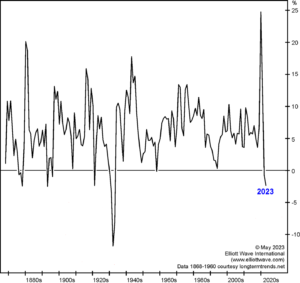
On the geopolitical front, the US Dollar continues to lose its status as the dominant reserve currency which it has held since 1944. Countries throughout Asia, Africa, and Latin America are moving away from the US Dollar, from the USA, and toward the BRICS alliance (Brazil-Russia-India-China-South Africa), the Shanghai Cooperation Organization and Mainland China’s Belt-Road Initiative. The first major “crack” in the western front line is France, which has stated its will to move away from the USA and toward China – this is also having a direct influence on western military support for the highly dangerous and futile Ukraine war directed against Russia. Once Germany cracks, Europe will become impotent. Germany has been, remains and will continue to be Europe’s locomotive, corner-stone and center of power. Without Germany, there is no Europe.
Contrary to what the corrupt governments in the west parrot, there is no need for “regime change” in eastern countries such as Russia or China. The need for “regime change” is in the USA, Canada, Japan, South Korea, Australia, New Zealand and in virtually all of Europe. The powers that be in the western world are clearly pushing for a Third World War against the massive Eurasian landmass – against Russia in the Ukraine and against Mainland China in Taiwan. At the very worst this will lead to global thermonuclear war; at the very best it will lead to the total defeat of the west. The so-called Ukrainian imminent “counteroffensive” will pit 200,000 Ukrainian conscripts (older men, boys and some women) against One Million highly trained and very well equipped Russian Army troops with near total Russian air superiority. The Ukrainian Air Force has lost an astounding 400 plus combat jets (with trained pilots now dead) and more than 20,000 drones in the last month alone. There are two (2) annual periods of extreme rain which make the deep & fertile soil / farmland of Eastern Europe unpassable (where most roads remain unpaved to this day) which deter mechanized and even horse-driven armies from moving. One is right now (the months of April and May) and the one before this was in November. Recall when the most massive military offensives were launched on the Eastern Front during World War Two: German Operation Barbarossa toward Moscow & Leningrad on June 22, 1941, German Case Blue toward the Volga River & Stalingrad on June 28, 1942, German Operation Citadel toward Kursk on July 5, 1943 and the Soviet Russian Operation Bagration to destroy German Army Group Center on June 22, 1944. There was a reason why these massive offensives were launched during the months of June & July……………large armies require solid unpaved roads and warm-enough weather. Needless to say that the combined losses on all sides were utterly massive beyond comprehension – 47.7 million human beings, 7.5 million army horses, 15.9 million cattle and 21.5 million sheep which were “conscripted” for military purposes. Trained dogs were often used for “suicide” missions – for detonating explosives under enemy tanks, for instance. The number of military vehicles expended (lost) such as tanks, armored fighting vehicles, self-propelled artillery pieces, trucks, cars and motorcycles were 8.1 million. Needless to say that most of the soldiers, animals, trucks, cars and motorcycles on all sides were conscripted or “confiscated” from peaceful prewar life to serve and die during wartime. Total worldwide losses & casualties during World War Two were at least 131 million human beings, 123 million animals and 22 million vehicles.
The numbers today will eventually be far worse. Note that the Ukraine had a peak human population of 52 million 30 years ago in 1993. Today, the rump dictatorial government in Kiev rules over perhaps 13 million people – a reduction of 39 million people to date.
In sum, there is only one sane and humane solution: negotiate peace and stop all war immediately and forever.
Financial, Economic and Social Mood Update (April 2, 2023)
Inflation (or more accurately: the loss of purchasing power) in North America, Europe, Australia and other countries tied to the west is in no way “transitory” – on the contrary, it looks to be permanent and getting worse by the day. In your own lives, look at the prices in the grocery store, for your monthly utility bills and for insurance – especially something like homeowner’s insurance. All of these prices have literally skyrocketed over the past few years.
The political & the financial system power structure in the western countries appears to be collapsing by the day as well, driven largely by an insane desire to promote conflict with and in much of the rest of the world. The power structure “on the other side” is becoming ever more independent from the west, specifically from the post-World War 2 hegemony of the American Dollar. The illegitimate Biden regime in Washington, D.C. is now presiding over the collapse of the American Empire which has ruled the world since 1945.
This “other side” power structure can be seen emerging most clearly in institutions such as the “BRICS” countries (these are Brazil, Russia, India, China and South Africa), in the SCO (the “Shanghai Cooperation Organization” which includes almost all of Asia) and in the Chinese BRI (“Belt and Road Initiative”). Note – BRICS actually includes the 5 main founding nations plus 3 applicant nations (Algeria, Argentina and Iran), 5 more nations which have officially expressed interest in applying for membership (Afghanistan, Egypt, Indonesia, Saudi Arabia and Turkey) and finally 6 additional nations now in official dialogue for BRICS expansion (Kazakhstan, Nicaragua, Nigeria, Senegal, Thailand and the United Arab Emirates).
The Belt and Road Initiative includes most of Asia, South America, Oceania, Australia, Europe, Canada and about half of Africa. The goal of the BRI is to tie the world to mainland China via infrastructure projects, economy and finance. The countries partaking in these initiatives are gradually moving away from the US Dollar as a medium of exchange and they are also unloading ever more of their holdings in the massive USD $31 TRILLION US national debt.
In a nutshell, this means that the American Dollar will continue to lose ever more of its purchasing power, which translates into an ever declining standard of living in the USA. The decline of the US Dollar is one reason I believe that interest rates & bond yields will not decline soon. One asset that is not “trash” is cash – be this in the USA or the rest of the world. Real estate, bonds (i.e. debt), tangible goods (things you can “touch” such as automobiles, etc.), precious metals (the best known one being gold bullion), corporate stocks and digital electronic cryptocurrencies all remain depressed and will likely remain depressed for many years to come.
The middle class is already almost gone – think about the fact that 80 percent of the American population already depends upon highly subsidized government healthcare through the likes of Medicare, Medicaid, Medi-Cal and Obamacare, and that about half of the US population no longer files an annual income tax return.
The modern day United States of America is experiencing something similar to the “Fall of Rome” which has happened to all formerly great global powers in the past. Think about what happened to the United Kingdom (England) especially after the fall of the former British Empire after World War 2 when American global hegemony replaced British hegemony. The purchasing power of the once mighty British Pound has collapsed over the course of hundreds of years, and the same thing is happening to the American Dollar today. The British Pound Sterling emerged between A.D. 600 and 800 (more than 1,400 years ago) and the Bank of England was the world’s first modern “central bank” which practiced “money printing” (in the form of modern credit inflation). The Pound has lost more than 96 percent of its purchasing power since 1945 alone according to the British House of Commons Library. The Pound has lost 99.3 percent of its purchasing power since 1751 when the British House of Commons Library began keeping annual inflation statistics.
The corrupt mainstream media (owned & controlled by the likes of the WEF World Economic Forum through major investment firms such as Blackrock & Vanguard) does not report this, but there are now massive popular demonstrations in many countries where governments are not legitimate. These countries include France, Israel, the United Kingdom, Portugal, Greece, Moldova, Nigeria, Venezuela and South Korea. Massive strikes have brought Germany to a halt. The European economies are now much worse off compared to the USA due to the American-led boycott of & war against Russia. Most of the European countries are now desperately trying to restart economic trade with China, because they are in dire need of the raw materials & natural resources from Asia, Russia & beyond. The Battle of Bakhmut in the Ukraine has turned into NATO’s Stalingrad. After Russia mops this up & after the spring rains cease (most roads are not paved in this part of the world are thus muddy beyond description), Russia will march west to neutralize what remains of the Ukraine. Napoleon Bonaparte was stupid enough to try to invade Russia in 1812. Adolf Hitler repeated the same mistake in 1941. NATO repeated this mistake yet again through its proxy the Ukraine in 2014/2022……………………..the end result will be no different.
Our entire global economy & society reached a “peak” in optimism & nominal prices at the end of 2021. This speech by Robert Prechter of Elliott Wave International illustrates this clearly: https://my.elliottwave.com/products/club/event.aspx?guid=d3a36c43-8759-4d48-b7ba-37a69f8c2e66. All of human society – be it the economy or mass human social mood, is now in the throes of a massive collapse. Here is yet another pertinent article by Elliott Wave International backing this up: https://www.elliottwave.com/en/Articles/2023/03/14/17/29/3-Stock-Indexes-One-Message.
Financial, Economic and Social Mood Update (March 1, 2023)
The US Department of Labor claims that a record 160 million Americans are employed, but this figure “double counts” people with more than one job. Furthermore, most large corporations are either laying people off or they have frozen hiring. Both the very important real estate sector and the automotive sector have severe levels of over-capacity. For instance, roughly one half of US commercial real property is currently not being used. The largest US homebuilding corporations are seeing more than two-thirds of their existing new home contracts cancelled by buyers. Potential buyers are pulling back due to job layoffs and due to their diminished purchasing power. The following excellent video by Elliott Wave International of Atlanta, Georgia clearly demonstrates how one asset market went from a market value of USD $18 TRILLION to ZERO in just 2 years (the global market for negative yield bonds). Note that this historically odd market was created by world governments flooding markets with “printed money” or easy credit, which is not a normal or healthy situation and which could not last forever: https://www.elliottwave.com/Market-Trek#15?utm_source=com&utm_medium=eml&utm_campaign=ar-ins&utm_content=insightsmarkettrekepi16.
Emerging World War 3
I wish that this were not happening, but it is. The countries in the west are being led by people who have no experience with or memory of war – hence they no longer fear what every rational person should and must fear. The foreign policy of the west is doing the bidding of the all-powerful and all-evil World Economic Forum (WEF) led by Klaus Schwab in Switzerland. This policy threatens to basically “colonize” much of the rest of the world and absurdly attempt to remake it in the image of the modern-day USA, the mainstream media and Hollywood – hence the threats to promote “regime change” in countries such as Russia, the countries of the former Soviet Union, Serbia, the Balkans, Mainland China, North Korea, Iran, much of Africa and much of the Islamic world. The fatal mistake here was to enlarge the European Union (EU) and the North Atlantic Treaty Organization (NATO) into the countries of the former Soviet Union, specifically to the borders of Russia in the form of the Ukraine, which is itself the historical origin of both the modern Russian nation state and of the Russian Orthodox Church.
The military forces being amassed by Russia & her allies on the Eastern Front today have the very real ability to grow into the largest military force in recorded human history. 700,000 troops equipped with 8,000 tanks & other armored fighting vehicles (AFV) such as infantry fighting vehicles (IFV) & mobile missile platforms are already deployed in three (3) army groups surrounding what is left of the Ukraine – from the north in Belarus, from the east in the Donbas region and then in the south just above the Crimea. Behind these troops in Russia, Belarus & Serbia are many more troops which can raise the troop level to 6.5 million men equipped with 85,000 tanks & other military vehicles. If need be, all of the Eurasian & African countries behind Russia have a combined resource of 786 million able-bodied potential soldiers – a force which will outnumber whatever the western countries can muster by more than 3.3 to one.
I recently heard an American college professor claim that the combined nuclear arsenals on earth could NOT destroy all life on earth. He is totally wrong in his belief and claim. Based upon what the US Army Air Force did to the Japanese cities of Hiroshima & Nagasaki in August 1945, the combined nuclear arsenals of today could kill everyone & everything on planet earth 5.7 times over. Furthermore, a whopping 83 percent of this combined nuclear firepower (with its utterly lethal radiation) belongs to Russia and her allies.
The only sane option here is to negotiate an end to the Ukraine war and to respect Russia’s right to her own sovereignty & to respect her geopolitical sphere of influence. The entire policy of “regime change” must end for all time. NATO should be disbanded=ended=terminated for all time as was the former Warsaw Pact in 1991. The European Union (EU) must cease its expansion for all time and reduce its governmental scope back to what it was in the 1950s to 1980s.
There has already been far too much duplicity & outright criminality. The Biden Administration along with the government of Norway deliberately destroyed the Nord Stream Pipeline which was exporting fairly priced Russian natural gas into Western Europe. This criminal act was meant to keep Europe subservient to the military-industrial complex of Washington, D.C. – this was an act of colonialism meant to keep one group of human beings subservient to another group of human beings.
Insane voices within certain western governments have already spoken of marching all the way to Red Square in Moscow, of re-gaining lost territory from the past and of using nuclear weaponry. None of this can end well. Almost every single war in human history never should have taken place. The situation after every war is always much worse than the situation was before the war. Survivors end up wishing that the world would go back to the way it was before the war. The only “winners” are the merchants of death – the armament manufacturers who become ever richer upon the dead bodies of tens or hundreds of millions of regular human beings who are sacrificed in ever more pointless wars.
Financial, Economic and Social Mood Update (February 1, 2023)
The deceptive bear market rallies in the stock market cannot mask the truth of a very sick economy at the start of New Year 2023. Bear markets are notoriously known for violent bear market rallies which trick very many people to get back into the market – the exact same thing happened during the Great Depression stock market from 1929 to 1949 – and yes, the market did not fully recover for 20 long years during that momentous & traumatic time in human history: https://www.elliottwave.com/Metals/How-Countertrend-Rallies-Can-Slyly-Lure-in-Investors?utm_source=com&utm_medium=eml&utm_campaign=ar-frup&utm_content=frupbscounterrally230126.
One of my subscribers recently asked me if I thought that Bitcoin BTC (which rallied as high as USD $20,000 on January 14 – and yes, a digital asset like this trades 24/7) will still go to zero. My reply is that I believe NOBODY should have anything to do with any cryptocurrency henceforth. Many people did make a killing in these digital assets, but those who did so got in especially in the beginning. The Bitcoin BTC “white paper” was released in 2009, private trading among pioneers took place from 2010 to 2015 and members of the public who did get it should have done so in 2015 & 2016. Most investors who purchased cryptocurrencies after 2016 either broke even, lost a little or lost their life savings. On January 13, 2023 the SEC (Security and Exchange Commission) sued both the Gemini Trust Company (owned by the Winkelvoss twins) and Genesis (owned by Barry Silbert who along with the Winkelvoss twins ranks among the 7 biggest US Dollar billionaire investors in cryptocurrency) due to the insolvency of the former “Gemini earn” program in which investor money has been totally frozen since November 16, 2022. As I have said, all cryptocurrencies and cryptocurrency “exchanges” have been behaving like commercial banks, taking customer money and making loans with that money. Due to the severe asset value price collapse in the entire cryptocurrency market since November 10, 2021 most of those loans have since gone bad – the loans were likely plowed back into the digital currency markets. “If it walks like a duck & quack like a duck, it must be a duck” – if cryptocurrencies & cryptocurrency exchanges behave like commercial banks, then guess what – they must be regulated like commercial banks.
The evidence of yet even more deflationary collapse brought on by government interference in the global economy can be seen in the all-important transportation & automotive manufacturing sector. The deflation in the financial markets is merely a normal free market response to so many years of governments creating inexpensive credit out of thin air – their policy of propping up consumer demand by way of artificially low interest rates and by “printing money” as the US government has been doing hand-over-fist …………………..with every succeeding Presidential Administration being even worse than all of its predecessors.
Very many automotive dealerships across the globe (this is especially noticeable in North America & Europe where electric vehicle sales are the highest due to the most government “incentives” – merely another form of “welfare”) have decided not to make the huge financial investments need to switch over to BEVs (battery electric vehicles). Here in the USA, only 64 percent of Ford and 59 percent of Lincoln dealerships will survive this expensive transition. Once again I will repeat that the current BEV (battery electric vehicle ala “Tesla”) is NOT the correct way to move forward – they are NOT good for the environment and furthermore the entire narrative invented by the powerful individuals behind the World Economic Forum (WEF) of Klaus Schwab is a huge LIE. The narrative of “climate change” and “global warming” are false – they are huge lies, and moving over to their so-called “green energies” will NOT help the environment – they will actually harm the environment, they will continue to destroy the global economy and they will continue to lower to the overall global standard of living & quality of life.
Far better alternatives for the transportation & automotive manufacturing (as well as for the energy sector) are the hydrogen fuel cell vehicles and the newer “e-fuels” being developed by companies such as BMW and Porsche – clean gasoline & diesel alternatives made largely from hydrogen & methane which will allow gasoline & diesel engines to run very clean.
These primary elements such as hydrogen (water or CO2), methane, carbon and Sulphur are the building blocks for all life on earth. It is nonsense & a huge dangerous lie to say that they harm the earth. Without them, earth never would have been home to life – the earth would have been a barren planet much like the Moon and Mars.
Everything but everything supported & backed by Klaus Schwab and his World Economic Forum (WEF) is bad to the core. The WEF pulls the strings behind all western governments (and many others beyond the west). They are behind the most massive wealth transfer in human history due to their false narratives behind numerous global industries including “green energy,” pharmaceuticals & healthcare (a false healthcare which is intended to keep people sick), armaments & defense (intended to invent false “enemies” & create perpetual wars), and the global central banking system (intended to maintain perpetual debt slavery & to destroy the purchasing power of money). They seek to create permanent chaos by promoting never-ending change, and by promoting “identity politics” which aims to divide & conquer the entire human race. They rig elections in countries all over the globe to ensure that their lackeys obtain political power & remain in power.
Emerging World War 3
I hate to have to write about this. The political & mainstream media “leadership” (or better = self-appointed “elites”) in the West = the USA, Canada & Europe (the European Union, the Council of Europe) are continuing to incite a Third World War against the likes of Russia, Mainland China, Iran and their allies in the bulk of the massive Eurasian landmass. The Vice Chancellor & Foreign Minister of Germany stated in front of the Council of Europe in Strasbourg that Europe is “at war” with Russia. She (who leads the German so-called environmental “Green” party) also said that she does not care that 63 percent of the German electorate is AGAINST sending weaponry to the corrupt government of the Ukraine. The Minister of Defense of Italy recently said that if Russia marches into the rest of the Ukraine (the capital city of Kiev plus the western Ukraine next to the Polish border) NATO will fight Russia and World War 3 will commence. A US Air Force General recently told the US Air Force that the USA will be at war with Mainland Red China by 2025 – 2 short years from today. A Dutch Admiral stated on January 29 that NATO “is ready for war with Russia” and that the economies of the west must transition to a “wartime economy.”
This is 100 percent INSANITY / MADNESS and this MUST STOP IMMEDIATELY!
This war in the Ukraine (which has already reduced the population of the entire country by 78 percent since its peak of 52 million people back in 1993) has been orchestrated by NATO to gradually encroach upon the territory of the former Soviet Union which collapsed in 1991. Western governments are now openly promoting the prospect of “regime change” for countries such as Russia, Belarus, Serbia, Mainland China and Iran. What does this mean? It means 1) military overthrow of their governments, 2) destruction of their economies, 3) annexation of their sovereign territory and 4) breaking them up into many, many smaller & highly unstable countries.
But the maniacs in the “leadership” of the West will not likely make it that far. Why? Because the countries of the massive Eurasian landmass (members of the Shanghai Cooperation Organization) have 86 percent of the human race on their side of the fence and their combined military strength outnumbers the West by more than 3 to one. Russia alone has the largest global nuclear arsenal which can destroy planet earth many times over. Mainland China (which has the 3rd largest nuclear arsenal in the world after the USA) has the capability to destroy the entire planet with the exception of South America (due to the range of their missiles).
The Russian-Belarusian-Serb army now massed in Eastern Europe is the 10th largest army in recorded human history with more than 4.1 million men under arms equipped with 13,000 modern tanks, infantry fighting vehicles (IFV), mobile rocket systems & other armored fighting vehicles (AFV). This massive army includes fighting men from countries including Russia, Belarus, Serbia, Syria, Iran, the Central African Republic, Libya, Mozambique, Mali and the UAE.
An end to this war must be negotiated IMMEDIATELY and the criminal elites “ruling” the western countries must step down. If not, a global war of ultimate destruction will commence before 2023 is over.
Financial, Economic and Social Mood Update (January 1, 2023)
The deceptive bear market rallies in the stock market cannot mask the truth of a very sick economy at the start of New Year 2023. According to the swiftly.com retail industry site, 70 percent of Americans are now struggling to pay their weekly grocery store bills, and 83 percent of consumers rely upon food discount coupons & supermarket retail brand name loyalty programs to put on the dining room table. CarMax, the largest used vehicle retailer in the USA with 238 auto dealerships (they sold 750,000 vehicles in fiscal year 2021) reported a 3rd Quarter 2022 sales decline of 21 percent and an 86 percent collapse in net income.
According to the MHFIN channel on YouTube, the coming ten year period until the year 2032 will be a “lost decade” for the real estate market due to collapsing demographics, deflation & collapsing asset prices: https://www.youtube.com/watch?v=5kiKmQPeWKU.
The cryptocurrency market is for all intents & purposes dead in the water, with digital currency trading platforms freezing customer accounts (many customers simply no longer able to access their money or having just limited access to their investment accounts per this FORBES article): https://www.forbes.com/sites/ninabambysheva/2022/12/13/binance-pauses-usdc-withdrawals-sees-3-billion-in-outflows-since-yesterday/?sh=3e8a67b71f27&fbclid=IwAR19IqGpsLIrKwNcAbA6V5W_5pHyW1rdZP_wpNzXkakuNsnJSM6Unukg3fk.
Cryptocurrencies & their exchanges need to be regulated no differently from commercial banks, complete with regulatory fees & capital reserve requirements. They have thus far been operating like commercial banks with very little regulation and almost no investor (depositor) protection. The 10 major cryptocurrency “digital asset” coins have lost more than 86 percent of their value since November 10, 2021 and they will never recover – they might not even last very much longer.
The overall stock market & the entire cryptocurrency market have been strongly correlated since early 2018 per Elliott Wave International of Georgia, which means that so-called electronic digital currency “investments” have ceased being anything out of the ordinary compared to the rest of the established asset markets: https://www.elliottwave.com/en/ElliottWaveTV/Episodes/2022/12/07/20/16/Cryptocurrencies-Joined-at-the-hip-with-the-stock-market?fbclid=IwAR0xX9plQs6NPwHqkaCD-iwBZo0ZNLAzI-uFpveDZSToXhQ4k-FpJqq22_8.
The theater show of World War 3 which commenced in the so-called Ukraine will soon take a dramatic turn. The Russian Army (and especially her allies in Belarus and Serbia) now have more than 2.5 million men at the front – the same size of the former German Army which conquered the Low Countries & France from May to June of 1940. Russia is merely waiting for the ground in the southern Ukraine to completely freeze over before she launches her massive Winter offensive. The most corrupt “government” of “the Ukraine” (a puppet state of the European Union, NATO and the CIA) is led by a person of perdition who was once a Russian-only speaking “comedian” known for playing the piano with his most private part. In a most ominous sign, both Poland and the USA have “volunteers” and/or military “advisors” in the Ukraine – the Poles deceptively dressed in Ukrainian uniforms (they have already taken 1,000 fatalities & 4,000 wounded among these so-called “volunteers”). If Poland succeeds in drawing the rest of NATO into this utter madness, Russia and her allies may be forced to march into the heart of Europe. Just as Russia has been provoked via false CIA “freedom” movements in the Ukraine & former Soviet Georgia, so has Serbia been provoked with the NATO client state of Kosovo on Serb territory. This, my readers is the harsh truth of our “new year 2023.”
Financial, Economic and Social Mood Update (December 1, 2022)
The deceptive bear market rallies in the stock market cannot mask the truth of a very sick economy. Almost 40 percent of small businesses did not pay their monthly rent in October 2022 & almost 40 percent of American households have received help from a food bank within the last 12 months. Up to 70 percent of customer foot traffic business volume at grocery stores is due to government assistance such as the food stamp program (US government acronyms including SNAP, WIC and TANF). Loan demand at Wells Fargo Bank (at one time the country’s biggest mortgage lender) has collapsed by 90 percent year-over-year as of October 2022. The situation at other commercial banks is not much different. The cryptocurrency industry – which is basically a far less regulated segment of the financial industry (it also solicits money from investors and lends that money out in the form of loans) saw its market value collapse by 72 percent as of November 9, 2022 compared to November 10, 2021. The collapse in the market value of individual cryptocurrencies is even more stark – 78 percent for Bitcoin & Tron, 82 percent for Ethereum, 90 percent for Cardano & Polkadot, 91 percent for Ripple XRP, 92 percent for Dogecoin, 95 percent for Solano, 96 percent for Yearn Finance and 100 percent for Terra US Dollar, Mirror Protocol and Frax. In yet another valid indicator pointing to the demise of digital currency is that the billionaire Winkelvoss twins from New York (once the 3rd biggest holders of cryptocurrency in the entire world) have already sold more than 95 percent of their Bitcoin BTC holdings.
This debacle for the value of cryptocurrencies will likely mean 1) new & strict regulation of the industry not unlike commercial bank regulation, 2) the demise of most cryptocurrencies, 3) cryptocurrency companies eventually being very similar to online banks & lenders, and 4) the demise of global governmental plans to replace paper fiat currencies with central bank digital currencies – this final point being a big victory for individual liberty & freedom from government control & manipulation. Cryptocurrency “staking rewards” (this was supposed to work much like bank interest paid on customer deposits) is now dead in the water due to the de-facto bankruptcy of the Genesis company. As mentioned previously, cryptocurrency companies were basically attempting to operate like commercial banks and stock brokers – accepting customer “deposits,” making loans and selling cryptocurrency “coins” much like shares of stock. All of this is now in jeopardy.
And talking about market value, the titans of high technology (among the largest companies on earth) have seen their market value collapse by huge amounts in the last 12 months. Amazon (the largest retailer) has become the first company in world history to lose USD $1 TRILLION in market value – 61 percent of its historical high value. The percentage losses at Meta (Facebook & Instagram) and Neflix (a major competitor to cable & dish TV) are even higher at 80 percent. Meta recently let go of 11,000 employees – total layoffs in the Silicon Valley were 20,000 when one includes Twitter, Stripe, Salesforce, Amazon and Google. The market value loss at Tesla (the largest electric car manufacturer in the world and the 2nd financially strongest auto group in the world after Volkswagen AG) is 65 percent – and keep in mind that without global government subsidies, no electric car company would even exist. The market value loss at Alphabet (Google, the world’s largest Internet search engine, and YouTube – yet another major competitor to traditional TV) is 54 percent. The market value loss at Apple (the largest computer and the largest smart phone company in the world) is as high as 41 percent.
Financial, Economic and Social Mood Update (November 1, 2022)
The entire world is now in the midst of an unprecedented societal collapse in which all asset classes are moving in the same direction except for cash, which currently loses its purchasing power due to inflation. By the time things hit bottom, human society will have to be rebuilt from the ground up in the most marked way since the Great Flood documented in the Old Testament.
The overall stock market had lost 41 percent of its record nominal value as of October 13, 2022 since values peaked from November 2021 to January 2022 depending upon the particular index or financial asset class, thus equaling the net loss in the stock market during the crash from January 2000 to October 2002 (33 months). The most recent prior stock market crash took place from October 2007 to March 2009 (17 months) when the asset market lost 63 percent of its value. This time around, the eventual cumulative loss will be much more severe. What we are witnessing in real time right now is a bear market rally – a deceptive “fool’s rally.”
How lackluster has the performance of precious metals been? Let’s look at gold, which is the major precious metal = it has lost 0.42 percent in the past week, 1.03 percent in the past one month, 8.05 percent in past 3 months, and a whopping 39.0 percent in the past 28 months. What does this show? The stock market, the currency market, the crypto market and the precious metals markets are all very strongly correlated to move in the same direction over the same period of time. In a deflationary collapse, only CASH will be king.
Nicholas Gerli of Reventure Consulting (this channel is on YouTube) is forecasting an interest rate “pivot” by the US Federal Reserve Bank as soon as January or February of 2023. This “pivot” to lower interest rates will be driven (as it always is) by the overall market, which is heading into an absolutely gargantuan deflationary collapse. Deflation will be driven by a collapse in consumer demand, a collapse in asset prices, a collapse in the prices of goods & services, a collapse in the overall level of full time employment (i.e. very, very many people will be laid off from their jobs and thus become unemployed), commercial bank failures, the demise of many more small businesses as well as the demise of many household business names (the bankruptcy of many large corporations). An astounding 40 percent of the US population have received at least some help from charitable food banks within the last 12 months – this fact tells us that we are already in a Great economic Depression (this from the YouTube channel of “Jeremiah Babe” in Palm Desert, California who obtains much of his news from the Hedge).
More proof of the worldwide deflationary “freight train” headed our way is the fact that rates for shipping goods both via rail & truck have become very depressed, that demand has fallen (i.e. much less business for the rail companies & for the trucking companies) and that excess unsold inventory has piled up in brick & mortar retail outlets such as Walmart & Target.
A deflationary collapse is a difficult concept for many people to understand. It will help to see the definition thereof, and to read about historical examples thereof: https://en.wikipedia.org/wiki/Deflation.
Financial, Economic and Social Mood Update (October 1, 2022)
The issue of hyperinflation is so serious that the central banks of the world need to tighten credit interest rates (i.e. raise interest rates) much faster & higher than they have been. The US federal government’s officially admitted annual inflation rate of 8 to 9 percent is far below the true honest rate of inflation which when one looks at prices for fuel, energy, food & groceries must be more like 20, 30 or 40 percent per annum over the past 2 to 3 years. Asset values for real property & corporate stock also remain far above their true honest levels. The solution to this unacceptable situation must be to raise interest rates above & beyond the rates we remember from early 1981, when the highest paying retail certificates of time deposits were paying from 20 to 22 percent per annum. I would say that the central bank’s key rate should be no lower than 19 percent per annum right now, because defending the value of the currency should be the only concern at this time. Every single country on earth has a lower standard of living today & all peoples have far weaker purchasing power today than they did at certain points in the past.
As of September 30, 2022 the overall US stock market has lost 37 percent of its nominal value since November 2021 to January 2022 depending upon the index. The digital currency market has lost 68 percent of its nominal value since November 10, 2021.
The entire world today has become like one big third world country, with a dying middle class, an exploding under class and very few corrupt people at the top controlling governments, politicians, the media, entertainment and large corporations. Europe peaked before World War One in 1914 and has basically been in decline since then. The Philippines peaked in 1897 and has likewise been in decline since then. The Philippines hit its peak economic & financial prosperity at the tail end of Spanish Colonial rule from 1861 to 1897, when one it took 27.7 US Dollars to purchase one Philippine Peso – when the Dollar Peso relationship was reversed from what it has been since then. The Philippines had a niche in two global commodity markets in 1897 – in hemp which was used for ship rigging & in Cigarillos which is a smaller version of the famous Cuban cigar.
China peaked before the Opium Wars in 1839. China was the last part of the world waiting to be “carved up” by Imperialist & Colonialist powers before the start of World War One in 1914, but the European “suicide” of 1914 to 1945 put a stop to those plans. China underwent yet more trauma during her Nationalist republican revolution in 1911, the horrific invasion by Imperial Japan in 1931, World War Two, the Communist revolution of 1949 and the disastrous Cultural Revolution under Mao. China has been recovering since the demise of Mao in 1976, but she doomed her own recovery with the “one child policy” which was overturned far too late – China now faces the worst demographic collapse in recorded human history.
Japan hit an economic & financial peak in 1989, when the Nikkei Dow stock index was worth more than any other stock index in the world. The market value of Japanese real estate was likewise worth more than that of any other country in the world. But Japan was one of the first countries in the world to die a demographic death due to too few births, which leads to an inverted population pyramid – too many older people & not enough younger people. The result today is that one third of residences in Japan are vacant (the figure is already one out of 10 in the USA) and that the nominal value of the Japanese asset market has had no net increase in 40 years.
Both Argentina & New Zealand were the most affluent countries on earth in 1945 and have been in decline since then. Latin America is similar to Argentina, with countries there having peaked at different times in the past. Mexico hit its peak no later than 1910.
The post-colonial experience of Africa has been marked by local corruption & abuse at the hands of a corrupt global corporate order. A huge case in point is the Congo – a large country in central equatorial Africa which is the poorest country on earth in terms of per capita income. The Congo is an ongoing victim of the global lie & scam we know as “climate change” or “global warming.” The Congo is deliberately being kept poor via so-called corporate “carbon credits” and her natural resources & environment are being ruined due to the disastrous global governmental push into BEV (battery electric vehicles) which are no way, shape or form “environmentally friendly.” As I have said previously, a far better choice is the hydrogen fuel cell car – now only being developed by the likes of Toyota, Hyundai and BMW. The best ever run country in colonial sub-Saharan Africa was the former Rhodesia under Ian Smith. He unfortunately failed to see the need to move to majority rule more quickly – the world should have given his short lived successor state of Zimbabwe-Rhodesia a fair chance to succeed, because Zimbabwe turned into an infamous kleptocracy marked by a falling standard of living, hyperinflation & starvation whereas the former Rhodesia was the bread basket of southern Africa.
The USA’s peak was a geopolitical extension of the peak of the British Empire after the end of World War One in 1918. The USA hit its economic prosperity no later than the decade of the 1970s and has been in decline since then, with a very marked decline since 2020.
Financial, Economic and Social Mood Update (September 1, 2022)
The economy (most especially the stock market) is being heavily manipulated to keep nominal prices artificially high, and now a second (and even larger & more lethal) geopolitical front has been opened with respect to Mainland communist China & Nationalist Taiwan…………………….on top of the also totally unnecessary conflict between Russia & the Ukraine – the latter being egged on by NATO & the European Union (EU) due to the unnecessary expansion of both entities (NATO & the EU) since the collapse of the former Soviet Union in 1991.
China has been the largest country on earth in terms of population for literally thousands of years – since perhaps 1,500 years before the birth of the former Shang Dynasty in 1500 B.C. (the first Chinese dynasty), but now they have lost this first place ranking to India. China brought this historic demographic disaster upon herself through her “one child policy” which was in effect for about 4 decades. They recently reversed course, but this was too little & too late to save them from catastrophe. The result is too many older people, not enough younger people, too many retired people, not enough people gainfully employed in the labor market, not enough children, not enough births, collapsing consumer demand, too much vacant real estate, too much debt & an insolvent commercial banking system among China’s more than 4,000 commercial banks. These dire signs may encourage Mainland China to attempt a military invasion of Taiwan in an attempt to gain an upper hand over the rest of the world before it is “too late” in the eyes of the communist leadership in Beijing. They also want to obtain a near-monopoly on computer chips (66 percent) & semiconductors (94 percent) in addition to their existing near global monopoly on products such as shipping containers (96 percent), antibiotics (90 percent), basic drug ingredients (80 percent), lithium batteries (80 percent), Tylenol (70 percent), shoes (70 percent) and many other products such as farm tractors, bulldozers, agricultural egg incubators, wood chippers, elevators, solar panels, windmills, coats, gloves, hats, dresses & other garments. The Beijing government is also eyeing something very important beneath Taiwan, but I will not get into that now. Suffice to say that conflict between the USA versus both Russia & Mainland China may lead to global thermonuclear war and the extinction of all life on earth.
Other rumors say that the CCP (Communist Party of China) may collapse within this current month of September 2022 – this being driven by the debt bubble & commercial banking industry liquidity crisis and real estate crash.
Now to pressing domestic economic issues as they affect every single household – the “average” household is now functioning just like the grossly incompetent & dishonest US government – i.e. only staying afloat due to deficit spending. In the case of households, this translates into credit card debt just to remain financially above water. An average household with 4 individuals has a yearly income of USD $87,000. Expenses equal $32,544 to fund debt (mostly mortgage, auto, student loan & medical), $30,450 to pay taxes & insurance, $20,800 for groceries, $5,993 for public utilities, $5,543 for telephone-Internet-TV and $1,341 for charity & gifts. This equals an average annual deficit of USD $9,671 which is the reason for the explosion in consumer credit cards being issued & used & abused.
Note: none of the following is “financial advice” – but merely my own personal opinion, what I would recommend & what I believe to be plain common sense.
What can people do to alleviate this problem? Don’t purchase a home, or if you do – downsize instead of getting something bigger & more expensive. If you are under contract to purchase a home, consider pulling out. Don’t purchase a new vehicle, or if you do – downsize instead of getting something bigger & more expensive. If the monthly payments on your vehicle are too much for you to handle, turn the car in even before it would be repossessed by a lender. Look instead at used cars & smaller cars – cars which not only cost less but which have fewer things that can & will go wrong (such as modern computer features & apps). Newer cars (especially “electric” cars) are far too dependent upon & vulnerable to inevitable computer problems which are complicated, expensive & time-consuming to fix. Most auto dealerships can services cars as old as 20 years, and one can purchase extended service contracts from 3rd parties after a manufacturer’s warranty runs out – examples advertised on TV include the likes of Car Shield, Everything Breaks, Endurance & Protect My Car. Specialty independent repair shops specializing in specific brands will work on cars up to 30 years old. Rare “craftsman” mechanics will work on collector cars even older than that. A friend of mine in California owns two collector cars which are each more than 90 years old – one can still find unique mechanics qualified to work on such old cars. A repair shop claiming that they can “work on anything” is likely not telling the truth – one needs to do some homework & shop around.
Consider terminating your Cable TV or dish service, and replacing it with an HDTV antenna – a high definition TV antenna which you can purchase at many retail stores. You pay once for the HDTV and then you can get many channels for free depending upon where you live. People living in large cities can easily get as many channels compared to expensive Cable TV & dish providers. The HDTV antenna should work with all television sets manufactured since about 2004 – merely plug the cable TV cord into the back of the TV set, place the antenna nearby & then use your TV remote control device to allow it to “scan” for all available stations in your area. Changing channels is more time consuming (going through one at a time) – but then the service is free.
With respect to retail spending, consider shopping at less expensive grocery stores, avoiding the upscale stores. Ditto with shopping for clothing & other consumer goods – one can shop at thrift stores, discount stores & online with sites such as E-Bay, where very many small businesses sell their wares. And when spending money in general, consider patronizing smaller, family owned businesses instead of large nationwide & global chains or big box stores – to try help to keep your neighbors & fellow community members in business & thriving.
Once again, I will give a strong recommendation to the following two (2) independent channels on YouTube – Nicholas Gerli’s “Reventure Consulting” out of Dallas, Texas as well as “Jeremiah Babe” out of Palm Desert, California – the first channel is very focused on the emerging real estate collapse whereas the second channel is more generally focused on the overall collapse of our society. Here is a link to “Reventure Consulting”: https://www.youtube.com/watch?v=lSW1ofbEfGA.
And here is a link to “Jeremiah Babe”: https://www.youtube.com/watch?v=-H7SyuSJJz8.
Financial, Economic and Social Mood Update (August 1, 2022)
Our society (government & economy) is on the verge an historic collapse. Hyperinflation is raging, and the deflationary collapse which follows hyperinflation is already manifesting in asset markets – equities, debt, real property and consumer durable products. The deflationary collapse will do even more damage than the hyperinflation, and it must follow the hyperinflation due to the historic level of debt on all levels – government, corporate, mortgage, auto, student loan, medical, credit card, etc. Massive employment layoffs have already commenced, with large population states (which are home to the largest corporations) leading in this bad news – such as California & New York.
What will push the world into the deflationary collapse which follows the current hyperinflation? Employment layoffs (involuntary job losses) are already leading to high delinquency rates for monthly mortgage payments & auto loans. This is leading to exploding inventory levels of homes for sale, cancelled home purchase contracts and repossessed cars & trucks. 2.2 million cars & trucks have been repossessed in the USA year to date – the worldwide total is more like 11.1 million vehicles year to date.
The USA is on the verge of both a governmental & economic collapse. With respect to the government, the current administration in Washington, D.C. is by far the worst in the entire history of the USA – no holds barred, no ifs, ands or buts. What will happen when the USA goes bankrupt? Right off the bat, the foreign trade deficit which pays for imported goods (at least half of which come from Mainland China) will be wiped off the Gross Domestic Product or GDP, which at first glance may be good thing. First of all, this represents only 1/25th of GDP. Next, the country must return to 1) manufacturing its own goods and 2) growing its own food. At the end of the day, every single country on earth should return to this. It makes absolutely no good common sense to depend upon on others for one’s basic needs.
The YouTube channel of “Jeremiah Babe” reported on July 27 the following figures for small businesses in the USA (small business is the backbone of all economies worldwide) = 35 percent unable to pay full monthly rent, 51 percent expect hyperinflation will force them out of business within 6 months and 45 percent are no longer hiring. I recommend his videos highly – he is honest, is not trying to sell anything, and merely speaks the truth & common sense– here is his most recent post from July 31: https://www.youtube.com/watch?v=-62Q8kkYbdA.
Premier Gold & Silver coin (a nationwide retailer) visits cities all over the USA and they pay cash for valuable assets. These are their prices for real money = Morgan Dollar (1878-1921) = up to USD $100,000, Silver Dollar (1794-1935) = up to $7,500, Kennedy Half Dollar pre 1970 = up to $400, Franklin Half Dollar (1948-1963) = up to $3,200, Walking Liberty Half Dollar (1916-1947) = up to $4,600, Washington Quarter pre 1965 = up to $600, Mercury Dime (1916-1945) = up to $3,400, Buffalo Nickel (1913-1938) = up to $4,200, Liberty Nickel (1883-1913) = up to $4,500 and the Wheat Penny (1909-1958) = up to $3,500. This illustrates how worthless our modern money has become – the “real” money listed here has real silver & copper content (copper in the case of the penny). These are the maximum prices they are willing to pay for these coins – which means they intend to sell them for more. They also purchase collections of vintage musical instruments, sterling silver, diamonds, platinum jewelry, antique toys, comic books, vintage ads, dental gold, costume jewelry, foreign coins, sports memorabilia, pocket knives, Coca-Cola memorabilia, candlestick holders, Zippo lighters, clocks, war memorabilia, watches, gold, silver, paper currency & rings.
Cryptocurrencies (electronic digital currencies) have collapsed by roughly 64 percent since November of 2021, but what does this mean? They are in fact still in the process of replacing traditional commercial & investment banks, and have already overtaken a significant portion of the lending market. Traditional “brick & mortar” banks will not last much longer – they are almost extinct. Most cryptocurrencies will likely not survive, because there are simply too many of them, and because launching new cryptocurrencies has become redundant. The most important & oldest cryptocurrencies such as Bitcoin BTC and Ethereum ETH will likely not become “everyday” global currencies, but the surviving “blue chip” stablecoins may indeed step into this function after the death of global paper fiat currencies, which are being killed off due to hyperinflation. Precious metals (especially gold bullion) are currently being artificially suppressed (in terms of value) due to their being digitized in the form of these metals being made available as cryptocurrencies, which is not a bad thing. Once this process is complete, the value of precious metals will increase greatly.
Most retail investors who have purchased cryptocurrencies since 2017 have either seen no net increase or they have been wiped out with up to 70 percent losses. How is this handled for income tax purposes? Not much different from shares of stock – think of one digital coin as one share of stock. If you sold it for a capital gain, then you pay capital gain – if you sold it for a capital loss, then you write off the capital loss as much as possible (to the extent of your other income).
A small number of investors have made huge gains in digital currencies, but these are basically big players who purchased larger numbers of coin (“shares”) prior to 2018 – investors who own in excess of 1,000 coin (“shares”).
Financial, Economic and Social Mood Update (July 1, 2022)
Elliott “waves” are often very difficult to predict, most especially with respect to “timing” and “degree” or “magnitude” (i.e. length and duration). That said, I believe I can now state that the long-awaited generational “crash” commenced on November 10, 2021. We can compare this to the horrific hyperinflation, asset price collapse and world war that took place from 1922 to 1949 – but this time it will be much worse. The nominal asset price collapse which took place from 1929 to 1949 (yes, it took a whopping 20 years or 2 decades for nominal prices to recover) wiped out an astounding 89 percent of peak nominal value from 1929 until 1933 (the nadir of the financial-economic crash at that time). This time around, I believe that we will hit rock bottom in the year 2033 (11 years from today) and that our by then much smaller and severely decimated world will have to rebuild from the ground up, from “ground zero” so to speak – we will be very close to “rock bottom” long before 2033 (Nick Gerli of Reventure Consulting says late 2022 and into 2023……………he reported on June 17 that lumber prices have crashed by 50 percent in the last 3 months!), but we will remain at “rock bottom” until 2033. Elliott Wave International of Atlanta, Georgia believes that the worst bear market in recorded history will take place from 2022 to 2024. I believe that the “you know what” will hit the fan worldwide no later than the end of the 3rd Quarter of 2022………………..by September 30, 2022. The economy of North America & Europe have already collapsed for all intents & purposes. The bulk of global asset market trading is already done via “aladdin” Artificial Intelligence and not by human beings…………………the die has already been cast. Here is an interesting image from Elliott Wave International showing the current market as represented by a graph. The “You Are Here” arrow at the peak of the market was January 2022 by their estimate. To me, this looks like part of a massive “head and shoulders” pattern, with the crash currently in its infancy. One thing to keep in mind is that bear market rallies are very deceptive – they lure people back into the market, only to be clobbered even worse when crash waves return:
I believe that the nominal asset value loss from 2020 to 2033 (a period of 13 years) will be circa 99 percent. That is my financial forecast without any sugar coating. The cryptocurrency market reached a record high value on November 10, 2021, but it has lost 70 percent of its value since then (73 percent loss reached on June 18, 2022), with no net increase since December of 2017 – or 4 ½ years ago. High technology stocks are down 64 percent (high tech market cap down by 87 percent), IPOs (initial public offerings on the stock market) are down by 70 percent and the overall American stock market is down by 33 percent in the same time period. There are merely 401 traditional “brick and mortar branch” commercial banking holding companies left in the world today, and this number is shrinking rapidly.
Governments all over the world are pushing (forcing) a change from largely gasoline and diesel powered motor vehicles into so-called BEV “battery electric vehicles.” The alleged excuse for this switch is environmental – i.e. so-called “global warming” and/or “climate change.” As with everything else being pushed by the global power establishment today, the public is not being told the truth. The so-called changes happening have nothing to do with so-called “fossil fuels” or “carbon emissions.” Firstly, change is constant, often very marked, and almost always beyond the control of mere mortal beings. The earth experienced massive climate changes when the dinosaurs became extinct, and again much more recently in the Middle Ages, but as we know factories and motor vehicles did not even exist during those times. Crude oil, natural gas and coal were also not in any measurable use.
That said, BEV “battery electric vehicles” comprise about one percent of the vehicle population on earth today. The materials needed to make their lithium batteries are already destroying the natural environment in countries such as Chile, Bolivia and the Congo (the Congo is one of the largest countries in Africa). This harvesting of these materials is also destroying the natural habitat of flamingo birds in Chile and Bolivia in South America, and thus wiping out these beautiful birds.
A much better choice would be hydrogen fuel cell vehicles, which use hydrogen to power their unique batteries. First of all, hydrogen is plentiful (the most common element on earth) – it can be produced anywhere from its primary substance which is water. Second, there would be no problem of costly and especially time-consuming “recharging,” which also requires a massive & costly infrastructure not yet in place. Hydrogen fuel cell vehicles are simply refueled at existing gasoline stations, which would merely have to be equipped with hydrogen fuel pumps – they look very similar to gasoline or diesel pumps. Hydrogen is also better than ethanol, because ethanol uses corn grain in much of the world, which cuts into the food supply for human beings and especially farm animals. Other types of ethanol require sugar cane (South America) or palm leaves (Asia). If the enforced move into the BEV “battery electric vehicle” fails, and if the market moves in the direction of the hydrogen fuel cell vehicle instead, just two (2) automotive companies are ready to benefit from this – Toyota of Japan and Hyundai of South Korea. Toyota owns the brand names of Toyota, Lexus, Daihatsu, Subaru and Hino. Hyundai owns the brand names of Hyundai, Kia, Genesis and Ioniq. If and when the automotive industry makes the correct move into hydrogen fuel cell vehicles, the remaining manufacturers will not likely be able to raise the necessary capital to make the move – in other words, they may not survive in the longer term. Why is this so? Because they have already spend or committed too much capital into the BEV “battery electric vehicle” – a cumulative circa USD $4.6 TRILLION, and the necessary capital to make the switch into hydrogen fuel cell vehicles will simply no longer exist in the global market.
Financial, Economic and Social Mood Update (June 1, 2022)
Elliott “waves” are often very difficult to predict, most especially with respect to “timing” and “degree” or “magnitude” (i.e. length and duration). That said, I believe I can now state that the long-awaited generational “crash” commenced on November 10, 2021. We can compare this to the horrific hyperinflation, asset price collapse and world war that took place from 1922 to 1949 – but this time it will be much worse. The nominal asset price collapse which took place from 1929 to 1949 (yes, it took a whopping 20 years or 2 decades for nominal prices to recover) wiped out an astounding 89 percent of peak nominal value from 1929 until 1933 (the nadir of the financial-economic crash at that time). This time around, I believe that we will hit rock bottom in the year 2033 (11 years from today) and that our by then much smaller and severely decimated world will have to rebuild from the ground up, from “ground zero” so to speak – we will be very close to “rock bottom” long before 2033, but we will remain at “rock bottom” until 2033. I believe that the nominal asset value loss from 2020 to 2033 (a period of 13 years) will be circa 99 percent. That is my financial forecast without any sugar coating. The cryptocurrency market reached a record high value on November 10, 2021, but it has lost 58 percent of its value since then, with no net increase since December of 2020.
All of the 5 FAANG stocks (the titans of American high technology) are already in a bear market. The 5 FAANG stocks are 1) Meta Platforms, Inc. (FB or Facebook down by 52 percent from its record high), 2) Amazon.com, Inc. (AMZN down by 36 percent), 3) Apple, Inc. (AAPL down by 19 percent), 4) Netflix, Inc. (NFLX down by 73 percent) and 5) Alphabet, Inc. (GOOG or Google down by 25 percent). The minimum description of a bear market is to be down by 10 percent. Tesla, Inc. (TSLA) has lost 41 percent of its peak market value. The aggregate US stock market, best represented by the NASDAQ Composite Index, is down by 27 percent since November 22, 2021. 44 percent of all publicly traded companies in the USA are now losing money. In the San Francisco-San Jose Bay Area of northern California 67 percent of all companies are losing money. In Boston, Massachusetts and in Seattle, Washington State 57 percent of all companies are financially under water.
The US government is now paying retail investors an incredible 9.62 percent interest per annum to fund its massive deficit and its massive debt. These debt instruments are based upon the annual rate of inflation, which is likely much higher than 9.62 percent. Labor market layoffs are already well underway in this economy, due both to 1) collapsing consumer demand and due to 2) supply chain failures. Consumer demand already shows evidence of emerging collapse in real estate, automobiles and in consumer durables such as appliances. What is happening in the USA today is not unlike what happened when the former Soviet Union collapsed in 1991. At the current rate of decline, how much longer can this last? Not much longer.
Financial, Economic and Social Mood Update (May 1, 2022)
The total global cryptocurrency market hit a record high market capitalization on November 10, 2021. Bitcoin BTC and over 19,729 other privately launched electronic digital cryptocurrencies have been surging in value over the past decade. They have already matured to a large degree, having replaced 94 percent of commercial and investment banks all over the world. Traditional commercial and investment banks as we have come to know them over hundreds of years will likely cease to exist in the very near future – this is how rapidly things are changing over into the new digital financial system. The cryptocurrency market reached a record high value on November 10, 2021, but it has lost 41 percent of its value since then.
4 of the 5 FAANG stocks (the titans of American high technology) are already in a bear market. The 5 FAANG stocks are 1) Meta Platforms, Inc. (FB or Facebook down by 48 percent from its record high), 2) Amazon.com, Inc. (AMZN down by 34 percent), 3) Apple, Inc. (AAPL down by 14 percent), 4) Netflix, Inc. (NFLX down by 73 percent) and 5) Alphabet, Inc. (GOOG or Google down by 24 percent). The minimum description of a bear market is to be down by 10 percent. The aggregate US stock market, best represented by the NASDAQ Composite Index, is down by 24 percent since November 22, 2021.
Recent stock market activity points to an emerging asset market collapse – the noise coming out of the real estate market is demonstrating this by the day. Central Bank Digital Currencies (CBDCs) which are forecast to replace existing national paper fiat currencies will likely be even more inflationary, and even worse than that, they will remove all remaining financial liberty. Governments will have the ability to determine who spends how much, on what goods & services, and by what time – i.e. money with an expiration date. Privately launched cryptocurrencies are an attempt to preserve financial liberty by those who own them, but most of them cannot and will not survive. Case in point: 19,730 cryptocurrencies now exist, of which only 10,081 are big enough to be even traded on an exchange. A mere 96 coins have a face value of at least one American cent. Bitcoin BTC is by far the oldest and biggest of these, and it also exists in “stock market” form in the likes of GBTC – the Grayscale Trust, which trades a number of the major coins. Those investors with liquidity (especially out of locations such as the Silicon Valley) are continuing to place their liquidity in numerous asset classes with intrinsic value. It is their statement that paper fiat currencies and the governments behind them will not endure. Many assets have already been “behaving like gold” – precious metals, jewelry, cryptocurrencies, real property, farmland, collectibles of all sorts such as coins, stamps, toys, books, trading cards, antique & classic vehicles, silverware, dishes & plates, artwork, NFTs, collectible furniture, and the list goes on.
The flight into such assets with intrinsic value is driven by the fear of hyperinflation. The Safewealth Group of Switzerland (long recommended by Elliott Wave International) has the following to say with respect to worldwide hyperinflation: “unprecedented world-wide inflationary climate to arise. Our studies support the thesis that the economic and monetary problems that lie ahead will be dramatically more consequential than anything else we have known before; i.e., Germany 1920 on a global basis.” The USA in particular is in dire need of a change in political leadership in the midterm election of November 2022 and especially in the Presidential election of November 2024. The policy of the US Federal Reserve Bank is finally tightening, but this tightening must be accelerated and held in place to stop the current hyperinflation. Credit is far too inflated, thus are prices so highly inflated (for absolutely everything – both goods & services), and there is far too much debt – government, corporate, individual, mortgage, credit cards, student loans and the list never stops growing. Far too many people have become dependent upon financial assistance, welfare benefits and handouts. Far too few people have productive lives. It has come to the point where we do nothing productive and manufacture nothing.
The entire world should learn something from people like the Amish and the Mennonites. They are living proof that “the meek shall inherit the earth.” They refuse to go to war, they refuse Social Security, Medicare & welfare. They refuse an impersonal and immoral modern society. They grow their own food and manufacture their own goods. They live “off the grid” and are not vulnerable to pandemics, supply shortages, media propaganda, EMPs (electro-magnetic pulses) and a world turned bad – a world in which ordinary people no longer have freedom, and where governments, corporations, social media platforms and the so-called “mainstream” media exercise censorship to eliminate any and all opposition to people who disagree with them in any way, shape or form. Welcome to George Orwell’s HELL of 1984.
The last Federal Reserve Chairman to have the guts to really tighten credit was Paul Volcker (1927-2019) who headed the central bank from 1979 until 1987. I can still remember when US interest rates most recently peaked in 1981. The US Congress had passed President Ronald Wilson Reagan’s retail IRA (Individual Retirement Account) bill, whereby retail investors were finally able to deduct up to USD $2,000 per year from their taxable income with the object of saving for their own retirement. Retail bank CD (Certificate of Deposit) rates hit 22 percent per annum for time deposits of 3 to 6 months, and banks & savings & loan associations were running special deals whereby depositors could earn 40 to 50 percent per annum on their USD $2,000 IRA deposits from January 1 until April 15 of 1981.
Financial, Economic and Social Mood Update (April 2, 2022)
The total global cryptocurrency market hit a record high market capitalization on November 10, 2021. Bitcoin BTC and over 19,145 other privately launched electronic digital cryptocurrencies have been surging in value over the past decade. They have already matured to a large degree, having replaced 91 percent of commercial and investment banks all over the world. Traditional commercial and investment banks as we have come to know them over hundreds of years will likely cease to exist in the very near future – this is how rapidly things are changing over into the new digital financial system. The cryptocurrency market reached a record high value on November 10, 2021, but it has lost 27 percent of its value since then. Recent stock market activity points to an emerging asset market collapse – the noise coming out of the real estate market is demonstrating this by the day. Central Bank Digital Currencies (CBDCs) which are forecast to replace existing national paper fiat currencies will likely be even more inflationary, and even worse than that, they will remove all remaining financial liberty. Governments will have the ability to determine who spends how much, on what goods & services, and by what time – i.e. money with an expiration date. Privately launched cryptocurrencies are an attempt to preserve financial liberty by those who own them, but most of them cannot and will not survive. Case in point: 19,146 cryptocurrencies now exist, of which only 9,847 are big enough to be even traded on an exchange. A mere 96 coins have a face value of at least one American cent. Bitcoin BTC is by far the oldest and biggest of these, and it also exists in “stock market” form in the likes of GBTC – the Grayscale Trust, which trades a number of the major coins. Those investors with liquidity (especially out of locations such as the Silicon Valley) are continuing to place their liquidity in numerous asset classes with intrinsic value. It is their statement that paper fiat currencies and the governments behind them will not endure. Many assets have already been “behaving like gold” – precious metals, cryptocurrencies, real property, farmland, collectibles of all sorts such as coins, stamps, toys, books, trading cards, antique & classic vehicles, silverware, dishes & plates, artwork, NFTs, collectible furniture, and the list goes on.
Things have become so bad that nothing (and I mean nothing) said by governments or by the so-called main stream media can be taken at face value. Whatever they tell the masses is simply not true – it is a bodyguard of lies with an evil agenda. What is left of the so-called American empire is falling to the ground. Only America’s lackey states tow her line – this being comprised of Canada, the UK, the European Union, the EFTA, Japan, South Korea, Taiwan, Australia and New Zealand. The USA is rapidly going the way that the former Soviet Union did by 1991 – a very obvious political and economic collapse. The current administration in Washington is both a nightmare and a train wreck – by far the worst in the history of the once great United States. It is unlikely that it will endure until November 2024. We must hope that the very real danger of a Third World War will be brought to an immediate halt. The flow of lethal arms to Eastern Europe must cease right away, and the adversaries must meet in person to negotiate an immediate end to hostilities. Any future peace must not allow for old Cold War (or even pre-World War 2) “power blocs” or “alliances.” Both NATO and European Union must cease to exist and be replaced by something which includes all of Eastern Europe and the former USSR. Ideally, any new agreement should not have any military alliance whatsoever – militaries need to be eliminated altogether. And whatever replaces the EU needs to be far less centralized. Remember that the Brexit occurred precisely because the EU removed the liberties of the individual nation states. The EU should be more like it used to be decades ago – more like the EFTA is today. The issue here is no different from States and Local Rights.
Financial, Economic and Social Mood Update (March 1, 2022)
The total global cryptocurrency market hit a record high market capitalization on November 10, 2021. Bitcoin BTC and over 18,326 other privately launched electronic digital cryptocurrencies have been surging in value over the past decade. They have already matured to a large degree, having replaced 87 percent of commercial and investment banks all over the world. Traditional commercial and investment banks as we have come to know them over hundreds of years will likely cease to exist by the end of the first trimester (i.e., one-third) of 2022 – this is how rapidly things are changing over into the new digital financial system. The cryptocurrency market reached a record high value on November 10, 2021, but it has lost 38 percent of its value since then. Recent stock market activity points to an emerging stock market collapse – in particular an emerging high technology equity market collapse to rival or exceed that of the historical dot.com bust.
The digital currency market is already much more mature than people realize. Here is where we stand right now: 114 million people own cryptocurrency. 300 million people use cryptocurrency for transactions, and 261 million people in China already use the digital Yuan CBDC for retail purposes = 561 million minimum retail digital currency users worldwide. 9 countries including China already have a live CBDC available for retail use. The combined human population of these 9 countries (which include the likes of Mainland China, India and Nigeria) is 3,085,500,000 people.
Interest rates have already begun to rise, especially for loans. This trend is not yet visible in retail interest rates for traditional commercial bank savings accounts, but staking rewards for cryptocurrencies (including those for stablecoins which do not fluctuate much in value unlike most very volatile cryptocurrency coins) have been far higher than commercial bank savings accounts for well over one year. Here is an interesting article from Elliott Wave International of Atlanta, Georgia which explains what makes the central bank lending rates go up or down (they merely follow the pattern for US Treasury Bills): https://www.elliottwave.com/Interest-Rates/Does-the-Fed-Really-Determine-the-Trend-of-Interest-Rates?rcn=220206socez&utm_source=com&utm_medium=eml&utm_campaign=ar-frup&utm_content=220206socez.
Financial, Economic and Social Mood Update (February 1, 2022)
The total global cryptocurrency market hit a record high market capitalization on November 10, 2021. Bitcoin BTC and over 17,723 other privately launched electronic digital cryptocurrencies have been surging in value over the past decade. They have already matured to a large degree, having replaced 84 percent of commercial and investment banks all over the world. Traditional commercial and investment banks as we have come to know them over hundreds of years will likely cease to exist by the end of the first trimester (i.e., one-third) of 2022 – this is how rapidly things are changing over into the new digital financial system. The cryptocurrency market reached a record high value on November 10, 2021, but it has lost 40 percent of its value since then. Recent stock market activity points to an emerging stock market collapse – in particular an emerging high technology equity market collapse to rival or exceed that of the historical dot.com bust. Here is a short interesting video from Elliott Wave International with respect to the emerging crash: https://www.elliottwave.com/Social-Mood/5-Trends-We-re-Watching-Beyond-the-Markets-in-2022?rcn=220123socez&utm_source=com&utm_medium=eml&utm_campaign=ar-frup&utm_content=220123socez.
We are all aware that most of the world is experiencing both hyperinflation and a shrinking labor pool. There is an increasing amount of evidence which points to the emerging deflationary collapse which follows the hyperinflation – much like from 1923 to 1949, but much worse this time around. The NASDAQ exchange has many more companies listed than either the blue chip Dow Jones 30 Industrials or than the S&P 500 Index, and one-third of the 3,554 companies listed on the NASDAQ have already lost a staggering 50 percent of their market value in merely ten (10) weeks. These 3,554 publicly listed corporations now comprise all publicly listed corporations in the entire USA – essentially the same demographic as the Wilshire 5000 Total Market Index. The Dow and the S&P are “Blue Chip” indices – in other words, they list the 500 largest companies in the country in the case of the S&P 500 Index. The entire US stock market has lost 15 percent of its value since November 22, 2021.
The hyperinflation has come about due to bad government policy, both in terms of the central banking system as well as in terms of bad fiscal and economic policy. The central banking system has done nothing but encourage debt, whereas bad fiscal & economic policy stems from both socialist thinking and from the desire to “socially engineer” the human population. The result has been to “dumb down” the human population and to deliberately make them dependent upon their so-called rulers. Demographic changes (often encouraged via social engineering) are now making things even worse. Put simply, the global human population is experiencing a demographic collapse. The traditional nuclear & extended family structure is pretty much gone, there is little procreation, the population is ageing profoundly – and this last point is of course pushing the mortality rate higher. All of this spells big trouble for national economies and for the entire global economy.
Why are demographics so important to the economy? Think of it this way: if you are a business owner, your demographics are your customers. If your customer base shrinks or dies out, your business will die out as well. We are seeing the evidence of this in the real estate market, which is now in the process of peaking. I recommend you view “Reventure Consulting” on YouTube. The young man Nicholas Gerli who owns this channel does an excellent job of research for the real estate market. He was once employed by a large real estate investment firm, and is now self-employed. Here is his most recent video: https://www.youtube.com/watch?v=rSOz8cI8yZ8.
The so-called “pandemic” is also a very major “excuse” for the collapsing global economy. The motor vehicle industry is experiencing a massive collapse largely due to the switch to so-called “green energy” and to an acute computer chip shortage. By the way, most computer chips for vehicles are sourced out of one country – Taiwan. This demonstrates how overdependence upon one source is a terrible idea. The severe global lockdowns due to the so-called “pandemic” have absolutely crushed small business, which always has been, is and always will be the major dynamic force in any and all economies. I am referring to the “Mom & Pop” businesses which are the backbone of the global economy – as many as 40 percent of them have already been destroyed due to restrictive and unfair tyrannical government “lockdowns” – which have turn allowed large discount retailers (such as Wal-mart and Target) or online retailers (such as Amazon) to thrive at their expense.
Financial, Economic and Social Mood Update (January 1, 2022)
The total global cryptocurrency market hit a record high market capitalization on November 10, 2021. Bitcoin BTC and over 16,694 other privately launched electronic digital cryptocurrencies have been surging in value over the past decade. They have already matured to a large degree, having replaced 80 percent of commercial and investment banks all over the world. Traditional commercial and investment banks as we have come to know them over hundreds of years will likely cease to exist by the end of the first trimester (i.e., one-third) of 2022 – this is how rapidly things are changing over into the new digital financial system. The cryptocurrency market reached a record high value on November 10, 2021. As of today, market capitalization is depressed, standing at 24 percent below the value reached on that date more than 7 weeks ago. Nevertheless, many billionaires and millionaires continue to invest capital in the cryptocurrency market – hedging against the very likely probability of the ongoing collapse of fiat currencies.
Just how bad is the current situation with respect to inflation? There is nothing “transitory” about this inflation, unless of course we realize that we are transitioning into financial and economic oblivion. More US American Dollars have been created or “printed” within the last 2 years than in all recorded history. This equals a disaster – no ifs, ands or buts. Mexico will launch its own national CBDC (Central Bank Digital Currency) in 2024 – such “governmental” digital currencies will make it even easier for national governments to hyper-inflate their own fiat currencies.
In the 24-hour period of December 14 & 15, 2021 both Bitcoin BTC and Zcash ZEC registered severe price swings on certain exchanges, afterwards attributed to computer system “glitches.” Nevertheless, Bitcoin BTC went as high as USD $5,604,063.00 per coin, and Zcash ZEC rose up to USD $19,809.64 per coin. How much would cryptocurrencies gain in value if such high prices were to hold for any length of time – not merely due to a supposed computer system glitch? The remaining multiples for maximum increase in value would be as follows:
Assuming that such currencies will replace all existing global paper fiat (government) currencies, Bitcoin BTC and other privately launched electronic digital cryptocurrencies have merely 8.56 fold left to increase in value. This calculation assumes that financial derivative instruments will continue to survive in their current volume, which is entirely imprudent. Financial derivative instruments can be thought of as “bets” which money center commercial and investment banks make upon the financial performance of anything and everything. Why are they imprudent? It would be like if you only had one Dollar to your name, but you promised to pay someone else 5 Dollars that you had no way of obtaining.
If financial derivative instruments were removed from the picture, then the maximum remaining average upside potential for cryptocurrencies equals just 1.56 fold from where they stand today – this assuming that cryptocurrencies will completely replace all paper fiat (government) currencies. The “window of opportunity” for people not yet invested in cryptocurrency is rapidly disappearing, and the remaining life span for the government paper fiat currencies is almost over.
With respect to the current dismal state of the country and of the world, I wish to quote a brief passage from a book titled “Drive!” by Lawrence Goldstone. The book is about Henry Ford, George Selden, and the race to invent the age of the automobile in the late 19th and early 20th centuries. The USA and the world experienced a severe financial downturn (or “collapse”) in 1907 which was reportedly brought about by speculation in the copper markets. US President Theodore Roosevelt and John Pierpont Morgan had the US government and the big banks step in to pump liquidity (money) into the financial system, and began the process which created the US Federal Reserve System, which was supposed to prevent such drastic economic swings in the future. The important quote starting on page 263 reads as follows:
“Although the nation suffered greatly, effects were not felt evenly. The impact was most acute on stockholders, at that time predominantly upper-income individuals and families. And in a nation that was still largely agrarian, people who grew their own food, sewed their own clothes, and canned their own preserves were better equipped to weather the storm. Consequently, the market crisis was felt disproportionately by city dwellers and the wealthy, precisely the markets that the ALAM members were targeting for their expensive cars.”
ALAM stood for “Association of Licensed Automobile Manufacturers” which included the earlier, larger automakers before the ascent of the Ford Motor Company.
The reason for sharing the above quote should be obvious – free and independent people are those who will endure and prosper – a perfect example thereof would be the Mennonites and the Amish, or native peoples all over the world before they were conquered by the Europeans, the Americans and other so-called developed or more advanced cultures.
Financial, Economic and Social Mood Update (December 1, 2021)
The total global cryptocurrency market hit a record high market capitalization on November 10, 2021. Bitcoin BTC and over 15,516 other privately launched electronic digital cryptocurrencies have been surging in value. They have already matured to a large degree, having replaced 74 percent of commercial and investment banks all over the world. Traditional commercial and investment banks as we have come to know them over hundreds of years will likely cease to exist by the end of the first trimester (i.e., one-third) of 2022 – this is how rapidly things are changing over into the new digital financial system.
Assuming that such currencies will replace all existing global paper fiat (government) currencies, Bitcoin BTC and other privately launched electronic digital cryptocurrencies have merely 198 fold left to increase in value. This calculation assumes that financial derivative instruments will continue to survive in their current volume, which is entirely imprudent. Financial derivative instruments can be thought of as “bets” which money center commercial and investment banks make upon the financial performance of anything and everything. Why are they imprudent? It would be like if you only had one Dollar to your name, but you promised to pay someone else 5 Dollars that you had no way of obtaining.
If financial derivative instruments were removed from the picture, then the maximum remaining average upside potential for cryptocurrencies equals just 36 fold from where they stand today – this assuming that cryptocurrencies will completely replace all paper fiat (government) currencies. The “window of opportunity” for people not yet invested in cryptocurrency is rapidly disappearing, and the remaining life span for the government paper fiat currencies is almost over.
It is so sad to see happen and to say – it has been just 13 months since the US Presidential election of 2020, and America is doing down in flames at such a rapid pace which none of us could have imagined. The entire world is experiencing a downfall, but with America devoid of any leadership the downfall is that much more devastating. The sham known as the “Green New Deal” is by no means confined to the USA – it is a global plan costing no less than USD $150 TRILLION. It purports a transition to clean energy, but as Steve Forbes so accurately said, its supporters never mention truly viable clean energy options such as natural gas or nuclear (especially nuclear fusion). This alleged “green” push is also leading the world to lithium battery electric cars and trucks. The ingredients needed to manufacture these batteries are already destroying the fragile environment in places such as Chile (the water needed for the lithium batteries) and the Congo (the minerals needed for the lithium batteries). The auto companies investing in this technology may destroy their own future if hydrogen fuel cell technology proves to be the better choice: https://www.hotcars.com/reasons-why-hydrogen-fuel-cell-is-better-than-evs/
The sole major global car companies which currently market brand new hydrogen fuel cell technology passenger vehicles include Toyota and Hyundai – the others (with the necessary capital) are putting all of their eggs into the basket of electric vehicles. Hydrogen fuel is very readily available – it is merely the infrastructure for distributing and selling it which needs to be upgraded. Existing energy companies (oil and gas companies) refine this product, and the existing network of gasoline stations would have to upgraded to dispense hydrogen in addition to gasoline, diesel fuel and ethanol. The concept of hydrogen fuel cell vehicles is not difficult to understand. The hydrogen fuel takes roughly 5 minutes to refill the car’s fuel tank at a gasoline-like pump. The fuel recharges batteries which make the car go.
Hydrogen fuel cell technology is of course related to nuclear fusion technology – the same energy which powers the Sun and all of the stars. Most people may not realize it, but this IS the technology of the future. It is plentiful, inexpensive and safe: https://www.reuters.com/business/energy/us-zero-carbon-fusion-energy-startup-helion-raises-500-mln-2021-11-05/.
As a short follow up to last month’s reference to the rapidly imploding (shrinking) US labor market, if people continue to stop working at the current rate over the last few months (be it via retirement or by way of outright resignation), literally nobody will be working for a living in the USA by the end of May 2023. Trends never continue in a straight line, but this merely illustrates the massive magnitude of what is taking place right now.
Financial, Economic and Social Mood Update (November 1, 2021)
Events are taking place at an ever quicker pace. For all intents and purposes, the American federal government is already bankrupt and has already defaulted on its so-called national debt. Mainland China looks like it may soon militarily invade the island nation of Taiwan (the People’s Republic of China versus the Republic of China), and is recklessly using the term “World War 3.” On October 5, 2021 it was reported that the US Treasury is preparing a possible USD One TRILLION coin – this makes the former German Weimar Republic look tame by comparison. The US government is also planning its own Central Bank Digital Currency (CBDC).
The total global cryptocurrency market hit a record high market capitalization on October 30, 2021. Bitcoin BTC and over 13,861 other privately launched electronic digital cryptocurrencies have been surging in value. They have already matured to a large degree, having replaced 66 percent of commercial and investment banks all over the world. Assuming that such currencies will replace all existing global paper fiat (government) currencies, Bitcoin BTC and other privately launched electronic digital cryptocurrencies have merely 351 fold left to increase in value. This calculation assumes that financial derivative instruments will continue to survive in their current volume, which is entirely imprudent. Financial derivative instruments can be thought of as “bets” which money center commercial and investment banks make upon the financial performance of anything and everything. Why are they imprudent? It would be like if you only had one Dollar to your name, but you promised to pay someone else 5 Dollars that you had no way of obtaining.
If financial derivative instruments were removed from the picture, then the maximum remaining average upside potential for cryptocurrencies equals just 64 fold from where they stand today – this assuming that cryptocurrencies will completely replace all paper fiat (government) currencies. The “window of opportunity” for people not yet invested in cryptocurrency is rapidly narrowing, and the remaining life span for the government paper fiat currencies is extremely limited.
In last month’s blog, I mentioned that 69 percent of employers worldwide have trouble finding enough qualified job applicants. The corresponding figure in the USA is now an incredible 92 percent. The maximum “potential” US labor force stands at about 160 million people. Of course, not all “able bodied” people within a certain age category are ever employed. Only 100 million Americans were actually gainfully employed in 2017, and this number has contracted very much since then. Within the past two years alone (the so-called “pandemic”), and astounding 29 million Americans have literally left their jobs – retiring and / or resigning from their positions. This is why the number of employed people is now so tiny in a country with a population of between 328 and 339 million people (only 71 million people still being productive and working for a living).
This is yet more evidence of the emerging global demographic collapse, which will eventually translate into a massive worldwide deflationary collapse. A demographic collapse means fewer and fewer people. Think of it this way: if you are a business, and you have fewer and fewer customers, you will soon have less and less revenue. Your spending power will go down, and if this happens throughout the economy, prices will go down. When you have no more business revenue, you will eventually try to sell everything you have in a futile effort to stay financially afloat – at the same time when everyone else is also trying to sell whatever they have. Prices will thus eventually collapse – this is a deflationary collapse………..after the already destructive hyperinflation happening right now. This will be an even more brutal example of what transpired from 1923 to 1949.
Financial, Economic and Social Mood Update (October 1, 2021)
It is so sad to see happen and to have to say, but the USA today is collapsing much like the former USSR did in 1991. We could be about one month away from a default on the US national debt, which will likely translate into a massive deflationary collapse following the current bout with hyperinflation. The last time something like this happened in world history was between 1923 and 1949. In 1923, a number of countries in Central Europe experienced hyperinflation due to the burdens placed upon them by the Treaty of Versailles (1919). These countries included Germany, Austria, the Free City of Danzig and Poland. Hyperinflation especially devastated the middle class. These countries did try to recover after 1923, but the deflationary collapse of 1929 (the stock market crash) totally destroyed whatever progress they had made over the 6 year period from 1923 to 1929. The deflationary collapse of 1929 was a worldwide phenomenon which was not even totally “cured” by the massive global deficit spending due to World War Two (1939 to 1945). In the USA, stock prices, rents and real estate prices did not recover their 1929 nominal values until 1949 – 20 years after the fact.
The emerging demographic collapse (which will eventually translate into a massive deflationary economic and financial collapse) evident in the USA is by no means confined to America – it is entirely global in its scope. A recent poll of 45,000 major global employers found that 69 percent of them now have severe problems in filling positions (jobs). Things are so bad that they are willing to hire inexperienced people and train them, which is very costly and time-consuming. The situation will not get better – it will only get worse as we move forward in time over the coming years.
The cryptocurrency market currently stands at 16 percent below its record market capitalization in April 2021. The top 11 investor groups own 87 percent of this market value. 2 of these 11 “groups” are national governments, 4 of them are investment funds or corporations, and the remaining 5 are individuals, groups of individuals or families. The market has already matured to a substantial degree. Assuming that cryptocurrency totally displaces all fiat currency, and that all assets worldwide will be represented solely in terms of cryptocurrency, the entire cryptocurrency market today will increase in value by 1,431 fold. This is a very large increase, but it is much less compared to what it used to be. That said, there is no other type of investment which will likely increase in value by 1,431 fold. And this calculation assumes that all existing 12,600 plus electronic digital currencies will survive – which is unlikely. Thus, the surviving currencies will do even better. The blue chip currencies such as Bitcoin BTC and Ethereum ETH are here to stay, but many of the newer and smaller currencies (smaller in terms of market capitalization) will likely not survive. Cryptocurrencies are already in the process of replacing both commercial banks & investment banks, of which they already comprise more than 60 percent of legally chartered banks.
Financial, Economic and Social Mood Update (September 1, 2021)
80 percent of Americans now pay $10 or less per month for health insurance (evidence of a highly subsidized price) whereas some people on the other end of the financial spectrum pay thousands of Dollars per month for the same type of health insurance. This is yet another example of socialism wrecking the economy of the USA. Healthcare in the USA is by far the most expensive in the world, but the end product is far from being the best – health in a number of other countries is actually quite a bit better.
The government first entered the healthcare industry in a very big way in the USA upon the advent of Medicare in 1963. Up to this time, healthcare in the USA was very affordable. Most people visited a doctor’s office upon a walk-in basis with no appointment needed. Most people paid for services in cash, which was very reasonably priced. Women giving birth in hospitals would often stay until they were ready to return home – there was no pressure to leave as soon as possible. Doctors even made house calls, visiting people in their homes. Very few people had medical insurance. People with medical insurance included those with long term health problems or those employed by larger employers such as the government and larger companies.
The “goal” of socialist government is provide “free” and “universal” healthcare. In truth, absolutely nothing is free. Those who have to pay the bill are the ones who suffer the most. And when a government spends too much money, the national currency becomes worthless – something we are experiencing first hand right now. Furthermore, the end result will not be that everyone has good healthcare. The end result will be that nobody has good healthcare. That is the irony of socialism – the end result is often the exact opposite of what was originally intended.
No society has ever, can or will ever last when 80 percent or more of its members are supported by such a social welfare state. 64 percent of Americans now rent their home instead of purchase it / own it – more evidence of the disappearing middle class and more evidence of the scourge of hyperinflation. 61 percent of Americans paid no income tax in 2020 – the highest percentage in over a century since the inception of income tax in the USA. As in the ancient Viking ships, everyone had to partake in rowing the oars – there is no other way to function. The goal of this socialist administration in Washington, D.C. is raise the number of Americans on welfare to an even higher number – perhaps in excess of 95 percent of the entire population. But nothing in life is ever “free.” The cost of welfare is the destruction of individual initiative, self-worth, pride, freedom and liberty.
Financial, Economic and Social Mood Update (August 1, 2021)
The cost of living, the rate of price inflation, the Consumer Price Index (CPI) can be measured many ways. One of the more accurate methods in the recent past has been to measure prices in terms of value of gold. Doing so gives us a much higher rate of inflation (and a far worthless fiat currency) compared to traditional methods. If we were to measure inflation in terms of the price of Bitcoin BTC since the advent of the Bitcoin BTC white paper in 2009, the result is far more devastating. A consumer price index has been kept for the USA at least since the year 1700, or before the USA became an independent nation – when it was still a colony of England. The CPI had a value of 130 in the year 1700, which decreased to an all-time record low of just 63 in the year 1739 – in other words, price deflation of 37 percent in the span of 39 years. It is amazing to consider today, but that means that fiat money actually increased in value back then. Compared to today, that sounds like paradise.
The American CPI reached an index value of 100 by the year 1770, and the last time the index had a value of 100 was the year 1899. The CPI did indeed fluctuate in between 1770 and 1899, but the net change in that 129 year time span was nothing at all. Once again, it is amazing to consider that the US Dollar held its value so well back then.
The CPI surpassed an index value of 200 by the year 1919 (right after the end of World War One), 300 by 1951 (during the Korean War), 400 by 1968 (during the Vietnam War), 500 by 1972 (still during the Vietnam War), 600 by 1975 (the end of the Vietnam War), 700 by 1977 (during the Presidency of Jimmy Carter), 800 by 1979 (still during the Jimmy Carter years), 900 by 1980 (the end of the Jimmy Carter years), 1,000 by 1981 (the start of the Ronald Reagan Presidency), 2,000 by the year 2000 (the end of the Bill Clinton Presidency) and 2,692 by the year 2011 (during the Presidency of Barack Obama). It was at this point when the CPI valued in terms of Bitcoin BTC absolutely skyrocketed. The index hit 34,996 in 2012, 716,072 in 2013, 1,211,401 by 2016, 2,153,601 by 2017, 9,374,895 by 2019, 24,584,515 by 2020 and a staggering 114,417,656 year to date in 2021. Do you ever have the feeling that your money has become worthless? This is the reason why – you are not imagining things.
As I said in last month’s blog, I can list a significant number of countries where the standard of living is much lower today than it was many years ago – these being limited to 87 countries where I have seen this with my own eyes. Given the collapse of fiat currencies, which has been caused by too much government interference in economies, too much debt, policies dedicated to waging war, redistributing wealth (to enable corrupt politicians to “buy” votes, to make people lazy & dependent, to control people, to destroy individual initiative) the standard of living has fallen virtually worldwide, in the vast majority of countries and territories. This is not unlike the fall and demise of ancient Rome. Think of countries such as Zimbabwe (which used to be the bread basket of southern Africa when it was known as Rhodesia before 1980), Guatemala & Honduras (which had fully modern cities as late as the 1940s and which now have among the highest crime and murder rates in the world), Venezuela (which used to be among the most affluent countries in Latin America as recently as the late 1990s) and the list goes on. A notable exception is mainland China, which turned to many free market economic policies after the fall & demise of Mao and his followers in 1976.
Financial, Economic and Social Mood Update (July 1, 2021)
The record high price for a Bitcoin BTC Internet domain name reached USD $11,020,500.00 as of June 2, 2021. The cryptocurrency crash in effect since April 14, 2021 reduced total cryptocurrency market capitalization by 44.99 percent by July 1, 2021. This engineered crash is serving to scare off retail investors (small investors and new investors) and add to the holdings of large investors – institutions, governments, billionaires, millionaires and whales. Wealth is being transferred into ever fewer hands, and the global wealth gap is widening. The middle class is disappearing, old industries / families / companies are dying out, and the fewer wealthy younger people will be heavily concentrated in high technology, biotechnology, nanotechnology, the Blockchain and cryptocurrency. The top 9 holders of cryptocurrencies own or manage 71 percent of all cryptocurrency market value worldwide. The other factor is that Bitcoin BTC and other currencies are coming under worldwide governmental regulation. Once this phase passes, their values will soar. There is finally a ranking of sovereign countries likely to accept cryptocurrency as legal tender: https://coinmarketcap.com/legal-tender-countries/.
El Salvador has become the very first country to adopt Bitcoin BTC as legal tender no different from how El Salvador accepts the US Dollar. They have been followed by Paraguay and Panama. Every country should do this, but most national governments are leaning in the direction of launching their own CBDC (Central Bank Digital Currency). A CBDC differs from Bitcoin BTC and more than 10,732 privately-launched cryptocurrencies in that it will be controlled by a sovereign government, which more than likely will want to control how, when, where and how much its citizens will spend. Such control is not good – it takes away individual liberty, it tends to be very inflationary by nature (example: the digital Yuan in China has a time limit on it – in other words, people must spend their digital currency by a certain date because after that date the currency becomes worthless). After the expiration date, a government creates yet more digital currency, which leads to still more inflation. Inflation is the most brutal and invisible form of taxation in human history, being especially brutal toward the middle class. More than one dozen countries have already launched digital currencies.
To this I will repeat what late US President Ronald Wilson Reagan said (1911-2004): “government is the problem.” More often than not, government control of anything and everything hams the economy, harms the people, takes away their liberty and lowers the overall standard of living. Too much government control leads to socialism, which has never worked in the past, which does not work today and which will never succeed in the future. Very many countries around the world today enjoy a much lower standard of living compared to what they had decades ago. I can list a number of valid examples I have seen in person, including the Philippines in Asia a number of countries in Latin America including Mexico, Brazil, Uruguay and Argentina. The same sad history is now being repeated in the USA, and to a lesser extent in both Europe and Japan (these are the parts of the world where governments are now “printing” the most money out of thin air and backed by absolutely nothing). The government of Singapore is doing the opposite (they tend to be the most advanced in Asia) – they are subsidizing research into the global Blockchain, of which all cryptocurrencies and Bitcoin BTC are an important part.
On June 6, 2021 Bloomberg News reported that US Treasury Secretary Janet Yellen commented that higher interest rates would be good for both the US economy and for the Federal Reserve banking system. Of course, interest rates only move up and down in response to the free market. The government (through its reckless spending) and the Federal Reserve System (through its reckless & unlimited “printing” of ever more fiat paper money backed by absolutely nothing) poison the otherwise free market. It is for this reason that both stock prices and real estate prices have gone in one direction for more than 3 decades: UP. Not having “crashes” is not normal. Any free market when left to its own devices will always go up and down in waves. Ms. Yellen’s comments tells me that the velocity of money is already zero or negative – in other words, the unlimited new printed fiat currency is having no net positive effect to stimulate consumer spending. In short, consumers are exhausted – their resources have been spent and they have no energy left to advance. What does this mean in simple layman’s terms? We are likely on the cusp of a very long overdue deflationary collapse where most asset prices will fall to near zero – notably the prices of corporate stocks and of real property. The paper fiat currencies and the entire traditional banking system are on the verge of death.
The real estate boom has already peaked. Unsold inventory is rising, mortgage applications have declined, and developers will soon realize that they have committed to build too much. Many wealthy homeowners decided to move during the pandemic, purchasing homes in other states sooner than originally planned. This demand is now spent and housing demand is falling back to more normal levels. Lumber prices are finally falling back: https://www.youtube.com/watch?v=yeWzdN0AJ0o&t=787s.
We are witnessing two very important things happening. The deflationary collapse is commencing with respect to tangible items – big ticket items such as homes and cars and other physical goods. Hyperinflation is setting in with respect to services – the nontangible part of the economy which comprises roughly 70 percent of GDP. This is a very ugly combination. Cryptocurrency will a limited volume (such as Bitcoin BTC which is now the number one store of wealth even more so than gold) will eventually swallow the entire global economy. We must remember that Bitcoin BTC is much rarer compared to gold and that it has technology which gold does not have at all.
Financial, Economic and Social Mood Update (June 1, 2021)
Bitcoin BTC is the oldest and biggest cryptocurrency. Its market dominance has fallen back to just 42.3 percent of total cryptocurrency market capitalization, but it already has a very impressive rank among all global currencies: https://coinmarketcap.com/fiat-currencies/. The current cryptocurrency market correction since April 14, 2021 sent total market capitalization for all cryptocurrencies down by 47.12 percent by May 23, 2021, and the market has been recovering since then (down 34.93 percent since April 14, 2021). What investor activity has this translated into? Simply put, small retail investors and new investors have bailed out at lower prices – a very big mistake on their part. On the other hand, large investor entities (banks, funds, governments, billionaires and whales) have been cornering what is left of the market with a voracious appetite. As of April 7, 2021 fully 73 percent of the world’s billionaires (often referred to as the “Forbes List”) are cryptocurrency billionaires. When one adds other high technology, nanotechnology and biotechnology billionaires to this, the proportion of high technology billionaires out of all Billionaires likely rises to an incredible 80 to 90 percent of the world’s billionaires – and this before the bulk of the hyperinflationary crash and following deflationary collapse has hit global markets. After the dust settles, old industries, old companies, old technologies and old families will be all but gone forever. Traditional commercial and investment banks are dying out very rapidly. One can now deposit US Dollars into Gemini Dollars, which maintain a constant face value and which pay an annual yield of 7.40 percent – 5.92 times more than the highest paying US commercial bank deposit today, and an incredible 105 times more than the average Money Market Account.
The US Federal Government under President Joe Biden is proposing a mind-boggling USD $6 TRILLION budget, most of which is new debt and the rest of which is to be funded with gargantuan tax increases. Biden says that inflation is not a problem, which in simple English means that we are upon the edge of a precipice. One news journal already forecasts that Mainland China will surpass the USA as the world’s number one military power in 2021. As I mentioned in a previous monthly blog, the discussion about the reserve currency status of the US Dollar is already a moot point – the Chinese Yuan is already the world’s number one currency by a very big margin.
Why would one say that Bitcoin BTC is such a good store of wealth and that it remains severely and profoundly undervalued even at USD $36,500 for just one coin? If you view the list of the largest 101 global currencies at the above link, notice the “maximum supply” seen in the far right hand column. Most of the currencies, and even many cryptocurrencies, have an “unlimited” supply. That is a very bad thing, which when not controlled, can lead to hyperinflation which can be seen in the US Dollar today. Bitcoin BTC has a limited supply of just 21 million coins – a very low number which by definition is deflationary. The only other currencies on this top list with volume limits are the cryptocurrencies Binance Coin, Cardano, XRP, Bitcoin Cash, Litecoin, Uniswap, Chainlink, Stellar, VeChain, Ethereum Classic and THETA. Notice that all of the national fiat currencies have no volume limit. The record high price for a Bitcoin Internet domain name reached USD $11,020,050.00 as of May 26, 2021.
I have seen credible forecasts from some analysts, large cryptocurrency investors (whales, millionaires, billionaires, fund managers) who believe that Bitcoin BTC alone will reach USD $100,000.00 within a month or 2 from today, and between USD $200,000.00 and USD $500,000.00 by year end 2021. One report said that if Bitcoin BTC were to replace the US Dollar as the world’s number one currency (it already ranks number 16 in the world, much larger than most countries), one Bitcoin BTC would be worth USD $10 million. And this forecast failed to take into account the value of the world’s derivative financial instruments, which far surpass the value of all real physical and monetary assets. If one were to add this into the equation (entirely reasonable), then one Bitcoin BTC would potentially be worth USD $209,710,960.00 – this is not a typo. Of course, there are now more than 10,470 currencies in the world and most of them will not survive. I believe that Bitcoin BTC and a number of other cryptocurrencies plus national currencies will eventually survive – perhaps no fewer than 80 currencies at the end of the day. Bitcoin BTC is already the 16th largest currency on earth – more valuable than the currencies of 94 percent of the world’s independent countries and dependent territories. Ethereum ETH ranks number 32 in the world, immediately ahead of number 33 the Philippine Peso. Tether, Cardano and Binance Coin rank number 52, 53 and 54 in the world, immediately ahead of number 55 the Jordanian Dinar. XRP (owned by Ripple) ranks number 57 in the world, right ahead of number 58 the Sri Lankan Rupee.
Autonomous Driving
Volkswagen AG plans to release its ID. Buzz Microbus with Level 4 Autonomy in 2025. The all-electric ID. Buzz will be released in 2022 and will be manufactured in the Volkswagen factory in Chattanooga, Tennessee. “Autonomy Levels” are ranked from zero to 5, with zero meaning no autonomy whatsoever (most older vehicles are in this category) and 5 meaning complete autonomy. An example of Level One 1 Autonomy is adaptive cruise control. Level 2 Partial Automation already exists in some Audi, Cadillac, Mercedes-Benz and Volvo cars: https://www.caranddriver.com/features/a15079828/autonomous-self-driving-car-levels-car-levels/.
Level 3 Conditional Automation is something already used by some new Audi vehicles (Audi is entirely owned by Volkswagen AG). Level 4 and Level 5 cars are not yet on the road for regular use. Level 4 High Automation is in the prototype stages with both Google and Volkswagen and Level 5 Full Automation with Google.
Financial, Economic and Social Mood Update (May 1, 2021)
Bitcoin BTC hit a new record high of USD $64,979.17 on April 14, 2021. The highest asking price for one collectible Bitcoin BTC on E-Bay stands at USD $499,999.50. Bitcoin BTC domain name asking prices on E-Bay are as high as USD $10,834.200.00 (May 1, 2021) and as low as USD $4,000.00…………..lower prices are for “Bitcoin related” names. None of this should be surprising. Remember that when Bitcoin began trading upon exchanges for the general public in 2016, one Bitcoin BTC cost just USD $427.00. We are talking about the future here – about high technology, biotechnology, nanotechnology, about the Blockchain and about Artificial Intelligence (AI) – notably about eventual Artificial General Intelligence and Artificial Super Intelligence. As the value of government fiat currency entirely disappears, the value of privately launched cryptocurrencies will soar into the universe.
Change is happening rapidly – and it even seems to be accelerating as we move forward in time. Fiat currencies all over the world are quickly losing their purchasing power, because governments everywhere have lost all responsible fiscal control. Governments and central banks are “printing” (i.e. creating) new units of money to infinity with no end in sight. The inevitable switch to encrypted digital electronic currency (“cryptocurrency”) is actually hastening this alarming trend. The global pandemic has forced too many people to stay physically isolated, it has forced too many small family-owned businesses out of business entirely (small business will always be the bedrock of the global economy) and the political “answer” to this disaster is to create even more money out of thin air and to pay it to people and industries (more likely big business as opposed to small business) on a regular basis. This is the reason why Central Bank Digital Currencies (CBDCs) will never be equal to or better than privately-launched cryptocurrencies, and why the value gap between fiat currencies and non-governmental cryptocurrencies will continue to widen. Governments are inefficient by their very nature. Governments are the largest entities on earth, followed by non-profit organizations and by big businesses. All large organizations are challenged by inertia. They tend to reach decisions by means of consensus, which takes too much time. Small businesses have always been the bedrock of the global economy and the source of innovation, because they must be far more efficient in order to survive, grow and thrive.
Cryptocurrencies are already in the process of replacing both fiat currencies and commercial banks. Stock brokerage houses will follow shortly. If one looks at current “staking rewards” paid by cryptocurrencies (these are annual yields) they already far surpass bank interest rates, which are near zero. In some countries (especially in Europe) bank interest rates are already negative. In other words, the hapless customer must pay the bank to keep their money on deposit. Some money center banks in Europe and the USA have already stopped taking on new depository customers.
There are more than 9,700 currencies in the entire world. The biggest currency in the world today is the Chinese Yuan, with the US Dollar at an already distant second: https://coinmarketcap.com/fiat-currencies/. Bitcoin BTC is the 14th largest currency in the world. There are a minimum of 179 independent countries and territories in the world today, and a maximum of perhaps 285 depending upon how they are recognized by other countries. The number of cryptocurrencies is 9,522 (as of May 1, 2021).
Commercial and investment banks are in the process of disappearing. Their market value is rapidly shrinking, and for the first time ever their assets (loans) equal merely half of their liabilities (customer deposits owned by people like us). The fact that the global banking industry is shrinking, and the fact that sovereign governments are “printing” money like there is no tomorrow is rock solid proof that the global economy is on the verge of collapse / implosion. Governments are desperately trying to make consumers spend money when they refuse to do so – demand has died and the world now faces the dual specter of hyperinflation followed by deflationary collapse. If Bitcoin BTC were a commercial bank, it would already be the biggest bank in the entire world by a big margin over number two JP Morgan Chase: https://companiesmarketcap.com/banks/largest-banks-by-market-cap/.
The largest companies on earth (ranked in terms of market capitalization) are in the field of high technology: https://coinmarketcap.com/largest-companies/. Bitcoin BTC is the 6th largest company in the world.
Another subject I’ve discussed at length in previous monthly blogs is that of autonomous driving for the BEV (battery electric vehicles) of the near future. Both public policy groups and major automotive manufacturers have confirmed that after cars and trucks become fully autonomous (no more human drivers, AI Artificial Intelligence technology where vehicles will perpetually communicate with each other to prevent accidents and to coordinate the flow of traffic), there will be far fewer privately owned vehicles. Especially in large cities and metropolitan areas, cars will be called up by consumers / riders much like Uber and Lyft are used today. Every major automotive manufacturer is now investing capital in their own ride sharing service similar to Uber and Lyft. Something very similar will happen to air travel in the future. Due to the much higher cost of cleaner fuels (such as hydrogen, ethanol, sugar cane alcohol, kerosene and electricity) commercial flying will once again become much more expensive for the flying public – as it used to be before airline deregulation came into effect in the late 1970s. In short, far fewer people will own a private vehicle, and far fewer people will be able to afford to fly on commercial airlines.
Financial, Economic and Social Mood Update (April 2, 2021)
Citigroup has finally admitted that Bitcoin may indeed become the new global currency of the future. As always, large entities such as commercial banks are very late into the game. This admission merely proves that this is already taking place right now. The US Federal Reserve is planning an official American cryptocurrency which will eventually replace the paper fiat US Dollar (the so-called “Fedcoin” due in a few years………….too little & too late). The USA is entering this field very late, behind many other countries – especially in Asia. This is yet more evidence of the inflation (even hyperinflation) decimating the US Dollar and other primary global currencies such as the Euro and the Pound Sterling. Hyperinflation has no mercy whatsoever. Do you remember what happened to the former German Reichsmark during the time period of the Weimar Republic (1918-1933)? During the devastating hyperinflation of 1923, one BILLION German Reichsmarks could not even purchase one pound of butter. If this were to happen today (very likely considering what is already happening to the values between paper fiat currencies and digital electronic cryptocurrencies backed by high technology, the Blockchain & Artificial Intelligence) we will see retail prices increase by a whopping ten million fold.
The first step toward “basic minimum income” in the USA (i.e. “welfare for almost everyone) were the first 3 “retail” stimulus packages in the USA under both the Trump and the Biden Administrations. There were also at least 5 “corporate” welfare stimulus packages (i.e. subsidies for certain industries and businesses). Starting in July 2021, something of a monthly child welfare credit will go into place. The Blockchain is a part of this. The great “global economic reset” is already underway. The second step will be the “global currency reset” when digital currencies finally replace fiat paper currencies altogether. The third and final step will be the global “currency revaluation” when many digital currencies and many foreign currencies will skyrocket in relation to the US Dollar – undoing the damage of hundreds of years of colonialism & imperialism.
Bitcoin reached yet another record high on the primary markets on March 13, 2021 of USD $61,785.00. Total cryptocurrency trading volume to date (since April 2010) is a cumulative USD $7 TRILLION. More importantly, valid cryptocurrency prices on the secondary markets (i.e., legitimate offers of sales & purchases between any and all individual potential sellers & buyers) have already gone to the moon – a Bitcoin BTC domain name at USD $11,001,600.00 and an Ethereum ETH Wallet at USD $1,222,406.11 for sale from Austria as of February 26, 2021 (this is NOT a typo), asking prices for single Bitcoins on E-Bay are as high as USD $2 MILLION (briefly on March 3, 2021), Litecoin LTC at USD $795 and Basic Attention Token BAT at $15.99. NFTs (non-fungible tokens) allow people to invest in unique assets which have not enjoyed immediate liquidity up until now – assets such as art, collectibles, real estate, and even Twitter posts………….these have already sold for 6 and 7 figures – USD $500,000 for digital art and USD $2.9 million for the very first Twitter post.
Many people have noticed how the TV series “The Simpsons” has been eerily accurate in “predicting” future events. Perhaps another TV series to note is the “Star Trek” franchise. In their timeline going from now to the year 2024, the theme is “homelessness, poverty and technology.” This sounds like our world today, where those at the forefront of technology become ever more affluent, and most of everyone else becomes less prosperous.
Update on the Global Motor Vehicle Industry
In spite of the diesel debacle, the Volkswagen Group (includes the brands of VW, Audi, SEAT, Skoda, Bentley, Lamborghini, Bugatti, Porsche, Scania, MAN, Karmann and Ducati) maintains a very distinct advantage within the global motor vehicle industry – although if this holds remains to be seen. Their advantage is in what I will call financial “firepower.” It is a combination of things like market value, profitability, cash on hand and money invested – capital investments in future R&D and production. VW has a whopping 41 percent global market share of this financial “firepower.” The up and coming high technology firms (of which Tesla is by far the biggest) hold another 21 percent – largely investor money they have received from the stock market. Toyota-Lexus has 13 percent, Hyundai-Kia 6 percent, Daimler AG (Mercedes-Benz) 4 percent, BMW AG 4 percent, Ford Motor Company 3 percent, Honda-Acura 2 percent, Caterpillar 2 percent, John Deere 1 percent, Volvo-Mack Truck 1 percent, Geely-Volvo Car 1 percent, Paccar-Kenworth-Peterbilt 1 percent and all others combined statistical zero percent (General Motors, Peugeot-FiatChrysler Auto, Mazda, Harley-Davidson and Aston-Martin are here). These “stragglers” are so tiny I doubt that they will survive. They are repeating the post-World War 2 “death dance” of the once great American independents such as AMC-Rambler (included Nash-Kelvinator and Hudson-Essex-Terraplane), Studebaker-Packard (included Avanti, Pierce-Arrow, White, Erskine and Rockne), Willys-Overland, Kaiser-Frazer (included Henry J and Allstate) and Crosley. Notable companies in the financial red (they should die out even sooner than the “stragglers”) include Renault-Nissan-Mitsubishi, Tata (Jaguar Land Rover) and Koenigsegg-Spyker. Investments for the technology of the future (now largely electric) have always been hugely expensive, and the smaller players simply don’t have the resources and cannot afford to make mistakes. In the old days, this was referred to a “retooling cost.” Case in point: the sales failure of the AMC Matador Coupé introduced in 1974 sealed the fate of AMC as did 1962 introduction of the the Avanti Coupé for Studebaker-Packard. They were not bad cars, but they failed to sell in sufficient numbers to justify their capital outlay.
The opposite example is Volkswagen AG. VW currently plans no fewer than 91 electric vehicle models from today until the year 2030. Compare this to the fact that VW now has 40 models (of all types) for sale all over the world, and that there are 49 already discontinued VW models going back to 1938 when the first production air-cooled VW Beetle Sedan was introduced. In other words, there were 89 VW models from 1938-2021 (83 years) compared to no fewer than 91 models planned from 2021-2030 (merely 9 years) – a capital investment which requires massive financial resources. Tesla has invested heavily in the infrastructure of recharging stations – a business model which is already replacing / displacing gasoline stations.
I expect overall volumes to decline dramatically in the future. Simply put, there are too many car companies, too many cars on the road, too many cars being built and too many retailers. In the future, very few private individuals will own cars……….the future is Uber and Lyft. Private car ownership will be limited to “rich” people like it was before the advent of the Ford Model T. Remember also that the unique minerals required to make the large BEV (battery electric vehicle) batteries coming from countries such as Chile and the Democratic Republic of the Congo are in rather short supply.
Dealership groups will also face the challenge of survival. Marketing will be done online, directly between the manufacturer and the consumer. Look at Tesla – others are following suit. Simply put, the new “Telsa” business model has no use for these middlemen. This is all part of the high technology Blockchain, Artificial Intelligence (AI), robotics, nanotechnology, biotechnology and automated driving phenomenon.
Financial, Economic and Social Mood Update (March 1, 2021)
Bitcoin reached yet another record high on the primary markets on February 21, 2021 of USD $58,330.57. Bitcoin comprises 61 percent of all USD $5.629 TRILLION global cryptocurrency and Blockchain technology market capitalization (as of February 26, 2021) – this greatly enhanced figure includes “fully diluted market capitalization” as well as the circulating supply of the top 75 cryptocurrencies worldwide plus the market value of companies such as Telsa and others who now accept and use cryptocurrencies for financial transactions (such as VISA and MasterCard). Bitcoin and its direct derivatives (coins launched as Bitcoin spinoffs and/or launched by the founders of Bitcoin) comprise 95 percent of all global cryptocurrency market capitalization. More importantly, prices on the secondary markets (i.e., legitimate offers of sales & purchases between any and all individual potential sellers & buyers) have already gone to the moon – a Bitcoin BTC domain name at USD $11,001,600.00 and an Ethereum ETH Wallet at USD $1,222,406.11 for sale from Austria as of February 26, 2021 (this is NOT a typo), single Bitcoins have sold for at least USD $60,000 on E-Bay, asking prices for single Bitcoins on E-Bay are as high as USD $299,999, Litecoin LTC at USD $795, Basic Attention Token BAT at $15.99 and Orchid OXT at USD $3.00 are but a few valid current examples.
The so-called pseudonym of the Bitcoin founder “Satoshi Nakamoto” is not a real individual person, but a group or consortium of people and companies in places such as northern California’s Silicon Valley and beyond. The world’s 2,095 USD billionaires are worth a combined USD $8 TRILLION, and much of this is now due to the extremely high value of high technology. So-called “old money” has died off to a very large degree – it is not what it used to be either demographically or financially.
The Blockchain is about the high technology Artificial Intelligence (AI) and robotics being developed day and night in locations such as northern California’s Silicon Valley, in other countries (including the likes of Mainland China and North Korea), by corporations (such as Telsa and Google) and by individuals located to a large degree in the Silicon Valley. It is rapidly leading to higher stages of AI such as Artificial General Intelligence (AGI) and Artificial Super Intelligence (ASI) closely modelled on the human brain. This will very soon surpass the level of all human intelligence on earth if it has not done so already. This has already resulted in the loss of roughly 500 MILLION jobs worldwide, with yet another 800 MILLION jobs on the chopping block (in the planning stages of being eliminated). The remaining 1.7 BILLION jobs in the world will follow over the coming decades – there was a maximum of about 3 BILLION jobs worldwide before this process commenced. Pretty much every single job is on the line – not merely those of taxicab drivers and truck drivers (due to automated driving) but those of medical doctors, nurses and medical assistants as well. Ditto for other job occupations requiring a formal higher education and a trade school / college certification or university degree – those of lawyers, researchers, accountants, bookkeepers, realtors, tax preparers, investment advisors, retirement planners and the list goes on. New AI, AGI and ASI will develop and write its own software and will progress and advance at exponential rates not constrained by human limitations. The renewed push for space exploration, colonization and exploitation is related to this. Ditto with the launching of entirely new cities and communities based upon the Blockchain in many parts of the world including China & Asia, Siberia, the former USSR, Europe, Latin America (Colombia) parts of the USA such as in Nevada (near Reno), California (Los Angeles County) and Hawaii (Maui).
The 8,613 cryptocurrencies currently in existence have a much better chance of enduring because of the fact that they now behave as “banks” and “lenders” while eliminating the middleman functions of traditional commercial and investment banks (all of those employees, branches, ATMs, offices, divisions and groups). Every cryptocurrency now pays an annual “yield” in excess of what commercial and investment banks pay. Their investors (“depositors”) can choose to lend or not to lend their cryptocurrency funds. Funds are not “guaranteed” by government entities such as the FDIC (Federal Deposit Insurance Corporation), but then the FDIC is really nothing more than the federal government promising to print yet even more worthless fiat currency. Cryptocurrency decentralized finance applications can now lend money to anyone in the world with a Smart Phone or a computer on the Internet. As an example, a farmer in Africa can thus borrow $200 (or any person anywhere on earth for whatever amount and for any reason) to expand their farm via their Smart Phone. No more banks. No more lending officers. Note that there are already 5 BILLION Smart Phones in existence throughout the world.
The recent massive arctic cold snap in the USA is yet another example of the collapsing value of fiat money. At least half of the state of Texas went dark and without running water, much like a Third World country. Recent deregulation of the public utility industry means that energy customers can either choose to have monthly utility bills which are more “fixed” or stable in nature or which are very subject to changing market conditions and prices. What does this mean? Many public utility customers in Texas have seen their monthly bills skyrocket beyond USD $17,000.
In past monthly posts I said that a $100 grocery store bill will likely soon skyrocket 10 fold to $1,000 or 100 fold to $10,000 or 1,000 fold to $100,000. I was not kidding. When (not if) cryptocurrencies increase 10, 100, 1000 fold (and more) in value, the opposite will happen to certain paper fiat currencies.
Financial, Economic and Social Mood Update (February 1, 2021)
Bitcoin reached yet another record high on the primary markets on January 8, 2021 of USD $42,000.00. Bitcoin alone comprises 63 percent of all USD $1.857 TRILLION global cryptocurrency market capitalization – this enhanced figure includes both “fully diluted market capitalization” as well as the circulating supply of the top 75 cryptocurrencies worldwide). Bitcoin and its direct derivatives (coins launched as Bitcoin spinoffs and/or launched by the founders of Bitcoin) comprise 90 percent of all global cryptocurrency market capitalization. More importantly, prices on the secondary markets (i.e., legitimate offers of sales & purchases between any and all individual potential sellers & buyers) have already gone to the moon – a Bitcoin BTC domain name at USD $10,934,100.00 for sale from Austria as of February 1, 2021 (this is NOT a typo), Litecoin LTC at USD $795, Basic Attention Token BAT at $15.99 and Orchid OXT at 39.2 cents are but a few valid examples.
If you believe that Bitcoin, cryptocurrencies, the Blockchain, Artificial Intelligence (AI) and robotics are a “joke,” then you believed that Facebook, Instagram, Apple, Amazon, Alphabet, Alibaba, Netflix, Google, Tesla, PayPal, E-Bay, Walmart and Target were “jokes.” They are not jokes. They have made their owners into BILLIONAIRES. These people and families are on the top lists of FORBES and FORTUNE. These ARE NOT JOKES. This is the current phase of the high technology revolution, which is NEVER GOING AWAY. Human beings will ALWAYS INNOVATE, and in order to achieve extraordinary financial and economic gains, one must identify VERTICAL TECHNOLOGICAL PROGRESS, in other words, to reinvent the wheel, to reinvent entire processes.
The Artificial Intelligence (AI) Blockchain is the foundation of our future. The cryptocurrency financial segment of this (of which Bitcoin comprises the lion’s share as a digital store of precious wealth) was developed to replace the failed system of central banking and government fiat paper currency – the current system which goes back in its modern form to the 17th century. The flaw in the current system is that it is possible to “print” (i.e. create out of thin air and backed by NOTHING) an endless quantity of worthless currency. The worst example of this is in the USA today where the political establishment spends money hand over fist – their “printing press” is the Federal Reserve System. Lesser examples exist in the Bank of England (the first modern central bank on earth), the European Central Bank in Frankfurt, the Swiss Central Bank and the Bank of Japan. Cryptocurrencies are different from fiat currencies in that their supply is LIMITED – hence their value.
Blockchain is the current phase of the high technology revolution – think of artificial intelligence (AI) and robotics. Cryptocurrency is the financial and economic part of the Blockchain, with Bitcoin being the first (oldest) and by far the largest of the cryptocurrencies. Bitcoin was launched in April 2010 by the pseudonym of “Satoshi Nakamoto.” This is likely a group of Silicon Valley-type high technology individuals and not just one person. The idea for a digital electronic encrypted currency came about after the financial crash of October 2007 – March 2009. Artificial intelligence (AI) is to replace fallible human beings, and a strictly limited supply of money is to replace the unlimited supply of paper fiat currencies, which are subject to corruption – politicians, central banks and voters who vote themselves unlimited benefits and financial entitlements (social welfare).
I estimate that the true rate of inflation for the first 11 months of 2020 in the USA was 85 percent per annum, and that this has ballooned to 454 percent in December 2020. A Democratic Presidency and Congress (Senate and House of Representatives) will want to print & spend even more than the GOP. This is called “basic minimum income” (i.e. welfare for everybody) – it will be like getting a federal stimulus payment every single month, and at an increased rate. Not $1,200 or $600 in one shot, but more like $2,000 every single month (with like amounts for every child in the household). Case in point – Canada has been paying its citizens CAD $1,800 per month since March 2020.
The result will be hyperinflation of world record proportion or magnitude, even worse than seen during the fall of the former Soviet Union in 1991. This will likely be on par with the collapse of the former Yugoslavia in 1994 and the hyperinflation seen during the German Weimar Republic in 1923. The only worse cases of historical hyperinflation were seen in Hungary in 1946 (communist revolution), Mainland China in 1949 (Maoist revolution) and in Zimbabwe in 2008 (Mugabe dictatorship).
I am not joking when I say that the US Dollar will likely fall to zero and be entirely replaced with a limited supply of cryptocurrencies. This will likely make most people very poor and a few people very wealthy.
Artificial Intelligence (AI) will surpass all human intelligence on earth by 2023, and the future momentum of AI generated progress will only increase. AI will do its own future programming, and it will far outstrip anything which human beings can do on their own.
The Blockchain also includes autonomous driving, robotics and the creation of global mega-cities where the mass of the population (poor people) will reside. All brand new cars and trucks will be fully autonomous by 2024-2025. In the near future, far fewer private individuals will likely “own” cars. Car ownership will return to the way it was before the likes of the VW Beetle and the Model T Ford – only wealthy people will own private cars. Another big thing in the future is artificial meat – such as vegetable burgers and sausages. AI will also be behind the thrust to the renewed exploration of, colonization of, and exploitation of outer space. Blockchain AI will eventually be bigger than the Internet, e-commerce retailing, the PC revolution and social media COMBINED.
Cryptocurrency is our current opportunity to replicate the past investment success of past phenomena like Facebook, Instagram, Apple, Alphabet, Alibaba, Amazon, Netflix, Google, Tesla, Walmart and Target.
Financial, Economic and Social Mood Update (January 1, 2021)
Here’s wishing all of my subscribers and readers a happy New Year – may 2021 be a better year than 2020.
Hyperinflation is here, NOW. US GDP and federal government “spending” (i.e., the “printing,” or the “creation” of brand new money out of thin air and backed by NOTHING) now equal USD $6.5 TRILLION for the year of 2020. The US Congress (Senate and House of Representatives) spent a record USD $3 TRILLION in December 2020, which portends an absolutely alarming trend of increased hyperinflation in 2021. If this trend continues for all of 2021, prices will increase by 5.5 fold – an annual inflation rate of 454 percent, which would be the 37th highest inflation rate in the recorded history of the entire world. I fear that the Federal Reserve System’s policy of “printing money” (i.e. creating brand new money out of thin air backed by absolutely nothing whatsoever) will become even worse after January of 2021. The Fed has crossed a line which they have never crossed before – they are now printing more money than the annual value of the entire United States GDP (Gross Domestic Product). What happens if the Fed goes all out and “prints” enough brand new money to cover the GDP of the entire world? If this were to happen, then prices would increase by a whopping 15.2 fold compared to what they are today. And what does this mean in plain English? Let’s say you spend USD $100 per week on groceries to feed your family household. Well, if prices increase by 5.5 fold, your income remains constant (no change) but your weekly grocery bill increases to USD $550. If prices increase by 15.2 fold, your weekly grocery bill goes up to a whopping USD $1,520. You get the picture – in simple terms, the vast majority of people will be very poor. This has happened in many countries all over the world at certain times in history, and I am afraid it will happen right here sooner rather than later.
Quasi government entities which fund and support so-called “affordable housing” in the USA are rapidly taking over the entire real estate market, of both brand new and “resale” homes. This is yet more valid evidence that the US Dollar is rapidly becoming worthless.
93 percent of all of the national economies worldwide are shrinking, whereas stock markets, real estate, bond prices, and cryptocurrencies are roaring at record high asset values – yet more hard evidence that hyperinflation is ravaging the paper fiat currencies (especially those from countries most deeply in debt such as the USA).
Let us pause now and look at some of the immediate symptoms of systemic failure, mostly in the U.S. The situation in the USA is so bleak that 40% of individuals, 61% of restaurants, and 35% of small businesses cannot make their December rent or mortgage payment: https://www.zerohedge.com/economics/record-61-restaurants-35-small-businesses-cant-pay-december-rent.
How important and how “big” have cryptocurrencies become?
Cryptocurrencies have outperformed every single other asset class for the past decade, and yet even among rich families, a mere 0.18 percent of wealth is invested here (compared to 3.3 percent invested in gold) – this according the site techcentral.co.za. The number of cryptocurrency exchanges in the world (all of which must be chartered as commercial “banks”) is now 504 – compared to an ever decreasing number of traditional commercial, credit card, Internet and investment banks – an estimated 3,904 institutions and dropping by the day. How many people around the world actually own some cryptocurrency? What follows are a few cues: there are least 35 million accounts, according the usage of www.coinbase.com The actual number of “individuals” who own cryptocurrency is 2.6 million according to the FCA – the “Financial Conduct Authority” of the UK, and 7 percent of Americans are estimated to own at least some cryptocurrency. The BTC (Bitcoin) base system has 153 million unique addresses, there are 24 million Bitcoin “wallet” addresses in the world (a grand total of 60 million “Blockchain” wallets), and the number of global ATM (automated teller machines) which transact in Bitcoin and other cryptocurrencies stands at 7,722. Perhaps a better question to ask with respect to the current retail “reach” of cryptocurrency is this: how many customers or users do the top global retailers who now accept cryptocurrency transactions serve? The answer is already quite impressive: 770 MILLION customers worldwide.
Bitcoin reached yet another record high on the primary markets on December 31, 2020 of USD $29,244.88. Bitcoin alone comprises 71 percent of all global cryptocurrency market capitalization. Bitcoin and its direct derivatives (coins launched as Bitcoin spinoffs and/or launched by the founders of Bitcoin) comprise 88 percent of all global cryptocurrency market capitalization. More importantly, prices on the secondary markets are already going to the moon – Bitcoin BTC at USD $1.2 MILLION (this is no typo), Litecoin LTC at USD $600, Basic Attention Token BAT at 79.9 cents and Orchid OXT at 39.2 cents are but a few valid examples. These investments have increased in value by as much as 101-fold or 10,000 percent since July of 2017. Once again, this is no typo.
Financial, Economic and Social Mood Update (December 1, 2020)
If the stock, bond and real property markets no longer reflect reality and the value of fiat currency is rapidly diminishing to zero purchasing power, what can risk-averse people do to partake in the expanding market of digital electronic encrypted currencies (i.e. cryptocurrencies)? The simplest and lowest risk plan would be to purchase cryptocurrencies tied to 1) an existing fiat currency and 2) real physical assets. Concrete examples thereof are the DAI Dai Stablecoin (tied closely to the US Dollar) and Paxos Gold PAXG (tied only to the price of physical gold bullion stored in vaults). USDT Tether is tied specifically to the US Dollar – if you want to be tied to a different fiat currency, then you should search for it. For example, XCHF CryptoFranc is tied to the Swiss Franc, BITCNY is tied to the Chinese Yuan, BKRW Binance KRW is tied to the South Korean Won, and EBASE is tied to a combination of the Euro & Bitcoin. The next candidate, although more volatile than the previously mentioned cryptocurrencies, would have to be Bitcoin BTC (or a Bitcoin-based fund such as the Grayscale Bitcoin Investment Trust = GBTC) simply due to the fact that Bitcoin & the hundred largest cryptocurrencies comprise 98 percent of global cryptocurrency market capitalization. Currencies directly descended from Bitcoin (such as Bitcoin Cash BCH) also fit this requirement. Cryptocurrencies can be purchased, owned and stored on exchanges such as Gemini, Kraken or even PayPal. You can find the largest cryptocurrencies and the largest cryptocurrency exchanges on a site such as www.coinmarketcap.com. These exchanges tie directly to commercial bank accounts denominated in major national fiat currencies and are themselves legally registered as commercial banks.
The daily trading volume for all cryptocurrencies as of November 30, 2020 was USD $253 BILLION = USD $22 TRILLION for the 4th quarter of 2020. J.P. Morgan Chase forecasts a 3-fold price increase for Bitcoin BTC. Citibank forecasts a Bitcoin BTC price of USD $300,000 by the end of 2021. Commercial and investment banks are very late to jump on the cryptocurrency bandwagon – some high technology forecasts already have Bitcoin BTC price targets as high as USD $10 MILLION. When electronic digital encrypted currencies eventually swallow the entire global economy, this should easily reach USD NINE figures = USD $100 MILLION.
The news story which reported that the US IRS confiscated a “dormant” USD $1 BILLION cryptocurrency account related to the illegal drug trade is a virtual non-issue. This comprises a mere 0.2 percent of the USD $573 BILLION capital market. Illegal activity of any kind can and does use any medium of exchange – this activity existed long before the crypto market and it will continue to exist for as long as human beings exist.
Three (3) of the major cryptocurrencies have already been chosen by enough of the central banks of the world to ensure that they are indeed becoming part of the new “reset” financial system – these being Bitcoin, Etherium and XRP. Bitcoin is the major store of wealth – the electronic equivalent of gold bullion. Ethereum is a network protocol that allows users to create and run smart contracts over a decentralized network (a “d-app”). A smart contract contains code that runs specific operations and interacts with other smart contracts, which has to be written by a developer. Unlike Bitcoin which stores a number, Ethereum stores executable code. XRP (owned by Ripple) is a system for cross border payment. Ethereum thus removes the need for a third party to handle transactions between peers. Since the middle man is replaced by code, all kinds of costs are reduced, including time and money. XRP is a digital asset built for payments. It is the native digital asset on the XRP Ledger—an open-source, permission-less and decentralized blockchain technology that can settle transactions in 3 to 5 seconds. XRP can be sent directly without needing a central intermediary, making it a convenient instrument in bridging two different currencies quickly and efficiently.
The People’s Bank of China (Mainland China) has reported that 4 million transactions have already been completed with their new Digital Yuan (as of November 3, 2020). The number one global currency used for foreign exchange is the Euro as of October 31, 2020.
Blockchain technology (of which cryptocurrencies are a part) is the current phase of the ongoing high technology revolution. Blockchain technology includes robotics, AI (Artificial Intelligence) and autonomous driving (self-driving vehicles) among other things. New cars and trucks will become fully self-driving by 2024-2025. The jobs of taxicab drivers and truck drivers will eventually disappear. Fewer and fewer individuals will actually own private vehicles. Ridesharing services (such as Uber, Lyft and those being launched by the large automakers) will be accessed by subscription or be utilized on an as-needed basis. Private vehicle ownership will decline as older vehicles are retired & scrapped, and private vehicle ownership will likely be confined to the affluent members of society.
Automation and the blockchain will eventually have eliminated at least 1.3 BILLION jobs worldwide (500 million down and 800 million to go as of right now). The structure of human society will eventually be comprised of no fewer than 97 percent “masses” and no more than 3 percent “affluent.” The middle class will basically cease to exist.
Financial, Economic and Social Mood Update (November 1, 2020)
Real US GDP has now fallen as low as USD $5 TRILLION per year according to economist Larry Summers (75 percent less than before the pandemic began). The Federal Government budget eats up all of this – sad proof that none of the real US economy still survives. Annual deficit spending has reached USD $4.235 TRILLION, which equals an actual annual inflation rate of 85 percent………….the loss in purchasing power of the US Dollar (the 44th highest rate of annual currency inflation in world history). 75 percent of the American population will experience a drop in nominal income (thus an even bigger drop in real income) this month due to the expiration of stimulus, relief and other welfare programs. Once again – “printing” or creating more worthless currency is never a good long term policy. No economy will ever recover unless its people return to work, and no economy will ever create new jobs unless small “mom and pop” businesses survive and thrive. Government (public sector), nonprofit organizations and large companies have never created net new jobs in any economy in the history of the world. The report of a “record” 33 percent increase in US GDP in the 3rd quarter of 2020 (which would take the USA “back” to USD $6.65 TRILLION) is meaningless in that this is still within the realm of the federal government creating yet more money out of thin air………………..this is federal government “pumping” in the form of government contracts and “grants” to state and local governments across the USA.
PayPal (spun off from E-Bay) will allow its vendors and customers to buy, sell, store and pay in major cryptocurrencies before the end of 2020 – specifically with Bitcoin, Etherium, Bitcoin Cash and Litecoin. PayPal has 346 million customer accounts, 26 million of which are vendors (retailers).
I believe that the digital electronic encrypted currencies will eventually be backed by physical assets. If you look at Bitcoin in particular, it already “behaves” much like a precious metal in the market – especially like gold and silver. The number of actual cryptocurrencies is far, far too high – 7,567 and counting as of October 31, 2020. There is no way that all of them can and will thrive and survive. At this point, entrepreneurs are going absolutely crazy launching new currencies. Let’s look at Bitcoin yet again (64 percent of crypto market capitalization and rising – Bitcoin has risen 16.4 percent since October 11 alone). It and its many directly related derivatives (related to it specifically by its founders – the biggest examples thereof are Bitcoin Cash, Bitcoin SV, Wrapped Bitcoin, Bitcoin Gold and Bitcoin Diamond) comprise 90 percent of all cryptocurrency market capitalization. The 100 largest coins put together with Bitcoin (those with circa USD $100 million or more in total market value) comprise 99 percent of total cryptocurrency market capitalization. Tether (USDT) is directly tied to the US Dollar, which is of course a paper fiat currency not backed by any physical assets. Both Digix (DGX) and Paxos Gold (PAXG) are backed with physical gold bullion. “Petro” is a Venezuelan electronic digital encrypted currency backed by gasoline, crude oil and diamonds. Decentraland (MANA), PROPY and Bee Token (BEE) are backed with real property, but as I have said many times, the optimal solution is for currency to be backed with physical assets such as mineral and natural resource reserves – i.e. precious metals such as gold, silver, copper, platinum, diamonds, gems and/or resources such as crude oil, natural gas, water, forests, etc.
The European Union (EU) central bank wants to “strictly” regulate stablecoins in particular. Such coins are deliberately tied to existing fiat currencies such as the Dai Stablecoin DAI is tied to the US Dollar. This tells me that both they and the governments trying to regulate them will likely fail. Governments are the largest entities on the plant and much like nonprofit organizations operate through “consensus.” This means that they are the slowest and the last people to act upon anything, always getting into things after it is already far too late. Any government CBDC (“Central Bank Digital Currency”) is merely an electronic version of paper or physical “fiat currency” – many or most countries already have some form of this today, and this is certainly no better than paper or physical fiat currency in terms of real value…………………….particularly when a government behaves like the US government – “printing” or creating new money backed by nothing.
Total cryptocurrency market capitalization is still very low – USD $402 Billion as of October 31, 2020. Total money throughout the world including financial derivatives “created” by money center banks (with the “blessing” of national central banks) is USD $4.521 QUADRILLION. I would expect that the surviving cryptocurrencies will eventually balloon to encompass 100 percent of the latter figure.
Furthermore, high technology has been on a relentless march since the beginning. I suppose we can say it began with IBM after World War 2, took another big jump with Apple and personal computing in 1976 (a strong tie to Silicon Valley due to Stanford University/IBM and the south San Francisco-San Jose, California Bay Area due to Apple Computer), invaded global retail with Amazon.com in 1994, invaded Hollywood, the television and movie industry with Netflix in 1997, invaded the Internet with Google in 1998 and cornered social media with the likes of LinkedIn (2002), Facebook (2004), Twitter (2006) and Instagram (2010). The current phase of this onslaught is in the form of Artificial Intelligence (AI), Blockchain & related cryptocurrencies and in companies such as Tesla & Nikola (autonomous driving). Cryptocurrency exchanges are in the process of killing commercial & investment banks, much like Amazon, E-Bay, Craigslist, Alibaba, Walmart and Target have killed most of global retail. Or like Uber and Lyft have killed the taxicab business. Or like real estate companies are in the process of being killed by real estate Apps. The number of cryptocurrency exchanges (banks) is up to 372 as of October 31, 2020. The total number of banks (commercial banks, investment banks, mortgage banks and cryptocurrency exchanges) is down to about 4,400 institutions – the lowest number in hundreds of years………………this number will continue its downward spiral as this “dinosaur” industry continues to die out. Crypto banks will eventually displace the old commercial and investment banks.
My point is that there is no stopping this process, regardless of whether or not we love it, like it, dislike it or hate it. Bitcoin will likely balloon 40 to 100 fold from its “secondary” market value today (circa USD $125,000 per coin as opposed to its primary market value of USD $14,000) and the few surviving “altcoins” (i.e. “alternative” to Bitcoin) will likely balloon by 1,000 fold or more.
Mainland China has already reached what the best business schools would call a “critical mass” of world power, much like dominant companies have done in their respective industries – think of companies like Facebook, Amazon, Apple, Netflix, Google (Alphabet) or Volkswagen. How is this quantified? Facebook has a 70 percent share of social media in the world today. Alibaba of China has 50 percent of the global retail market, Amazon has 20 percent and Walmart has 10 percent. Volkswagen has 41 percent of worldwide motor vehicle liquidity, Toyota has 16 percent, Tesla & Hyundai have 7 percent each and Daimler, BMW & BYD of China have 5 percent each. Mainland China and her very many global partners in the massive Belt Road Initiative (the “BRI” or the new Silk Road for the 21st Century) include 90 percent of the earth’s population and 87 percent of its GDP. The only parts of the world not yet partaking in the BRI include the USA, most of Central America, some of the Caribbean, Paraguay, part of Central Africa, Syria, Taiwan, Japan, North Korea and some of the smaller island countries primarily in the Pacific Ocean.
I expect everything to reach a critical point even before the end of 2020. Not merely the demise of specific companies and industries, but the demise of specific governments, economies, currencies, people, cities, states, provinces, regions and countries.
Financial, Economic and Social Mood Update (October 1, 2020)
Bitcoin has increased in value by an average 88.31 percent per year since July 2017. Such “digital electronic encrypted currencies” are already in the process of replacing government-issued paper & physical “fiat currencies.” Cryptocurrency exchanges (high technology companies legally chartered as banks) are already in the process of replacing commercial & investment banks. The AI (“Artificial Intelligence”) high technology behind the cryptocurrency blockchain (a digital leger of transactions which cannot be altered) is already in the process of putting entire industries out of business. Examples of this include ride-sharing companies such as Uber and Lyft putting taxicab companies out of business, and cryptocurrency exchanges putting commercial & investment banks out of business. Other businesses soon to be eliminated include real estate companies and truck driving transportation companies. Soon to be released real estate apps will unite far more potential buyers & sellers locally, regionally, nationally and even internationally. Real estate will thus be far easier to liquidate and transaction costs will drop significantly. Autonomous driving (driverless driving) will eventually eliminate the jobs of truck drivers. How significant is this? VERY – for example, the occupation of “truck driver” is the most common type of job still existing today.
Bitcoin was launched as the very first digital electronic crypto-currency in April 2010. The first Bitcoin investment fund was launched back on May 11, 2015. Since that time, the fund has gained an average 751.45 percent per annum. One US Dollar invested into Bitcoin at the beginning in April 2010 is worth almost USD $4 million today on the primary market – in other words, per the price quoted in the news, and based upon what one would pay at a crypto exchange chartered as a commercial bank or trust company (such as Gemini in New York or Kraken in California). The price of Bitcoin and other crypto-currencies on the secondary market has already gone much, much higher than on the primary market. This can be seen via the largest global online retailers, who sell anything and everything. Based upon nominal prices on the secondary market, that one US Dollar invested in Bitcoin back in April 2010 would already be worth more than USD $2 BILLION today. Far better than a silly “lottery ticket” and this is not a joke. With these facts in mind, what awaits our entire world in the very near future, as soon as 2021? Let’s take a look at the most extreme example of past currency upheavals, and of severely devalued currencies in existence today.
The worst historical hyperinflation ever seen occurred in Hungary in 1946, with an annual inflation rate of 75,624 percent – this equals a 757.24 fold increase in prices. What happened in Zimbabwe in 2008 under the corrupt rule of Robert Mugabe was the 3rd worst example in history, and what took place in the German “Weimar” Republic in 1923 was the 5th worst example in world history. Toward the end of 1923, one Billion German Reichsmarks was not enough money to buy one pound of butter. This is one main example of how fiat paper money can and will lose its purchasing power if and when a government will “print” money in the form of creating endless debt and government spending.
The other even more damaging example of what governments can and have done to currencies in the past is something which colonial powers have done to their dependent colonial possessions. In other words, the more powerful country (often the colonial “mother” or “parent” country) will devalue the currency of its colonial possession. This is done to ensure that the colonial subject will be forever “dependent” upon the colonial overlord, and to ensure that the colonial dependency must purchase finished consumer goods (manufactured items) from the mother country. The end result of this policy is that most countries in the world today use national currencies which have been severely devalued in the past. The most extreme example existing today is the Iranian Rial. One US Dollar equals 41,992 Iranian Rials. The worst colonial policies in history often “reversed” the existing currency exchange relationship between a mother country and a colonial dependency.
The emerging Global Economic Reset (GER), Global Currency Reset (GCR) and global currency Revaluation (RV) will undo all of this, and it will replace paper fiat currencies with digital electronic encrypted currencies recorded by an incorruptible “blockchain,” or permanent ledger of transactions. The already emerging high technology financial and economic world of the future will feature decentralized banking as opposed to the centralized banking system now in existence. Modern central banking can be traced back to the Bank of England in 1694 – the largest central banks today include the Federal Reserve in the USA, the European Central Bank in Frankfurt, the original Bank of England, the Bank of Japan and the Bank of Switzerland. Mainland China is already moving fast forward into the digital Chinese Yuan. Digital electronic encrypted currencies are recorded on the global blockchain, and the currencies themselves will be backed by a basket of precious metals and commodities (natural resources still in the ground), depending upon where they are domiciled.
Here is yet another informative article about the blockchain published in the Russian news: https://sputniknews.com/interviews/202009081080397944-enter-the-matrix-nations-tech-firms-race-to-deploy-blockchain-to-digitise-global-power-futurist/.
Ongoing economic casualties of the Covid 19 pandemic include United Airlines, which is cutting 16,000 jobs. This comes on top of 19,000 jobs cut at American Airlines, which also reduced its overall flight schedule by 55 percent. Airline travel in the USA is off by 85 percent compared to last year – worldwide airline travel is down by 91 percent compared to 2019. 80 million Americans have lost their jobs or had their hours cut back since the pandemic began early this year – 48 percent of the pre-pandemic labor force of 167 million people (the worldwide average job loss is about the same – one in 2 jobs). 67 percent of businesses which closed due to the pandemic have failed to reopen. More facts taken from the Drudge Report (which pulls its news items from many news outlets across the world): more than half of US households in the largest cities are struggling financially, the federal budget deficit has hit US $3 TRILLION (and this does NOT include the large entitlement programs such as Social Security, Medicare and Medicaid), and the Federal Reserve now owns almost 1/3 of all US mortgages as the traditional commercial banking system dies out.
Real US GDP has now fallen to USD $8 TRILLION per year (less than half of the level before the pandemic began). The Federal Government budget equals USD $6 TRILLION per year, or 75 percent of US GDP – yet more vivid proof that not much of the US economy even exists. The remainder of the US economy today = $2 TRILLION (8 minus 6), which is not much above the deagel.com forecast for the year 2025 for the US GDP = $1.63 TRILLION. Third world status is already a reality for the USA for all intents and purposes, and the US Dollar has already lost its post-World War 2 status as the premier “reserve currency” in the world.
Financial, Economic and Social Mood Update (September 1, 2020)
The stock market is at or near record all time nominal high values, which in no way reflects the reality of our world. In any case, the nominal value of our “fiat” paper money is falling through the floor (see my commentary related to the rise of crypto-currencies toward the end of this month’s blog).
The world economy has undergone an absolutely tremendous change since the global pandemic hit in late 2019. The pandemic surfaced in China at the end of November 2019 and it reached most of the rest of world by February or March of 2020. Much of the global economy was forcibly shut down, leading to the demise of many industry sectors, businesses and to the collapse of gainful employment. Mainland China was quick to curtail the spread of the pandemic domestically, but unfortunately most other countries have been nowhere near as disciplined or successful in doing likewise. For example, China has the 12th lowest per capita rate of infection among 285 countries & territories whereas the USA (which was far too slow to accept the gravity of the pandemic) has the highest absolute number of cases, the highest absolute number of fatalities and the 7th highest global per capita rate of infection with Covid-19. One out of every 11 people in the world have been tested for Covid-19 thus far – usually people who have shown symptoms, and people in professions where they are at much higher risk due to coming into contact with many other people. The largely worldwide martial law measures of quarantine, lock-down, social distancing and face masks show no sign of abating. These measures have crippled most of the global economy, ruined most small businesses, led to epidemics of psychological depression & suicide, and collapsed birth rates. These measures are utterly disastrous for the educational & social development of children, and are downright unhealthy for healthy people (case in point – wearing a “face mask” ensures that one does not breathe enough oxygen and breathes too much carbon dioxide, which can lead to passing out or a lack of consciousness). The disaster of this global pandemic merely highlights the need to utterly deregulate global healthcare and the pharmaceutical industry (as was done in the past with banking, telecommunications and airline travel). Without free market competition, both of these will DESTROY health.
The American economy and most of the global economy continue to collapse. Up to 28 million American families or 40 percent of the population face possible eviction from their homes due to lapsed payments for rent and mortgages. One out of every 3 Americans have lost a job since the pandemic began (58,296,000 people out of 167,000,000 in the labor force before the pandemic began = 35 percent) – worldwide, the figure is a horrific one out of every 2 people in the global work force. Due to the ongoing collapse of the value of the fiat paper US Dollar, up to 92 percent of brand new housing in the USA now falls into an officially subsidized so-called “affordable” category. Global property prices have actually plunged by 48 percent since the pandemic began less than one year ago. US Grocery prices have risen 70 percent and the overall American cost of living has soared by 40 percent in the same time period. Almost 20 percent of families in the USA do not have enough food to eat. 32 percent of American families have not paid their mortgages or rent for four (4) consecutive months. 54 percent of businesses in San Francisco, California are no longer in business. Airline travel is down by 85 percent compared to 2019; American Airlines is letting go of 19,000 employees and MGM resorts is cutting 18,000 jobs. Japan’s economy is shrinking at the rate of 28 percent per annum. Facts such as these make it mathematically certain that much of the global commercial and investment banking industry is already de facto insolvent.
The Chinese economy was globally unique in registering a positive 3.2 growth rate in the 2nd quarter of 2020, and the Chinese new auto & truck market has returned to normal health as well, with a SAAR (“seasonally adjusted annual rate” of sales) of 27 million new cars and trucks.
Total global GDP in terms of PPP (“purchasing power parity”) has fallen from USD $138 TRILLION to an estimated USD $99 TRILLION, or by 28 percent. Economies are now ranked as follows. The EU (European Union) is counted twice by the UN – once as a supra-national entity and by its individual member countries (with the largest EU member countries being Germany, France, Italy, Spain and Poland):
- China: $30 TRILLION
- European Union: $13 TRILLION
- USA: $9 TRILLION
- India: $5 TRILLION
- Japan: $4 TRILLION
- Germany: $3 TRILLION
All of the preceding & following have been rounded either up or down as required to equal whole numbers = $2 TRILLION each: Indonesia, Brazil and South Korea and $1 TRILLION each: France, Mexico, Turkey, Italy, Saudi Arabia, Canada, Spain, Egypt, Iran, Taiwan, Australia, Poland, Pakistan, Nigeria, Malaysia, the Philippines and Vietnam. The 26 largest economies thus comprise USD $87 TRILLION of the worldwide USD $99 TRILLION total.
Digital Electronic Encrypted (or Crypto) Currency
Digital electronic encrypted (or crypto) currencies are all part of the global “block-chain” technology. The Block-chain is a permanent and unalterable record or ledger of transactions. There were 6,618 such currencies in existence as of August 30, 2020, with Bitcoin being the oldest (launched in April 2010) and the largest in terms of unit value & market capitalization. Each currency attempts to have a unique quality – hence the very large number of ongoing startups by venture capitalists. The one quality which differentiates digital electronic encrypted (or crypto) currencies from the many national paper fiat currencies is the fact that fiat currencies by their very nature are inflationary. In other words, they are doomed to lose their value or their purchasing power – there is no limit to the amount of money governments can or will print. Crypto currencies are by their very nature deflationary. In other words, the supply of crypto currencies is limited to an absolutely finite amount, only a limited number of “coins” can be electronically “mined” by computers, they are not controlled by any government, they are not controlled by any bank, and they cannot be confiscated by any government or by any commercial bank. These are the very qualities which will doom all paper fiat currencies into oblivion and which ensure their replacement with digital electronic encrypted (or crypto) currencies. Encryption is of course done for the purpose of online Internet web security.
Over the weekend of August 15-16, the crypto-currency named Orchid (OXT) increased in value by almost 5-fold versus the US Dollar. This highly volatile case in point demonstrates NOT the volatility of digital electronic currencies, but of utterly worthless paper fiat currencies such as the US Dollar. “Fiat” is a Latin word meaning government “decree.” In other words, governments decree that their paper currencies have a given amount of purchasing power, but in truth they may have no value whatsoever. Another very important point is that this price movement took place on a weekend. In other words, the crypto market operates 24 hours per day, 7 days per week – it never sleeps. Welcome to the world of AI (artificial intelligence). The day of the “traditional” commercial bank, investment bank, stock market, bond market, currency market or commodity market is over and done with, never to return.
Financial, Economic and Social Mood Update (August 1, 2020)
The stock market indices continue to remain near record high nominal values despite the fact of very few companies remaining profitable and GDP down by as much as 55 percent as of June 5th (per the Atlanta Federal Reserve Bank). When reality sets in, expect both the equity and real estate markets to drop to near zero. 30 percent of Americans failed to pay their monthly mortgage debt in June – which now exceeds the percentage of the US labor force laid off since the start of the pandemic (54 million Americans already having filed for first time unemployment benefits = 32 percent of the 167 million people in the US labor force at the start of the pandemic). According to a study by the University of California at Santa Cruz, up to 66 percent of businesses in the USA have shut down permanently since February 2020. 80 percent of Americans are now paying only part or none of their monthly debt servicing obligations according to the NSA (National Security Agency). 60 percent of all restaurants in the USA have shut permanently since March 2020 according to a survey done by www.yelp.com.
The largest pension fund on earth is the Japanese government pension fund, and it lost 11 percent of its value in the first quarter of 2020. Pensions worldwide (regardless of country) are in a similar predicament. Remember that most equity funds consistently UNDERPEFORM the general stock market indices – this has been the case for decades – so much for “professional” management. The German auto market was off by 35 percent in June 2020, but the Chinese auto market (the largest market on earth) has seen record sales for the past 2 months and is now selling new vehicles at an annual rate of 27 million units. The global human fertility rate (i.e., average number of children born per woman per lifetime) is down to a record low 1.7 (a rate of 2.1 is necessary just to maintain zero population growth) – all of this translates into imploding economic demand. The “high” estimate for current world population is 7.8 BILLION people (per the UN), but a current internal study done by Walmart (for the purposes of opening stores in more countries) places the current global population at just 6.5 BILLION people – 17 percent below the UN “high” estimate and an incredible 58 percent below the highest UN projection for the year 2100 of 15.6 BILLION. With current trends, it does not look like any of these high end numbers will ever materialize.
The only economy which managed positive growth for the second quarter of 2020 was that of Mainland China, which reached an annual economic growth rate of 3.2 percent – more on this in next month’s blog. The Chinese auto market is also the largest on earth, with an annual rate of sales of 27 million new units.
The first attempt at global governance or oversight was the League of Nations, which lasted from 1920-1946. Its notable failure was the occurrence of the Second World War, which for all intents and purposes lasted from 1937-1945 when one includes the Japanese invasion of China which preceded the German invasions of Austria, the former Czechoslovakia and Poland. United Nations (UN) was founded in 1945 and has 195 member states today out of as many as 285 independent nations and dependent territories (colonies) worldwide. Each member state has one (1) seat in the UN regardless of its population – a situation similar to the United States Senate, where 50 states have 2 Senators each regardless of their population. Washington, DC and the dependent territories of the USA have no voting power in either the US Senate or the US House of Representatives (the House being the Lower Chamber of American government).
The most representative trans-national legislative body is that of the European Union (EU), which traces its founding back to the European Coal and Steel Community in 1952. The European Parliament is based in the city of Strasbourg and is elected every 5 years, the most recent election having been in 2019. The population of the European Union (EU) is 447 million, making it significantly larger than the USA. The only more populous countries outside of the EU are China (22 percent of the world population) and India (20 percent of the world). The EU comprises up to 7 percent of the global human population. Mainland China is governed by a communist national front which includes both the communist party (68 percent of the total) and other parties (including the Chinese Nationalist party which today rules Taiwan). India is the world’s largest democracy, but is today ruled by a Hindu Nationalist party (56 percent of the total) which suppresses equal rights for minority groups in India such as Muslims and Christians – a very regrettable state of affairs.
Parliamentary Systems
The earliest modern constitutions (such as the “Magna Carta”) and parliaments gave representation to the upper nobility (the crown), the lesser nobility (provincial estates) and to the upper and lower clergy (the Church). The American revolution (1776) and the French revolution (1789) gave rise to most parliamentary systems we know today. The Americans followed the Anglo-Saxon British model of a “first past the post system” for the House of Representatives, where members of Congress are elected from individual districts by plurality (not necessarily majority) of popular votes. Most continental European parliaments are elected based upon “proportional” national representation, whereby political parties are awarded a percentage of seats closely resembling their share of a national popular vote. Voting electorates were initially comprised of Caucasian males with a certain amount of property or wealth (share of taxes paid). Eventually, property ownership & wealth requirements were removed, and electorates were expanded to include women, non-whites and younger voters.
“Communist” or “socialist” systems in the former Eastern Bloc, the former Soviet Union as well as modern day China are comprised of “national fronts” whereby all political parties have to vote similarly on most issues. Non-communist parties are allowed to exist, but they must operate within very limited constraints. These parties basically exist to pay lip service to different parts of the electorate. Fascist systems did not even bother to do that – they basically only allowed single national parties, such as the former National Socialist (“Nazi”) party during the time of the Third Reich (1933-1945).
Modern Germany (since 1945) has a “mixed” system whereby they do elect parliamentary representatives from individual districts such as in the USA, the UK, Canada, Australia, New Zealand and South Africa, but a party’s overall number of seats is dependent upon its performance in the national popular vote. A minimum 5 percent threshold was required to discourage tiny “splinter” parties. The bad part of this is that small democratic groups are prevented from any parliamentary representation. Perhaps a better idea would be to be stricter where parties do not respect democracy at all – in other words, to legally ban politically extremist political parties such as neo-fascist parties.
The American Electoral College
American presidents since 1789 have been indirectly elected by the “Electoral College” system. In this system, presidential candidates campaign to win individual states to acquire their electoral votes. The Electoral College system has given the USA remarkable political stability compared to many other democracies, but it is a very indirect and antiquated form of democracy which favors states with smaller populations – and often in contradiction of the overall popular vote. In only 5 national elections has a winning candidate won the American presidency with an electoral majority but not the largest percentage of the popular vote. These elections took place in 1824 (decided by the House of Representatives as no candidate even won an electoral majority), 1876, 1888, 2000 and 2016. The GOP won all 5 of these elections, as the Republican Party tends to have stronger support in states with smaller populations.
If the United Nations (UN) ever moves in the direction of establishing a lower legislative chamber below its General Assembly (which has some similarity with the US Senate), a likely choice would be modelled after the European Parliament in Strasbourg. The largest political groups in the European Parliament are the Christian Democrats (27 percent), the Social Democrats (21 percent) and the Liberals (14 percent). Greens (environmentalists) have 10 percent, the European Left has 6 percent and ultraconservative or far-right (neo-fascist) parties comprise much of the remaining 22 percent – by far the most disturbing political phenomenon in Europe since 1945.
Financial, Economic and Social Mood Update (July 1, 2020)
The subject of this month’s update is the apparent fall of the “American empire.” America has likely never been as dysfunctional as it is today, which is represented by its utter lack of leadership on the national level. Whatever the outcome of its national election in November 2020, America needs to rejoin the global community of nations in a fully functional manner and the world as a whole needs to work together, to cooperate, to make this world work and function much better and much more fairly & morally for all of its inhabitants, be they human or otherwise. According to one of the regional Federal Reserve Banks, US GDP (Gross Domestic Product) has collapsed by 52 percent since the Covid 19 pandemic began – significantly worse than during the Great Depression of 1929-1941. And the Federal Reserve is now bailing out more companies than banks, insurers, automakers – incredibly, they are now pumping money into the likes of AT&T, Walmart, Apple Computer and even the distiller Jack Daniel’s. If even Walmart and Apple need to be bailed out, America is doomed.
Official job losses equal 45 million (27 percent of the labor force). When one includes those partially furloughed or with pay cuts, this jumps to almost 100 million people. 31 percent of Americans have stopped paying or are now behind on their bills, health insurance and debt payments. 47 percent of small businesses in the USA anticipate closing PERMANENTLY (from a survey taken by Alzo, a financial services company) – this includes 85 percent of independently owned restaurants. As small businesses in the USA still employ 58.9 million people today (after the loss of 43 million jobs due to the pandemic) this would add yet another 27,683,000 Americans to the ranks of the unemployed for a grand total of 72,183,000 people – a staggering 43 percent of the pre-pandemic US labor force of 167 million people. Yet another strong warning sign with respect to the lack of health of the US economy is a survey done by www.studyfinds.org that 47 percent of homeowners are considering selling their homes due to difficulties with making their mortgage payments. In 2004, 33 percent of brand new housing in the USA was financially subsidized by quasi-government entities, which require new homebuyers to be employed (or to have a pension), to have annual income below a certain level (USD $70,000 in 2014) and to have virtually no liquidity (less than a few thousand Dollars in total savings). Today, an incredible 65 percent of brand new housing in the USA is financially subsidized by such quasi-government entities – yet more proof of the evaporating purchasing power of the now feeble US Dollar. Safewealth Group of Switzerland forecasts a US inflation rate of 22.5 percent per annum by 2022, but grocery store food prices have already risen by a whopping 70 percent since the pandemic began.
GDP in the United Kingdom has collapsed by 20 percent due to the pandemic, and auto manufacturing in the UK had collapsed by 95 percent in the month of May 2020 compared to the same period one year ago.
Political groupings coalesce around interest groups and factions, and today’s world has no fewer than three major and one minor groups. These groups include 1) Mainland China (the PRC), 2) the formerly British Commonwealth, 3) the Roman Catholic Church (i.e., Europe and especially the European Union or EU centered in Germany) and 4) a non-majority of the USA (i.e., what remains of the past American power structure).
The largest group centers on Mainland China, which includes China and those countries working most closely with China – this comprises roughly 44 percent of the human race on earth today. Most people outside of China have profoundly little understanding and knowledge of China, which can easily translate into xenophobia. The fact of the matter is that modern China, for all of its shortcomings, behaves very much as China has throughout its very long history – going back to the time when China was a monarchy with an emperor. Many people in the West (especially in the USA) resent China for its newfound prosperity and might. But what we see today is a modern Chinese state which has overturned imperialism and which has returned China to her ancient global position of wealth and power. The peak of imperialism was in 1914 just before the outbreak of World War One. At that time, Europe, America and Japan pretty much ruled the entire world. China was one of the last parts of the world which was very much in the process of being carved up into spheres of colonies and influence by the Europeans, the Americans and the Japanese. World War One put an end to that.
The second largest global grouping centers on the formerly British Commonwealth of Nations (35 percent of the human race). Its largest members are not British – they include the likes of India, Pakistan, Nigeria and Bangladesh (these 4 countries comprising 79 percent of the Commonwealth’s population). The Commonwealth is a trans-national legislative legacy of the former British Empire. Its largest member, India, much like China, was a bona-fide superpower for much of ancient history – up to the time when the European powers expanded globally during the era of “discovery,” colonialism and imperialism.
The third largest global grouping centers on the Roman Catholic Church (the Judeo-Christian church), Europe, the European Union (EU), and non-European countries around the world which share this way of life (20 percent of the human race). The Roman Catholic Church is not merely successor to Jesus Christ – it is also the most major global geopolitical organization which influences finance, economics and governments regardless of these entities being in a Roman Catholic country or not.
Europe’s geographical, economic and financial center remains Germany. The former “Holy Roman Empire of the German Nation” (800-1806) named itself the successor to the old Roman Empire, as well as naming itself the “First German Empire,” or “Reich” in German. The most powerful German-speaking state during that time was Austria, which was ruled by the noble family of Habsburg-Lorraine. This family remained on top of German affairs until it was displaced by Prussian Germany in 1866, which became a modern nation-state and which proclaimed a “Second German Empire” which lasted from 1871-1918. The inept leadership of the Second German Empire led to the mistake we know as the First World War (1914-1918) – its leadership was inept, but not evil. The humiliation of defeat but most especially the worldwide economic depression which followed led to extreme tragedy of the “Third German Empire” (1933-1945) whose leadership was blatantly evil, and the to the tragedies of the Holocaust and the Second World War (1939-1945). Postwar German governments have consistently made amends for the wrongdoings of the past. These amends can never undo history, but good behavior since that time, today and into the future ensure that such a tragedy will not be repeated. In other words, it is by changing our outlook and behavior that we can become better people. The modern day European Union (EU) seeks to ensure that there will never again be war, most especially never again a “world war.” Germany continues to be on the receiving end of bad feelings largely in the Western world, due to the fact that two world wars put a brutal end to the European & American adventure into global colonialism & imperialism. But the flip side of this is that modern Germany’s (and modern Europe’s) reputation in the rest of the world is extremely good. Modern Europe, much like modern China, has ventured into the rest of world in the form of economic development, exports and many quality products which the peoples of the world both want and need. The future of global finance could well see Bitcoin (and other similar digital electronic crypto-currencies) representing the value of gold bullion and other tangible natural resources around the world. The paper fiat US Dollar may be replaced by the new digital electronic Chinese Yuan as the world’s primary reserve currency.
The sole remaining group (minor in global population but still in the possession of nuclear weaponry) is what remains of the old power structure of the USA…………representing but minority (less than half) of the entire American population. It is this group now in the midst of a political and societal collapse, much like the former Soviet Union collapsed in 1991. With political change, hopefully this group will rejoin the rest of the world in an effort to make the entire world a better place for all of its inhabitants, with no exceptions. Note that major Republican figures including Colin Powell (US Secretary of State from 2001-2005), Carly Fiorina (former CEO of Hewlett-Packard and the GOP candidate for the US Senate from California for 2010), Mark Cuban, George Walker Bush (US President from 2001-2009) and Mitt Romney (GOP candidate for President in 2012) as well of hundreds of higher level employees from the Bush administration have all said that they will NOT back the attempted re-election of Donald John Trump in November 2020 – much like the national Republican party did not endorse David Duke when he ran for both US Senator from Louisiana (1990) and for Governor of Louisiana (1991).
The major secular global legislative body since 1945 has been the United Nations (UN) in New York City, where 195 member nations have one seat each regardless of their population. The UN Security Council is something of an “upper house” of parliament which has 15 members, including 5 permanent members with “veto” power and 10 rotating members with no veto power. This is a less representative and less direct form of government, comparable to the US Senate where all 50 US states have 2 Senators regardless of population. Next month’s blog will address the issue of the need for more representative government on this global level as well, with the alternatives being parliamentary systems “first past the post” (i.e., by individual districts as in the UK, Canada, the USA, Australia, New Zealand and South Africa) or based upon more proportional representation as in the European Union and other parts of the world.
Financial, Economic and Social Mood Update (June 1, 2020)
This month’s update will try to make some sense of all the turmoil taking place today. I have often written about a very widespread global demographic collapse. The pandemic did not cause this, but it is adding to it. Furthermore, any pandemic is yet another manifestation of negative social mood – people are not at ease, and therefore their health suffers. Many countries have actually done a good job of containing the pandemic. The USA has not (it is among the most infected on a per capita basis) and on top of this problem it now faces violent protests and riots in over 75 of its cities from coast to coast – evidence of a profound societal dysfunction………..the society has simply ceased to function. The stock market is utterly disconnected from this morbid reality, but as we shall see, nominal “money” in the USA has little or no real value left.
In any case, it looks like global population has been declining in the recent past and that it will continue to decline in the foreseeable future. One very interesting site which quantifies this in clear terms is “Deagle.” Deagle is a site dedicated mainly to update us on global military weapons system, be they for land forces, naval forces or air forces. One of their internal links has very detailed data for global population, GDP (Gross Domestic Product), annual military budgets and per capita GDP in terms of PPP (Purchasing Power Parity). The first set of figures is actual data for 209 countries in 2017, the second set of figures is for 183 countries forecast for 2025, or a mere 4 years from today: http://www.deagel.com/country/forecast.aspx.
Their global population forecast for 2025 is 6,827,253,938 – or what it was a decade ago in 2010.
Yet another topic is what is happening in the world, and specifically in the USA, today. What America is experiencing today is not unlike what the former Soviet Union experienced during its economic, social and political collapse in 1991. Very many people are unemployed, many businesses have closed for good, the purchasing power of money is rapidly evaporating. The pandemic may be seen as a surprise “black swan” event, what has been happening over the last few months is a Global Economic Reset (GER), and the next two stages will be a Global Currency Reset (GCR) and finally a global currency Revaluation (RV). The Global Economic Reset (GER) is visible in the collapse of world trade. The trade war launched by the administration in Washington is a reaction against the inability to continue to purchase foreign goods with an ever collapsing currency – hence the rising prices for these largely basic items in American stores. But as most of us know and accept, no war and no trade war will ever have a good outcome.
The rapidly upcoming Global Currency Reset (GCR) will basically negate global foreign exchange and “reset” all currencies to equal each other at par value – one to one, so to speak. As we have seen, the lion’s share of worldwide financial instruments are financial derivative instruments, which are basically “bets” which money center banks make on the foreign exchange markets. These derivative instruments comprise 80 percent of the USD $4.5 QUADRILLION financial instruments in the world today. The manipulation of foreign exchange (and trade) is basically how the “colonial” powers of the world have short-changed much of the so-called developing world, or their former colonial possessions. The endless creation of credit (the modern day method of “printing money”) has made our money worth less and less. Just one case in point – Quantas (the national airline of Australia) says that social distancing requirements may force air ticket prices up by a whopping 9 fold. Price increases like this will affect everyone. Changes such as this will negate airline deregulation, which took place around 1979. We may return to a world where all airline flights will be the equivalent of today’s first class & business class.
The global currency Revaluation (RV) will take this a step further by inverting global currency valuations as they exist today – thus negating the effect of centuries of colonial policy. Yet another issue is the emergence of digital electronic “encrypted” currencies since 2010, or a mere decade ago when Bitcoin was born. Today, there are at least 285 sovereign countries & dependent territories (“colonies”), but there are already more than 6,000 digital electronic crypto-currencies. The market capitalization of these currencies is a total USD $258 BILLION, or 17,557 times less than the world’s total financial instruments. This is the reasoning behind the belief that digital electronic currencies will continue to soar in value – because eventually all currency will be digital electronic currency.
Here are a few closing statistics with respect to the economic cost of the global quarantine, lock-down, face mask and social distancing costs thus far. 25 percent of US workers have lost their jobs, but the actual figure for unemployment & underemployment is much higher (and of the remaining maximum 75 percent who still have their jobs, the average pay cut is 11 percent of pre-pandemic pay). Something like 30 percent of the American population is unemployed and 40 percent of those demographically in the labor force have no job. Los Angeles County (the most populous American county with 10 million inhabitants) has an estimated unemployment rate of 55 percent – this is likely a better reflection of the national situation in the USA. 60 percent of residents in the European Union report having financial problems due to this pandemic quarantine. Most businesses (at least 70 percent) in the world today are retail businesses (most of these being relatively small in size). Of 7 million such businesses, as many as 681,000 have already gone out of business. Not merely shut for the duration of the quarantine, but permanently out of business. These are concrete reasons why quarantine and lock-down cannot and must not be allowed to last forever. The most recent worldwide precedent (similar situation) was the Spanish Influenza of 1918-1919. That lasted for about 15 months, infected 500 million people (1/3 of the then global population of 1.5 BILLION people) and killed as many as 100 million people. Thankfully, it is looking to be much less of an effect this time around. And thankfully, the entire planet was not affected by previous recent scares such as SARS, Ebola and the Bird Flu.
Financial, Economic and Social Mood Update (May 1, 2020)
The subject of this month’s update is a follow-up to last month’s topic analyzing the emerging economic collapse and fallout from the global pandemic. Much of the world’s economy remains intentionally shut down in an effort to slow the growth of the pandemic, and repercussions remain huge. At least 100 countries have asked the International Monetary Fund (IMF) for a financial bailout. In the USA, the annual federal government budget deficit exceeds USD $4 TRILLION and the official national debt has surpassed USD $25 TRILLION. Keep in mind that the US national debt does not include “off balance sheet” unfunded liability items such as Social Security, Medicare and Medicaid, which in sum surpass the rest of debt. The massive USD $2 TRILLION stimulus package has already been spent in the sense that so many people remain without gainful employment. Business Insider estimates that fewer than half of Americans will have a paycheck in the month of May. One in six Americans have already filed for unemployment benefits, and 40 percent of families have trouble putting food on the table. In much of the rest of the world, especially in the very populous developing world, the situation is worse than this.
These massive sums of money can never and should not be paid back for the simple reason that most of the world’s debt has been “created” out of thin air by the central banks of the world, which are owned by the world’s commercial banks, which in turn are owned by the most powerful families in recorded history. The sum of money “printed” to date is astronomical, and a number of indebted entities are even deeper in the hole than the US federal government. Who are they?
European Union (EU) pension liabilities exceed USD $29 TRILLION. Total US Dollar-denominated debt exceeds USD $250 TRILLION (think not merely of US federal government debt, but of US municipal debt, corporate debt, junk bonds, mortgage debt, auto loans, student loans, credit card debt and now even the horror of medical debt). US unfunded liabilities exceed USD $111 TRILLION (think of Social Security, Medicare, Medicaid, and the value of all unpaid pensions both in public and private sector). Unfunded pension liabilities in countries including the likes of Mainland China, India, Japan, Canada and Australia exceed USD $400 TRILLION (their combined population exceeds 3 BILLION people, so this makes perfect sense). On top of this, the money center banks of the world are sitting upon USD $4 QUADRILLION in financial derivatives, largely financial “bets” on the foreign exchange markets of the world. These vast sums of money equal an amazing USD $670,000 for every man, woman and child on earth.
The so-called and self-styled leadership of our world has become profoundly dysfunctional to say the very least. The central banks of the world must be nationalized in the short term, if only to write off this massive (and unpayable) debt and to help the peoples of the world move beyond this global crisis. It is not merely the American population in dire need of temporary financial “stimulus,” but the population of all of the world’s countries put together. The corrupt central bankers who have created money out of thin air (which they then want paid back to them – this defies all logic and all morality), who have destroyed the real value of money, and who have created worthless fiat paper money, should and must not be paid back for something which they never should have been allowed to create in the first place.
Once the world moves beyond this pandemic, the entire global economy and all financial currencies worldwide need to be reset to real honest value in our modern age. We need digital currencies (to eliminate criminal and physically unsanitary use of paper money) backed by real assets such as minerals and natural resources which will not be exploited, but preserved to back the real value of this new money.
Dysfunctional “leadership” has devalued the stock market by an incredible 70 percent (priced in gold bullion) since 1999. Most of the monies invested in the stock markets of the world back people’s retirement savings – their hard-earned pensions. Mitch McConnell of Kentucky recently said that public entities (specifically US states, counties and cities) should be allowed to declare bankruptcy so that they can default on their pensions. His public stance is both wrong and immoral. As we have seen, it is not merely American government entities which are in a financial bind, but all entities worldwide – be they public sector government, nonprofit healthcare or private sector industrial. The central banks of the world have created this problem, so it is they (and their powerful owners) who should foot the bill to move this world past the horrific effects of this pandemic.
Financial, Economic and Social Mood Update (April 2, 2020)
The subject of this month’s update is the worldwide coronavirus pandemic. I am re-sharing a Facebook video which I have found extremely informative and helpful: https://www.facebook.com/jojo.borromeo.56/videos/1598183023671819/
The video was made by a medical doctor in the Philippines who is working on the “front line” of this very important battle. He explains the need for quarantine, lock-down, social distancing and most especially the need to wear face masks. We can even make our own masks using cloth (such as a handkerchief) tied with string. The pluses of social distancing were proven 100 years ago during the worldwide Spanish influenza epidemic – political jurisdictions where social distancing was practiced significantly reduced the exponential growth rate of the pandemic. Another point the doctor raises is that any epidemic will have to infect virtually every person on earth (most people will carry a disease but not become ill with it) to reach what is called “herd immunity.” This is yet another reason for everyone to wear a face mask.
Stock markets all over the world have lost a cumulative 23 percent since this crisis began. The Dow Jones 30 Industrials Index has been down by as much as 39 percent from its record high nominal value 49 days ago. Safewealth Group of Switzerland (which uses Elliott Wave forecasting techniques) has an eventual crash target level for the Dow Jones 30 Industrials Index of around 12,000 to 13,000.
Many interest rates, including central bank key rates as well as some consumer CD savings rates (certificates of deposit) are now at zero or less. The price of crude oil has collapsed by 86 percent since oil’s high value was reached in 2007-2008, and now hovers around USD $20 per barrel. Some analysts believe that the price of crude oil may also turn to zero or less due to collapsed demand and too much supply. Real estate values in the strongest US coastal markets may already be down by as much as 25 percent. Official unemployment in the US job market has been pegged as high as 32 percent of the active labor force by some news outlets. Auto sales in the first quarter of 2020 are estimated to be down by 42 percent from the same period in 2019. Auto sales in China (which was by far the largest market on earth before the pandemic began) were down by 90 percent in February 2020 and by 59 percent in March 2020 compared to the same periods in 2019. As of today, as much as 71 percent of the world’s people are living under some sort of mandatory or recommended quarantine, lock-down or social distancing.
The Covid-19 virus has been identified in 218 countries and dependent territories all over the world, with just 28 political jurisdictions reporting no confirmed cases – mostly on very small and very isolated islands. 90 countries and territories have per capita infection rates above what has been reported in Mainland China. The highest rate of infection in the world has been recorded in the tiny country of San Marino, which is entirely surrounded by Italy. Italy has the highest infection rate among the larger countries. The infection rate in Italy is 32 times what is reported in China – the infection rate in San Marino is an astonishing 129 times the Chinese rate.
Financial, Economic and Social Mood Update (March 1, 2020)
The globe is in the midst of a lethal pandemic which may be seen as a “black swan” (i.e., unforeseen) event which is collapsing markets and economic activity. The US stock market has lost 17 percent of its value since the historic nominal record of February 12. Real property values in the hottest (largely coastal) US markets are down by 15 percent. Interest rate yields are already at historic lows for all of recorded human history. Central banks will likely intervene in the markets very shortly by making rates even lower (many rates especially in Japan & Europe are already negative). As I have said in the past, this is the modern day version of “printing” worthless fiat currency. The worthless markets & paper fiat currencies will likely be replaced by electronic digital currencies backed by real precious metals, largely gold bullion. Remember that the supply of precious metals and crypto-currencies is limited, which means that their values will eventually skyrocket.
The subject of the March 2020 update reverts back to politics. Our world today is plagued by challenging times and societal unrest. When conditions are not as good, people are less patient and more demanding with respect to correcting wrongs from the past and present. The examples I will use to illustrate this come from southern Africa, but these examples can be and should be applied to the entire world. The gist of this message is that the overwhelming mass of the “have nots” in the world must be invited & allowed to partake in the political & economic system before it is too late…………..the way global events are unfolding, it may already be too late. In any case, the alternative to political & economic inclusion is a society at war with itself – an alternative to horrific to contemplate.
The historic example of southern Africa
When the era of colonialism was winding down, there were still a number of nations in the southern part of the African continent which still practiced minority rule – in other words, enfranchised rule by a relatively small minority of the population over the disenfranchised majority of the population. The issue of political disenfranchisement can, has been and is unfortunately done to minority groups as well. The last countries of Africa which practiced this massive form of disenfranchisement were the Republic of South Africa, Rhodesia (now known as Zimbabwe) and Southwest Africa (now known as Namibia). The former Rhodesia was actually once known as Southern Rhodesia, with Northern Rhodesia being the modern day country of Zambia. Rhodesia was named after Cecil Rhodes, an Englishman who colonized and exploited both the former Northern and Southern Rhodesia for their people, flora, fauna and natural resources (most especially for gold bullion). Southern Rhodesia became a magnet for settlement (immigration) from the British Isles and from South Africa proper. Non-Bantu Africans comprised as much as 9 percent of the population of the former (Southern) Rhodesia in the 1970s – 7 percent White (Caucasian or European, mostly British), one percent Asian (largely from the Indian subcontinent) and one percent Coloured (largely Afrikaans speaking & Dutch Reformed Coloured from South Africa). The native Black African population is largely Shona with fewer than one-fifth being Ndebele. The Ndebele population was largely led by the late Joshua Nkomo, whereas the majority Shona population had numerous political leaders including the late Robert Mugabe and the late Abel Muzorewa. A majority of the White population supported the late Ian Smith, whose former “Rhodesian Front” party had very tight voting rights rules which in effect disenfranchised most of the non-White population of the former (Southern) Rhodesia, now known as Zimbabwe. The problem with the Ian Smith approach is that the world was moving much, much faster than he and his supporters were willing to move. The result is that a man such as Robert Mugabe eventually became the new Prime Minister of an independent Zimbabwe. Mugabe was an avowed Marxist, but worse than that, he proved himself to be a de facto “kleptocrat” (a political leader who steals from his or her country and people) and a virtual dictator who refused to let go of power for very many years. What happened to Zimbabwe is a tragedy, and that tragedy is ongoing as of today. The former breadbasket of southern Africa faces ongoing starvation. The overwhelming majority of the European (White) population was forced leave, which eliminated a great deal of capital and expertise. The national fiat currency became virtually worthless.
By contrast, the Republic of South Africa chose a different and much more realistic path when compared to Rhodesia or Zimbabwe. The most recent European (or White) Prime Minister, Frederik Willem de Klerk (then leader of the former National Party of South Africa) chose to release Nelson Mandela (then leader of the African National Congress) and negotiate a peaceful transition to majority rule, which transpired in 1994. The largely Afrikaans speaking National Party had ruled South Africa from 1948 until 1994, enacting “Apartheid” (“apartness” in English) legislation which made racial segregation even more mandatory and official than before. Apartheid paid lip service to separate but equal development, but never followed through in practice…………that was not its actual intent. The British had established the former “Union of South Africa” in 1910 – this being their solution after the Boer War in which the British Empire conquered by force of arms the former Boer (Afrikaner or Cape Dutch) republics of southern Africa – the Cape Colony, the Natal (largely British Whites among the European population), the Orange Free State and the Transvaal. The British Empire took control of southern Africa from the Dutch (who settled the Cape of Good Hope in 1652) as a result of the Napoleonic Wars in Europe (1792-1815). In the 17th century much of the Black African population of southern Africa was still Khoisan (once called “Bushmen” or “Hottentots”). The indigenous Khoisan peoples were largely hunter-gatherers, and had populated about half of the African continent in prehistoric times. Over time, the Khoisan peoples were largely displaced by the much larger Niger-Congo (Bantu) population from central Africa, and all of these groups of people came into contact with settlers and colonists from Europe and Asia. The Afrikaners (or Cape Dutch or Boers) were largely Reformed Protestant Dutch, Germans and French Huguenots. “Boer” is the Dutch word for “farmer.” The Asians were largely East Indians plus a number of Malays and Chinese. The “Coloured” population of southern Africa is yet another distinct and unique ethnic group. Their ancestry is largely a union of White Afrikaner, Black Khoisan and Malay background. Today, most Coloureds speak Afrikaans (Cape Dutch) and belong to the various Dutch Reformed churches. Modern South Africa is 80 percent Bantu Black African (represented by at least 9 Bantu languages), 9 percent Coloured, 8 percent White (largely Afrikaner, English or Portuguese), almost 3 percent Asian and less than one percent indigenous Khoisan Black African.
South Africa has come a long way especially since 1994, and her current challenges include extending true economic opportunity to the Black African majority. Coloureds and Asians have done very well since the end of Apartheid, but Black Africans perhaps need more education, motivation, incentive and reward to realize the fruits which a market economy has to offer.
Namibia – the former Southwest Africa (colonial German Southwest Africa until World War One) has perhaps addressed the challenges of inequalities the most successfully in southern Africa. Like the Republic of South Africa, Namibia has enjoyed a peaceful and democratic transition to majority rule since 1990. The people of Namibia are 70 percent Bantu Black African (speaking 5 Bantu languages), 15 percent Khoisan indigenous Black African (speaking 3 Khoisan languages), 8 percent Coloured and 7 percent White (largely Afrikaner, German and English). The government of Namibia has made it policy not stress the issue of race as officially as in other countries, which has translated into more social harmony.
When we compare the challenges of southern Africa to the challenges we face worldwide, I believe that the road taken by Frederik Willem de Klerk is the one we must choose – we need to avoid the road taken by Ian Smith. By this I mean that the vast majority of the earth’s inhabitants continue to be excluded from true voter enfranchisement and the opportunity to share in the fruits of education and economic reward. In order to promote social peace & harmony (and to do what is right or correct), we must continue to move our democracies toward greater popular representation irrespective of race, national origin, ethnicity, language, affluence, gender, faith, religious beliefs, confession, parentage and so forth. The alternative to moving in this direction is not thinkable or acceptable, because the result of continued exclusion will only translate into conflict and violence.
Financial, Economic and Social Mood Update (February 1, 2020)
Nominal stock market and other major asset prices (i.e. real property) are at record high or fairly robust levels, but we must remember that the real purchasing value of most fiat currency has fallen dramatically – which makes nominal price records largely meaningless. US equity prices are about 4 percent below their record nominal highs. US real estate prices within the more robust regions (largely along the coasts) are roughly 12 percent below their record nominal values.
The subject of February’s update returns to economics. As we already too painfully know, the purchasing power of our money has declined tremendously, and it will continue to do so at an even greater rate compared to the past. Furthermore, the income and wealth difference between the countries of the developed world and the countries of the developing world is getting smaller – a good thing which evens out the disparities of the past. But interestingly, the income and asset value difference within certain countries especially in parts of the developed world are increasing at alarming rates. Why is this taking place, and what does it mean?
In the USA, the difference between the far more populated (and far more affluent) coasts and the much less populated & less affluent inland parts of America is becoming ever more pronounced. These differences are noticeable as well within many of the 50 states. The most affluent large metro areas in the USA include San Francisco-San Jose, Los Angeles, New York (including suburban New Jersey, Connecticut & Pennsylvania), Boston and the District of Columbia (including northern Virginia & suburban Maryland). A good measure of cost and purchasing power is the salary required to purchase a home. By this measure, the priciest metro area in the USA is New York, where a family needs an annual income of USD $418,482 to purchase a single family residence. The most affordable metro area in the USA is Detroit, where the comparable income requirement is a mere USD $8,328. By this measure, the income requirement difference between the most affluent and the least affluent is a whopping 50.25 to one – much like the difference between two very different countries. But this does not mean that people are flocking to places like Detroit – quite the opposite. In fact, the collapsing prices in places such as the so-called rust belt or snow-belt are being mercilessly driven by collapsing human demographics. A similar phenomenon is also taking place within states – such as the difference between heavily populated & affluent urban & coastal California (San Francisco, San Jose, Los Angeles and San Diego) compared to the sparsely populated, economically dying and rapidly ageing inland parts of California. But if we think that these differences are astonishing, the difference in asset values are even more alarming.
The asset value most people find the easiest to grasp is the value of their own home. The most affluent home value zip code in the USA is that of Atherton, California where the average home value is now an incredible USD $7,050,000. Atherton is an affluent suburb located on the peninsula south of the city of San Francisco. It was once known to have a good deal of “old money,” whereas today much of this has been supplanted by high technology money from Silicon Valley, which is located south of the southern tip of the San Francisco Bay. The least affluent home value zip code in the USA is (you guessed it) in metropolitan Detroit, Michigan where the average home value is a shocking USD $6,388. This translates into a difference of 1,103.63 to one – a difference much more significant compared to the per capita income (measured in Purchasing Power Parity or PPP) difference between the most affluent and the least affluent countries, which stood at 347.75 to one in 2017. But the global difference in real estate home values is even more pronounced. The priciest residence on earth is a huge 400,000 square foot high rise building owned by the family of an Indian multibillionaire in Mumbai, India at an incredible USD $1 BILLION. At the opposite end of the worldwide home value spectrum are the entire Italian mainland (from north to south) and the islands of Sardinia and Sicily, where homes in depressed neighborhoods are now being offered for sale at a mere one Euro each. Why are these areas so economically depressed? Because they are demographically depressed and dying out, with very low rates of birth (female fertility rates). Young people leave such places due to the lack of economic opportunity (few or no jobs, or jobs which pay & challenge very little) and such communities are more often than not left with older and/or retired people with limited services, businesses and transportation. Neither businesses nor immigrants move to such places, because they have little or nothing to offer in the way of current economic and employment opportunity.
The so-called “middle class” in the USA is for all intents and purposes gone. In the most affluent regions of the USA (the Pacific Ocean Coast and the Northeast New England Atlantic Ocean Coast) a family of 4 needs an annual income of USD $350,000 to be considered “middle class.” A mere 5 percent of the American population meets this criteria. This will get worse as we get further into the emerging Global Economic Reset (GER), Global Currency Reset (GCR) or global currency Revaluation (RV).
Many of the dead and dying regions of the world are plagued with something I will call the “Archie Bunker and Fred Flintstone” demographic. They are experiencing collapsing demographics, the loss young & talented people, job loss, collapsing real estate values, and they attract very few newcomers, be they domestic newcomers or immigrants. Many of these areas are now plagued with angry & fearful voters, which translates into dangerously angry & fearful politics – a subject I discussed at length two months ago.
I believe that at least some of the remedy to this phenomenon is the pending events of global economic reset (GER), global currency reset (GCR) and global currency revaluation (RV) which will take place no later than year-end 2021 (22 months or less from now). This will involve an initially painful reduction in credit & debt, and a necessary return to currencies backed by real and tangible precious minerals and natural resources. This is closely related to the necessary environmental switch over from polluting, emitting & toxic fossil fuels to forms of energy which do not pollute or harm the earth’s environment and its inhabitants and life forms. Let us hope that both the “coronavirus” (think of this much like the common flu) and the locust plague in Africa, the Middle East, the Persian Gulf and the Indian subcontinent will abate, and do so quickly. Thus far both events have cut air travel and sea travel to and from the affected areas tremendously – in the range of 40 to 90 percent. This is largely due to fear, which we need to avoid.
Financial, Economic and Social Mood Update (January 1, 2020)
Happy New Year 2020 to all!
The asset markets reached yet more “nominal” highs in December 2019, driven largely by the Central Bank’s relentless creation of yet more credit out of thin air – the modern version of printing worthless money. The volume of this credit is a staggering USD $10 TRILLION since the middle of September 2019, done to shore up dried up liquidity in the global banking market. The economy is quite frankly no longer a “real” economy. 99 percent of purchases are made on credit, interest rates are at artificially low levels (often near or below zero), the overwhelming majority of the population receives some sort of financial subsidy and almost nothing is being produced (no production of physical goods). The population continues to implode due to collapsing demographics, which spells disaster. An imploding population translates into an inverted (i.e. upside down) population pyramid, spelling eventual disaster for economic growth, asset values, tax collection, pensions, insurance and banking. When the credit bubble does finally burst, expect asset values (the stock markets and real estate values) as well as the consumer economy (automotive purchases and everything else) to fall to zero.
The subject of this month’s update is the progress with the International Thermonuclear Experimental Reactor (ITER), an all-important nuclear fusion power reactor located in Provence in southern France just 44 miles north of the coastal city of Marseilles. Nuclear fusion power is the great promise of safe, efficient and affordable power generation for the future of the entire world, a source of power generation used by our sun and by all of the stars in the limitless universe. 35 countries representing 50 percent of humanity and 80 percent of global GDP are part of this huge project. To give us an overview of the present situation, all forms of global energy usage now equal 85 percent fossil fuels (crude oil, coal and natural gas in this order). In merely 4 years by the year 2023 this will decline to just 58 percent of total worldwide energy usage. The goal is bring this down to zero shortly after the year 2050 – only 31 years from now.
One short side note or observation: it would be more efficient (and environmentally friendly) if we were to phase out gasoline as soon as possible and use both diesel fuel and natural gas as substitutes in the interim period between today and the year 2050. Why so? Because with diesel fuel in lieu of gasoline or petroleum, global crude oil consumption would drop as much as 40 percent. And natural gas (methane) although not perfect, is far cleaner than crude oil in terms of overall emissions and pollution. With respect to diesel fuel, some elements thereof pollute more than gasoline – but some other elements of diesel actually pollute less than gasoline. In sum, the goal here must be to reduce and ultimately to eliminate the production and the consumption of all fossil fuels (coal, crude oil and natural gas).
Unlike nuclear fission power plants (which generate power by splitting atoms inside of fission reactors – a potentially very dangerous and explosive process), the ITER reactor will fuse atoms together at 150 million degrees Celsius / Centigrade, a temperature 10 times hotter than our sun. This project grew out of collaboration between the governments of the former USSR and the USA when Mikhail Gorbachev and Ronald Reagan were in office, respectively. An international ITER treaty was signed in 2006 which welcomed China, the European Union (EU), India, Japan, Russia (the main successor state of the former Soviet Union or USSR) and South Korea to this very important global project. Construction of the USD $22 billion reactor is already 65 percent complete and is scheduled to commence testing in 2025. This is the largest and the most important nuclear fusion project in the world, and the goal of this effort is to give the world limitless emissions-free (pollution-free and carbon-free) power generation by the year 2050.
Here is the link to an article on the project, complete with recent color illustrations: https://www.bloomberg.com/features/2019-iter-nuclear-fusion/.
Financial, Economic and Social Mood Update (December 1, 2019)
The subject matter I’ve chosen for our December update is regrettable, but necessary. It has to do with the rise of the so-called extreme or far-right wing political movement, which has become as threatening today as it was in the very early 1930s – and this in numerous countries all over the world. The extreme or far-right ideology gave our world its bloodiest wars (World Wars One and Two) and a similar type of tribalism gave the world the so-called Middle or “Dark” Age after the fall of the old Western Roman Empire in the 5th Century A.D – 1000 years of near zero growth accompanied by drastic declines in living standards, health, affluence and urban development. One dangerous individual in the USA seeks to unite modern day extreme or far-right wing political parties into something what would be a neo-fascist international. His name is Steve Bannon. The parties he backs (or seeks to infiltrate with like-minded extreme or far-right wing individuals) share a common and very disturbing thread which includes nationalism, xenophobia, exclusion of certain groups of people based upon race, religion, national origin and more.
Where are these political parties located and what have they or some of their officials & supporters said in the recent past which is so disturbing?
These political parties include the likes of the National Rally of France (successor to the National Front which once claimed that Adolf Hitler did not “do enough”), Fidesz of Hungary (a formerly centrist party which has supporters who want to arm their fellow Hungarians against the long time Roma or Sinti minority – once called gypsies), the Northern League & Five Star Movement of Italy (who legally persecuted people when in power in Rome for assisting migrants and immigrants to Italy), the Alternative for Germany Party (whose tirades against minorities reminds one of Joseph Goebbels – the Minister of Propaganda under Adolf Hitler), the Law and Justice Party of Poland (whose supporters often seek to suppress the equal rights of minority groups such as ethnic Germans, Silesians, Masurians, Kashubians, Russians, Ukrainians, Jews and LGBTQ), the Sweden Democrats (yet more anti-minority tirades), the Party for Freedom of the Netherlands (extreme anti-Muslim), the Freedom Party of Austria (which recently had to resign from the government in Vienna due to a bribery scandal involving a Russian billionaire), the Swiss Peoples Party, the UK Independence Party of Great Britain (which seeks to pull the UK out of the European Union and whose leaders have made highly offensive remarks about certain ethnic groups), the Flemish Interest Party of Flanders in Belgium, the Peoples Party of Wallonia in Belgium, the Vox Party of Spain, the Finns Party of Finland, the Indentitarian Movement in the European Union, the Serb Nationalist Party of Bosnia-Herzegovina, Jair Bolsonaro of Brazil (whose supporters have already murdered Native Americans in the Amazon region), the Likud Party of Israel of Benjamin Netanyahu (whose supporters continue to suppress the equal political rights of 26 percent of Israel’s population who are Arab, Muslim and Druze), the Liberal Democratic Party of Japan (a formerly centrist party now infiltrated by the far right), the BJP of India, the Peoples Front of Russia (the party of right wing nationalist Vladimir Putin), Mohammed bin Salman of Saudi Arabia, AK PARTi of Turkey (led by Erdogan who seeks to re-establish the old Ottoman Empire), the GOP of the USA (the Trump Administration undertaking legal action such as prosecuting the State of California & 22 other states for allegedly enacting environmental legislation which is too strict – something the government in Sacramento has been doing since the 1970s), as well as current governing administrations in countries such as Egypt, the Philippines (the forces of President Duterte killing not merely drug dealers but drug addicts & users as well), South Korea, Australia & Indonesia (the 2 latter governments suppressing the equal rights of the Melanesian inhabitants of West Papua due to the huge gold deposits in the region and due to Canberra’s backtracking on environmental commitments related to the reduction of the use of polluting fossil fuel emissions).
The common thread here is intolerance towards groups of people perceived to be too “different” (and therefore undesirable) and reactionary politics with respect to the environment, the natural world and individual liberty. What is happening in numerous countries today is frightening close to what happened to the German Weimar Republic which fell to Hitler’s National Socialism (“Nazism”) in 1933. Challenging times have driven many once centrist voters to the political extremes of the far left and the far right, which makes governing a country difficult to impossible.
After World War 2, responsible political leaders in Germany and the rest of Europe sought to prevent such a disaster from happening ever again. They sought to suppress the tribal nationalism of their own individual countries and unite to form a democratic Europe. In Germany in particular the early post World War 2 governments monitored extreme political groups of both the far left and the far right in an effort to prevent what happened in between 1930 and 1933. All political groups which failed to respect democratic principles and the equal rights of all peoples were banned outright. Sad to say, but this type of vigilance has become very necessary in today’s world – and the lesson of the past is that we as a collective society must never let our guard down against the potential threat of extremism. By the 1970s and 1980s it almost seemed as if political extremism was dead, and none of the mainstream leaders of either the center-left or the center-right dared preach hatred or intolerance.
Political extremists can be accurately compared to schoolyard “bullies.” In other words, only a few extreme individuals are responsible for doing something very wrong. Another small group of people sit on the sidelines and cheer the bullies on. But the overwhelming majority of people do nothing at all, which by default enables the extremists to do wrong. This is exactly what happened in Germany from 1933 to 1945. Hitler’s party never even won an absolute majority in a free election. His party came to national power due to the fact that the old German monarchist party made the fatal mistake of agreeing to form a coalition government with him – with the intent that they (the monarchists) would control the German government. This of course did not happen (Hitler controlled the government instead) and the rest is tragic history.
The time has come for the people of the world to reject the extreme ideology of Steve Bannon and the political parties he seeks to unite into something of a global neo-fascist international – all political groups who preach such dangerous ideas need to be banned through legislative means. Our future as a world does not lie in hatred, exclusion, discrimination, racism, nationalism, tribalism, war or conflict. The only future we can dare to contemplate is a future based upon mutual respect, inclusion, diversity and cooperation in the one common home we call the planet earth.
Financial, Economic and Social Mood Update (November 1, 2019)
Last month’s blog strayed from the usual monthly topics by updating my readership with respect to new information on our own Borromeo family genealogy. This month’s blog will discuss more information concerning the unmistakable emerging global demographic collapse (incredibly, it is actually gaining momentum) and the economic & financial ramifications emanating from this phenomenon.
I believe that the Philippines is very well positioned for the near future, but then again, ALL population groups on earth regardless of nationality, race, region, affluence, faith, location, language (or whatever other criteria) are either in declining growth or in an outright decline. We can extend this worrisome trend to much of the natural world as well – wild animals including mammals, birds (an alarming 30 percent decline since 1970), fish, pollinating insects and so forth. The disturbing trend in the natural world is due to loss of habitat, deforestation, over-hunting, so called “sport” hunting which should cease outright, genetic modification, abuse of toxic chemicals and the massive pollution of the oceans, lakes and rivers especially with plastics.
After the disaster of the Ferdinand Marcos years (1965 to 1986), the Philippines went from being the 2nd richest per capita nation in Asia after Japan to being among the poorest above countries such as those in Indo-China and Papua New Guinea. The Philippines has made tremendous progress since 1986, seeing its per capita GDP rise from about USD $600 to USD $10,000 in terms of Purchasing Power Parity (PPP). In spite of declining fertility rates, birth rates and smaller families, the Philippines continues to enjoy one of the most rapid population growth rates on earth – important to maintaining robust economic growth and in order to fund pension programs and other social programs. The Philippines today has the 26th largest economy in the world out of as many as 291 independent countries and dependent territories. By the year 2025 (a mere 6 years from now) the Philippines is projected to increase its rank to number 21 in the world. Most of these changes will take place not merely due to relatively robust growth in the Philippines, but due to ongoing demographic collapse in much of the rest of the world. Add to this fact a pending global currency reset (GCR), global economic reset (GER) and/or global currency Revaluation (RV), and the worldwide rank of the Philippine economy is projected to rise to number 13.
The number one reason that the GCR / GER / RV is necessary is because the USA no longer has the financial clout to maintain its global economic dominance. It is more heavily indebted than any country in human history. 94 percent of global debt servicing payments now come from the USA, for the simple reason that the USA is so heavily indebted (both the public sector and private sector of the US economy) and because its creditworthiness is so far below the global average. In the absence of credit, the USA would become the poorest country in the world overnight – even poorer than the now poorest Democratic Republic of the Congo in central Africa…………the country with the lowest per capita GDP in the world today. The average person in the USA now spends an astonishing USD $7,400 per year more than they have in income, and 44 percent of Americans spend more than they make. In other words, there is no net savings in the USA – only more debt which gets the country and its people further into the hole.
Neither major political party in the USA addresses these ills or even has the will to do so – the same holds true with their political supporters in the mass of the American population. The Trump Administration has launched a highly destructive global trade war in a vain effort to postpone the bankruptcy of the American corporate state. Its Democratic rivals fall over each other as to whom can offer the most “free stuff” (NOTHING is free) – government programs which would cost a mind boggling USD $210 TRILLION, or almost double the GDP of the entire planet earth. These resources simply DO NOT EXIST.
The USA is rapidly running out of friends in the world. The vain war on global trade targets the likes of China, India, Europe, Canada and Mexico. America’s few remaining friends include the likes of the UK (with the right wing BREXIT attempt to return England to her lost glory – something which will never happen), Israel (which will hopefully change her right wing course and cease being an Apartheid State), Poland (yet another country with a right wing government displaying xenophobic tendencies) and Australia (with a newly elected right wing government at odds with its Pacific neighbors over environmental policy and the continued use of fossil fuels). Australia, Indonesia and the USA enviously eye neighboring Papua New Guinea’s world record gold reserves in another desperate attempt to avoid the bankruptcy of the American corporate state. The cost here is yet more environmental destruction which takes the entire world (willing or not) to the brink.
The US Federal Reserve is now pumping financial markets with between USD $70 to USD $105 BILLION per day. Why create such massive amounts credit out of thin air? Because liquidity among banks has literally dried up. Interest rates are at historical lows – 5,000 year historical lows according to the Bank of America. Creditworthy demand has dried up, and with rates so low it no longer pays to lend money. This are highly troublesome signs of a sick and dying economy and these trends bring the survival of the entire financial industry into question.
The Central Banks of the USA, the UK and the EU have already prepared currency notes with much higher denominations than those currently in public circulation, for the simple reason that the currencies of these countries will soon lose much of their purchasing power vis-à-vis the rest of the world. In a very real sense, we can already see that is process is well underway. Merely think of your visits to the grocery store, the restaurant, the cost for home improvement & repair, and the list goes on. The purchasing power of our money is rapidly disappearing………………but it is about to get much worse. The first step of the currency devaluation in the west will result in a “haircut” of about 40 percent – in other words, your Dollar today will be worth just 60 cents tomorrow. And keep in mind that further “haircuts” will follow the first “haircut.” Not a pretty picture.
Financial, Economic and Social Mood Update (October 1, 2019)
The topic for the October 2019 has to do with our own Borromeo family in the Philippines. Rusty, his wife Susie and I work together to run our two sites (the main site for the family plus the separate site dedicated to the monthly blog) as well as our 3 respective Facebook pages. We’re connected to more than 3,600 individuals via Facebook, 67 percent of whom belong to the extended worldwide Borromeo family. Add to this more than 1,400 people connected to us via Instagram (a Facebook subsidiary company) or via e-mail, 400 more individuals via LinkedIn and 100 plus people via Skype. Our websites have received more than 1.5 million hits from visitors in 196 countries since we went live in November of 2006 (my nephew Matthew runs the technical side of these sites). I’ve published 11 books since 2010, 3 of which are about Volkswagen, the car company based in Germany. I am the number one community poster on the worldwide VW Facebook page, which has over 34 million followers.
Now back to the important news regarding the Borromeo family. Prior to the Second World War in the Philippines (December 1941 – September 1945), my maternal grandfather’s best friend and first degree cousin Marcial Borromeo y Guerrero completed a genealogy of the family which established that the first Borromeo in the Philippines settled in Cavite City on Luzon in 1744 by way of Canton (Guangzhou) in China. Successive generations settled in Iloilo City (on Panay) in 1769, in Tanjay City on Negros in 1794 and finally in Cebu City in 1819. The records of this genealogy were lost or destroyed during the violence of the Second World War, as was much else. For example, both the ancestral homes of my grandparents and great-great grandparents were destroyed during the war. Now fast forward to the present time.
We were always able to maintain the relationship among the extended Borromeo family in Cebu – this includes my 1st degree cousins (descendants of Judge Andrés Borromeo, my maternal grandfather and the most famous member of the Borromeo family of the Philippines), my 2nd degree cousins (the descendants of José Maria Borromeo y Galan, my great-grandfather and the entrepreneur who manufactured the horse-drawn “Tartanilla” carts named after sailing vessels unique to the Italian side of the Adriatic Sea), my 3rd degree cousins (descendants of my great great-grandfather Maximo Borromeo y Feliz, who owned a homestead located on Banawa Street) and finally my 4th degree cousins of the “thin” Borromeo line in Cebu (the “mga niwang” line of the Cebuano Borromeo family also known as the “Montebello” Borromeo line – the name of one of their 3 hotels located in Cebu).
The link reconnecting us on Cebu with Borromeo family of neighboring Negros (my 5th degree cousins) was re-established due to help specifically from Glenn Anthony Borromeo of Tanjay City.
In August 2019 we finally re-established the connection to the Borromeo lines from both Iloilo on Panay (my 6th degree cousins) and Cavite City on Luzon (my 7th degree cousins) due to help specifically from Freddie Borromeo of Makati City. The updated information paints an interesting picture of how we came to the Philippines, and how we have contributed to the history (and the present) of transportation in the Philippines – both on land and at sea.
The surname “Borromeo” goes back to the year 1416 in Milan (Lombardy), Italy. The Borromeo family of Milan is directly descended from the Vitaliani family of Padua, the surname “Vitaliani” going back beyond Saint Justina of Padua in the year A.D. 303. The Vitaliani family of Padua is in turn directly descended from the Vitellius family of Nocera, a suburb of Pompeii – a genealogy which goes back to 292 B.C. This information came through the help of Osvaldo Vitaliani (born & raised in Bozen, South Tyrol, Italy and now resident as an executive chef in Romania).
The first 2 generations of Borromeos in the Philippines used Italian given names, these being Carlo “Capitan Aro” Borromeo (1720) who settled in Cavite City on Luzon by way of Canton (Guangzhou in China) in 1744 and his son Carlo Borromeo II (1745) who settled in Ilioilo City on Pany in 1769. Both father and son were harbor captains by trade, and Carlo the elder also served as an important government official in Cavite City – as a “Gobernadorcillo” which was in effect both a Municipal Judge and a Governor. These traditions were carried on by the likes of my 2nd degree cousin Gerardo “Dito” Borromeo, CEO of Philippine Transmarine Carriers and Aboitiz-Jebsen, which today employ 51,000 maritime professionals who serve aboard more than 1,000 commercial vessels worldwide and by my late maternal grandfather Judge Andrés Borromeo y Reynes (1880-1923), who served as Judge of the Court of First Instance for the Provinces of Surigao and Agusan on Mindanao from July 1914 until he was felled by an assassin’s bullet in Manila in January 1923 – prior to his appointment to the Supreme Court of the Philippines.
The Borromeo family of the Philippines expanded to Tanjay City on the Island of Negros in 1794 and finally to Cebu City in 1819. The many other branches of the Borromeo family which today exist throughout Luzon (as far north as Ilocos and as far south as Bicol) as well as throughout Mindanao are likely offshoots of the original branches from Cavite, Iloilo, Tanjay City and Cebu City.
Both the Borromeo lines from Cavite City and from Cebu City have legendary “stout” and “thin” lines of their respective families. “Stout” is “Dako” in Tagalog for Cavite and “Tambok” in Cebuano for Cebu & Negros, whereas “Thin” is “Mataba” in Tagalog for Cavite and “Niwang” in Cebuano for Cebu & Negros. Furthermore, both the Borromeo lines from Cavite on Luzon and from Iloilo City on Panay eventually intermarried with the “Thin” Borromeo line from Cebu. This took place roughly 4 generations ago during the generation of my maternal grandparents (specifically by their 2nd degree cousins in Cebu City).
The Borromeo family from Tanjay City on the Island of Negros (where Cebuano is also the native language as it is in Cebu, Bohol and northern Mindanao) has a legend that our roots go back to Italy. The horse drawn carts which were manufactured by the company started by my great-grandfather José Maria Borromeo y Galan (1847-1930) were called “Tartanilla” carts. This name is the Spanish translation of the Italian “Tartana” which is the name of a type of sailing vessel unique to the Adriatic Sea in Europe. All of the horse drawn passenger carts unique to the Philippines were manufactured by different branches of the same Borromeo family – the “Karatela” from Manila on Luzon by the Barredo de Borromeo family (my 3rd degree cousins), the “Calesa” from Iloilo City on Panay by the descendants of Carlo Borromeo II (my 6th degree cousins) and of course the “Tartanila” from Cebu City by my great-grandfather José Maria Borromeo y Galan (1847-1930), who founded the company which grew into the modern day Borromeo Group of Companies led by my 2nd degree cousin Max Borromeo. All told, the 3 cart manufacturing branches of the Borromeo family built and sold more than 121,000 vehicles from 1870 to 1940. The Barredo de Borromeo family owned the first Philippine automotive assembly plant in 1945 – Studebaker which was replaced by Morris from England in 1966 and finally by Toyota prior to 1980. Today, the Borromeo Group of Companies of Cebu City owns and operates 98 vehicle dealerships throughout the Philippines, marketing, selling and servicing the brand names of Ford, Mazda, Suzuki, SsangYong, Kawasaki and Yamaha. The extended family in Cebu owns up to 65 properties, including what will be the 3 tallest commercial towers in Cebu City after June 2020, Judge Andrés Borromeo Plaza I, II, III and IV on Lopez Street in downtown Cebu City, the Borromeo Shopping Arcade and Casino Español on F. Ramos Street, the Centro Maximo I and II corporate headquarters on D. Jakosalem Street (the former homestead property of my great-grandparents), the South Gate residential subdivision in Talisay, the “Poblacion” subdivision in Liloan, the Plaza Margarita shopping center in Minglanilla, agricultural land in Pamutan, Mantalongon, Sibonga as well as in San Isidro on the Island of Leyte (purchased by my great-grandmother Doña Margarita Sy Reynes de Borromeo who lived from 1853 to 1931).
In conclusion, I will point out that the noble Borromeo family from Milan (the eldest male heir is a “Count” and thus a member of the lesser European nobility) has a very informative page on Wikipedia. The links toward the bottom of their page show related sites, including a link to my book titled “The Borromeo Family of Cebu – with more on the Borromeo Family of the Philippines and beyond to Italy.” Everything has finally come around full circle: https://en.wikipedia.org/wiki/House_of_Borromeo.
Financial, Economic and Social Mood Update (September 1, 2019)
The topic chosen for the September 2019 blog is due to a request from one of our readers, who asked that I comment on the subject of environmental degradation (climate change), specifically with respect to natural resources backing global currencies, credit and wealth – all of which equal global power. His particular interest is in Bougainville Island (an autonomous region within the nation of Papua New Guinea), which is home to very large deposits of gold mine deposits. This is of global importance due to the fact that precious metal assets (especially gold bullion) must ultimately back national currencies. The largest untapped underground gold reserves in the world today are in 1) Grasberg (West Papua, Indonesia), 2) South Deep (near Johannesburg, South Africa), and in Bougainville, Papua New Guinea.
The USA has been the world’s number one economic, military and colonial power especially since the end of World War 2. The dominance by the USA is basically a continuation of British world power which lasted from the time of the English & Dutch defeat of the Spanish naval Armada (in 1588) until the end of World War 2 when Germany & Japan had weakened England to the point where she could no longer be the number one power in the world (in 1945). Spain and her Iberian neighbor Portugal emerged as Germanic states which overthrew the yoke of Islamic colonialism on the Iberian Peninsula in the 13th century A.D. to become world naval powers which initiated their own colonial domination over most of Latin America & the Caribbean, the southwestern USA, much of the Pacific (the Philippines, Guam and Micronesia) and parts of Africa.
The ancient world witnessed the rise of numerous regional empires. In the Americas, they included the Inca (Peru), Aztec & Maya (Mexico & Central America). In the Middle East, Asia Minor, the Balkans, North Africa & Central Asia this included the Islamic and later the Ottoman Empires. Asia was home the economically richest and most populous empires of China and India. This is of prime importance to this discussion because China was the source of the great “Silk Road” which linked much of the old world (i.e. the eastern hemisphere) to China via trade & commerce, because China had the greatest trade surplus (this is what led Britain to infringe upon Chinese sovereignty during the infamous Opium Wars) and because China owned the largest & most valuable reserves of precious metals which backed currency – especially the Chinese reserves of gold bullion.
Since 1976, the People’s Republic of China (PRC) has embarked upon the most successful economic expansion in human history. China as a nation-state is in the process of reclaiming her historical ancient role as a global super and economic power. China has the largest middle class on earth today. Fully 90 percent of Chinese families own their own home, and an astounding 20 percent of Chinese families own 2 or more homes – a definite sign of upper middle class affluence. These are absolutely amazing accomplishments in a country with more than 1.4 BILLION inhabitants. It is against this success (and the impending doom of record American debt – by far the most massive debt in human history) that US President Donald J. Trump, Sr. has embarked upon a lose-lose crusade of engaging China, India, the rest of Asia, Europe, Canada and Latin America in a futile, vain and destructive global trade war.
The 10 largest underground gold deposits on earth today (including the one in Papua New Guinea) have proven reserves of 16,958 tons of gold bullion. The reserves of already-mined and processed gold (in the alleged possession of countries, organizations, companies and individuals) is officially 190,040 tons but reportedly as high as 325,607 tons. The problem arises with respect to ownership, because like with any valuable resource, wars have been waged over such issues.
The Philippines has a large amount of gold bullion, due to the fact that the Japanese invaders took these gold reserves away from the then Republic of China (formerly in the possession of the last Imperial Manchu Dynasty of China) and stored this stolen bounty in the then Japanese occupied Philippines. Yet other very large reserves of processed gold bullion are in the possession of the Chinese, the American government (Fort Knox, Kentucky) and the Swiss (powerful European based banking families). The lion’s share of this gold bullion is actually Chinese and lawfully belongs to China.
Mining (be it for gold, for other precious metals, for crude oil, for natural gas, for coal or for other hard minerals) is closely tied to global wealth. These resources back this wealth and/or they make the creation of wealth possible through industrial and manufacturing processes. Mining and manufacturing processes gave birth to the modern industrial revolution (which began in the 18th Century), made the industrialized world what it is today, made wealth what it is today (with modern millionaires and billionaires) – but it has also led the world to an unprecedented level of environmental degradation. “Global warming” or not, we can and should all agree about the fact of pollution and unprecedented species extinction happening before our very eyes. The most basic building blocks of the global food chain (insects on land and the oceans which comprise 70 to 75 percent of our planet) are literally dying out. It is for this reason that the global motor vehicle manufacturing industry has committed itself to convert from fossil fuels (crude oil, gasoline and diesel) to battery electric vehicles from right now to reach the goal of 100 percent electric vehicles by the year 2050. This is good, but it is not an end in itself – the minerals required for these batteries are already causing tremendous environmental mining stress in countries such as Chile (for the battery water) and in the Congo (for the battery minerals).
Crude oil is used in most modern manufacturing processes, and gives us not merely refined gasoline and diesel fuel…………….but all of our plastic products and packaging which refuses to degrade when thrown away – and which is killing our oceans and our ocean life. The message here is that we cannot afford to stop trying to develop more environmentally friendly methods of running our economies and our lives – if we fail in this attempt, we as a human race will pay the ultimate price by not being able to survive to tell about it. Most of the governments of the world have committed themselves to continue to move in this direction. The USA must not merely jump on board in this common effort, but stay on board.
Financial, Economic and Social Mood Update (August 1, 2019)
The Dow Jones 30 Industrials stock market index reached a new nominal high value on July 3, 2019 – slightly surpassing the previous record from October of 2018. Bitcoin rose by 75 percent in the month of June, has lost some value since then, but is up by a net 143 percent since July 2017.
The topic of this month’s update is the rise of the so-called “far right” wing political parties across the world. This phenomenon became especially noticeable after the recent June 2019 parliamentary elections in the European Union. Such political groups have had tremendous difficulty in being elected to political bodies since the end of Second World War (1945), but they do exist throughout the world, and of late have had their greatest electoral successes since 1945. The reason for their lack of success since 1945 is of course directly related to the cumulative horrors due to the scourge of “nationalism.” Nationalism came to the forefront of geopolitics with the French Revolution, the rise of Napoleon and the Napoleonic Wars (1789-1815) and culminated in the horrors of two global world wars which laid waste to much of both Europe and Asia (1914-1945).
Today’s European Union is the fruit of negotiations between the “Benelux” governments of the Belgium, the Netherlands and Luxembourg at that time domiciled in exile in London in the autumn of 1944. The thinking was that nationalism (and the corporate entity of the “nation state”) had to be subverted in trans-national political organizations where people would live and work together in peace, prosperity and security. Benelux was signed in 1944, came into effect as a customs union / free trade zone in 1948, and grew into the European Coal and Steel Community in 1952, the European Economic Community in 1957 and the European Community in 1965. A popularly elected European Parliament was launched in Strasbourg (the capital city of the German-speaking French Alsace province) in 1979 and these elections have been held every 5 years since then (1984, 1989, 1994, 1999, 2004, 2009, 2014 and finally again in 2019). The European Union (EU) came about in 1993. The “Euro” currency name was adopted in 1995, the currency was introduced to financial markets in 1999 and actual physical currency was introduced in 2002, thus replacing the former national currencies of the individual countries or “nation states.”
Political groupings (or parties) are quite similar across much of Europe and they do have their approximate counterparts worldwide. In the first popular European election in 1979, the largest groups were the Liberals (31% for “old school” European liberals roughly comparable to Libertarians in the USA), the Social Democrats (28% for a center-left political group similar to moderate Democrats in the USA), the Christian Democrats (26% for a center-right political group similar to moderate Republicans in the USA), 11% for Euro communists (these grew out of the labor movement primarily in Italy and France) and the remaining 4% went to independents similar to the Liberals – being more focused on local politics and less focused on issues such as foreign policy or national defense.
The political landscape in 2019 is markedly different from that which existed back in 1979. The two largest groups in 2019 had 24% each – these being the moderate Christian Democrats and the second group being the NOT moderate far right wing. The Social Democrats fell to 20%, the Liberals fell even further to 18%, the “Greens” or “environmentalists” (who did not exist in 1979) won 9% and the European communists fell to just 5% of the popular vote in Europe.
The strength of the extreme right wing is by no means equal across Europe – in some countries they have become alarmingly strong, whereas in other countries they barely exist at all. The extreme right won absolute majorities in Hungary (53%) and in the Italy (51%), while they won a plurality in Poland (45%). They won 31% in the UK (in favor of “Brexit”), 27% in Slovakia, 24% in the Czech Republic, 23% in France (the far right wing movement led by Marine Le Pen), 18% in the Netherlands (the far right wing movement led by Geert Wilders), 17% in Austria (the Austrian Freedom Party), 16% in Latvia, 15% in Sweden, 14% in both Croatia and Finland, 13% in Estonia, 12% in Germany, 11% in Denmark, 9% in Greece, 8% in Lithuania, 7% in Cyprus and 6% in Spain.
A common thread throughout all of these far right wing movements is the fear of anything foreign or allegedly too different – be it based upon religion, race, or national origin, and the fear of the European central government in Brussels (executive), Strasbourg (legislative) and The Hague (judicial). The electoral power base of the far right in Europe is much like it is worldwide – it tends to be more rural (not so much in suburbs and almost not at all in large cities), more working class (or formerly working class), somewhat middle class, less formally educated, and demographically older (relatively few younger people support the far right wing).
It is one thing to oppose the status quo for disagreements of opinion or on differences in policy, but it is another thing to put forward “solutions” which make the current situation worse instead of better – this is yet another common thread among far right wing political movements……………and yes, such movements do exist all over the world – in the Americas (North and South), in Africa, in Asia as well as in Australia-Oceania. A case in point is Hungary, where the far right won 53 percent and where they control the national government. They are very anti-immigrant in a country which has relatively few immigrants and which is quite homogeneous. The reason why relatively few immigrants move to Hungary is due to the fact that the economy there (as is the case in much of the former Eastern Europe) is quite depressed. In other words, most younger people with both education and ambition would NOT move to such a place.
Yet another case in point is Italy, where the far right won 51 percent (largely held by the Northern League and by the Five Star Movement). Italy can be seen as a larger version of Greece – in other words, very economically depressed and fiscally broke or near bankrupt. The situation is similar in that very many of their own younger people with both education & ambition have already left Italy for greener pastures in other countries – in other words, for better economic opportunity elsewhere.
These parties of the far right have failed to offer any solutions which make things better instead of worse. They promote intolerance of whatever they see as too “different,” they bring back ugly ghosts from the past (nationalism, hatred, racism, intolerance and prejudice), they have failed to demonstrate maturity (or good behavior) when they are in office, and their economic policies seem to fear anything and everything which would lead to growth and prosperity.
If voters do not like an overbearing central government, then a saner solution would be to reverse that centralization and move back to what existed just a few decades ago. In the case of the European Union, it would mean looking more like the modern day European Free Trade Association (EFTA) – or more like what the European was in the 1950s through the 1990s. The problem with modern mass immigration (which is painful for both countries on the giving and on the receiving end) would likely be better solved to end BOTH the “War on Terror” (which is causing more terror) and the “War on Drugs” (which is costing the world even more lives than the “War on Terror”). The solution to the problems of today is certainly NOT to resurrect the hatred and the intolerance of the past – in other words, the very darkest and worst side of the “good old days.”
Financial, Economic and Social Mood Update (July 1, 2019)
The topic of this month’s financial blog is one dear to many people – the health (or lack thereof) of their own financial retirement. The pension administrator of my own personal plan recently wrote about the situation not merely with respect to own plan, but for retirement in general in the USA and worldwide. So this is a topic to which most of us can relate.
The biggest challenge for retirement plans today is changing demographics. Human populations in all countries on all continents are ageing. In other words, the current human population demographic is older than it has ever been in recorded history. One the one hand, we are living longer, but on the other hand, birth rates and female fertility rates have fallen to historical lows. This phenomenon translates or can translate into an inverse (or upside down) population pyramid. In other words, too many retired people (or economically inactive people) and not enough younger people (or people who should be economically active and contributing into to the common economic resource). Needless to say, some countries look better and others look worse when it comes to this phenomenon.
In financial terms, this phenomenon translates into a so-called “pension gap,” 75 percent of which is currently attributable to deficits in government-funded public sector pensions (such as social security) and in pension plans for public sector employees (such as national government employees, provincial or state government employees, local or municipal government employees, members of the military, law enforcement personnel, firefighting personnel and for employees of the public education system). The 8 countries with the biggest “pension gaps” had a combined unfunded liability of USD $70 TRILLION in 2015, which is projected to balloon to an astounding USD $435 TRILLION by the year 2050 – a mere 31 years from today. Where do these ballooning ageing populations and unfunded pension gaps exist?
Number one is in the USA, where the gap is forecast to rise to USD $140 TRILLION by the year 2050. 2nd on the list is China, where the gap is forecast to rise to USD $120 TRILLION by 2050. 3rd on the list is India, where the pension gap is forecast to increase to USD $85 TRILLION by the year 2050. 4th on the list is the UK, where the unfunded pension gap is forecast to rise to USD $35 TRILLION by 2050. Number 5 on the list is Japan, where the underfunded pension gap is forecast to rise to USD $25 TRILLION by the year 2050. 6th on the list is Canada, where the pension shortfall is forecast to rise to USD $15 TRILION by 2050. Number 7 on the list is Australia, where the pension deficit is forecast to increase to USD $10 TRILLION and number 8 on the list is the Netherlands, where that figure is predicted to increase to USD $5 TRILLION.
This unhappy picture is likely to translate into much higher taxes in the future as well as into reduced monthly benefits and into reduced healthcare benefits. The entire global economy today produces at least USD $81 TRILLION per year in terms of nominal GDP or as much as USD $135 TRILLION per year in terms of PPP (Purchasing Power Parity) GDP, or Gross Domestic Product. This may appear to equal a large amount of money, but we must remember that everything is “relative.” In other words, how does GDP (or output, or in a simple sense = income) stack up against assets and liabilities?
Global stock market equity stands at about USD $99 TRILLION. In other words, all of the fair market value of all of the substantial corporations in the entire world put together. This wealth exists in the form of cash (liquidity), gold (precious metals), real property, mineral reserves (in the land and under the oceans) and in the form of other physical assets.
The sum of liabilities (actual debt owed plus unfunded liabilities discussed earlier plus contingent liabilities such as financial derivative instruments) is unfortunately much, much higher. The sum of actual worldwide debt (loans) stands at USD $184 TRILLION. Total unfunded liabilities (for the entire world – not merely for the 8 countries listed earlier………..and today, not in 2050) amount to USD $188 TRILLION. Add to this the sum of contingent liabilities or “derivative financial instruments” largely “betted” by global money center banks which equal USD 1,043 TRILLION, and one comes up with an absolutely mind-boggling figure of USD $1,415 TRILLION for combined debt, unfunded liabilities plus contingent liabilities.
Among the likely solutions to this horrendous problem are not merely increased levels of taxation (which are already too high, and which are being paid by those at the top of the economic ladder with rates of confiscation as high as 90 percent in the industrialized world), decreased monthly benefits, decreased healthcare benefits (healthcare is already being “rationed” in the form of socialized medicine = higher volume = lower quality) but in the form of massive currency devaluation. Fiat currency devaluation will visit us in the form of inflation (reduced purchasing power) and ultimately in a much more profound form – in the form of a necessary global economic reset, a global currency reset, or more accurately, in the form a necessary global currency “revaluation” in which the swindled countries of the formerly colonial world may re-emerge to the front of the global pack of countries.
Financial, Economic and Social Mood Update (June 1, 2019)
Before proceeding to this month’s number one topic (China), I would like to say that the American policy of a global trade war must not be allowed to continue. The combined worldwide cost of this insanity now stands at USD $33 TRILLION. It is opposed internationally as well as by the leadership of the American business community. The broader US equity market is flirting with a corrective bear market – it is down by a cumulative 12 percent in 8 months. The European parliamentary election of last weekend confirms a disturbing long term trend since Europe commenced popular elections in 1979 – the main political groupings of Christian Democrats, Social Democrats (socialists), Free Democrats (liberals) and even the “new” left (communists) have seen their fortunes plummet. The 2 groups which have gained since 1979 are the Greens (the environmentalists) but especially the far right wing (up from just 3 percent of the popular vote to an astounding 24 percent of the popular vote). The far right wing plays upon issues such as immigration, fear, trade wars, old nationalism and divisiveness, but they offer no constructive alternatives for the future. The mainstream parties of the postwar period (especially the Christian Democrats, Social Democrats and Liberals) need to address these fears of the electorate, and in order to do so they need to backtrack on the centralization of power in Brussels and Strasbourg. They need to direct today’s European Union (EU) to become more like the European Free Trade Association (EFTA) – much like the EU used to be decades ago.
CHINA
An ongoing and very current topic in my monthly blog has been the subject of the evolving and changing balance of power in the world – in other words, the decline of the former colonial powers (North America, Europe and Japan) and the rise of much of the rest of the world, in particular of Asia. The potential “leaders” of the future are to be found in the 5 BRICS nations, of whom 3 have “stepped up to the plate” so to speak – these being China, India and Russia (in that order). The next group of up-and-coming countries belong to the so-called “Next 11” group, but they will not be the topic of this month’s blog.
The largest power of our emerging times is the People’s Republic of China (PRC), the largest country on earth in terms of both human population and in terms of GDP or economic output. Clear evidence of this is seen in the BRI (Belt and Road Initiative) infrastructure project, which is by far the most massive economic project in human history. The sum of investment is now up to a projected USD $21 TRILLION, which includes 29 international organizations and 126 countries spanning 4 continents and Oceania. The only regions not yet on board are North America and Australia.
One might think of these emerging changes as a toppling of the “old order” of rule by the so-called industrialized regions of North America, Europe and Japan, but in a sense, it is a return to a much older order of a pre-colonial world in which countries such as China and India were among the largest, the richest and the most advanced. The order we know today reached its peak before the outbreak of World War One in July of 1914. At that time, almost the entire world was either under the direct rule or the influence of North America (the USA), Europe and Japan. World Wars One and Two (1914-1945) were something of a civil war (or mutual suicide) among the industrialized countries of the world. Colonialism was a phenomenon executed by the industrialized countries upon the rest of the world – in truth a horrific phenomenon in which the industrialized countries of today deliberately impoverished the rest of the world through unfair trade, the destruction of native industries and through the deliberate manipulation of currency exchange rates. The net result of this deliberate manipulation of currency exchange rates was to devalue the currencies in use by the rest of the world by nothing less than 1,000 fold compared to today.
If the effects of colonialism were not bad enough, the powers-that-be in the industrialized countries continue to effect a campaign of slander (misinformation, disinformation and outright character assassination) against the emerging leadership in the rest of the world. A very clear case in point is the largely Western campaign of slander against Mainland China. China is repeatedly demonized for things which she has never done, things which the industrialized countries have in fact done to China and to most of the rest of the world. I speak here of economic oppression, financial manipulation and geo-political or military intervention. The “aggressor” states are not in the rest of the world, but in the declining so-called industrialized world. The colonial powers in 1914 included the USA, Japan, the UK (England), France, the Netherlands, Belgium, Italy, Denmark, Sweden, Spain, Portugal, Russia and Germany. The Ottoman Empire (Turkey) was then in decline and Austria-Hungary (Austria) was actually a dual monarchy which was headed in the direction of becoming a “triple monarchy” which would have defused much of the instability in the Balkans – something which would have eliminated the initial excuse for the plunge into World War One in 1914.
The fact of the matter is that China today is the best positioned country to take the global lead, and that most of the countries in the world finally accept this fact and this reality. Furthermore, it is not and need not be seen as something threatening or bad. China simply does not have an historical track record of global oppression which compares to anything already done by countries in North America (the USA), Europe or by Japan. Today’s China traces her political roots to the Communist revolution of 1949, but has benefited from pragmatic rule since 1976 which has produced the largest economy on earth and both a larger middle class and more private ownership than in the USA, Europe or Japan.
From 1912-1949 all of China was known as the “Republic of China” which is still the official name of so-called “Nationalist China” on the island of Taiwan. The Chinese revolution of 1912 overthrew a long tradition of Chinese monarchy which went back literally thousands of years in time. The so-called “Nationalist Party” of 1912 was actually very socialist in ideology, subscribing to ideas such as universal minimum income (universal welfare) and the redistribution of wealth. When one sees history in this light, one can see that the differences between Mainland China (the People’s Republic of China or the PRC) and Nationalist China (Taiwan) are not as great as we have been led to believe.
The most recent Chinese monarchy was the Manchu Dynasty which ruled all of China from 1644 until 1912. The Imperial Manchu family and the Manchu people come from a region in northern China known as “Manchuria.” They are a relatively small ethnic group apart from the vast majority Han Chinese who comprise something almost 92 percent of the Mainland Chinese population (70 percent of the population of Mainland China today speaks the majority Mandarin Chinese language). The Manchus are closely related to both the Koreans and the Japanese, which explains why modern day China and Japan continue to be so interested in both North and South Korea.
The next topic which deserves our attention is the status of democracy in modern day China. Democracy need not and should “parrot” what exists in the USA and the West, but needs to be understood under its own unique terms in the many different cultures which exist all over the world.
Mainland China, or the People’s Republic of China (PRC) is led by legislative a “Standing Committee” of 175 individuals, 121 or 69 percent of whom are members of the Communist Party of China (CPC). The main and lower body of China’s legislature is the National People’s Congress, which has 2,980 members – 2,119 or 71 percent of whom are members of the Communist Party of China (CPC). 23 percent of these 2,980 legislators are female and 14 percent are members of ethnic minorities. Modern China includes 23 Provinces (including the island of Taiwan), 5 Autonomous Regions, 4 Municipalities and finally 2 Special Administrative Regions (these being Hong Kong and Macao). One can now see that modern day China is not quite the “one party state” which the so-called mainstream media has led us to believe that it is.
Financial, Economic and Social Mood Update (May 1, 2019)
In the April 2019 monthly blog we looked at how the modern day automotive industry (the core of global manufacturing) is consolidating by country, by region, by brand and above all by automotive group or alliance. To recap, the largest global players in terms of unit market share by group or alliance are 1) Volkswagen of Germany (29 percent), 2) Geely of China (19 percent), Honda of Japan (14 percent), Peugeot of France (updated and raised to 12 percent compared to the last analysis due to Peugeot’s motorcycle manufacturing relationships with both Yamaha and Mahindra), Toyota of Japan (10 percent), Hyundai of Korea (7 percent) and General Motors of the USA (7 percent).
The largest global vehicle market today is China, and the Volkswagen brand name has been number one in China for 30 years and counting – since 1989. 50 percent of all Volkswagen brand vehicles are sold in China (the Volkswagen brand name being the largest marque within the even larger Volkswagen Group). The Volkswagen Group recently launched a brand new entry level marque specifically for the Chinese market under the name “Jetta.” The Volkswagen “Jetta” is of course the sedan version of the Volkswagen “Golf” hatchback – the Volkswagen “Golf” being the modern day successor of the original and venerable Volkswagen “Beetle” economy car. The new “Jetta” brand name is targeted and younger, first time car buyers in the large Chinese market and will include 3 models – one sedan (the “Jetta” itself) plus two SUVs (sport utility vehicles). The “Jetta” brand will be manufactured by the Volkswagen-FAW (First Automotive Works) joint venture in China. There will be 200 brand new retail dealerships across China by December 31, 2019 and these retail outlets will be concentrated in digital showrooms, mobile sales trucks and shopping malls. The core entry level product will be the “Jetta” sedan, which will retail for the equivalent of 5,000 to 6,000 Euros – an absolutely tremendous value in the entry level segment which definitely returns Volkswagen back to where it must be.
Volkswagen made its good name with the original and venerable “Beetle” economy car, which became the most produced car (automotive platform) in history. The endearing attributes which made Volkswagen so successful include true value, true economy, high build quality and reliability. Add to these facts that the new “Jetta” provides a ride and driving quality which its price segment competitors do not match.
Update on Worldwide Electric Vehicle Sales & Projections
400,000 new electric vehicles were sold globally in 2015, and this year that number should reach about 3 million units (out of a total new vehicle market of 93.4 million new cars and trucks). The projections for electric vehicle market share in the worldwide new vehicle sales market are as follows: 12 percent of the total by 2025, 36% by 2030, 57 percent by 2035, 78 percent by 2040 and 99 percent by 2045. The advances already being made in battery technology can be compared to recent advances in computer and cellular telephone technology – in other words, miniaturization accompanied by quantum leaps in performance. This translates into smaller engines, lighter engines, engines with far fewer moving parts, higher speeds and quicker acceleration. The largest electric vehicle manufacturer in the world today is BYD (“Build Your Dreams”) of China. A major shareholder in BYD is Berkshire Hathaway of Omaha, the large holding company led by Warren Buffett of Nebraska.
The CB Association
This month’s blog has a special link to “The CB Association,” a non-profit charity organization named for my 3rd degree cousin Cecilia “Cibbie” Barredo Borromeo Lutz (1950-2019) who suffered from amyotrophic lateral sclerosis (ALS), also known as Lou Gehrig’s disease. She passed away surrounded by her immediate family members (her husband and children) in Switzerland on April 30, 2019. Amyotrophic lateral sclerosis (ALS), also known as motor neurone disease (MND) or Lou Gehrig’s disease, is a specific disease that causes the death of neurons controlling voluntary muscles. Some also use the term motor neuron disease for a group of conditions of which ALS is the most common. ALS is characterized by stiff muscles, muscle twitching, and gradually worsening weakness due to muscles decreasing in size. It may begin with weakness in the arms or legs, or with difficulty speaking or swallowing. About half of the people affected develop at least mild difficulties with thinking and behavior and most people experience pain. Most eventually lose the ability to walk, use their hands, speak, swallow, and breathe. Here is the link to a YouTube video about the foundation: https://www.youtube.com/watch?v=By_JleRQllE&fbclid=IwAR3Wp9gF8HSRwk2O0-uOoNqmsCs0WiQoX2jZDTVywmHqUW8Tt-2YTttQsko
Financial, Economic and Social Mood Update (April 2, 2019)
In the March 2019 blog we discussed more important topics about the global vehicle manufacturing industry, about valid worldwide environmental quality concerns which need to be addressed and about the pitfalls of succumbing to the highly destructive ideology of socialism.
Global new vehicle sales peaked at 95.2 million units in 2017 and declined to 94.2 million in 2018. Much the same happened in the USA, which is the second largest national market after mainland China. The makeup of this market has changed dramatically over time. The dominance of the American companies reached a peak in 1947, when they held 92 percent of global unit sales (50 percent belonged to General Motors alone). How things have changed in the 72 years since then! Today, companies headquartered in Asia have 56 percent of the global market. European companies have 37 percent and US companies have a mere 7 percent. Automotive companies are divided into “groups” (which describes equity ownership) and sometimes into “alliances” which describes cooperation in the areas of manufacturing, sharing of common platforms & parts, and in marketing agreements for various parts of the world market. The largest player today both in terms of unit sales / market share and in terms of capital is the Volkswagen Group (and an alliance above and beyond just the group).
The Volkswagen Group (headquartered in Wolfsburg, Lower Saxony, Germany) owns the active brand names of Volkswagen, Audi, SEAT, Skoda, Bentley, Lamborghini, Bugatti, Porsche, Scania, MAN, NEOMAN Ducati, CUPRA and Italdesign Giugiaro as well as the Karmann coachbuilding company. VW is also the major joint venture partner of SAIC Motor of China (Shanghai Automotive Industry Corporation). The VW Group manufactures 10.8 million vehicles per year. SAIC is number one in China, with annual sales of 6.9 million units. The SAIC-Volkswagen Automotive, Limited joint venture sells 1.7 million cars per year, including both Skoda and Volkswagen models. The VW Lavida, VW Lamando, VW Santana, VW Passat and VW Tiguan are all exported to ASEAN countries including the Philippines. Other SAIC Motor brands include Maxus, Yuejin, MG Cars and Roewe (formerly Rover of England). MG Cars (another formerly English company) is the export market arm of Roewe, selling cars worldwide under the MG brand name.
VW recently formed a global alliance with the Ford Motor Company of Michigan. Ford (which includes the brand names of Ford and Lincoln) is still very active in the USA and Africa, but in most other global markets Ford will contribute to the VW truck lineup. Volkswagen Commercial Vehicles is headquartered in Hanover, Lower Saxony in Germany and is well known for products such as the Volkswagen Transporter Bus (now in its 6th generation), the Volkswagen Transporter Panel Van, the Volkswagen Transporter Pickup Truck, The Volkswagen Transporter Camper, The Volkswagen Crafter (built on the same platform as the Mercedes-Benz Sprinter), MAN trucks, Scania trucks and large commercial trucks with the VW nameplate sold in both Europe and South America. The contribution by Ford will come in the way of light trucks such as pickup trucks which will replace the next generation Volkswagen Amarok. Ford sells 6.6 million vehicles per year worldwide, and the largest Ford franchise in the Philippines (as well as the largest Ford dealership in Asia) is owned by Reynes de Borromeo Business Group of Cebu City. Volkswagen Philippines is represented by the Zobel de Ayala Business Group of Makati, which also owns the Philippine franchises for Honda Cars and Mitsubishi Cars. The Mitsubishi Keiretsu of Japan has 2 seats on the Board of Directors of the Ayala Corporation (the oldest Philippine corporation founded in 1834).
Yet another large joint venture partner of the Volkswagen Group in China is FAW (First Automobile Works founded in 1953). FAW manufactures 2.7 million vehicles per year under brand names including Besturn, Freewind, Haima, Hongqi, Jiaxing, Jie Fang, Vita and Xiali. FAW oldest joint venture is with the Volkswagen Group. Models built by the venture include the Audi 100 Sedan and the VW Magotan Sedan (a 7th generation VW Passat).
GAZ of Russia is yet another VW partner – this is a smaller company which makes 87,000 vehicles per year under the “Volga” brand name. The VW Group has a 16.6 percent equity interest in Navistar International of Illinois which makes 65,000 large trucks per year under the “International” brand name. The VW Group brands and other companies allied to the VW Group control 29 percent of the global vehicle market.
The runners up include the Geely alliance of China (19 percent of the world vehicle market), Honda of Japan (14 percent), Toyota of Japan (10 percent), Hyundai of Korea (7 percent), General Motors of the USA (7 percent), Peugeot of France (6 percent) and Suzuki of Japan (5 percent). The only one here which needs a description is Geely of China. Their story is one of a relatively rapid rise to the heights of the FORBES list and very impressive success in the world of business. Geely was founded by Mr. Li Shufu (born June 25 1963) with borrowed money as a refrigerator manufacturer in 1986 – a mere 33 years ago. He soon expanded into making other inexpensive products for Chinese consumers. He started making motorcycles in 1995, small vans by 1998 and his first passenger car by 1999. He launched his first IPO on the Hong Kong stock exchange by 2004. Geely first partook in the Frankfurt Motor Show in 2005 and the Detroit Auto Show in 2006. “Geely” translates to “auspicious” or “lucky” from Mandarin Chinese. Geely purchased Volvo Cars of Sweden from the Ford Motor Company in 2010. Unit sales in 2010 were 415,000 passenger cars. Geely commenced auto exports to the UK and Italy in 2012. Geely agreed to purchase a majority stake in Lotus Cars of the UK from Proton Holdings of Malaysia in 2017, as well as a 49.9 percent stake in Proton (Proton was once related to of Mitsubishi of Japan). Another purchase in 2017 was of Terrafugia, an American manufacturer of flying cars. Before the end of 2017 Geely became the largest shareholder in the “Volvo Group” (a commercial truck manufacturer which owns the truck brands of Volvo, Mack, Dongfeng and Terex) and in 2018 they became the largest shareholder in Daimler-Benz of Germany, which owns the brands of Mercedes-Benz, AMG, Smart, Detroit Diesel, Freightliner, Western Star, Thomas, Setra, Mitsubishi Fuso, MV Augusta, Maybach, AIG, Denza, KAMAZ and Beijing Automotive. Geely’s stake in Daimler-Benz gives them alliance relationships with RenaultNissan B.V. (Renault, Nissan, Mitsubishi, Dacia, Samsung, Lada and Datsun) as well as with Tesla of California.
Financial, Economic and Social Mood Update (March 1, 2019)
In February’s blog we discussed the fact that electric vehicle sales are set to increase at a very rapid pace due to worldwide governmental legislation and the related commitment from the motor vehicle (automotive) industry to reach this goal. Even if people from multiple sides of the political spectrum do not agree on the issue of “climate change” or “global warming,” everyone can agree that environmental pollution is serious enough to warrant a switch from the burning of fossil fuels (crude oil, natural gas and coal) to something much cleaner, safer, healthier, more environmentally responsible and ultimately more affordable – “green” energy sources and ultimately nuclear fusion energy (note – this is NOT nuclear fission energy). The US State of California has long led not just the USA but the entire world in legislation related to the environment and related to motor vehicle safety. In other words, what California has enacted into environmental and automotive industry law has eventually found its way to the rest of the USA and ultimately to the rest of the world. In spite of this progressive environmental and automotive safety trend, California will not (by its own admission) meet its environmental goals of reducing tailpipe emissions. Why is this so?
Much of it has to do with the fact that California is home to very large metropolitan regions (Los Angeles – San Diego in the south and the San Francisco – San Jose / Silicon Valley in the north) where millions of people make long daily commutes to and from their homes and places of employment. In other words, far too many vehicles on road getting far too much daily use. Another issue (more in the rest of the USA compared to California) is the type of new vehicles consumers now purchase – i.e. large trucks and so-called SUVs (sport utility vehicles). These vehicles (necessary for many businesses but not necessary for most consumers) tend to be very large, very powerful (large displacement internal combustion engines with massive horsepower, rapid acceleration, high top speeds and massive tailpipe emissions harmful to global environmental health). Perhaps the next step which global lawmakers need to consider is a progressive tax on vehicle size, weight, engine displacement, horsepower, acceleration and top speed) – for initial purchase, for secondary (used) purchase and based upon actual usage (miles or kilometers per annum on an odometer) – for consumer purchase but not for legitimate commercial business need. This would be a far more reasonable, fair and constructive way to raise public sector revenue compared to existing socialist proposals to raise income and even asset (net financial worth) taxes.
Socialism has never worked, does not work and will never work!
Income and wealth taxes are nothing but counterproductive to human achievement – they literally reward failure and punish success with the end result that NOBODY will continue work for a living and contribute to the common good. Socialist concepts are already a part of the American economy, and the result is 100 percent bad. In the USA today, fully 51 percent of the population receives more in public sector “benefit” payments than they actually contribute into the common system. In other words, their net effect (contribution) to the GDP of the USA is negative. Among immigrants (both legal and illegal) the figure is even worse – 63 percent receive more in public sector “benefit” payments than they pay into the common system in the form of taxes and “mandatory” insurance (i.e. health insurance). In California, both of these percentages are much higher, although the relationship between US citizens and immigrants (both legal and illegal) is actually reversed. 78 percent of Californians receive more in public sector “benefit” payments than they pay into the common system, and among US citizens in California the figure is a whopping 83 percent. The lion’s share of public sector “benefits” are part of the health care system in the form of programs such as Medicare, Medicaid and MediCal. What does all of this mean and why is it so bad? It means that the once great American middle class is shrinking (it is virtually gone in states such as California) and that relatively very few Americans are doing their fair share to “row the oars in the boat” so to speak. The unfair burden of rowing the oars in the boat falls upon a paltry 17 percent of American citizens in a rich state such as California, which means that these numbers cannot and will not last – the eventual result will be the bankruptcy of our society. With respect to the inefficient, overhead-heavy and expensive American health care system, it likely means that we need to de-regulate health care much like commercial banking, commercial aviation and telecommunications were deregulated in the 1970s and beyond. Doctors, nurses, and alternative health care providers must be freed to pursue their career talents independently (as they did before Medicare became law in 1966). And just as medical professionals (doctors, nurses as well as alternative healers) need to be freed, consumers must be freed to purchase as little or as much as they so choose in the field of health care.
Financial, Economic and Social Mood Update (February 2, 2019)
It looks like we may be in a bear market. The Dow Jones 30 Industrial Index is down by 7 percent from its record high. The corresponding decline in the S&P 500 Index is 8 percent and for the NASDAQ Composite Index it is already a 11 percent loss (in late December this was a 24 percent loss). The NASDAQ is by far the most “representative” of the 3 major indices because it contains 95 percent of all publicly traded companies in the USA. An even more ominous sign is the rise of the acceptance of the concept of “socialism” in the USA. Dangerous proposals for massive increases in taxation (which is already sky high) and the implementation of a so-called “wealth tax” on one’s net worth foretell the event of an eventual “debt jubilee” or the write down of financial assets and liquid wealth (i.e. US Dollar denominated bank accounts, retirement savings, pension plans, life insurance contracts and the like) – an eventual global currency reset or “global economic reset” which will bring the US Dollar back down to earth. The leader of the future is clearly China and the continent of Asia – not America or Europe.
New auto sales in the USA reached 17,334,481 new units in 2018. The Volkswagen Group had a record year worldwide, in China and in the USA (the 2 largest national global auto markets, respectively). The VW Group is the largest and best capitalized vehicle group on earth. Their record performance in the US market is due to their large number of brands which now include Volkswagen (the mass market brand from Germany), Audi (a luxury brand from Germany), Porsche (a luxury and a sports car brand from Germany), Navistar (a commercial truck brand based in Illinois), Scania (a commercial truck brand based in Sweden), Ducati (a motorcycle brand from Italy), Bentley (a very exclusive luxury brand from England), Lamborghini (a very exclusive sports car brand from Italy) and Bugatti (the most expensive production car brand in the world originally from Italy but now based in the Alemmanic Alsace region of France). The total number of unit sales for all of these brands in the US market in 2018 reached a record 896,755 – 36 percent more than in 2017. The cumulative unit total for the Volkswagen Group in the US market since 1948 (71 years ago) is now up to 20,906,016 motor vehicles.
A number of my recent monthly updates have touched upon the subject of the massive changes coming to the global automotive industry, notably the big move from the internal combustion engine to electric motors – from carbon fuels to something which will hopefully have much less of a negative impact on the environment. The Volkswagen Group is now leading the entire global industry (all automotive groups are part of this massive effort which is being driven by legislation in almost all countries in the world) in a record USD $300 BILLION investment to reach this goal. Sales of electric vehicles continue to grow by large factors – up to 7.5 fold over the same month one year ago. If these huge rates of increase continue, electric vehicles will have all of the new global vehicle market as soon as the end of 2020 – next year.
Financial, Economic and Social Mood Update (January 1, 2019)
Happy New Year to all – may 2019 be a good and better year for each and every one of us, with no exceptions. I would like to follow up on some of the topics from the December 2018 blog.
It looks like we’ve finally entered a bear market. The Dow Jones 30 Industrial Index is down by 14 percent from its record high. The corresponding decline in the S&P 500 Index is 15 percent and for the NASDAQ Composite Index it is already a 19 percent loss (just a few days ago this was a 24 percent loss). The NASDAQ is by far the most “representative” of the 3 major indices because it contains 95 percent of all publicly traded companies in the USA. Even more importantly, the US Dollar value of all global debt has declined by 26 percent in the last 12 months – from USD $247 TRILLION down to USD $184 TRILLION. This means that we should soon see clear signs of asset price deflation and of financial company failures – such as banks, credit unions, brokerage houses, mortgage companies and insurance companies. The value of global financial derivatives (“contingent liabilities” which are basically very risky bets taken by commercial money center banks) has collapsed by a Fibonacci-near 63 percent in the last 2 years – down from USD $4 QUADRILLION to USD $1.5 QUADRILLION. Bankruptcies should follow in close order among major pension plans and among the unfunded liabilities of the major socialist welfare states in the industrialized countries of North America (USA and Canada), Japan and the European Union.
BEV (batter electric vehicle) sales increased at an even faster pace during the first 11 months of 2018 and even more so during November 2018. As I mentioned, the financially strongest automotive groups and many of the largest government jurisdictions on earth are on board with this, so it is likely to continue. The goal here is to reduce our negative environmental impact – to greatly reduce air pollution emissions and the negative side effects from drilling, mining, refining and producing fossil fuels such as crude oil, methane natural gas, NGL products and coal. If current growth rates continue, BEV sales will comprise all new vehicle sales in both the USA and globally by 2021 to 2022. The largest subsidiaries within the Volkswagen Group (VW and Audi) have now committed USD $66 BILLION toward reaching this goal. The last and final VW platforms with internal combustion engines will likely be introduced in 2026 – thereafter everything will be completely electric.
The forecast job cuts at the weak automotive groups are intensifying. General Motors Corporation (GM) and the Ford Motor Company (the sole large remaining US headquartered automotive groups) are planning employment reductions of 15 and 25 percent, respectively. A good deal of Ford’s North American plant capacity may be taken over by Volkswagen and Telsa may do likewise with GM plant capacity. Tata Motors (the Indian parent company of UK based Jaguar and Land-Rover) is approaching junk credit status – one step before bankruptcy. The Renault-Nissan alliance may unravel due to the arrest of their Chairman Carlos Ghosn for tax fraud in Japan. Renault includes Renault of France, Dacia of Romania, Samsung of Korea, Lada of Russia plus Nissan, Nissan Diesel, Datsun and Mitsubishi of Japan.
GE (General Electric) was also once a major manufacturing company. It transformed itself into a mostly financial company (much like a commercial bank or an insurance company). It was once one of the largest and most valuable companies in the entire world, and today it moves ever closer toward financial bankruptcy. Unlike the last time around (the most recent global economic recession or depression of 2007-2009) governments must allow weak companies to die a natural death. Socialism has never worked, it does not work and it never will work – left wing socialism (socialism, communism or Marxism) as well as right wing socialism (feudalism, fascism or national-socialism) are the worst form of governance ever devised by mankind. A free market (as opposed to crony capitalism, colonialism or imperialism) is the only good way for an economy to function.
Our world is at a crossroads. The western powers are literally dying out. The superpowers of the ancient world (most especially mainland China and India) will lead the world into the future. China and India are the most prominent of the 5 BRICS countries. Number 3 among the BRICS countries is clearly Russia but the 2 stragglers are Brazil and South Africa. Brazil recently elected a far right government. Populism does not have to be bad, but statements from Brazil with respect ignoring the rights of minority population groups are disturbing. South Africa ended Apartheid in 1994. Although South Africans elected the ANC (African National Congress, which has historical roots in socialism and Marxism), their first leader Nelson Mandela wisely chose to pursue mostly free market policies. The current South African government appears to be pursuing a policy of asset confiscation & redistribution without fair market value compensation, which would prove to be disastrous to South Africa – the result of such policies would be much like that in neighboring Zimbabwe (formerly Southern Rhodesia). Inequity suffered by certain population groups and opportunity for all must be addressed, but never by the means of socialism. The rights of every single population group must always be respected, with no exceptions. In South Africa, Bantu Black African land ownership fell from 13 percent of the total (upon the end of Apartheid) to 4 percent in 2018. European land ownership (mostly Afrikaner Cape Dutch & English) fell from 87 percent to 72 percent in the same time period. Those who have done well during the Nelson Mandela years include the Coloureds (mostly Afrikaans-speaking Cape Coloureds and Cape Malays) and Asians (mostly East Indians and Chinese) – their share rose from virtually nil to 24 percent of the pie. Africans (both Bantu and the small Khoisan minority) must have better opportunity, but socialist confiscation & so-called redistribution is not the way to reach that goal. Something should be done which also respects the uniqueness of individual ethnic groups such as the Afrikaners, Cape Coloureds, Asians, Khoisan, Zulu, Xhosa, Ndebele, Tswana, Sotho, Swazi, Venda and beyond. Apartheid paid lip service to this concept but never accomplished it in practice. All peoples must have “economic viability” – i.e. an adequate portion of the resource “pie.”
Another part of the world that must embrace universal suffrage is the Holy Land. The Golan Heights will have return to Syria and the Palestinian territories will need more equitable political representation (one person one vote) as well as better economic opportunity for their inhabitants – much like the process which began in Southern Africa after the end of minority rule in Zimbabwe-Rhodesia, the Republic of South Africa and Namibia-Southwest Africa.
Any country can be susceptible to falling into the mistake of taking the road of socialism. Formerly affluent countries which have made such a mistake include Argentina (Peronism) and Venezeula (once the most affluent country in Latin America and now the worst off). A US American road to socialism would most likely emulate the example of Venezuela, which went from prosperity to total ruin in the span of 2 decades.
Liberal style western democracy appears to be in peril, and the level of civil discourse has devolved to become uncivil, profane, disrespectful, intolerant, hostile, dysfunctional and counterproductive. The sole remaining countries with self-described liberal majorities are in the USA and the Netherlands (Holland). Similar parliamentary majorities remain in Germany, Canada and France – but current public opinion polls in these countries would not retain them if new elections were to be held today. Much of the rest of world has turned (or was already to begin with) either far left or far right. Populism of either the left or the right need not be bad, but the tendencies to find “scapegoats” must be tamed and ultimately avoided. The rights of minority groups must never be trampled upon with no exceptions.
Recent examples where leaders of national governments have made comments failing to respect the full and complete rights of demographic minorities include Brazil (Native American Indians), Spain (Catalonians and Basques), Italy (Tyroleans and Venetians), Poland (ethnic Germans, Silesians, Kashubians and Masurians), and France (the French government has failed to give ethnic minorities full language rights in places such as the Alsace-Lorraine, Flanders, Brittany, the Basque Country and in Provence).
The worldwide difficulty with mass immigration (both legal and illegal) is due to policies such as deliberate political & military destabilization perpetrated mostly by western governments against countries such as Libya, Syria, Iraq and Afghanistan. Yet another root cause is the so-called “drug war” in countries such as Mexico, Honduras and Afghanistan. Keeping drugs “illegal” attracts the attention of organized crime syndicates and violence. Mexico recently elected a “far left” government quite different from anything Mexico has seen for the last century. The frustration of Mexican electorate with respect to the drug war (even bloodier than the war in Afghanistan), with respect to extreme domestic political corruption and with respect to the lack of economic opportunity for the Mexican population is very understandable. The important aspect here is that the Mexican government be more pragmatic than dogmatic when it comes to its adherence to the principles of socialism. An example of a socialist governed country which has been far more pragmatic as opposed to dogmatic is the People’s Republic of China (PRC) since the demise of Mao Tse-Dong since 1976. Political corruption = economic decline = 164 million economic immigrants worldwide in 2018 = 700 million people homeless or “near homeless” worldwide in 2018. Eliminate the corruption, and this poverty will largely disappear. Replace corruption and government control (socialism) with a truly free market, and the poverty will largely cease to exist.
Yet another destructive policy coming from western governments is that of imposing economic “sanctions” against countries they deem to be problematic such as against Russia, Iran, Syria and North Korea. Such sanctions never affect political leaders, but they are guaranteed to severely harm the economic wellbeing of common people – which in turn can lead to the pitfalls of political extremism.
Financial, Economic and Social Mood Update (December 1, 2018)
Is a stock market top finally in place? Perhaps – all of the major indices have fallen somewhat. The NASDAQ Composite Index has fallen the most, by a net 11 percent since August 30, 2018 (it had been down by as much as 16 percent). The bond market has been in a visible decline for about 4 years. One can already find retail US Dollar CD rates as high as 3 percent per annum in “brick and mortar” bank branches (not merely at Internet banks). Commodities are also in a definite bear market – the “black gold” known as crude oil has fallen by more than 30 percent in 2 months. The US Dollar remains artificially very high, but much of the rest of the world continues to move away from US Dollar denominated international trade. Both the Ford Motor Company and General Motors (GM) have announced substantial job cuts, factory closures and model terminations which represent about 15 percent of their total size. General Electric (GE), once one of the most respected and valuable Fortune 500 companies in the USA, is moving ever closer toward bankruptcy – a future which may also be in store for the United States of America.
This month’s blog deals with huge macro-economic topics confronting today’s global economy. The biggest monetary investment to date is the “One Belt, one Road” (OBOR) project originating in mainland China. The Chinese and their 67 global partners (67 other countries) are investing up to USD $8 TRILLION in massive infrastructure projects which will eventually be a 21st century copy of the ancient Chinese “silk road” which linked China to much of the rest of the world through trade and finance. The 68 countries partaking in the OBOR project comprise 65 percent of humanity and 40 percent of global GDP – most of Australasia, Europe and the Persian Gulf / Middle East / Northeast Africa. The Russians recently revealed an expansion of this which would construct the world’s longest superhighway (freeway) from New York City to the US Midwest, Canada, Fairbanks and Nome (Alaska, across the Bering Strait, over Siberia & the Ural Mountains, through Moscow, Belarus, Central Europe, the Low Countries, France and finally across the English Channel to the city of London, England. This would include a superhighway for cars & trucks plus rail lines and energy pipelines.
The US multinational crude oil and natural gas companies had a goal of investing up to USD $1 TRILLION in Russian Siberia during the Obama Administration, but it does not look like this came to pass as it was planned.
The global automotive industry (the core of global heavy manufacturing which is still the most economically significant industrial sector in the world) has a capital war chest worth about USD $1.7 TRILLION (23% Volkswagen, 16% Toyota, 10% Daimler, 9% BMW, 9% Ford, 8% Hyundai, 5% Honda, 4% RenaultNissan, 4% SAIC-FAW of China, 3% Caterpillar, 3% Tesla, 2% John Deere, 1% Geely-Volvo and 1% Tata-Jaguar). This huge amount of capital is necessary to convert the automotive industry from fossil fuel usage (internal combustion engines which use the likes of gasoline, diesel fuel, biodiesel fuel, corn ethanol, sugar-cane alcohol ethanol, palm leaf ethanol and methane natural gas) to plug-in electricity. Until most electricity is sources from nuclear fusion plants (NOT to be confused with current day nuclear fission plants which require a dangerous mineral known as uranium), carbon emissions will have to continue from centralized power plants. Many of these plants have been and continue to convert from the usage of coal to the usage of methane natural gas and NGL (natural gas liquid) products – not pollution free but much cleaner than the likes of coal.
We are already seeing many more partially electric vehicles (hybrid cars) and fully electric cars (plug in or battery electric vehicles) on the roads. Norway leads the world with electric vehicles comprising 60 percent of all new vehicles sold in September 2018. Iceland is in 2nd place with 22 percent followed by Andorra (9 percent), Sweden-Hong Kong (8 percent), California (7 percent), Belgium-Netherlands-Finland-Switzerland (4 percent), China-Austria-France-UK-Europe (3 percent), USA-Japan (2 percent) and Denmark (one percent).
These numbers will continue to rise dramatically in the coming years, because the major automotive manufacturers are releasing many more such models to the market. Volkswagen AG (the largest automotive group on earth) is introducing the first true mass market battery electric vehicle (BEV) automotive platform likely in late 2019 and plans to build at least 10 million units. VW has already committed USD $50 BILLION to electric vehicle development from today until 2023. At current rates of growth, electric vehicles will comprise a majority of global vehicle sales as soon as 2023 to 2025.
We just need to be prepared for the reality that these electric vehicles are more expensive than the cars we have come to know in the past. They will require less (mechanic) maintenance, which will change the nature of automotive retail dealerships, likely leading to fewer such dealerships. More people will continue to migrate to larger, more vibrant cities and urban areas. Ride sharing (such as Uber and Lyft) will become more commonplace. More people will use mass transportation networks, and private vehicle ownership will likely continue to decline. 43 percent of crude oil extracted & refined today is used to power motor vehicles, 10 percent is used for airplane jet fuel and one percent is used to generate electricity.
he remaining 46 percent of crude oil and petroleum products are used for the paving of roads (asphalt), in the production of cosmetics, foodstuffs & medications and in the manufacturing of all plastic products – a very major source of non-biodegradable pollution and in the severe pollution of the world’s oceans, seas, lakes, rivers and waterways. These issues will also have to be addressed, and more environmentally friendly alternatives will have to be found.
Financial, Economic and Social Mood Update (November 1, 2018)
I skipped the monthly update blog for October, but we are now back in business in November. I took a much needed vacation to the San Francisco, California Bay Area in the second half of September. It was a trip down “memory lane” for me as I grew up in the East Bay from 1967 to 1987 – Elementary School, First Communion, Middle School, Confirmation, High School and finally my undergraduate studies at UC Berkeley (Class of 1984).
The stock market remains relatively robust, but it appears that we may (perhaps) have hit the top of the price-value bubble. The Dow Jones 30 Industrials Index hit a new nominal record on October 3, 2018 (26,852) and had lost 7 percent by November 1. The NASDAQ Composite Index (this one has the largest number of publicly listed companies) hit a new nominal record on August 30 (8,133) had lost 10 percent by the close of trade on November 1 (10 percent or more is the usual threshold into a bear market). The S&P 500 “Blue Chip” Index hit a new nominal record high on September 21 (2,940) and had lost 8 percent by November 1. The Dow Jones Wilshire 5000 “Total Market” Index (this index includes all of the publicly listed companies in the USA) hit a new nominal record high on September 20 (30,500) and had lost 8 percent by November 1.
As I’ve said many times before, the most difficult thing to estimate in any market is timing. Nothing ever moves in a straight line forever, so obviously the stock market will have its up and downs just like everything else in life. A “crash” will happen, but the question is when. Falling stocks mean your investments (especially your retirement savings) go down in value. Falling bonds mean that interest rates will go up – bad for debtors but good for savers. Falling real estate prices mean that the value of your home will go down – this is often a “nest egg” for most families. And the “mother of all markets” is the currency and foreign exchange market. The US Dollar will not remain as the global reserve currency forever, and the US Dollar represents the biggest asset bubble in the history of humanity. Eventually, the US Dollar will crash, which will mean that many other currencies will rise in value vis-à-vis the US Dollar. Ditto with precious metals, such as gold bullion (the only true global currency), palladium (used largely for vehicle emissions systems) and platinum (also used largely to manufacture vehicle emission or pollution control systems for carbon fuels such as gasoline and diesel). Crypto currencies should also benefit from the eventual fall of the “imperialist” American Dollar – the most valuable electronic crypto currencies as of November 1 were Bitcoin ($6,356), Maker ($632), Bitcoin Cash ($425), Ethereum ($198), Dash ($154), Zcash ($115) and Monero ($104). Silver (once used for coinage) has become a largely industrial metal, as have both palladium and platinum. The situation with copper is the same.
Now back to the topic of the greater San Francisco-San Jose, California Bay Area. It has always been one of the largest, most desirable, most expensive and most prosperous parts of the USA, but due to the presence of the Silicon Valley, California in general and the Bay Area in particular have become even more affluent in comparison to the rest of the country. The population is officially something over 7 million people, but I’ve read that the Bay Area has become the 3rd largest urban area in the USA after New York and Los Angeles……….which would mean that the actual population of the Bay Area is closer to 10 million people. Gauging from the traffic on the freeways, I would say that it is closer to 10 million than to 7 million. When I grew up in the Bay Area (1967 to 1987), the south bay was the least affluent part of the Bay Area. Due to the success and growth of the Silicon Valley, it is now the most affluent part of the Bay Area. The intellectual heart of the Silicon Valley can be seen as Stanford University in Palo Alto in the southern part of the peninsula below the city of San Francisco. California real estate prices are number one in the USA, even higher than in beautiful Hawaii. The most expensive parts of the Bay Area are the south Bay, the peninsula and San Francisco itself. San Francisco more than ever is now a magnet for young people from everywhere and for immigrants from Asia and the Pacific Rim. Housing is so precious & expensive, rents are sky high and more often than not more than one family will be living under the same roof just due to very high costs. Much of the East Bay (especially the southern part of the East Bay) have also become super expensive due to the proximity to the Silicon Valley. Communities such as Fremont and Newark (where I attended Elementary School) used to be quite middle class and working class, but this has changed due to the cutting edge industries of high technology, information technology, biotechnology and management information systems – these industries now driving 39 percent of California’s GDP. The demographic mix has also changed, as it does everywhere on earth. Fremont and Newark were once largely Caucasian, but are today something like 60 to 70 percent East Indian and Afghan. The important thing is that they continue to be a great place to live, to raise a family and to send children to school – they are clean, safe and prosperous.
Going over the mountains from Alameda County (which is along the eastern coast of the San Francisco Bay) one moves into Contra Costa County (literally = on the other side of the coast). I lived in the gorgeous town of Danville when I attended both Middle School and High School. Danville is the 14th most affluent zip code in the USA, and for communities with more than 40,000 inhabitants it is number 2 in affluence in the USA. Danville is home to Blackhawk Country Club, the Blackhawk commercial center and the Behring Museum, which features exhibits for antique & classic automobiles, Native American history and African history. The exhibit on Native American history is especially extensive and informative. Blackhawk was developed by Wisconsin born real estate developer Kenneth Behring starting in 1977.
The farther one gets from locations such as the Silicon Valley and San Francisco, the more one will find property prices which are more “affordable.” The north Bay (cities such as Pleasant Hill, Concord, Martinez, Benicia, Pittsburg, Antioch and Vallejo) are in this area. Traffic is so heavy every day & pretty much all day long because so many people who work in the Bay Area live far away in the central California valley. They commute into the Bay Area for better compensation, but they cannot afford to live in the Bay Area. It will be interesting to see what happens to property values in California once the overall global equity markets turn down. These markets have lost a cumulative USD $13 Trillion in value during the course of the last month.
Financial, Economic and Social Mood Update (September 1, 2018)
The stock market and the overall economy remain robust. There have been repeated calls for a massive crash of both since at least 1995, but nothing major has transpired outside of the partial crashes which took place in 2000-2002 and again in 2007-2009. The Dow Jones 30 Industrial Average is at 98 percent of its record high from January 26, 2018 and the other major US indices (NASDAQ Composite Index, S&P 500 Index and the Wilshire 5000 “Total Market” Index) all reached record nominal high values within the past few trading days.
I suppose I can say that this month’s topic has to do with demographics, but in a way that interests most of us in a much more personal way – this being with respect to our genealogy or to our ancestry. After a good deal of prodding, I finally had my own DNA test done. The results which came back both confirmed much of what I already expected, as well as surprised me a very good deal. An Italian (Sicilian) American friend of mine had this done, and his results surprised him immensely. All of his ancestors came from Sicily to New York, much like so many Italian-Americans in the USA. His DNA test came back 75% Greek, 20% Jewish and just 5% Sicilian. If anything, this reminds us just how much people have moved around over the centuries and beyond.
Another Borromeo from the Philippines shared his DNA test results with me as well. His father’s family (Borromeo) came from Camiguin Island, which is directly north of the much larger island of Mindanao in the southern Philippines. His mother’s family came from Cavite on the island of Luzon (the northern Philippines). Cavite is the same place where we believe that the surname Borromeo originated in the Philippines in the year 1744 – this from pre-World War 2 genealogical research done by Marcial Borromeo y Guerrero, who was a first degree cousin of my own maternal grandfather Judge Andrés Borromeo y Reynes (1880-1923). Mico Borromeo’s DNA test came back 81% Chinese, 8% from the Philippines, 4% from South Asia, 3% from Central Asia, 1% from Somalia and 3% from Sardinia (an island which belongs to modern Italy). The predominance of Chinese DNA in his results are not too surprising in that so many Chinese have settled in the Philippines over hundreds of years or more. South Asia refers to the Indian subcontinent and Central Asia refers to what we refer to today as “formerly Soviet” Central Asia. The link to Sardinia may confirm the link to the Borromeo surname from northern Italy.
Now to my own DNA test results. My father’s half came back 41% from the German region of Saxony, 5% from Scandinavia, 3% from Finland and 1% from the British Isles. The German DNA also confirmed my link with the branch of the Nonnenkamp family which emigrated from Germany to St. Louis, Missouri via the port of New Orleans in 1850. The ancestry from Scandinavia, Finland and the British Isles was a complete surprise to me. The surname Nonnenkamp goes back to the year 1500 in the German city of Hildesheim, and possibly to the Flemish (southern Dutch) city of Antwerp in the year 1200. The German region of Saxony is quite large – it covers modern day Lower Saxony (including the port city of Bremen), Saxony-Anhalt and Saxony proper which borders both the Czech Republic and Poland. The cultural link between northern Germany and the Low Countries (the Netherlands and Flemish Belgium) is very strong – the High Dutch Language has many similarities to the Low German or “Plattdeutsch” dialect. These languages are also closely related to the “Cape Dutch” Afrikaans Language of Southern Africa.
My mother’s half came back 38% from the Philippines and Guam, 9% Polynesian, and 1% each from Central Asia, the Iberian Peninsula (Spain and Portugal) and from the Czech Republic. The Philippines was expected, but the absence of Chinese was totally unexpected. The mention of Guam (which is part of Micronesia) and Polynesia were also a big surprise. My late first degree cousin Edmond “Ed” Morrow Paterno Borromeo (1942-1995) has some of his roots in Guam, but this was due to his mother’s family (Morrow) – we had no idea that the Borromeo line had roots there as well. The link to Spain was not a surprise in that we knew this about the family of my maternal grandmother Anunciacion Rallos de Borromeo (1885-1938).
Polynesia was a big surprise to me. It happens to be my favorite part of the world (!), but as far as the DNA roots are concerned I don’t know what to say. Once again, this demonstrates to us just how much human beings have moved around over the centuries and the millennia. The link to the Czech Republic was not a complete surprise. One of the more interesting visitors to the Borromeo site (www.theborromeofamily.com which I have managed since 2006) was someone from Bohemia whose grand uncle (a Roman Catholic bishop) was named “Carolus Borromeo Schwartz.”
My own genealogical research which began in earnest in 1981 led me to believe that most people on earth are at least cousins of the 27th degree. The DNA lab results point to an even closer relation between most of us, that we are likely all cousins of the 14th degree. The names listed among my cousins of the 1st to the 8th degree included 696,875 individuals including ancestors (and I stopped counting after 22 pages). This includes people of all races, which proves beyond any doubt that we are one big family descended from Adam and Eve.
One can upload results from ancestry.com to another website at wegene.com. The 2nd site will analyze in greater detail the results from the first site, taking the DNA as far back as 34,000 years for one’s paternal and/or maternal haplogroup, complete with world maps showing the source of prehistoric human migration patterns from human origins in Africa to the old world (i.e., the Persian Gulf, the Indian subcontinent, Central Asia, Asia, Europe and beyond. Native American DNA of course comes from Asia via the former land bridge in between Siberia and Alaska.
Financial, Economic and Social Mood Update (August 1, 2018)
The stock market and the overall economy remain quite robust. There have been repeated calls for a massive crash of both since at least 1995, but nothing major has transpired outside of the partial crashes which took place in 2000-2002 and again in 2007-2009.
I will now continue with a discussion about the major demographic changes taking place in our world. Birth rates have collapsed, people are living longer, the traditional family structure is under tremendous stress, families are smaller, and the relative sizes of the major human ethnic groups are shifting.
Asians have long been the largest group within the human family. At the time of Jesus Christ, the world human population was about 200 million, 50 million of whom lived in China. The percentage of Asians in the world peaked at 66% of the human race in 1750. Today it stands at 60 percent and by the year 2100 (82 years from now) it is projected to fall to 52 percent. Families are still relatively large on the Indian subcontinent, but in other parts of Asia they have become very small – especially in places such as China, Hong Kong, Macao, Taiwan, Thailand, Japan, Korea, Iran and in the countries of the former Soviet Union.
Like all regions which experienced European and American colonization, Africa suffered a relative loss in population for many years. Africa’s percentage of the worldwide human population fell from 74 percent in A.D. 550 to just 7 percent by 1900. Today it stands at 16 percent, but it is projected to skyrocket to 38 percent by the year 2100. The reason for this is that Africans have the largest traditional family structure in the world today – the highest birth and fertility rates which compare with how birth and fertility rates were in America, Europe and Asia a generation or so ago.
Europeans reached a peak of worldwide population of 32 percent of the human race in 1900 – a few years before they commenced the fratricidal and suicidal experience of World Wars One and Two. Their percentage of the world population has fallen to merely 10 percent today, and it is projected to collapse to just 3 percent by the year 2100. European birth rates have collapsed, and many residents of the “Old World” are no longer of European extraction – many immigrants from Asia Minor, the Middle East, the Persian Gulf, Africa, the Indian subcontinent and Asia have migrated to Europe since 1950 to fill a huge void in the European labor market.
Latin America and the Caribbean comprised 8 percent of the world population in A.D. 450 but this had fallen to just one percent by the year 1750. The region suffered tremendously due to European colonization, and the Native American populace had little or no immunity to childhood diseases from the Old World. Latin America (Central and South America) and the Caribbean peaked at 10 percent of world population in 2005, they stand at 9 percent today and are projected to fall to 5 percent by the year 2100. This decline is also due to collapsing demographics – fewer births, smaller families and weaker traditional families.
The USA is experiencing a major demographic shift comparable to what is happening in Europe. America’s population continues to grow, but this is entirely due to immigration from all over the world – especially from Latin America, the Caribbean, Asia, the Middle East and Africa. A belief in “Manifest Destiny” and abundant immigration from Europe translated into American expansion beyond the original 13 colonies after the Revolutionary War of Independence from Great Britain in 1783. The Louisiana Purchase from Napoleon’s France, the addition of Spanish Florida (including the Gulf Coast), the purchase of the Pacific Northeast from Canada (Britain) but especially the armed conquest of Texas and the Spanish southwest brought America to the shore of the Pacific Ocean. Next came the Alaska Purchase from Imperial Russia in 1867, and ultimately the armed conquest of Hawaii plus Guam, the Philippines, Puerto Rico and Cuba from the Spanish Crown in 1898.
America became a true global power during World War One and America replaced Great Britain as the foremost superpower during World War Two. On Pearl Harbor Day in 1941, America’s population was 91 percent Caucasian. Today, this has fallen to 41 percent. If one omits European-Americans who still maintain strong cultural ties to their “old country,” this drops even further to a mere 33 percent. The USA in 2018 is 21 percent Hispanic (including undocumented immigrants), 13 percent Black, one percent Native American (the largest Indian nation being that of the Navajo in the “Four Corners” region), 5 percent Asian & Pacific Islander, 5 percent Arab & Muslim and 3 percent Multiracial. Other groups of statistical note include veterans (7 percent), LBGTQ (4 percent) and those who are incarcerated (one percent). America has one of the highest rates of incarceration on earth – not something of which we can be proud.
European-American groups maintaining strong cultural & religious ties to their heritage include the Germans / Austrians / Swiss (Amish, Pennsylvania Dutch, Brethren German Baptist, Mennonites and Evangelical Lutheran Church), the Armenians, the Eastern Orthodox (largely Greek, Russian, Serbian and Romanian), the Mormons, the Reformed Churches (Dutch Reformed, Swiss & Hungarian Calvinist and Scottish Presbyterian), and the Scandinavians (the Evangelical Lutheran Church). Most American Jews have an Ashkenazi Germanic and Yiddish heritage, a number of European-Americans still speak the language of the “old country.” These include Welsh Gaelic (2,000 individuals), Irish Gaelic (22,000), Finnish (26,000), Swedish (57,000), Dutch & Flemish (136,000), Polish (540,000), Italian (754,000), French (2 million largely in Louisiana and Acadia) and German (7.5 million).
On top of collapsing global human demographics, the natural world is under stress like never before – both animal and plant species are dying out in unprecedented rates. Of the entire global population of mammals, human beings comprise 36 percent of the total. 60 percent of mammals today are domesticated animals – both livestock and companion animals. A mere 4 percent of mammals are wild animals – a testament to how they have nearly died off. A similar trend can be seen among the global population of birds – 70 percent are domesticated (poultry and pets) and merely 30 percent are wild. Of the total amount of “biomass” on earth (an estimated 560 billion tonnes C), 82 percent is comprised of flora (plant life), 13 percent is bacteria and 5 percent is comprised of living beings (animals, fish, insects and fungi). Due to species extinction, biodiversity has collapsed markedly. If we were to compare this to what has happened to the human population alone, we could point to the rapid decline in the number of historical languages and dialects which have virtually disappeared. Once they are gone, we will never get them back – and we will be very much the poorer for that loss.
Financial, Economic and Social Mood Update (July 1, 2018)
The US stock market peaked on January 26, 2018 with the Dow Jones 30 Industrials Index reaching 26,617 on that date. The market dropped 3,272 points by April 2, 2018 which was a loss of 12.3 percent of its wealth. Its value on Friday June 29 was no less than 24,302 – just 8.7 percent off its record high. The American economy and the global economy are relatively robust.
44 percent of the human population on earth belongs to the upper or to the middle class. Part of the global lower class is not what one would term destitute – 34 percent of the globe belongs to the “working” lower class. The bottom 22 percent of the human global population is still largely destitute, being either homeless or in lack of “adequate” shelter.
June’s topic largely dealt with imploding (or collapsing) global human population demographics. Much more remains to be said on this monumental problem – which will be discussed at more length in future monthly updates. Gargantuan changes are awaiting us on the economic and financial fronts as well. Populist political trends are putting an immense amount of pressure upon the post-World War 2 European experiment – the European Union or EU.
The dream for the current EU was born shortly before the end of the Second World War, when the exiled governments of the Low Countries (the Netherlands, Belgium and Luxembourg) met in London in 1944. Adolf Hitler’s attempt to unite and rule Europe by the force of German arms would end in the rubble of Germany’s great capital city of Berlin in May 1945. Hitler’s Germany & its extreme right-wing politics were a very severe “reaction” to what had happened after the disaster of the “Great War” of World War One (1914-1918) – when the great nations of Europe began the collective armed suicide which ended in the rubble of Berlin in May 1945.
The “League of Nations” of 1919 was the precursor to the “United Nations” of 1945. The Western Allied powers handed the former Imperial German Empire (1871-1918) and her Central Power axis allies (Austria-Hungary, Bulgaria and the Turkish Islamic Ottoman Empire) extremely harsh peace terms – massive confiscation of land, massive financial reparations, total confiscation of colonial possessions, confiscation of most remaining military hardware, severe restrictions on future military strength and the outright elimination of long-existing nation states. On top of this, Weimar Germany and the other defeated nations of World War One were to be diplomatically isolated from 1918 until the ascent of Adolf Hitler in 1933. The highly destructive Treaty of Versailles of 1919 was in stark contrast to what the Allied Nations had done to Napoleonic France at the Congress of Vienna in 1815 – after Napoleon Bonaparte of Imperial France had launched a world war (the Napoleonic Wars of 1791-1815) in the vain attempt to conquer all of Europe – prewar France had been left largely intact along with most of her extensive global colonial empire…………….at the time second in size to the British Empire. Not surprisingly, Napoleon Bonaparte of France was the number one career idol of Adolf Hitler.
Modern Europe is facing outright rebellion against the Euro currency union. We must remember here that much of Western Europe remains under American military occupation following the end of World War 2 in 1945. Indeed American military forces are stationed in more than 100 countries all over the entire world today. In a sense, this overbearing domination can be seen as the successor to the once mighty British colonial Empire – a continuation of Anglo-Saxon world domination which commenced upon the British defeat of the Spanish Naval Armada in August of 1588.
In addition to being under American military occupation, modern Europe has failed in the sense that it does not include Russia and the former countries of the Soviet Union (the USSR or “Union of Soviet Socialist Republics”). The USSR was the tragic successor to the Imperial Russian Empire of the Tsars, born in the violence of the end of World War One and in the bloody communist revolution of 1917. The murderous government of the former USSR terrorized and enslaved its own people, the effects of this being compounded by Germany’s brutal invasion and occupation of the USSR in June 1941. The USSR eventually ended in bankruptcy in 1991 due to failed communist economic policies and due to insanely high levels of military spending – a problem plaguing the USA today. When the USSR collapsed in 1991, there was initially the hope for an end to the destructive “Cold War” which witnessed nuclear brinkmanship and the “client wars” in the bloodied regions of the Korean Peninsula, former French Indo-China (Vietnam, Laos and Cambodia), Afghanistan, the Middle East and the Holy Land of Israel and Palestine.
The major promise which the United States failed to keep after the fall of the USSR in 1991 was the promise to Russia and the successor states of the USSR not to expand the North Atlantic Treaty Organization (NATO) – a military alliance born in 1949 with the dual goal of keeping a defeated Germany down and a larger Russia from expanding westward.
We must remind ourselves that European peace cannot and will not be successful without Russia, and that Asian peace cannot and will not be successful without Mainland China. America’s attempt to “punish” Europe, Russia, China plus Canada and Mexico today with protective economic tariffs is not a good long term idea. We need to stop seeing each other as adversaries or worse, as enemies. Another important thing to remember is that national currencies such as the American Dollar, the British Pound and now the European Euro have served to benefit some countries and to impoverish the peoples of many more countries over the long course of recorded human history.
The only “real” currency throughout the long thread of recorded human history on earth has been gold, and to a lesser extent other related precious metals and minerals. Ultimately the paper “fiat currencies” referenced in the preceding paragraph must go and be replaced by modern electronic money backed by gold. Modern technology such as high technology, IT, MIS, artificial intelligence, crypto-currency and the block-chain is here to stay. The old national currencies are “dinosaurs” doomed to eventual extinction much like the brick-and-mortar retail store chains and small regional & community commercial banks being replaced by the onslaught of innovative high technology.
The new American trade tariffs directed against the likes of Europe, China, Japan, Canada and Mexico may work to America’s benefit in the very short term (merely as a negotiating tactic), but eventually America will only lose a trade war. The optimal solution will be to eliminate all tariffs worldwide and to allow the most efficient people, industries, technologies, businesses and countries to thrive.
The European yearning for continental unification, peace and prosperity (in contrast to the destructive wars of the past) will only succeed if more European countries are members of a united Europe. The two largest countries and peoples of Europe are the Germans and the Russians, and a united Europe must include both of them in order to succeed. Today’s Europe and the Europe of the future are and will continue to be markedly different from the Europe of the past. The overall population has grown much older, with far fewer younger people little population growth. Much of Europe’s population growth in recent history has been due to very substantial immigration from outside of the European cultural realm. Like it or not, these are the stark realities of the modern world. People need to accept this and work constructively and peacefully within its constraints.
Yet another important reality of our modern world is the fact that the time of American dominance is rapidly coming to a close, just as British Anglo-Saxon dominance ended after the Second World War. The major global heavyweights of our time and of the future are first and foremost Mainland China and India. The continent and the people who are leading the world into this common future are Asia and the Asians. Just as Europe has no future in the absence of excellent relations between Germany and Russia, so the world has no future without excellent relations with the People’s Republic of China. Like it or not, this is reality. Remember this – fully HALF of all physical goods on earth are now manufactured in Mainland China. Global energy consumption is not much different. China has been home to the world’s number one automotive market since 2009 – and that market is now almost double the size of the world’s second largest automotive market (the USA).
The meeting of the American and the North Korean governments in Singapore for the first time since the cease fire of the Korean War in 1953 is a first step in the right direction. Other attendees of this all important meeting included the governments of both South Korea and Japan. The meeting of the American and the Russian governments in Helsinki, Finland in July 2018 is yet another step in the right direction which will hopefully lead to a more cordial and trusting relationship with Russia. All important issues on the table will include armed conflict in both the Ukraine (the Donbass region) and in the Holy Land (Israel proper, the West Bank of the Jordan River, the Golan Heights, Syria and Iran). Armed conflict must end, military occupation must end and economic sanctions must end. Remember that so-called economic sanctions never harm the political leaders of any society – the people who pay the high price for economic sanctions are the common people.
Financial, Economic and Social Mood Update (June 1, 2018)
The US stock market peaked on January 26, 2018 with the Dow Jones 30 Industrials Index reaching 26,617 on that date. The market dropped 3,272 points by April 2, 2018 which was a loss of 12.3 percent of its wealth. It’s value on Friday June 1 was no less than 24,542 – just 7.8 percent off its record high.
In the April 2018 monthly blog I discussed the very serious issue of collapsing (imploding) demographics on a global scale. Fewer marriages, fewer children and smaller families will translate into less robust economies, less demand, falling values, falling tax revenue, and impoverished pension systems. Just as an unprecedented number of plant and animal species are literally dying out, the outlook for future growth of the human population of the planet earth is not bright. In the USA, fully 44 percent of individuals between the age of 40 and 60 are literally single – in other words, no spouse and no significant other. In Germany, 46 percent of males polled answered that the “ideal family size” is one person – no spouse, no significant other and no children. Many countries in Eastern Europe are already losing people. Not enough births, lackluster local economies, not enough immigrants, and many of the educated & ambitious local younger people migrating west in the search of a better career and a better future. The countries experiencing this to varying degrees include the Baltic countries (Lithuania, Latvia and Estonia), Romania, Bulgaria, Belarus (formerly known as “White Russia,” the Ukraine and Russia itself. The demographic economies of Southern Europe are not in much better shape. Greece, Italy, Spain and Portugal all fall into the same category. The most robust European demographic economies of Germany, Austria, Switzerland, Liechtenstein, Scandinavia (Denmark, the Faeroe Islands, Norway, Sweden, Iceland and Finland) and the Low Countries (the Netherlands, Belgium and Luxembourg) continue to attract record numbers of immigrants due to too few local workers and too many vacant job positions. The remainder of Western and Eastern Europe fall in between the countries mentioned above – i.e. those literally dying out and those still able to grow domestic economies. Latin America and the Caribbean are rather depressed. Many villages and smaller towns in Mexico and Central America have already lost many of their people to the USA. In the USA, there is a big disparity between the booming coasts (both Pacific and Atlantic) and the states in the interior of the country. There are of course exceptions. Non-Pacific or Atlantic states such as Colorado, Texas, Iowa and Nebraska are considerably healthier than the others. The newly elected mayor of Santa Fe, New Mexico said it best – the city is basically missing the entire demographic of people between the ages of 25 and 40. In economic terms, this is the age group one can least afford not to have. These people tend to be at the peak of their earning and spending power, driving all important demand for real estate, motor vehicle and appliance sales.
Other news that caught my attention over the past month is that the “Big 3” automakers of Detroit (GM, Ford and Chrysler) all plan to kill off most of their passenger car platforms in between now and 2022. They will concentrate mostly on SUVs, light trucks and crossovers. Crossovers are basically SUVs built upon passenger car platforms instead of light truck platforms. Passenger car sales have fallen to 32 percent of new auto sales in the USA compared to 75 percent worldwide. When one includes all vehicles (not merely passenger cars and light trucks), SUV-light truck-crossover sales represent just 6 percent of the global total. “Other” vehicles include 2-wheelers, 3-wheelers, large commercial trucks, aircraft, trains, trolleys, ships, boats, as well as non-motorized vehicles. Global new vehicle sales are now at the level of 154 million units per year. 66.5 percent of this market is held by Asian companies, 25.2 percent by European companies and just 8.4 percent by American companies. In terms of annual unit sales, Ford ranks number 6 in the world, GM number 12 and Fiat Chrysler number 13.
My take on this is that the “Big 3” continue to retreat, much like the great American independent automakers before them. The last great American independent automaker to die was AMC or American Motors Corporation of Kenosha, Wisconsin in 1987 (they were purchased by the Chrysler Corporation). They sold the brands of AMC, Rambler, Jeep, Renault, as well as Kelvinator refrigerators. AMC was formed in 1954 out of a merger between Nash-Kelvinator and Hudson. Nash was a carmaker which traced its corporate ancestry to the Jeffrey Company. Hudson once included the brands of Hudson, Essex and Terraplane. Jeep grew out of the Willys-Overland Company from Ohio, and the actual famous Jeep product was developed by Bantam during World War 2. Other brands once owned by Willys-Overland included the likes of Kaiser, Frazer and Henry J, these last 3 having been launched by Henry J. Kaiser of California – he is famous for the manufacturing of the World War 2 “liberty ships.”
The car business is an expensive business to be in, with very high financial barriers to entry. It requires a very large amount of capital, and much of this capital has to do with retooling cost to make new models. The final model which killed American Motors was the failure of the Matador Coupe, a car introduced to the market in 1974. The final model which killed Studebaker (they left the car business after the 1966 model year) was the failure of the Avanti, competitor to the Ford Mustang which came to the market in 1963. The Matador and the Avanti were not bad cars, but they just failed to sell in sufficient numbers to recoup retooling costs for AMC and Studebaker.
GM in the USA is basically Chevrolet, GMC and Cadillac. Buick has become a brand largely for the Chinese market – Buick sells 4 times as many vehicles in Mainland China compared to all of the USA, Canada and Mexico combined. With the shift into SUVs and light trucks, there will now be little difference between Chevrolet and GMC. The Ford Motor Company has just 2 brands, these being Ford and Lincoln. Both Cadillac and Lincoln are luxury brands which were once the largest luxury brands in the world (many years ago). The US market has 39 brands for sale today from all automakers. 20 of these brands are luxury brands, and Lincoln ranks just 7th out of these 20 luxury brands for sale in its native USA. The number one luxury brands in the USA in terms of unit sales are Mercedes-Benz, BMW, Lexus, Audi, Infiniti and Acura.
SUV, light truck and crossover now comprise 97 percent of Chrysler sales, 90 percent of Ford Motor Company sales and 84 percent of GM sales. Chrysler is actually part of Fiat Chrysler Auto, an Italian-owned company based in the Netherlands for tax purposes. Fiat Chrysler has unsuccessfully tried to sell itself to both GM and Volkswagen in the recent past – neither company wished to merge with Fiat Chrysler.
SUVs, light trucks, and crossovers tend to be much more expensive compared to passenger cars, as well as being much bigger and heavier – in other words, their environmental footprint is much bigger. When (not if) the economy contracts the next time around, more expensive vehicles will see their sales decline more than the average decline.
Financial, Economic and Social Mood Update (May 1, 2018)
The US stock market peaked on January 26, 2018 with the Dow Jones 30 Industrials Index reaching 26,617 on that date. The market dropped 3,272 points by April 2, 2018 which was a loss of 12.3 percent of its wealth. EWI analysis believes that this is the start of the largest bear market in world history since the late 18th century – in other words, much more severe compared to the Great Depression of the 1920s through the 1940s. They point to an interesting historical fractal relationship between the Nasdaq Composite “Dot com” bubble peak & bust of 1998-2003 and the modern day Blue Chip market of the Dow Jones 30 Industrials & the Standard & Poor’s 500 indices. If this fractal relationship continues to repeat itself (which it has been doing since September of 2017), then the Blue Chip indices will lose 78 percent of their value by April of 2019, which would translate into a nominal value of 5,856 for the Dow by April 2019. One should keep in mind that the Dow lost 90 percent of its nominal value from 1929 to 1932, and that the records of 1929 were not matched until 1949, or 20 years after the fact.
In last month’s blog, I mentioned that the global derivatives market has finally taken a massive hit to its nominal value – losing a staggering 70 percent of its nominal value (down from USD $4 Quadrillion to USD $1.2 Quadrillion). Derivative financial instruments are basically massive “bets” which money center banks make on all sorts of financial asset and income classes. Derivative financial instruments are contingent liability items which do not show up on a company’s balance sheet – they are to be found in the “notes” at the end of a company’s annual financial report. Commercial banks have had these for many years, but in the old days they were confined to international trade finance in the form of commercial letters of credit. The 1970s, 1980s and 1990s saw them grow into standby letters of credit which usually backed major projects such as large commercial real estate developments – earning handsome fee income for the banks underwriting these guarantees. The 2000s and 2010s have seen these financial instruments balloon all out of proportion to sound finance – betting on anything and everything under the sun, including bets as risky as the performance of a celebrity’s career. Keep in mind that the “fake money” of derivative financial instruments far exceeds the true value of the entire world’s real wealth and real income combined.
The next asset class which needs to collapse is that of unfunded liabilities. Unfunded liabilities are most often owed by government entities and even by some private corporations. The most common form of unfunded liability is a social welfare program such as Social Security, Medicare, Medicaid, Food Stamps, Veteran’s Benefits, public sector employee pensions and some of the old style corporate pensions. These liabilities also fail to appear on a government’s “income statement,” or its annual budget. If they did so, the real deficits of the last 25 years would make everyone’s jaw drop to the ground. To make a long story short, governments have promised to pay out an absolutely staggering amount of money which does not exist. The best example of the most bankrupt government entity within the USA is the Commonwealth of Puerto Rico, where public sector pensions are funded at a mere 3 cents on the Dollar – in other words, the Puerto Rican government does not have 97 percent of the money it owes. Reality tells us that these obligations will have to be written off, which will bring living standards down to the ground. People have gotten used to living far beyond their financial means. There is no other way to describe this mess. Unfunded liabilities worldwide now exceed USD $252 Trillion – more than the nominal value of all global debt combined.
Total global debt (loans not including the unfunded liabilities and derivative financial instruments referenced in the above paragraphs) now exceeds USD $248 Trillion. Included in “debt” are things like the national debt of the USA and of all other countries in the world, the debt of state / provincial / local governments / school districts / etc., corporate debt, mortgage debt, car loan debt, credit card debt and student load debt.
And why will the above referenced debt, unfunded liabilities and derivative financial instruments (the latter being “contingent liabilities” which become liabilities if and when the “bet” is lost) be written down perhaps to zero? Because the value of all of the stock markets, real estate and gold bullion in the entire world is just USD $112 Trillion. Compare this to USD $248 Trillion in actual debt, plus USD $252 Trillion in unfunded liabilities and at least USD $1.2 Quadrillion in remaining derivative financial instruments. 248 plus 252 plus 1200 equals 1700. 1700 divided by 112 means that all of the debt, unfunded liabilities and contingent liabilities is a staggering 15 TIMES the entire world’s asset base put together! Would you run your own life like this insanity? I surely hope not! Would you like to have $100,000 to your name and then owe $1.5 million? You would likely be unable to sleep at night.
Financial, Economic and Social Mood Update (April 1, 2018)
The US stock market peaked on January 26, 2018 with the Dow Jones 30 Industrials Index reaching 26,617 on that date. The market dropped 3,234 points in 14 days but it has recovered 17 percent of that initial drop since then. The overall stock market remains robust with high asset values – 90 percent of record high value. EWI analysis believes that the crash has commenced and that the next major target is Dow Jones = 18,000. Last month marked a major USD $ 4 QUADRILLION global write-down of derivative financial instruments, hedge funds or contingent liability financial instruments. These are risky “bets” which money center banks made much larger than their entire balance sheets (much larger than the balance sheets of everything in the entire world).
Next in line will be both unfunded liabilities and actual mostly Dollar-denominated debt instruments worth up to USD $485 TRILLION. The value of “real” assets is much smaller – USD $99 TRILLION in the equity market and USD $8 TRILLION global supply of gold bullion. To make a long story short, this is the reason for the need to write off the inflated “funny money” of debt, unfunded liabilities and derivative financial instruments.
The visible events in the global equity markets and political arena mask a much more factual 3-way struggle for supremacy behind the scenes. The “old order” is represented by the American Petro-Dollar, the European Union (EU) and the Japanese Yen. The 2 “challengers” are based largely in Asia. One of these camps is represented by the Chinese Yuan (Mainland China), China’s BRICS allies and the formerly British Commonwealth. The 3rd camp is represented by the forces behind the emerging crypto-currencies and closely related block-chain technology. The Chinese “Petro-Yuan” commenced trading on March 26, 2018.
The “old order” is marked by sky-high levels of indebtedness and by demographic collapse. The magnitude of this demographic implosion is magnifying the problem of indebtedness with the pending insolvency of the banking system, the pension system and of the socialist welfare state. Collapsing demographics is creating an inverse population pyramid with too many older people and too few younger people which in turn is collapsing consumer demand.
Many formerly industrialized countries are transforming themselves into massive retirement communities. There is no other way to describe this than as a full blown economic disaster. The “oldest” country in the world today is Japan. By the year 2050, fully 69 percent of the Japanese population will over the age of 60 years. The following countries will not be too far behind in the forecast percentage of their respective populations being over the age of 60. These include:
- 59 percent = Italy
- 53 percent = Finland and Portugal
- 51 percent = Bulgaria, Greece, Latvia and Sweden
- 49 percent = Austria, Croatia, the Czech Republic, Denmark, Estonia, France, Lithuania, Malta, Slovenia and Spain
- 46 percent = Belgium, the Channel Islands, Hungary, the Netherlands, Switzerland, the UK and the Virgin Islands
- 44 percent = Canada, Norway and Serbia
- 41 percent = Bosnia-Herzegovina, Curacao, Hong Kong, Romania and the Ukraine
- 40 percent = Germany
- 38 percent = Barbados, Slovakia and the USA
Human fertility rates (represented by the average number of children a woman will bear during her lifetime) has dropped to alarmingly low rates. Women now have 2 or more children (a number necessary to keep the population at a steady level) in merely 120 out of 273 independent nations, countries with limited sovereign recognition, dependencies and territories.
I think about how these rates have dropped so markedly in just 2 generations. My own grandparents had more children than the people of the “high fertility” countries do today.
Average female fertility is highest in sub-Saharan Africa, but these rates are far below what they used to be in Europe and Asia just a generation or so ago. The countries of Niger, Angola and Mali have the highest rates, where the average woman will bear at least 6 children in her lifetime. A figure of 5 or more children exists in countries such as Burundi, Somalia, Uganda, Burkina Faso, Zambia, Malawi, Afghanistan, Mozambique, the South Sudan, Nigeria and Liberia. A number of 4 or more children is to be found in countries including Ethiopia, East Timor, Benin, Tanzania, Guinea, Sierra Leone, Cameroon, the Congo, Gabon, Equatorial Guinea, Togo, Chad, the Central African Republic, Senegal, Sao Tome & Principe, the Palestinian Territories, Guinea-Bissau, Madagascar, Ghana and Iraq.
The average female will bare at least 3 children in countries such as Eritrea, Zimbabwe, Rwanda, the Western Sahara, Mauritania, Yemen, the Sudan, Gambia, Egypt, the Ivory Coast, the Comoros Islands, Namibia, Jordan, the Solomon Islands, Tonga, Vanuatu, Papua New Guinea, the Marshall Islands and the Philippines.
Countries where the number of children is at least 2 (necessary for zero population growth) include Kenya, Guam, Tuvalu, Belize, Oman, the US Commonwealth of the Northern Mariana Islands, Nauru, Guatemala, Haiti, Samoa, Algeria, Laos, Swaziland, American Samoa, Honduras, Israel, Tajikistan, Bolivia, Lesotho, Pakistan, Kyrgyzstan, Botswana, Cambodia, Syria, Malaysia, India, Micronesia, Fiji, Kuwait, the Faroe Islands, the United Arab Emirates, Venezuela, Djibouti, Panama, South Africa, the Dominican Republic, Argentina, Kazakhstan, Mexico, Cape Verde, Tunisia, the Cook Islands, Ecuador, Bangladesh, Burma, Peru, Nepal, Morocco, Indonesia, Sri Lanka, St. Martin, Curacao, Libya, Dominica, New Zealand, Grenada, Turkey, Antigua & Barbuda, Iceland, Guyana and Colombia.
All other 153 countries and territories around the world are at an alarming figure of less than 2 children. This is an ominous omen for economic consumer demand, for the viability of pension systems, for real property values, for vacancy rates, for tax revenues, for the social welfare state, and for the healthcare system. It is also a major reason why government and business leaders in so many so-called developed countries want ever more immigrants. Human consumer demand peaks at the average age of 45 and falls steadily thereafter.
Financial, Economic and Social Mood Update (March 2, 2018)
The US stock market peaked on January 26, 2018 with the Dow Jones 30 Industrials Index reaching 26,617 on that date. The market dropped 3,234 points in 14 days but it has recovered 26 percent of that initial drop since then. The overall stock market remains robust with high asset values – 91 percent of record high value. EWI analysis believes that the crash has commenced and that the next major target is Dow Jones = 18,000.
In recent monthly updates I have discussed the major technological changes coming our way. These include Artificial Intelligence (AI which is projected to eliminate 70 to 80 percent of all existing jobs over the coming 2 decades) and the revolution in energy whereby nuclear fusion electricity will eventually eliminate much but not all of the need for fossil fuels such as crude oil, natural gas and coal. Crude will still be needed for things such as asphalt pavement (roads and the like) plus the production of everything plastic which includes much of the physical goods produced in the world today.
Both governments and major auto manufacturing companies worldwide have committed a tremendous amount of capital and they have set real timetables for the coming transformation in transportation. These changes are already underway.
Geely (the number 8 automaker in China with annual output of 1,266,456 units) owns both Volvo Cars and Volvo Truck of Sweden. Starting in the 2019 model year Volvo will only manufacture either plug-in hybrid or gasoline-hybrid engines.
Brazil is the largest country in Latin America with 209 million inhabitants. 94 percent of all new motor vehicles in Brazil run on sugarcane-based ethanol (they refer to this fuel as alcohol). This burns much cleaner than either gasoline or diesel, and has resulted in much better air quality in Brazil.
Mainland China is the most populous country on earth with 1.41 billion people. China has the largest GDP on earth, the largest auto market on earth and China is the number one manufacturing country in the world which makes one half of all physical goods on earth. China has long had very serious problems with both air and water pollution since the major advances in both industrialization and wealth creation commenced in 1976. By 2020 China will require all automotive manufacturers to have a product portfolio in China with an average fuel economy of 47 miles per gallon. This compares to an average 25 miles per gallon in the USA in 2015.
The European Union (EU) is a 28-member country supra-national entity with 512 million inhabitants. The GDP of the EU is larger than that of the USA. By 2021 the EU will require all automotive manufacturers to have a product portfolio in the EU with an average fuel economy of 57 miles per gallon – even more aggressive and ambitious compared to the law in China.
The existing law in the USA (the 3rd most populous country in the world with 324 million inhabitants) requires automakers to reach an average fuel economy rating of 47 miles per gallon by the year 2026. The Trump Administration is considering lowering this target to 36 miles per gallon by 2026 – basically decreasing the rapidity of the goal but by no means eliminating the goal. Lincoln (the small upscale luxury division of the Ford Motor Company of the USA) will electrify its entire model portfolio (much like Volvo) by the year 2022. The state of California (the richest and most populous US state with 40 million inhabitants) is considering a new law which would require all new motor vehicles to be plug-in electric by the year 2040.
The Kingdom of Norway (a small and wealthy Scandinavian country with only 5 million people) has the largest percentage of new motor vehicles which are either plug-in electric or hybrid electric – 52 percent of all new cars sales in 2017. This is mandated by law to be 100 percent by the year 2025. This is very interesting when one considers that Norway is both a major producer and exporter of crude oil.
Volkswagen AG of Germany (the largest automaker on earth with annual unit volume of 10.7 million new cars and trucks) will go 33 percent plug-in electric and hybrid electric by the year 2025 and 100 percent by the year 2030. Mazda (the 7th largest motor vehicle manufacturer from Japan with annual unit volume of 1,586,013 new cars and trucks) will do likewise.
India (the 2nd most populous country in the world with 1.324 billion inhabitants) will require all new motor vehicles to be electric by the year 2030. France and the UK (the 3rd and the 4th most populous countries in Europe with 67 and 66 million inhabitants, respectively) will do likewise by the year 2040. The first nuclear fusion plants are forecast to come online by 2040 and by 2050 they should be fully commercial on a global basis. Unlike nuclear fission power, nuclear fusion power does not use the dangerous mineral of uranium, but instead uses hydrogen or water. Nuclear fusion power is what powers the sun and the stars. It is safe, plentiful and inexpensive.
Financial, Economic and Social Mood Update (February 1, 2018)
The US stock market continues to be very robust – the Dow Jones 30 Industrials Index reached a new record nominal high of 26,617 on January 26, 2018. The NASDAQ Composite Index hit a new record nominal high of 7,506 (on January 26), as did the S&P 500 Index at a level of 2,873 (also on January 26) and the Wilshire 5000 “Total Market Index” at the level of 29,761 (on January 26 as well). A major failure of Elliott Wave International has been the timing of the forecast collapse of the equity market – it must happen at some point, but the truth is that the equity market has skyrocketed in nominal value for the last decade. And when this crash does come it may manifest as a collapse of the real value of our currency as opposed to a collapse in nominal value. Here are a few examples of the increase in nominal value in the last 10 years. The Dow Jones 30 Industrials have gained 293 percent, the NASDAQ Composite has gained 470 percent, the S&P 500 Index has gained 312 percent, the Wilshire 5000 Total Market Index has gained 239 percent, and Berkshire Hathaway (a huge conglomerate holding company with equity stakes in most major industrial sectors) has gained 339 percent. The Bitcoin Investment Trust has gained a whopping 6,344 percent since its inception in July 2016.
This month’s topic is the future of the automotive industry, especially with respect to AI (artificial intelligence), ride-sharing and all-electric plug-in vehicles. Since 2010 I have written and published three books about Volkswagen AG, the largest automaker in Europe and the manufacturer of my favorite automotive brand name (their core brand of VW).
VW (Volkswagen) and many other carmakers with deep financial pockets have already committed to invest no less than USD $90 BILLION to reach the goal of these new technologies. Whether we like it or not, and regardless if we are ready for it (or not), these changes are coming. Why are these changes coming? One reason is governmental regulation of a worldwide scope, and the other reason is due to advancements in many different types of technology.
The reason behind the governmental regulation has to do with the environment in which we live on the planet earth. High levels of emissions from motor vehicles (pollution) has led to very serious problems with air quality, water quality and the like especially in the very large urban regions of Asia and Europe. Many political jurisdictions including very populous countries such as Mainland China, India, the EU government in Brussels, the USA, the UK, France and Norway already have definite legislation which will eventually outlaw all new internal combustion engines for passenger cars and commercial vehicles (or legislation which greatly increases mandated MPG or miles per gallon of gasoline / diesel / ethanol).
The technological changes afoot are doing the following. AI (artificial intelligence) will eventually allow motor vehicles to be “self-driving” whereby human beings will be no more than informed passengers in those motor vehicles. Ride-sharing services (computer applications or apps) such as Uber and Lyft will put traditional taxicab businesses out of business, and they will allow tens (or hundreds) of millions of drivers & passengers especially in larger urban areas to forego personal motor vehicle ownership altogether.
All-electric plug-in vehicles are becoming more practical in the sense that they are faster, quicker and above all that their driving ranges are becoming longer & that their battery recharging times are going down. Current problems or obstacles include the special type of water required for their batteries (a threat to flamingo bird habitat in countries such as Chile because the water needed is in their habitat) and in the unique minerals needed to manufacture such batteries (the largest supplier of these hard minerals is the Democratic Republic of the Congo in central Africa – one of the poorest per capital GDP and the most corruptly-governed countries on earth). Another obstacle is the huge cost necessary to upgrade global infrastructure. Every car owner will require a special recharging station in their garage (like the ones made by Bosch today) which will require both an initial purchase and monthly electricity usage charges. These recharging stations will eventually replace the gasoline, diesel and ethanol stations of today.
The massive amount of electricity required for this evolving change in our lives will eventually have to come from nuclear fusion power (not to be confused with the nuclear fission power which began in the decade of the 1940s). Nuclear fusion power uses water or hydrogen which is like the power used by the sun and the stars in the universe. Nuclear fission power requires a very dangerous mineral which is of course uranium. Nuclear fission power was primarily developed at the Los Alamos National Laboratory (LANL) which located in remote northern New Mexico. Nuclear fusion power is being developed in southern France by the International ITER project. Prototype nuclear fusion power plants should come on line around the year 2040 and this should be fully globally commercial by 2050. The power generated will be efficient, plentiful, inexpensive and safe – but the global infrastructure needed to accommodate this change will not be inexpensive at all.
What do these changes mean to the lives of most ordinary people on earth? I believe that individual motor vehicle ownership will become much more expensive than it is today, and that many or most people on earth will no longer be able to afford their own personal car or truck. Car ownership will likely return to what it was until the introduction of the Ford Model T in 1908. Before 1908, most car owners were wealthy individuals who owned cars as enthusiasts – they owned these expensive cars merely because they wanted to enjoy them during their free time.
Artificial Intelligence (AI) may eliminate 70 to 80 percent of all jobs now in existence within 20 years from today, and the powers that be at the top of society are debating the necessity of a guaranteed minimum income – social welfare benefits for the masses due to the likely displacement (outplacement) of so many workers.
Financial, Economic and Social Mood Update (January 1, 2018)
Happy New Year to all of you! The US stock market continues to be very robust – the Dow Jones 30 Industrials Index reached a new record nominal high of 24,876 on December 18, 2017. The NASDAQ Composite Index hit a new record nominal high of 7,004 (on December 18), as did the S&P 500 Index at a level of 2,695 (on December 18) and the Wilshire 5000 “Total Market Index” at the level of 27,870 (on December 18).
My good friend and fellow William & Mary MBA Class of 1989 Edward George “Ted” Kaufman had a comment to last month’s financial update. Ted is a broker with Scott & Stringfellow in Norfolk, Virginia (a subsidiary of Branch Banking & Trust Company out of North Carolina). After reading my post about the huge historical fluctuation in foreign exchange rates, Ted said that I should say something about Bitcoin and other similar electronic cryptocurrencies. Bitcoin was introduced to the world on January 3, 2009 and began trading in April 2010 at the value of USD $0.003 per one Bitcoin. Bitcoin is a cryptocurrency, a worldwide payment system and a decentralized digital currency. Its critics claim that it is not backed by anything, but in all fairness, neither are the fiat paper currencies of the world ever since the gold standard was abandoned. Fiat paper currencies have the taxing authority of governments behind them, as well as the ability of quasi-national “central banks” to issue ever more credit out of thin air – giving us the horrendous credit inflation of the last 3 centuries.
There are now many more cryptocurrencies in addition to Bitcoin such as Etherium, Ripple, Litecoin, Monero, Etherium Classic and more than 1,300 others. Some national governments such as those in China, Russia, Venezuela, Switzerland and Sweden are preparing to launch their own digital currencies backed by commodities such as gold, silver and crude oil reserves. Some countries are already moving away from the US Dollar as a main medium of exchange, in particular away from the US Petrodollar as a required method of payment to buy and sell crude oil across any national boundary. These countries include the likes of the BRICS nations (Brazil, Russia, India, China and South Africa) as well as Venezuela, Iran and Qatar.
Fiat paper currencies will eventually implode in value due to the reckless policies of national governments (spending and especially promising far more money mostly for social welfare benefits than even exists to confiscate by means of taxation), and some other governments are already withdrawing physical paper currency from mass circulation (such as in India and Sweden). The world will eventually be forced back into forms of currency backed by gold (gold has been the only true global currency since the start of recorded human history) and digital currencies must eventually replace costly and archaic physical paper and coin currencies. These digital currencies will have to be backed by gold and/or other commodities of high value – which of course brings us back to Bitcoin. Bitcoin and other digital currencies are merely filling a necessary vacuum.
How much has Bitcoin increased in nominal value since it commenced trading in April 2010? If you had purchased one US Dollar of Bitcoin in April 2010, that same holding would be worth a whopping USD $5,017,062.67 today. The price of one Bitcoin stood at USD $2,756.60 on July 13, 2017. It closed at USD $15,051.19 on December 29, 2017. The upper “resistance level” for one Bitcoin stood at USD $49,879.54 on December 19, 2017. The record actual closing price was USD $25,875.08 on the same date. How high can prices go? Who knows? The highest price for one unit of any corporate stock or commodity was USD $300,000.00 per share of Berkshire Hathaway (the company owned by Warren Buffett) on December 29, 2017. One share of Berkshire Hathaway was worth just USD $7,100.00 on June 1, 1990 – 28 years ago.
Can Bitcoin or other digital electronic crypto-currencies crash? Of course they can – just like any other asset class, be they stocks, bonds or the value of your own home. If digital electronic crypto-currencies end up replacing paper fiat currencies, and if they are to be backed by commodities with true value (i.e., especially gold bullion) then their value can continue to skyrocket. Gold is the only true global currency, as it has been since the beginning of recorded human history on earth. But it makes no sense for everyone to carry physical gold on their person and to conduct everyday financial transactions in physical gold. At the same time, both paper currency and coins are out of date – their time has come and their use will continue to diminish………they represent an obsolete technology.
Financial, Economic and Social Mood Update (December 1, 2017)
The US stock market continues to be very robust – the Dow Jones 30 Industrials Index reached a new record nominal high of 24,328 on November 30, 2017. The NASDAQ Composite Index hit a new record nominal high of 6914 (on November 28), as did the S&P 500 Index at a level of 2,658 (on November 30) and the Wilshire 5000 “Total Market Index” at the level of 27,508 (on November 30).
A friend on Facebook suggested that I take a slightly different approach with the monthly financial update. He suggested that I concentrate on one main issue in each blog, so that important concepts will become clearer to many more readers. I agree that this is an excellent suggestion, and we will therefore start with this right away.
Currency Exchange Rates
Currency exchange rates have existed for hundreds of years, but in today’s world they have become far more common and much more precise. The foreign exchange market (much like the bond market) is actually far bigger and thus perhaps even more important than the stock market in many ways. Most independent countries have their own unique national currency. Some countries use the national currency of a different country, and some countries have pooled their resources to create common “supra national” currencies, such as the European Euro or the SDR (Special Drawing Rights) used by major countries such as the USA, the European Union (mainly Germany), China, Japan and the UK.
Unfortunately, foreign currency exchange rates (much like everything else in our world) are used as “tools” by major world powers to influence and control other countries with less power. Major powers use foreign exchange rates much like they use diplomacy, military might, warfare, foreign trade, monetary policy, immigration policy, judicial courts of law, and popular vote elections – to expand their influence as they see fit. The United States of America (USA) has been the number one global economic power at least since the time of the Bretton-Woods Agreement of 1944. Before the USA it was likely the United Kingdom (Britain) since England defeated the Spanish Armada (Navy) in the 16th Century. Other major powers who challenged Anglo-American hegemony over the course of this period in history have included France (the Napoleonic Wars), Germany (World Wars One and Two), Japan (World War Two) and Russia (the Cold War). The main emerging global superpower of today is the People’s Republic of China.
The fluctuation in foreign exchange rates have made some people very prosperous (such as in many developed economies today), but in turn they have impoverished many people over the course of history. This can have massive worldwide consequences – a good example is the German hyperinflation of 1923, when the German Mark became virtually worthless. This and the ensuing economic depression of the late 1920s and early 1930s set the stage for the rise of political extremism, devastating world war and the Cold War which followed the world war.
The concrete example I will use for the effect of foreign exchange rates is that of the Philippines. The country has a population of 112 million today, making it the 12th most populous of 247 independent countries and dependencies around the world today.
The national currency used in the Philippines is the Peso, which has been the medium of exchange since the time of Spanish rule (1521-1898), American rule (1898-1946), Japanese military occupation (1942-1945) and since the time of Philippine independence (1946). The time period I have chosen for this example runs from 1860 until today – from the latter period of Spanish rule until now.
Here is the example I will give you of what has happened to the people in the Philippines since the year 1860 due to the deliberate manipulation of the foreign exchange rate between the US Dollar and the Philippine Peso – a feat basically accomplished by the US Federal Reserve System and by its predecessors before the Fed was established in 1913. On November 30, 2017 one US Dollar was worth 50.1337 Philippine Pesos. Assume that you owned $100 worth of Philippine Pesos on that date.
The American government fixed the value of the Philippine Peso at 2 Pesos to one US Dollar from 1898-1946, and this fixed rate held until 1956, or 10 years after Philippine independence from the USA. Everything else being equal, the $100 worth Philippine Pesos on November 30, 2017 was worth $2,507 from 1898-1956, or 25 TIMES AS MUCH.
Bad as this has been for the Philippines, the story does not end there. During the final years of Spanish rule in the Philippines from 1860-1897 one Philippine Peso was worth 27.7432 US Dollars – in other words, the relationship was the reverse of what has been since 1898. Everything else being equal, the $100 worth of Philippine Pesos on November 30, 2017 was worth $69,543 from 1860-1897, or 695 TIMES AS MUCH.
There many examples throughout the course of human history even worse that what I have just illustrated. The German hyperinflation of October 1923 ranks as the 5th worst example of currency depreciation ever. Instead of the 695-fold difference I illustrated above, Germany experienced a 9,522-fold collapse. This shows how an entire national economy can be destroyed, and how human beings can resort to such desperate measures – doing things they would otherwise never do.
Financial, Economic and Social Mood Update (November 1, 2017)
The US stock market continues to be very robust – the Dow Jones 30 Industrials Index reached a new record nominal high of 23,518 on November 1, 2017. The NASDAQ Composite Index hit a new record nominal high of 6760, the S&P 500 Index did likewise (2,588) as did the Wilshire 5000 “Total Market Index” (26,801) on the same date. Keep in mind that these records are “nominal” high values, but NOT real purchasing high values. In other words, the real purchasing power of all global fiat currencies continues to fall. You might be making “good” money – but you might not necessarily feel rich.
The power structure, or the “corporate state” in many countries all over the world is in the process of collapsing or imploding – due to corruption and over-extension (i.e., drowning in debt, unfunded liabilities and in “hedged” derivative financial instruments). Here is an interesting summary of the present-day liability balance sheet of planet earth (US Dollar figures listed in MILLIONS):
| US-Dollar denominated financial derivatives: | ($4,000,000,000) |
| US Dollar-denominated debt (UN): | ($223,000,000) |
| US Total Unfunded Liabilities: | ($150,000,000) |
| FMV of all global equities (08/27/2014): | ($66,000,000) |
| EU Pension Liabilities: | ($39,300,000) |
| Japan Total Debt and Unfunded Liabilities: | ($19,921,661) |
| United Kingdom of Great Britain and N. Ireland: | ($10,157,000) |
| Federal Republic of Germany: | ($5,674,000) |
| French Republic (France): | ($5,632,000) |
| Public Sector Pension shortfall (USA): | ($4,700,000) |
| Italian Republic (Italy): | ($2,600,000) |
| Netherlands: | ($2,590,000) |
| Kingdom of Spain: | ($2,392,000) |
| Ireland: | ($2,260,000) |
| Kingdom of Belgium: | ($1,457,000) |
| Swiss Confederation: | ($1,332,000) |
| Commonwealth of Australia: | ($1,283,000) |
| Hong Kong (Peoples Republic of China): | ($939,830) |
| Hellenic Republic (Greece): | ($546,920) |
| Portugal: | ($511,940) |
| S&P 1000 Unfunded Pension Liability (USA): | ($435,000) |
The financial derivatives listed above are thus worth US $4 QUADRILLION. Please note that the entire global stock market is miniscule by comparison. Derivatives are a sort of “funny money” whereby people (especially large financial institutions) can bet upon the performance of very many diverse assets classes, some of them quite strange in nature. Banks like derivatives, which are off-balance sheet items (they appear in the footnotes of most financial statements) due to the fee income they generate. If you are on the right side of the bet, you will be fine. But if a bank finds itself on the wrong side of a bet, the bank can go under. Derivatives far outvalue the nominal value of “real wealth,” which is a very dangerous thing – this has only been “legal” within the last decade or so. The world would be better off if it were NOT legal. After all, if you only have a Dollar to your name, why should you be allowed to bet 10, 100 or a thousand Dollars? That is the best analogy I can give.
A “reset” of the global economy is coming, and it is very necessary. Crony capitalism is not the answer, but then neither is socialism. A real free market with the absence of government is the answer – a real free market with millions and even billions of competitors on a much more even playing field. Have you ever wondered why some individuals at the top of the economic totem pole are in favor of socialism? It is because they fear free competition, and because they do not want the large mass of humanity to challenge their position of power, privilege, monopoly or oligopoly. Socialism has never worked, it does not work now and it never will work. And why is this? Simply put, socialism has a backward system of incentives – i.e., success is punished and failure is rewarded. Those individuals who would perform well see no point in doing so because the fruit of their labor & talent is confiscated, and those who do nothing see no point in doing anything because the government promises them a certain minimum level of subsistence regardless.
And by “confiscation” I refer tall forms of taxation and “mandatory” insurance, because insurance behaves exactly like a tax. This “mandatory confiscation” of income and wealth includes income tax, payroll tax, healthcare tax / insurance, pension contributions, sales tax, property tax, estate & gift tax and the like. The amount of money involved here is enormous. In some European countries with the most advanced social welfare states, those at the top of the economic ladder will pay up to 99 percent of what they earn and/or receive in the way of income. In my own case, it is a whopping 83 percent.
Steve Forbes is correct when he says that if governments around the world had real free market policies in place, and if this had been the case for the past few decades, the amount of wealth on earth today would easily be ten times what it now is. Unfortunately, very few leaders in business or government support such policies. In the USA, I would think of individuals such as former Congressman Ron Paul, his son Senator Rand Paul, and former New Mexico Governor Gary Johnson. The most recent American President who at least subscribed to these ideas in theory is the late Ronald Wilson Reagan, and before him Herbert Clark Hoover. There are a number of so-called alternate news sources one can visit to obtain a different (and more accurate) picture of the world compared to the so-called mainstream media – the latter dying out in any case. I like to read sources such as Bob Prechter (Elliott Wave International), Safe Wealth Group of Switzerland (a global partner of EWI), Fabian 4 Liberty (Fabian Calvo), Michael Brown (Spirit Daily), Mark Mallett, Benjamin Fulford and Nancy Lieder (Zeta Talk). Some of this is financial, some religious and some spiritual or new age – one needs to discern and sift through all news to determine what is accurate and what is not.
Yet another 800 pound gorilla in the room is the problem with imploding (collapsing) global demographics. It is for this reason that economies are doomed, tax revenues are doomed and pension systems are doomed. Frankly put, the population is becoming far too old – i.e., the population pyramid is in many cases upside down. A perfect example thereof is the public pension system in the USA, wherein the number of retirees & their beneficiaries (recipients) outnumber the population of active employees currently contributing into the same pension system. Families worldwide are now much smaller, very broken, highly dysfunctional, short term in nature, and they simply are not producing enough children.
Demographics are collapsing all over the world, regardless of continent, country, ethnic group, race, linguistic group, religious affiliation, political leaning or level of income & wealth (be it rich, poor or anything in between). Right now, sub-Saharan central Africa has the highest level of human fertility – meaning that the average female will give birth to anywhere between 4 and 8 children in her lifetime. In much of the world, fertility rates are so low that the local population (not including net immigration) is in rapid decline. Included here are North America, Brazil, Chile, Colombia, Uruguay, Bolivia, Guyana, Nicaragua, Costa Rica, Cuba, all of Europe (except for France), the former USSR, both Koreas, Japan, China, Taiwan, Australia, Vietnam, Thailand and Iran.
One small update on our investment in the Bitcoin Investment Trust (GBTC). This is up by 148% since July 13 for an annualized yield of 486 percent. It looks like the central banks of the fiat currency world will be forced to raise their “fund” rates in December, which is very good news for the savers in this world. Retail interest rates for savers have already risen by 75 percent since November 2014. Remember – central banks DO NOT control interest rates………..they merely follow the market much like the tail of a dog.
Civility (or lack thereof) in the Public Forum
One of the many things we can lament in the present day is the lack of civility and lack of respect among people in general, especially when they find themselves on opposite sides of the fence, so to speak. Especially now with social media, many people, especially many younger people, commonly use profanity and commonly attack other people verbally just because those other people have a different point of view. The mainstream media likes to talk about “hate” or “bullying,” but when you come right down to it, most people are guilty of this to differing degrees. People find themselves demeaning (or excluding) others due to a number of factors be these factors race, ethnicity, language, national origin, gender, age, income level, wealth level, faith, religion, or political point of view. The mainstream media enjoys attacking historical figures such as Adolf Hitler or “Nazism,” but did you realize that both Joseph Stalin and Mao Tse Tung were responsible for many more deaths than Hitler? Demeaning others for reasons of race (Hitler) or political ideology / social status (Stalin / Mao) or for FOR ANY REASON IS ALWAYS WRONG.
The only way we can break that cycle is respect one another, regardless of our differences.
Financial, Economic and Social Mood Update (October 1, 2017)
The US stock market continues to be very robust – the Dow Jones 30 Industrials Index reached a new record nominal high of 22,420 on September 21, 2017. The NASDAQ Composite Index hit a new record nominal high of 6498 on September 29, the S&P 500 Index did likewise on the same date (2,519) and the Wilshire 5000 “Total Market Index” did so as well (26,131).
Timing is the key – but it is almost impossible to do!
The most difficult aspects of market forecasting include 1) timing and 2) degree (magnitude in this case) of wave strength. Elliott Wave International was established near Atlanta, Georgia in 1979 and they accurately called for the bottom of the then near term stock market which took place in 1982 – at that time, the Dow Jones 30 Industrials Index reached a level in between 700 and 800. After this happened, they attempted to forecast how long in time and how high in value a new record bull market would go. The initial forecast called for a “top” as early as 1995 and a value for the Dow as high as 5,000. This did take place, but what happened is that the Dow failed to stop so soon in both time and magnitude. The Dow and the market as a whole kept going until early 2000, when the Dow reached a nominal value of 11,700. Thereafter, a crash did indeed occur – but this was by no means the end of the story. The overall market and in particular the Dow fell to a level of 7,100 by October of 2002. After this, the market went back up once again to break new records – up to the level of Dow 14,800 by October 2007. What took place at this point is the most serious decline of our era – the market as a whole and in particular the Dow fell to a level of 6,400 by March 2009. Since that time we have witnessed the greatest bull market in human history reach the level of Dow 22,200 as of September 15, 2017. We know this cannot and will not last forever, but when will the top come, and how far down toward the ground will we eventually fall? It actually would have been better if the market would have experience its “ultimate” crash years ago, but unfortunately that did not take place. We can blame the central banking system, with the politicians behind them, and the “puppet masters” behind the political façade.
Regardless, our Long Term Fate is Sealed!
Nobody on earth knows for sure, but I still believe that this will happen sooner rather than later, and that the end result will be nothing less than completely brutal. The central banks of the world have taken the level of credit, the level of unfunded liabilities (mostly social welfare programs in the developed economies) and the level of financial derivative instruments (mostly held by money center banks in the form of “bets”) to unprecedented levels. The major fiat currencies are backed by nothing more than central bank credit and by the ability of governments to tax their people. Eventually, credit will literally dry up, and something will have to replace the fiat currencies – either paper or electronic crypto currencies backed by precious metals such as gold bullion. Most of the people on this planet including rich, poor and everyone in between are not prepared for this eventuality. In the USA almost 80 percent of the population (rich, middle class and poor alike) are one paycheck away from financial insolvency. Central bank policy of “credit inflation” and a sense of responsibility totally different from a generation ago has allowed people to live far beyond their financial means, but eventually this fantasy existence will come to a very abrupt and brutal end.
It all comes down to Demographics – we need MANY more Kids, they need to be smart, and they need to make a lot of Money!
Another aspect of life in today’s world is the greatest demographic collapse of all time. Families are no longer very traditional, families are broken (and short term in duration), families are much smaller than in the past, the population is becoming older than ever before and very few young people are being born to replace the old. We can actually take this trend even further – because animal and plant species are dying out at an unprecedented rate as well. And what does a human demographic collapse mean in language that all of us can understand? Too few younger people = too many older people = a vanishing labor force = an evaporating tax base = a much lower level of affluence over the long term future. In statistical terms, human purchasing habits reach a peak at the age of 45, and go into decline thereafter. For the average global human population (at age 45), marriages have already taken place, the children have left the nest and therefore adults spend less and less money until they finally die. It doesn’t sound nice, but statistically speaking it is accurate!
Manufacturing & Transportation – Key Industries as always
The most affluent industries on earth include heavy manufacturing (especially transportation or motor vehicles), energy (crude oil, natural gas and beyond) and now information technology. But as we have seen, these industries are just as vulnerable to collapse as everything else. Energy is now moving away from fossil fuels, which will affect not just energy but every aspect of life on earth. The motor vehicle industry has committed to spend vast amounts of capital to make this into a reality over the course of the coming 3 decades, but the end result is still in question (with respect to their continued future sales of cars and trucks). Massive infrastructure will have to be built to accommodate the new technology, and in the final analysis cars and trucks will likely be much more expensive to purchase and own. Furthermore, the eventual collapse of credit will end the practice of so many people living so far beyond their financial means. And the global demographic collapse means that the smaller pool of younger people (especially those with the best education, the best skills and the highest levels of income) will migrate ever more toward large and affluent metropolitan areas. These younger people are already far less likely to own private motor vehicles when compared to their elders – and largely out of their own choice or preference. In very large and very crowded cities, a private car or truck is more often than not too much of a burden to own.
High Technology – a much newer Key Industrial Player
The phenomenon known as “Artificial Intelligence” (AI) means that the Silicon Valley and the San Francisco Bay Area of northern California (which already owns 5 percent of the wealth on earth) will continue to become ever more affluent and ever more influential. Employment on all levels – be it low, middle and even higher level employment – will gradually be eliminated due to Artificial Intelligence and the ongoing information technology revolution. Leaders in both industry and government have warmed up to the idea of “guaranteed minimum income” (i.e., expanded social welfare benefits for virtually the entire population), but this will just continue to raise already record levels of debt, dependence, and take yet more power away from the general population – a continued and even more extreme “dumbing down” of the human population, so to speak.
How are our short funds doing?
“Our” being “5 Guys Takeovers” – comprised of fellow MBAs William Benecke, Tony Cruz, George Afferden, Rusty Leopoldshagen and me. Crypto-currency or electronic currency in the form of the Bitcoin Investment Trust (GBTC) is up 89 percent in the last 78 days, or 418 percent on an annual basis. We also short bonds (i.e., bonds, notes, bills, Fed Funds, Fed Reserve, Prime Rate, Auto, Home Mortgage, HELOC, plus the weakest national bonds including Greece, India, Mexico and Brazil), which is lucrative when interest rates go up – which they have been doing very nicely (thank you) since we initiated this part of the short fund in November 2014………our net increase since then has been an okay 17 percent. We like precious metals (especially gold bullion and silver, the latter being more of an industrial metal) – these are still down from their record highs which means a net loss for this part of our fund. Remember, we expect both precious metals and crypto currencies to soar once the global paper fiat currencies collapse – in particular the American Dollar, the Euro and the Japanese Yen (home to the most indebted nations on earth, in this order). We short currencies as well, and expect many developing country currencies to eventually reward our patience – similar scenario to precious metals. The lion’s share of our current short fund is comprised of equities – in particular the Dow, the NASDAQ, the S&P and the Wilshire indices. With these at a record high, we believe that our continued patience will eventually be handsomely rewarded. Our record high overall short fund value was reached in January 2015. And why did we decide NOT to sell at that point in spite of a monumental paper gain? Once again, because we firmly believe that the mother of all global crashes is not far off. Our analysis material is complicated, but we ARE willing to answer any and all questions to the best of our ability.
Websites and Books
I’ve run 2 websites and published 11 books since 2006 which have been visited / read by more than 811,800 people from 194 countries on 6 continents. The 11 books have been “liked” by more than 51,100 readers to date, and we are connected to more than 4,100 friends on social media sites such as Facebook. Rusty, his wife Susie and their eldest children Barbara & Wolfgang help in running the social media – many thanks!
3 of my books have been on the subject of the carmaker Volkswagen AG. VW has finally moved beyond the self-inflicted mess of the so-called “diesel scandal” in the sense that they are once again the financially strongest automaker in the world. This “strength” I estimate not merely by profitability, but by capital investment, liquidity and market value as well. The VW Group is on track for record unit sales worldwide (10.3 million new cars and trucks) as well as in the USA (637,000 new cars and trucks). They are the biggest car company in the world (and my favorite since I was a kid).
2 of my 11 books published are on the subject of scale model collectible cars. You probably heard that “Toys R Us” has declared bankruptcy due to very high levels of debt. Sounds like the entire USA, and even like the EU and Japan to a lesser extent! The 2 largest American toy companies (Mattel and Hasbro, respectively) are also faltering in more ways than one – market capitalization and market share. The largest toymaker in the world is Lego from Denmark – still family owned and on the Forbes list of course. It’s amazing to see how their product line has grown – themed building sets for both boys and girls, and an entire line of product for high technology as well. The other large toy companies are domiciled in Germany and in the UK – namely Simba Dickie (they own Schuco among many other brands) and Hornby (they own Corgi among many other brands). Mattel from El Segundo, California is particularly known for the likes of Barbie Dolls, Hot Wheels and Matchbox, albeit true Matchbox enthusiasts and collectors always prefer the good old stuff made by Lesney Products in England prior to 1983.
Our Archives
To access our archives going back to December 2011, please visit this link, which has recently become our most popular link (34,500 plus visitors and growing by the day): http://www.theborromeofamily.com/the-marc-nonnenkamp-show/.
Financial, Economic and Social Mood Update (September 1, 2017)
The US stock market continues to be profoundly robust – the Dow Jones 30 Industrials Index reached a new record high of 22,179 on August 8, 2017. But the breadth of this advance is narrow – large cap stocks continue to reach new records whereas the broader market does not do so. Eventually the bubble will burst, and the entire world will experience a crash like never before – regardless of political allegiance.
52 days ago I finally purchased a stake in the “Bitcoin Investment Trust” (GBTC). Online companies proved too frustrating to deal with, so I went the more traditional route – I contacted my good friend and fellow College of William and Mary Mason School of Business MBA Edward George “Ted” Kaufman. Ted is a Vice President and Financial Advisor with Scott & Stringfellow, a wholly-owned stock brokerage subsidiary of Branch Banking & Trust Company (BB&T). BB&T is ranked as high as the number 8 commercial bank in the USA with more than 2,100 offices in 15 states and the District of Columbia. Ted has been their top performing broker for more than 20 years. He is a prominent and active member of the business scene in Hampton Roads, Virginia especially in charitable and in Jewish organizations. He and his business partner Joseph Feldman (Senior VP with Scott & Stringfellow) manage the “Shalom Trust,” an investment portfolio for companies based in Israel or which have a strong link to Israel. Ted can be reached toll free at 1-800-515-0294.
“Bitcoin” is of course the best known of the so-called electronic crypto-currencies, having been launched in 2010. GBTC has gained 109 percent in the last 52 days, which translates into an annualized return of 765 percent.
Due to the current strength of the nominal stock market, my own “short fund” based upon the Dow Jones 30 Industrials Index is up by a just 25 percent since 2010. The increase since the most recent nadir of the modern bull market in 2009 is a much healthier 80 percent. We who manage this fund stick with it because we remain firmly convinced that the market will eventually collapse. The fund was up by as much as 414 percent in January 2015 compared to December 2010, and we continue to believe that our patience will eventually be rewarded even more than this.
The Global Automotive Market (2019-2041)
Manufacturing has been the core industry on earth since the days of the industrial revolution which commenced around the year 1760. The automotive industry has been the core of global manufacturing for about 130 years, but it is now upon the cusp of massive changes which will eventually eliminate the traditional internal combustion engine based solely upon gasoline and diesel fuel. The final outcome by the year 2050 will likely be plentiful electricity powered by nuclear fusion – not to be confused with dangerous nuclear fission. And how are these changes starting to take place?
Much of Latin America (most noticeably in Brazil) has already switched to “flex fuel” technology based upon ethanol, methanol and sugar cane-based alcohol fuel. This type of fuel is far cleaner than either petroleum gasoline or diesel fuel, but it requires a large amount of water to produce. The engines running on this fuel are somewhat less fuel efficient compared to petroleum gasoline, but they produce slightly more horsepower.
Volvo Cars of Sweden (entirely owned by Geely of China) will only manufacture either electric or hybrid electric automotive engines starting in 2019. Geely purchased a 51 percent equity stake in Lotus Cars effective September 1, 2017, with the remainder of Lotus still owned by Proton of Malaysia.
Rapidly rising legal standards for fuel economy will likewise necessitate the elimination of brand new traditional internal combustion engines. The People’s Republic of China requires an average fuel economy rating of 47 miles per gallon (MPG) starting in 2020. The European Union (EU) requires an average fuel economy rating of 57 miles per gallon (MPG) starting in 2021, and the standard for the USA will rise to 54.4 miles per gallon (MPG) starting in 2025.
Volkswagen AG of Germany (the largest automotive group in the world with annual unit sales of 10,300,000 cars and trucks) is committed to 33% electric vehicles by 2025 and 100% by the year 2041.
Norway (a member of the European Free Trade Association) will only allow brand new electric automobiles starting in 2025 – no more brand new internal combustion engines. India mandates the same thing starting in 2030, and both the UK and France mandate the same requirement starting in 2040.
All of these changes will likely mean that individual car ownership will become more expensive and thus rarer as time goes on. For those of us enthusiasts in the collector car hobby, it means that keeping our classic and antique cars alive will become ever more pricey.
So-called “environmental” concerns
The driving force behind the massive changes coming upon the automotive industry is the concern over supposed “climate change.” Not everyone agrees on this verdict (nor should they be forced to do so), but perhaps more people will agree concerning the issue of air pollution (something we have all experienced firsthand). One argument says that pollution levels will decrease as the use of fossil fuels goes down. We can see validity in this argument by looking at examples such as Brazil (where sugar cane-based alcohol ethanol has replaced both petroleum gasoline and diesel to a very large degree) or in the American state of Texas, where a cleaner fossil fuel (natural methane gas) has largely replace a dirtier fossil fuel (coal). Electric and hybrid motor vehicles require much more battery power compared to other motor vehicles, and much of the unique water necessary to power these large batteries comes from flamingo habitat in Latin America. The cars will get their power, but the birds will lose their habitat and die – not a good thing! The promise of the future does not lie here, but in the development of nuclear fusion power (NOT to be confused with the nuclear fission power we have known since 1945). Nuclear fusion power is akin to the power found in the sun and the stars, and its primary “fuel” is water. Nuclear fission power requires the mineral of uranium, which is highly unstable, toxic, cancerous and dangerous to the health. Nuclear fusion power is now being developed in the south of France, in a small community comparable to Los Alamos in northern New Mexico (where nuclear fission power has been developed since the 1940s). Nuclear fusion power will be safe, plentiful and inexpensive. The power plants will also be relatively small in size. Nuclear fusion power will likely become experimental by 2040 and fully commercial by 2050.
Financial, Economic and Social Mood Update (July 30, 2017)
The US stock market continues to be profoundly robust – the Dow Jones 30 Industrials Index reached a new record high of 21,841 on July 28, 2017. Other major indices including the NASDAQ Composite, S&P 500 as well as the Wilshire 5000 “Total Market Index” did so one day earlier on July 27, 2017.
The remarkable success of Amazon.com (led by its CEO Jeff Bezos as being one of the richest people if not the richest person on earth depending upon the day) has finally attracted the notice of potential anti-trust legislation by the US Congress and of President Donald J. Trump, Sr. This after the announced purchase by Amazon.com of Whole Foods – an upscale supermarket chain which ranks among the 5 largest supermarket chains in the USA. Such anti-trust legislation has nothing to do with “wrongdoing” but with negative social mood. Something similar took place with the breakup of AT&T, banking deregulation and airline deregulation in the late 1970s and early 1980s (Presidents James Earl Carter and Ronald Wilson Reagan). Ditto with the breakup of ALCOA (Aluminum Corporation of America) during the Great Depression of the 1930s – these companies did nothing “wrong” per se other than be very big and very successful (President Franklin Delano Roosevelt. The end result of such anti-trust legislation may even be bad in the long run – history will be the judge. Banking deregulation gave us much more risk, much higher service fees, many more bad loans, illegally aggressive sales marketing (ala Wells Fargo Corporation) and airline deregulation has given us much lower ticket costs albeit with much poorer service – “sardine can” coach, economy and “last class” service.
Bitcoin Investment Trust (GBTC)
I was finally able to “purchase” Bitcoin in the form of GBTC (Bitcoin Investment Trust) via a large commercial and investment bank on the East Coast of the USA. This appears the way to go – forego the new tech firms and go through a reputable stock broker instead. The coming seismic changes in the global economy will likely crush paper fiat currencies and give rise to the electronic crypto currencies. The same seismic changes will shift the balance of power, both economic and military (i.e. financial and geo-political). The USA (North America), the EU, Eastern Europe including the former USSR and Japan will lose clout. The most competitive regions will be the Indian Subcontinent (2.3 billion people in 2017) and greater Mainland China (1.4 billion people). Africa (1.1 billion people) has gained in competitiveness, but it clearly lags both India and China. I do not see Africa closing this critical gap. Japan, the Philippines, both Koreas and Taiwan would be smart to hop on China’s bandwagon by keeping good and peaceful relations with the government in Beijing.
Both the Islamic world (1.4 billion people) and Latin America (600 million people) are clearly behind Africa in their developing competitiveness – a very bad thing for both of them. Australia continues to lose its manufacturing base much like has happened in the USA. New Zealand is attracting high end immigration from both Asia and the USA – much to the dislike of its local population. New Zealand’s attractions include its isolation (i.e. safety) and its high level of development).
As mentioned in a previous monthly financial update post, American-born children can barely get themselves accepted to the best American universities and colleges anymore (Ivy League schools, the best public universities such as the UC system in California and even into the second tier of public colleges and universities on the coasts such as the California State system). This due to the fact of so many foreign born high school students from large population countries such as Mainland China and India who consistently earn “perfect” grade point averages – in other words, many other countries are graduating high school students in both massive quantity and in flawless quality.
Financial, Economic and Social Mood Update (July 2, 2017)
The US stock market continues to be remarkably robust – the Dow Jones 30 Industrials Index reached a new record high of 21,535 on June 20, 2017.
Greece has had four (4) financial bailouts in the course of the last eleven (11) years, and in spite of this massive subsidy of a failed country, the Greek stock market has still fallen by an astounding 90 percent since 2006. They represent the future for much of the “developed” countries. As we learned last month, the U.S. Commonwealth of Puerto Rico is already de jure bankrupt. The government of the U.S. Virgin Islands and the State of Illinois are the next candidates for bankruptcy and junk debt status. The state governments of both New Jersey and Maine have shut down due to an impasse – the failure of the executive and the legislative branches of governments to agree on how to tackle a budget crisis. Ultimately, there is no such thing as a free lunch, and both taxes and welfare benefits cannot and must not be allowed to survive at current sky high levels. Socialism, communism, Marxism, etc. destroy human initiative by having “ass backwards” incentives – they reward failure and they punish success. The rest of the world is not so stupid – countries such as Mainland China and India continue to march forward with more free market reforms. Even their high performing children are crowding American children out of Ivy League, big name and even regional state colleges and universities. The only institutions of higher learning left to American high school graduates will be minor colleges and universities, community colleges, trade schools, adult education and for-profit institutions (many of which are actually going bankrupt).
Lending standards (requirements) today are weaker than ever before. Prior to the most recent financial crisis in 2007, so-called “covenant lite” loans comprised 25 percent of institutional loan issuance. Today, that figure is a frightening 70 percent of all new loans. These risky loans require far less documentation and thresholds for credit worthiness. In many cases, all the borrower needs is a pulse – i.e., that they are alive. This is of course setting the world up for the impending financial crash.
Bitcoin Exchanges
Fiat currencies originating from countries with the most massive debt (this debt being comprised of “normal” debt plus unfunded liabilities plus derivative financial instruments) such as the USA, the EU bloc plus Japan will eventually collapse the hardest. They will likely be replaced by national and regional currencies backed by precious metals (mostly gold bullion) and by very new digital and crypto currencies such as Bitcoin. I have been trying to establish a relationship with the largest Bitcoin exchanges in the USA. My initial search was for Circle Bitcoin, but I was unable to locate them on the Internet. My second search was with Kraken Bitcoin, which is based in San Francisco, California. I opened an account and verified myself up to Tier 2 status (the first status is Tier 0 and the second is Tier 1). In order to fund an account via your bank, you must be verified up to Tier 3 status, which requires giving your SSN. Their customer service is extremely slow to respond (I am guessing that they simply do not have enough staff due to the extreme growth in trading) and they submit encrypted Adobe Acrobat PDF documents which are impossible to open – extremely frustrating to deal with to say the very least. The 3rd largest American Bitcoin exchange is Gemini – their customer reviews on the Internet are somewhat better than those of Kraken Bitcoin, but not by much.
The major investment banks and trading houses need to step up to the plate, so to speak, and start trading in these electronic currencies of the future. Many online businesses are already eliminating traditional commercial banking services by accepting direct end customer payment for their goods and services in the form of crypto currencies such as Bitcoin – Elliott Wave International, Amazon, E-Bay and PayPal to name a few. The retail sector of the economy is the major sector of the global economy, comprising circa 70 percent of worldwide GDP. Amazon is already the number one retail player in the USA, with a 20 percent retail sector market share. Other online companies (such as E-Bay, PayPal, Craig’s List and the like) have another 18 percent of the retail market in the USA. Walmart (the largest “brick and mortar” store in the USA) has a 10 percent market share. Unlike most other “dying” brick and mortar retailers, Walmart is aggressively entering the online retail business – a very smart and necessary move to stay alive in today’s world.
Financial, Economic and Social Mood Update (June 1, 2017)
The biggest financial news this month is not the stock market, but the declaration of bankruptcy by the United States Commonwealth of Puerto Rico effective May 4, 2017. Puerto Rican government debt is now selling at just 65 cents on the Dollar. Puerto Rican debt was already yielding 10 percent interest per annum prior to the declaration of bankruptcy, roughly equivalent to that of Brazil – which itself has gone from being a member of the star “BRICS” bloc to being one of Latin America’s most troubled economies.
This biggest American government entity declaration of bankruptcy (to date) is just the tip of the iceberg. The next state governments next in line to do likewise include Illinois, Arizona, Ohio and Nevada – and local government entities on the same list include the likes of Chicago, Dallas, Houston and El Paso. These 9 government entities in the USA (including Puerto Rico) have a total of 63 million inhabitants, or 19 percent of the entire population under American political jurisdiction.
In last month’s blog, I once again discussed the current state of the global motor vehicle manufacturing industry. Today, that industry builds 151 million new units per year which is divided among 109 manufacturing holding companies. This pie is 67 percent Asian (i.e., built by Asian-based companies), 25 percent European and 8 percent American. In 1947, or just two years after the end of the Second World War, the global motor vehicle market was 92 percent American. Twenty years from today, the motor vehicle market is forecast to be 81 percent Asian, 15 percent European and just 4 percent American. Unit volume is forecast to increase to 425 million per year, with big gains especially among major emerging market players such as in Mainland China and India. Antiquated players such as the Ford Motor Company and General Motors Corporation will be hard pressed to maintain their corporate independence – they will likely repeat the fate of the doomed independent automakers of the past. GM has already retreated out of Europe, India and South Africa. GM now imports vehicles for sale in South America from plants in Asia. GM will reduce staff in its sole remaining “international” HQ office in Singapore. None of the 3 major American brand groups (GM, Ford or Chrysler) will partake in the Japanese International Auto Show for 2018 models.
Australia will soon be void of any auto plants at all – for any manufacturer.
Recent examples of vanishing independent automakers include the likes of Lada of Russia (majority owned by Renault of France since 2016), Chrysler Corporation (100 percent owned by Fiat of Italy since 2014), Ducati Motor Holding (purchased by Volkswagen in 2012), MAN Trucks (purchased by Volkswagen in 2011), Scania AB of Sweden (purchased by Volkswagen in 2008), the MG Rover Group (purchased by SAIC of China in 2005), Fuso Truck and Bus Corporation of Japan (majority owned by Daimler AG of Germany since 2005), Rolls-Royce Motors (owned by BMW of Germany since 2003), Skoda Auto of the Czech Republic (purchased by Volkswagen in 2000), Samsung Motors (purchased by Renault of France in 2000), Detroit Diesel (owned by Daimler AG of Germany since 2000), Western Star Trucks of Cleveland, Ohio (owned by Daimler AG of Germany since 2000), Volvo Cars (purchased by Ford in 1999 and then by Geely of China in 2010), Dacia of Romania (purchased by Renault of France in 1999), Bentley Motors Limited (purchased by Volkswagen in 1998), Bugatti (purchased by Volkswagen in 1998), Automobili Lamborghini (purchased by Volkswagen in 1998), Daihatsu Motor Company (majority owned by Toyota since 1998), Kia Motors (majority owned by Hyundai since 1998), Lotus Cars of England (owned by Proton of Malaysia since 1996), Mini (purchased by BMW of Germany in 1994), American Motors Corporation or “AMC” (purchased by Chrysler Corporation in 1987), SEAT of Spain (purchased by Volkswagen in 1986), Freightliner Trucks (owned by Daimler AG of Germany since 1981) and Audi (purchased by Volkswagen in 1964).
Financial, Economic and Social Mood Update (May 2, 2017)
The employment cuts coming to the public sector of the US economy in 2017-2021 will be even more severe than reported in last month’s update. Instead of the maximum 12 million positions to be eliminated, the figure may now go as high as 18.6 million. As said so many times, the resources to staff, maintain and fund the socialist welfare state simply no longer exist. As the late Margaret Thatcher of England once said, socialism does not work because eventually, you run out of “other peoples’” money to spend. Socialism, communism, Marxism, Leninism, Stalinism, Maoism, Fascism, religious fundamentalism, crony capitalism and feudalism are all among the WORST forms of government possible. Only the true capitalist free market as articulated so clearly by Adam Smith of England will work well.
The US attack on Syria is yet another ongoing mistake of American foreign policy regardless of which of the two large political parties is “in charge” in Washington – Democratic or Republican, are equally as bad. The American government, its so-called Allies around the world and the international mainstream media all claim that the Syrian government is responsible for having used chemical weaponry on their own population – propaganda we have heard in the past with respect to Iraq before “regime change” removed the government of Saddam Hussein. Both the Syrian government and the Russian government (the Russians are allied to Syria) deny having done this. All one needs to do is to study the “fruit” of “regime change” where so-called dictators have been targeted. The removal of the Shah of Iran in 1979 produced an Islamic fundamentalist regime in Tehran. The removal of Saddam Hussein in Iraq in 2003 produced the horror of ISIL-ISIS-Daesh. The removal of strongmen in countries such as Egypt and Libya has only given the region more chaos and anarchy. The removal of the government in Afghanistan (after the attack on the World Trade Center in New York City in 2001 – where I worked at the time) led to merely more instability, chaos and terror in Afghanistan. The current civil war in Syria has given us much of the so-called refugee crisis which has inundated the European Union with far too many immigrants………………newcomers who are in large part hostile toward western culture and values.
Update on the Automotive Industry
Interesting things are happening in the global vehicle industry. Total worldwide output of motor vehicles including cars, light trucks, large commercial trucks, motorcycles and motor-scooters is up to 151 million units per year made by 109 manufacturers. 67 percent of the market is controlled by business groups based in Asia, 25 percent is held by European-based companies and merely 8 percent is controlled by the Americans. Back in 1947 (2 years after the end of the Second World War) US auto companies held a global market share of 92 percent……………..this situation has now reversed itself. In 1947, General Motors Corporation alone controlled a 50 percent global market share and 40 percent in the USA. In 1927 (after the demise of the Ford Model T), General Motors had a 78 percent market share in the USA alone. Those days are gone, never to return.
Among the 109 manufacturers in the global vehicle industry, many companies have chosen set up alliances and to cooperate with each other. Honda is primarily a motorcycle manufacturer and they cooperate with other Japanese motorcycle manufacturers especially outside of their native Japan. These companies combined (Honda, Kawasaki and Yamaha) control 19 percent of global unit output.
Volkswagen AG of Germany and Austria is the largest company in terms of car production (passenger cars and light trucks) plus large commercial trucks. VW already controls or has an equity interest in many other automotive brands including Audi, SEAT, Skoda, Bentley, Lamborghini, Bugatti, Ducati, Porsche, Scania, MAN, NEOMAN, ERF, Navistar International, Cosworth, Quattro and Karmann. VW has manufacturing cooperation agreements in place with the likes of Magna, Steyr, Puch, GAZ-Volga, BMW, SAIC and FAW. FCA (Fiat Chrysler Automobiles) has at one point or another sought a merger agreement with either Volkswagen AG or with General Motors Corporation. FCA is based in the Netherlands and its ownership is entirely based in Italy. FCA owns the active brands of Fiat, Lancia, Alfa-Romeo, Maserati, Ferrari, Iveco, Magirus-Deutz, Chrysler, Dodge, Jeep, Ram, Mopar and Yugo. VW is a much larger company compared to FCA – VW would own 81 percent of the equity in a merger combining VW and FCA. The two automotive groups put together control 17 percent of the global market.
Next in rank comes Renault-Nissan, which like FCA is based in the Netherlands. Most of the group’s equity ownership is based in France and Japan. They own the brands of Renault, Dacia, Samsung, Nissan, Infiniti, Datsun, Mitsubishi and Lada. Renault-Nissan shares some cross ownership with Daimler AG of Germany. Daimler owns the brands of Mercedes-Benz, Maybach, Smart, Freightliner, Western Star, Fuso, Setra and Detroit Diesel. This alliance controls 9 percent of the worldwide vehicle market.
In 4th place is Toyota of Japan which owns the brands of Toyota, Lexus, Hino, Daihatsu, Isuzu and Fuji-Subaru. They have 8 percent of the global market.
In 5th place is Peugeot SA of France. Peugeot is 14 percent owned each by the Peugeot family, by the French government and by Dongfeng of China, Dongfeng being 45 percent owned by Volvo AB of Sweden. They have the brands of Peugeot, Citroën, DS, Dongfeng, Mack Trucks, Volvo Trucks, Opel and Vauxhall. They manufacture cars for Holden of Australia and for Buick of the USA and China. Volvo Auto is entirely a separate company, being owned by Geely of China. Peugeot has 6 percent of the global market.
In 6th place is Hyundai-Kia of South Korea with 5 percent of the global market.
Among the remaining larger automotive groups with at least a one percent global market share are medium sized players who are no longer necessarily able to compete on a fully global scale. The Ford Motor Company of Dearborn, Michigan (Ford and Lincoln brands) has just 4 percent of the global market, and appears less likely than its crosstown rival GM to merge with another automaker. General Motors Corporation of Detroit, Michigan (brands of Chevrolet, Cadillac and GMC) has just 3 percent of the global market and no longer has any significant representation in either Europe or Africa. Suzuki (which terminated its former equity cross ownership with Volkswagen AG) makes both cars & motorcycles and like GM has 3 percent of the global market. Solex of France (they make carburetors, motorized bicycles and mopeds) and Mazda of Japan (a money losing former brand of the Ford Group) have just one percent of the global market each. Mazda will likely be absorbed by Toyota of Japan. Both GM and Ford are dependent upon their native US market for survival, and the next collapse in US retail sales has likely already commenced. But this time around (unlike in 2000-2002 and again in 2007-2009), the combined resources of the public sector of North America, Japan and the EU will not be able to bail out the failing manufacturing companies, banks and insurance companies.
A number of developing national automotive industries have a significant share of the global market when put together. Vehicle companies from India have 13 percent of the market. Those from Mainland China have 8 percent of the market. Those from Taiwan and Iran have one percent of the market each.
Financial, Economic and Social Mood Update (April 2, 2017)
The nominal stock market is still near record high (nominal) values, but like I said in last month’s update, the purchasing power of the American Dollar has greatly diminished. One of the most astute commentators today is Mr. David Stockman, former Budget Director under the late U.S. President Ronald Wilson Reagan. Mr. Stockman points out that regardless of which of the two large U.S. political parties has a governing majority (either the Democratic Party or the Republican Party), the USA has slid so far down with respect to its massive debt burden that we have literally passed the point of no return – as Patrick Buchanan says (he is yet another veteran of the Reagan Administration), the USA is clearly becoming a Third World Country.
Mr. Stockman points out that regardless of what current U.S. President Donald J. Trump wants, there will likely be no tax cut and no massive spending on necessary American infrastructure – the USA simply no longer has the resources to do these things. Even the nominal stock market is severely over-valued, and will eventually crash to the ground. Massive cuts in employment are coming to the public sector in the USA, in particular to employment on the state, county and city government levels. These cuts and consolidation will commence around June 2017 and they will not stop for a long time. Millions of current employees will be adversely affected simple because the USA has literally run out of financial resources. Circa 12 million positions are slated for elimination or “down sizing.”
Socialism has never worked, it does not work today and it will never work in the future. Plainly said, Socialism is an “ass backwards” philosophy which has all the wrong incentives – it rewards failure and it punishes success. Former U.S. President Barack Hussein Obama oversaw the largest expansion of the socialist welfare state in American history especially due to his so-called “Affordable Health Care Act.” Defeated candidate Hillary Rodham Clinton wanted to oversee an even larger expansion of the socialist welfare state by reducing the minimum age for both Social Security and Medicare to 55. Her defeated Socialist rival Bernie Sanders wanted even more Socialism & Communism in the form of so-called “free” college education.
Americans at the highest level of society already pay an overwhelming burden in the form of mandatory taxes and insurance – FOX News commentator Bill O’Reilly pays 90 percent of his gross income in the form of mandatory taxes & insurance. My own rate is up to a staggering 83 percent of gross earned income. Affluent Americans are forsaking their U.S. citizenship in record numbers, migrating to countries as far and wide as New Zealand and Colombia. Americans will be prudent to acquire dual citizenship and beyond.
The American middle class is vanishing, and with it the necessary bedrock to maintain a democracy and a free society. 58 percent of Americans no longer file an income tax return, because their annual income falls below the necessary threshold requiring them to do so. Of the 42 percent who do file an income tax return, fully 46 of these have chosen to pay the “Obamacare” tax penalty instead of actually purchasing health insurance – this is yet another glaring example of the failure of socialized medicine. Nobody should be “forced” to buy anything! An average mean of 47 percent of American babies are now born into families receiving “Medicaid,” the so-called “free” health care plan for the so-called “poor.” Among the 50 US states, babies born into Medicaid account for 49 percent of all births in the USA. This ranges from a high of 72 percent in New Mexico to a low of 27 percent in New Hampshire. The demographic and cultural makeup of the USA has also changed dramatically. Today, a mere 25 percent of children in American schools are native born Caucasians.
Europe (the EU)
Dutch voters went to the polls on March 15. The media tells us how the “far right” supposedly “lost” this election. Not really. Far right political parties in Europe have been virtually taboo since Germany surrendered to the Allied powers in May 1945. In recent years, far right political parties have finally come close to winning national elections. In the Austrian Presidential election in December 2016 the right wing Freedom Party of Austria won an impressive 46 percent of the popular vote. French voters will go to the polls in April and May (first and second round, respectively) to elect a President. National Front leader Marine Le Pen is polling as much as 44 percent of the popular vote for the second round – another record high performance for a right wing candidate in the post-World War 2 period. The vote in the Netherlands turned out as follows. The Christian Democrats (similar to the Republican Party in the USA) won 13 percent of the vote. The Socialists (similar to the Democrats in the USA) won 16 percent of the vote. The Liberals (similar to the Libertarians in the USA) won 30 percent of the vote – the Dutch Prime Minister comes from this political party. The Greens (environmentalists) won 10 percent of the popular vote. The far right political party of Geert Wilders won a record 20 percent of the popular vote. Conservative independents won 6 percent and a Pensioners Party (in favor of even more generous Social Security and health care) won 5 percent of the popular vote in Holland. The parties of the far right wing will likely gain support as times become ever more challenging in many more countries all over the world.
The Real Value of the US Dollar (March 1, 2017)
The nominal stock market is demonstrating amazing robustness. The Dow Jones 30 Industrials Index hit an all-time record high value of 21,162 on March 1, 2017. The Wilshire 5000 Index (which includes all publicly listed corporations in the USA) hit an all-time record high value of 25,009 on the same date. But the “real” value of money is much more significant than its nominal value or denomination. In terms of the value of gold bullion (the only true global “currency” or medium of financial exchange), the US Dollar has lost a whopping 64 percent of its purchasing power since 1999 or 18 years ago. By comparison, one of the worst economies on earth today (Venezuela) has seen the “real” value of its national stock market crash by 76 percent in the 10 years since 2007. By this assessment, the USA is not that much ahead of Venezuela.
The US Dollar will have to be devalued in the very near future. The USA is seeking a more level playing field especially with regard to both Mainland China and Japan, and the USA will have to become more competitive vis-a-vis exporter nations if good manufacturing jobs are to return to the USA. The rumored near term devaluation of the US Dollar will be in the neighborhood of 2 or 3 to one. In other words, the nominal cost of imported goods and services in the USA will increase by two to three fold compared to now.
What is today the USA reached the relative height of its per capita prosperity in the year 1739, or 278 years ago. After the American Revolutionary War ended in 1783, the 13 American states were among the wealthiest political jurisdictions in the entire world – equivalent to countries such as Monaco, Liechtenstein, Luxembourg, Norway and Qatar today. As of 2013, there were already 106 independent nations and dependent territories worldwide with a higher per capita GDP compared to the USA. Since then, the relative standing of the USA has deteriorated further.
The USA desperately needs to regain its lost manufacturing base. The American Dollar must be devalued not merely to make the USA more competitive in terms of wage cost, but also in order to address the massive American problem of debt, of unfunded liabilities and of contingent liabilities. Taxes must also be reduced in a very significant way. The American public sector of government and so-called “nonprofit” healthcare has become a horrific albatross around America’s neck. Top rates for mandatory taxes and insurance in the USA now stand at an unacceptable 90 percent of income – these include income taxes, social insurance taxes, payroll taxes and mandatory health insurance.
A very good example of a country where socialism-communism has destroyed that country in today’s world is Venezuela. As recently as 1995 Venezuela had one of the most prosperous economies in Latin America, and the city of Caracas was one of the top Spanish-speaking commercial & investment banking cities in the Western Hemisphere alongside Miami, Florida. Today, Venezuela is among the most impoverished countries on earth. Here is a new article on conditions in Venezuela by the “Socio-economist” magazine, published by Elliott Wave International: http://www.socionomics.net/2017/02/article-negative-social-mood-wreaks-havoc-on-venezuela/.
The European Union (EU)
On the opposite side of the Atlantic Ocean, the European Union (EU) is facing the most serious crisis of confidence in Europe since the end of the Second World War in May 1945. The majority of the people in many key European countries no longer have a positive view of the government of the EU. This includes 70 percent of Greeks, 61 percent of Cypriots, 60 percent of the British, 59 percent of the French, 58 percent of the Italians, 52 percent of the Austrians, 51 percent of the Swiss and the Czechs and even 50 percent of the Germans. These key European countries are those in which public sector “bailouts” have decimated savings through the near bankruptcy of commercial banks (such as Greece and Cyprus) and in more affluent countries where taxpayers have been hit the hardest to pay for the costly European social welfare state (such as in the UK, France, Italy, Austria, the Czech Republic and Germany). The most important national elections within the EU countries in 2017 will take place in France, the Netherlands and Germany. It is 100 percent certain that France will turn markedly to the right, and very likely that the Netherlands will do the same. In Germany, there is a real possibility that the 12 year administration of Chancellor Angela Merkel may finally come to an end. The Social Democratic Party of Germany (SPD) has made Martin Schulz, the former President of the European Parliament in Strassburg, Alsace their Chancellor Candidate. The three parties of Germany’s left wing including the SPD, the Greens (Environmentalists) and the Left Party (the former ruling communist party of Eastern Germany from 1945 to 1990), will attempt to join forces in order to oust the Angela Merkel’s centrist Christian Democratic Union (CDU) and the Christian Social Union (CSU) of Bavaria from national power in Berlin. The right wing parties in Germany include the free market Free Democratic Party (FDP), the nationalist Alternative for Germany (AfD) and the Free Voters (FW) of Bavaria. The only ethnic minority party of significance in Germany is the SSW of Schleswig-Holstein which represents the ethnic Danish and ethnic Frisian minorities of northern Germany – this party organizes with the SPD in parliament.
Adam Opel-Vauxhall sale to Peugeot-Citroën of France
General Motors Corporation is in talks to sell their German-British subsidiary (all of GM’s European operations) to the Peugeot Group of France by March 9, 2017. GM is the largest automaker in the USA and ranks number 6 in the world in terms of annual new unit sales. Adam Opel AG is a German company founded in Rüsselsheim (Hessen) in 1862 as a manufacturer of sewing machines. They made their first bicycle in 1886 and their first automobile in 1899. GM purchased a majority stake in Opel in 1929 and assumed full ownership of Opel in 1931. Vauxhall was founded in London, England in 1857 as a manufacturer of pumps and marine engines. They became an iron works company in 1897 and they made their first car in 1903. Vauxhall was purchased by General Motors in 1925.
Peugeot of France is the 2nd largest automaker in Europe after Volkswagen AG of Germany. Fiat Chrysler Auto of Italy is a larger company compared to Peugeot, but much of their operations are in the USA as opposed to Italy. Peugeot was founded in the Free County of Burgundy in 1810 as a manufacturer of coffee mills and bicycles. They made a steam-powered tricycle in 1889 and a gasoline-powered car in 1890. Peugeot was bailed out of financial insolvency in 2014 when the French government purchased a 14 percent equity stake in the company and when Dongfeng Motors of China purchased an additional 14 percent equity stake in Peugeot. The Peugeot family still owns 14 percent of the company as well, with the remaining 58 percent being listed on the French stock exchange. Dongfeng is 55 percent owned by the Chinese government and 45 percent owned by the Swedish Truck maker Volvo AB (Volvo cars is entirely separate from Volvo AB and it is owned by Geely of China). Geely is listed on the Hong Kong Stock Exchange (the Hang Seng Index).
Citroën is another French automotive brand owned by Peugeot. Citroën was founded in 1919. Due to the financial insolvency of Citroën, their fellow French company Peugeot purchased 38 percent of Citroën in 1974. This equity stake had to increase to 90 percent by 1976 due to continuing financial problems at Citroën. In 2009 Citroën launched a new upscale brand called “DS.” The original Citroën DS luxury car of 1955-1975 was the first production car in the world to be equipped with disc brakes.
The sale of Opel & Vauxhall to Peugeot should be complete by March 9, 2017 for the sum of US $2 BILLION. Opel makes almost 900,000 vehicles per year and will increase the worldwide annual unit sales rank of PSA Peugeot-Citroën to number 15 out of 109 vehicle manufacturers.
General Motors will keep its global rank of number 6, but it will have withdrawn from the European market. The new and somewhat smaller GM will be left with the American brands of Buick, Cadillac, Chevrolet & GMC plus the Australian brand of Holden and the Chinese brand of Wuling.
China has the largest auto market in the world. Volkswagen ranks number one in China, followed by GM-Wuling of the USA, Hyundai of South Korea, Changan of China, Toyota of Japan, Buick (GM), Nissan, Ford, Honda, Chevrolet (GM), Kia, Dongfeng, Audi (VW), Chery, BYD, Haval (Great Wall), Geely, Peugeot, Citroën, BAIC, Skoda (VW), BMW, Suzuki, Mazda, JAC, Great Wall, Baojun, Haima, Besturn, Lifan, Zotye, Mercedes-Benz, Brilliance, Roewe (formerly Rover of the UK now owned by SAIC of China), Trumpchi and Venucia. All of these brands sold at least 100,000 new cars in China in one calendar year. They ranged from 2,710,504 for Volkswagen to 114,035 for Venucia, a brand owned by both Dongfeng and Nissan. The VW Group brands of VW, Audi and Skoda sold 3,749,760 new cars and trucks in China.
Financial, Economic and Social Mood Update (February 4, 2017)
The big date was January 20, 2017 – the inauguration of Donald J. Trump as the 45th President of the United States (POTUS). This marked not merely a changing of the administration in the USA, but more importantly a key element in the overturning of the existing global power structure going back at least to 1944. The main source of power in the world is the “creation” of money. The respective central or national banks of the world perform this all important function, and certain central banks are more important than others. Those which come to mind today include the central banks of the USA (the Federal Reserve System), the UK (the Bank of England), the EU (the European or German Central Bank in Frankfurt), Switzerland, Japan and the much newer BRICS bloc. “BRICS” stands for Brazil, Russia, India, China and South Africa. Above the central banking system of individual countries or “supra national” states such as the EU, NAFTA and BRICS are organizations of global reach such as the World Bank and the IMF (International Monetary Fund). The most important newer such organization is the AIIB (Asian Infrastructure Investment Bank) which is led by Mainland China. China by herself has 17.9 percent of global GDP today, but more importantly the 100 plus member countries of the AIIB (by no means confined to Asia) control almost 80 percent of global GDP in 2017. The USA has a mere 15.6 percent of global GDP today compared to 50 percent in 1945. The USA has a mere 10 percent of the global vehicle industry in 2017 compared to 92 percent 70 years ago in 1947. The USA and its closest financial allies (mainly Japan) control less than 20 percent of global GDP in 2017. These are the important numbers – almost 80 percent of global GDP controlled by the members of the AIIB and less than 20 percent of global GDP controlled by the USA-Japan-etc. A major devaluation of the US Dollar is not far off. This will commence with a 2 to 1 devaluation of the US Dollar vis-à-vis all other currencies. Imported goods in the USA will thus double in price, and countries currently exporting to the USA will see their business shrink. Large export economies such as China and Germany will have to find alternative markets, and many of the 90-plus million idle Americans will hopefully be put back to work in domestic American manufacturing, trades and agriculture.
The US stock market indices (Dow Jones 30 Industrials Index, NASDAQ Composite Index, S&P 500 Index, Wilshire 5000 Index) all hit nominal highs on January 6, 2017 with the Dow reaching 20,126. Nevertheless, the stock market and the bond market is NOT the place to be. The US stock market has already lost much of its purchasing power in terms of the value of Gold Bullion, and the approaching devaluation of US currency will decimate this purchasing power even more. Investors should be short the US stock market, short US bond prices, and they should be stocking up on precious metals, foreign currencies (excepting the Euro) and hard foreign assets.
One important aspect which remains to be seen is how the rivalry between the USA and Mainland China will progress. One hopes that this will be resolved peacefully, and that all parties involved will see the importance of maintaining world peace, cross-national cooperation and global trade. The rhetoric of the Trump Administration vis-à-vis China has already softened, so this is a very positive sign.
Yet more evidence of the declining affluence of the USA can be seen in the rising average age of motor vehicles on the American road. Worldwide, the average vehicle in existence (automobiles, light trucks, large commercial trucks, motorcycles, motor-scooters, mopeds and motorized bicycles) is 5 years old. In the USA, it is now 12 years old. In “basket case” economies such as Argentina and Cuba, it is 15 years old and 30 years old, respectively. The only reason people refrain from buying a new vehicle is because they cannot afford to do so – statistically speaking, there is no other reason.
The global Auto Industry in 2016
2016 ended with the production of more than 150 million motor vehicles – cars, light trucks, large commercial trucks, motorcycles and motor-scooters. 67 percent of the market was held by Asian companies, 23 percent by the Europeans and the remaining 10 percent by the USA. The company with the largest unit volume was Honda of Japan (20 million), but this includes 15.5 million motorcycles and motor-scooters. Number 2 was Volkswagen AG of Germany with 10.3 million – VW’s sole motorcycle brand is Ducati of Italy which is very high end and low volume (44,000 bikes per year). Number 3 was Toyota of Japan with almost 10.1 million and number 4 was Hero of India (a motorcycle manufacturer) with 10 million units in 2016. Number 5 in the world was Hyundai of South Korea (which includes Kia of South Korea) at a little under 8 million units. Hyundai is also the strongest vehicle manufacturer in terms of overall financial strength, whereas VW of Germany fell to number 2 in terms of overall financial strength due to the cost of their self-inflicted diesel exhaust emissions scandal. Most of this cost was incurred in the expensive and highly regulated US market. In spite of this scandal, VW Group of America had its 4th best year since they officially entered the US market in 1949 with 591,054 units sold in the USA in 2016. VW will soon introduce a larger and redesigned Tiguan SUV (made in Germany), a large family SUV called the VW Atlas (made in Chattanooga, Tennessee) and perhaps even the very attractive Skoda brand from the Czech Republic.
Number 6 in the world was General Motors Corporation of the USA with just under 7.5 million units sold. Number 7 was the Ford Motor Company of Dearborn, Michigan with just under 6.4 million units sold. Number 8 was Suzuki of Japan (they make both cars and motorcycles) with a little over 5.3 million units sold in 2016. Number 9 was Nissan of Japan with a little over 5.17 million units sold. Nissan is an important corporate alliance partner of Renault of France, Dacia of Romania, Samsung of South Korea, Daimler AG of German and Lada of Russia. Number 10 was Fiat-Chrysler of Italy with 4.865 million units sold. There were 109 vehicle manufacturers in the world at the end of 2016.
| Auto Group (2016) | Units | Major Brands | |
| 1 | Honda (Japan): | 20,043,838 | Honda, Acura (15.5 million motorcycles) |
| 2 | Volkswagen (Germany): | 10,300,000 | Volkswagen, Audi, SEAT, Skoda, Bentley |
| 3 | Toyota (Japan): | 10,083,831 | Toyota, Lexus, Daihatsu, Hino |
| 4 | Hero Motor Corporation (India): | 10,000,000 | Hero Motorcycles |
| 5 | Hyundai-Kia (South Korea): | 7,988,479 | Hyundai, Kia |
| 6 | General Motors (USA): | 7,485,587 | Buick, Cadillac, Chevrolet, GMC, Opel |
| 7 | Ford (USA): | 6,396,369 | Ford, Lincoln |
| 8 | Suzuki (Japan): | 5,303,081 | Suzuki, Maruti (2,269,000 Motorcycles) |
| 9 | Nissan (Japan): | 5,170,074 | Nissan, Nissan Diesel, Datsun, Infiniti |
| 10 | Fiat Chrysler Auto (Italy): | 4,865,233 | Fiat, Lancia, Alfa-Romeo, Maserati, Ferrari |
| 11 | SAIC (China): | 4,500,000 | Baojun, Maxus, MG, Roewe, Soyat, Yuejin |
| 12 | Yamaha Motorcycles (Japan): | 4,246,194 | Yamaha |
| 13 | Bajaj Auto Motorcycles (India): | 4,240,000 | Bajaj |
| 14 | Kawasaki Motorcycles (Japan): | 3,906,380 | Kawasaki |
| 15 | Dongfeng (China): | 3,500,000 | Dongfeng (45% owned by Volvo AB) |
| 16 | Renault (France): | 3,032,652 | Renault, Dacia, Samsung |
| 17 | TVS Motorcycle Company (India): | 3,000,000 | TVS Motorcycles |
| 18 | Peugeot (France): | 2,982,035 | Peugeot, Citroën, DS |
| 19 | FAW (China): | 2,700,000 | Besturn, Freewind, Haima, Hongqi, Jiaxing |
| 20 | BMW (Germany): | 2,416,466 | BMW, Mini, Rolls-Royce (117,100 cycles) |
| 21 | Daimler (Germany): | 2,134,645 | Mercedes-Benz, Maybach, Smart |
| 22 | Solex Motorized Bicycles (France): | 2,000,000 | Solex |
| 23 | China Changan Automotive (China): | 1,900,000 | Changan |
| 24 | Chongqing Lifan (China): | 1,635,894 | Chongqing, Lifan (1.4 million motorcycles) |
| 25 | Mazda (Japan): | 1,540,576 | Mazda |
| 26 | Loncin Motorcycles (China): | 1,500,000 | Loncin |
| 27 | Mitsubishi (Japan): | 1,218,853 | Mitsubishi, Diamond Star |
| 28 | Beijing Automotive Group (China): | 1,169,894 | Beijing, AIG (12% owned by Daimler AG) |
| 29 | Tata (India): | 1,009,369 | Tata, Land-Rover, Jaguar |
| 30 | Zongshen Motorcycles (China): | 1,000,000 | Zongshen |
| 31 | Geely-Volvo Cars (China): | 999,802 | Geely, Volvo |
| 32 | Fuji-Subaru (Japan): | 938,553 | Fuji, Subaru |
| 33 | Great Wall Motor (China): | 869,592 | Great Wall |
| 34 | Isuzu (Japan): | 669,284 | Isuzu |
| 35 | Sanyang Motorcycles (Taiwan): | 620,000 | Sanyang |
| 36 | Piaggio Motor-Scooters (Italy): | 615,500 | Piaggio |
| 37 | Jinan Qingqi Motorcycle Company (China): | 612,993 | Sinnis |
| 38 | JAC Automotive (China): | 584,038 | Anhui, Jianghuai |
| 39 | Kymco Motorcycles (Taiwan): | 570,000 | Kymco |
| 40 | Brilliance (China): | 562,308 | Brilliance |
| 41 | Chery (China): | 525,922 | Chery |
| 42 | Iran Khodro (Iran): | 509,204 | Iran Khodro |
| 43 | BYD (China): | 446,885 | BYD |
| 44 | Mahindra (India): | 422,121 | Mahindra |
| 45 | Italika Motorcycles (Mexico): | 400,000 | Italika |
| 46 | Saipa (Iran): | 368,778 | Saipa Diesel, Pars Khodro |
| 47 | Avtovaz (Russia): | 307,890 | Avtovaz, Lada, Moskvitch |
| 48 | Royal Enfield Motorcycles (India): | 302,591 | Royal Enfield |
| 49 | Harley-Davidson Motorcycles (USA): | 249,849 | Harley-Davidson |
| 50 | Hunan Jiangnan Automobile (China): | 221,524 | Hunan, Jiangnan |
| 51 | Dafra Motorcycles (Brazil): | 200,000 | Dafra |
| 52 | Guangzhou Automobile (China): | 199,341 | Guangzhou, Changfeng, Guangqi |
| 53 | Zanella Motorcycles (Argentina): | 168,000 | Zanella |
| 54 | Paccar (USA): Big Five | 152,589 | Kenworth, Peterbilt, DAF, Tatra, Foden |
| 55 | China National Heavy Duty Truck (China): | 152,218 | China National Heavy Duty Truck |
| 56 | Ashok Leyland (India): | 134,603 | Ashok Leyland |
| 57 | FAW Haima Automobile Company (China): | 111,878 | Haima |
| 58 | Shannxi Auto (China): | 107,377 | Shannxi |
| 59 | Minsk Motorcycles (Belarus): | 100,000 | Minsk |
| 60 | Proton (Malaysia): | 97,662 | Proton, Lotus |
| 61 | Xiamen King Long (China): | 93,927 | Xiamen, King, Long |
| 62 | Gaz (Russia): | 83,408 | GAZ, Volga |
| 63 | Modenas Motorcycles (Malaysia): | 83,333 | Modenas |
| 64 | Tesla Motors (USA): | 80,000 | Tesla |
| 65 | AKT Motorcycles (Colombia): | 80,000 | AKT |
| 66 | Southeast Fujian (China): | 70,019 | Soueast |
| 67 | Zhengzhou Yutong (China): | 67,801 | King Long, Higer, Zhongtong Bus, Ankai |
| 68 | Rongcheng Huatai (China): | 66,119 | Hawtai |
| 69 | Navistar International (USA): | 65,101 | Navistar, International |
| 70 | Guihang Youngman Lotus (China): | 63,724 | NEOPLAN, MAN, Lotus |
| 71 | Sollers OAO UAZ Severstal Auto (Russia): | 57,171 | UAZ |
| 72 | Triumph Motorcycles, Limited (England): | 49,000 | Triumph |
| 73 | Eicher Motors, Limited (India): | 46,701 | Eicher, Royal Enfield |
| 74 | IMZ-Ural Motorcycles (Russia): | 42,667 | IMZ-Ural |
| 75 | Chengdu Dayun Automotive Group (China): | 40,422 | Dayun, Weichai |
| 76 | ZAZ (Ukraine): | 40,120 | ZAZ |
| 77 | Hebei Zhongxing Automobile Company (China): | 37,354 | ZX |
| 78 | Jincheng Suzuki Motorcycles (China): | 36,000 | Suzuki |
| 79 | National Electric Vehicle Sweden (China): | 35,000 | formerly Saab Automobile |
| 80 | KRAZ (Ukraine): | 30,655 | KRAZ |
| 81 | Bohdan (Ukraine): | 26,000 | Bohdan |
| 82 | Polaris-Indian Motorcycles (USA): | 16,250 | Victory, Indian |
| 83 | PAZ (Russia): | 10,000 | PAZ |
| 84 | DINA Camiones S.A. de C.V. (Mexico): | 8,395 | DINA |
| 85 | Agrale (Brazil): | 5,000 | Agrale |
| 86 | REVA (India): | 4,000 | REVA |
| 87 | Gogoro Motor-Scooters (Taiwan): | 4,000 | Gogoro |
| 88 | Clews Competition Motorcycles (England): | 3,500 | CCM |
| 89 | Hindustan Motors (India): | 2,500 | Hindustan |
| 90 | Aftab Automobiles (Bangladesh): | 2,400 | Aftab |
| 91 | TVR Motors Company, Limited (England): | 2,000 | TVR |
| 92 | Pragoti (Bangladesh): | 1,064 | Pragoti |
| 93 | MAZ (Belarus): | 1,000 | MAZ |
| 94 | Norton Motorcycle Company (England): | 1,000 | Norton |
| 95 | Pyeonghwa Motors (North Korea): | 650 | Pyeonghwa |
| 96 | McLaren Automotive (England): | 375 | McLaren |
| 97 | Optare Group, Limited (England): | 320 | Optare |
| 98 | Métisse Motorcycles (England): | 300 | Métisse |
| 99 | Boss Hoss Motorcycles (Tennessee, USA): | 300 | Boss Hoss |
| 100 | Mastrettadesign Tecnoidea (Mexico): | 200 | Mastretta |
| 101 | Sungri (North Korea): | 150 | Sungri |
| 102 | Ariel, Limited (England): | 100 | Ariel |
| 103 | Jetcar (Germany): | 100 | Jetcar |
| 104 | Confederate Motorcycles (Alabama, USA): | 61 | Confederate |
| 105 | Midual Motorcycles (France): | 35 | Midual |
| 106 | Gumpert (Germany): | 30 | Gumpert |
| 107 | Venturi (Monaco): | 30 | Venturi |
| 108 | Hesketh Motorcycles (England): | 24 | Hesketh |
| 109 | Avinton Motorcycles (France): | 10 | Avinton |
| 150,748,268 | |||
Financial, Economic and Social Mood Update (January 1, 2017)
So-called “liberal” and left-wing governments are in a broad retreat all over the world. Even Vice President Joe Biden of the USA said in December 2016 that Germany and Canada are the last two major (i.e., most powerful and most affluent) government stalwarts of this so-called grouping.
The much anticipated and long awaited “Global Economic Reset” (actually a global currency reset which determines the ranking of worldwide reserve currencies held by central banks, commercial banks, investment banks, corporations and individuals) is upon us at the start of the year A.D. 2017. The baton has been held by the US Dollar since it overtook the GBP British Pound Sterling in 1944. The “Special Drawing Rights” (SDR) held by the IMF, World Bank and other supra national quasi-public sector central banks is about to shift and give the number one position to the BRICS countries (Brazil, Russia, India, China and South Africa) which have surpassed the US economy in terms of size of GDP (Gross Domestic Product). The most important of the 5 BRICS countries is Mainland China, and its new OBOR (One Belt, One Road) grouping will actually become even more important than BRICS. OBOR is comprised of 64 countries which together have 60 percent of the world population and 40 percent of global GDP……………………..much larger than the USA, NAFTA or the EU. What does this mean? As I have continually said especially when talking about “debt” (not just conventional “debt,” but unfunded liabilities and contingent liabilities as well) it will translate into relative devaluations of the Japanese Yen, the EU Euro and most especially of the US Dollar. Americans will feel this as their incomes remain frozen and as their cost of living will skyrocket many fold.
The foreign exchange market is the biggest financial market on earth – larger than the bond market, the stock market, or the commodities market. As with any other market, the futures market gives us much more insight compared to just the daily cash market. This is where one can see the eventual collapse of the American Dollar. It is necessary to study futures currency cross rates with many currencies, not merely with the so-called major currencies. In the short term, the market appears ready to accept up to a three-fold devaluation of the American Dollar – this from looking at futures currency cross rates going back 4 weeks. Over the longer term, the market appears ready to tolerate as much as a 29-fold devaluation of the American Dollar – this from studying futures currency cross rates going back 3 months.
All of these phenomena are related – i.e. the collapse of the equity market, the bond market, the commodities market and the currency market. As stated so often in the past, the level of debt (which includes conventional debt, unfunded liabilities and contingent liabilities) is far too high and cannot be paid off. The USA is the “mother of all debtor nations,” so to speak, with a whopping 97.87 percent of the global debt total either owned by entities in the USA or in debt denominated in US Dollars. Unfunded liabilities are owed mostly by government entities (the bulk of this is for social welfare programs) and contingent liabilities are mostly “bets” made by money center banks. Almost 290 million Americans are so-called “beneficiaries” of so-called government welfare benefit programs. Most of these people are no longer gainfully employed, and even those who are employed can no longer pay their own way, so to speak. In other words, their wages are so low that they cannot support themselves financially. And their skill set is so low that they cannot earn higher wages. A similar situation exists but to a lesser degree in both the European Union (EU) and Japan – the other two “debtor” regions in the world. The only way to solve this massive problem is to eliminate the public sector (i.e. government) as much as possible. Only the free market can solve this problem, and the massive social and economic crash is the manifestation of this powerful free market. The whole racket of government “social welfare entitlements” must come to an end – the political class has successfully used this scheme over the course of multiple generations to dumb down the masses, to make them willingly dependent upon the government and to thereby destroy modern democracy.
The crash will move the balance of power away from the Americas, Europe and Japan and it will move this balance of power toward Asia and Africa…………………especially toward East Asia, Mainland China, South Asia, India, Central Asia, the former Soviet Union and Sub-Saharan Africa.
The prognosis for the stock market remains the same. The Dow Jones 30 Industrial Average will likely rise to about 20,000 and collapse thereafter – no temporal political party in any country on earth has control over this. One interesting part of the equity market is that of privately held companies, i.e. those not listed on any public stock exchange. In the USA the most vibrant part of this market exists in the Silicon Valley of the San Francisco – San Jose Bay Area due to the information technology and high technology sector. The term “Unicorn” refers to privately held corporations in the USA with an estimated fair market value of US $1 BILLION or more. In January 2016 there were 229 such corporations but by May 2016 this had fallen to just 160 companies. The forecast for September 2016 would be 112 corporations and that for January 2017 would be merely 78 companies. This foretells the collapse in not just American but in global stock market indices. A level of ZERO would be reached by January of 2022 or just five years from today.
The USA must peacefully adjust to its new status of no longer being a so-called “superpower.” President-elect Donald J. Trump of the USA has already stated his desire for the USA to join China in the OBOR initiative – disagreements over trade, the South China Sea and Taiwan aside. Trump has also stated his desire to cease the insane NATO confrontation and attempted geographic encirclement of Russia – and for Russia and the USA to join forces with Mainland China (a new “Triple Alliance” or “Triple Entente”) to defeat ISIS-ISIL-Daesh. It is very high time for all of this to become a reality.
The future of China is not merely as an economic superpower. The political changes enacted in Mainland China since 1976 have in effect given the Chinese people their economic freedom much more so than during the dictatorship of Mao. Today, fully 60 percent of the Chinese economy is private sector – the public sector still comprises 40 percent of GDP, which in any case is much less than in many western countries. On the political front, the Chinese people can already vote for different candidates on the provincial and local level (but not yet on the national level). In terms of religious freedom, many major eastern and western faiths already thrive in China, but unfortunately much of this is still heavily regulated by the national government in Beijing. The future of Mainland China should follow that which has already taken place in jurisdictions such as Macao (the former Portuguese colony), in Hong Kong (the former British colony) and on Taiwan (governed by the Chinese Republican Nationalists who also governed Mainland China from 1911 until the Communist revolution of 1949). The government in Beijing needs to give complete freedom to the major religious faiths operating in Mainland China, they need to adopt a uniquely “Chinese” form of democracy as is seen on Taiwan, and they need to end any remaining restrictions on family size………………..the so-called one and two child policy which exists in Mainland China today. China and much of mainland East Asia is facing a demographic collapse similar to that facing North America, Europe and the former Soviet Union. Even Latin America, the Middle East and South Asia have natural population growth rates which are now only slightly positive. Africa remains the sole continent with population growth comparable to that which the entire human race enjoyed until a generation or so ago – a growth rate absolutely necessary to ensure a healthy economy and pension system.
Financial, Economic and Social Mood Update (December 1, 2016)
The Dow Jones 30 Industrials Index reached a new record nominal high of 19,225 on November 30, 2016. It will likely rise to about 20,000 before crashing in a very major way. The global bond market has already commenced its decline, and the currency markets have become much more active (and volatile) as well. The US Dollar is the ultimate global bubble and will likely be the final market to collapse to the ground – after the collapse of the bond, stock, commodity, real property and consumer products markets.
On November 8, 2016 the USA partook in the massive populist wave which is encompassing much of the world by electing the political outsider Donald J. Trump to be the 45th President of these United States. Examples of similar populist politics can be seen in Europe – in the UK vote to leave the European Union, in Hungary (95 percent of the Hungarian electorate rejecting the EU policy of open immigration from the Islamic countries), in Poland, Moldova, Ukraine and the Baltic countries (nationalist governments less than friendly toward Russia), in Russia itself (suffering under western economic sanctions but 80 percent in favor of President Vladimir Putin), and in numerous other European countries where nationalist parties are upsetting the post-World War 2 balance of power (in the Netherlands, Belgium, France, Italy, Germany and the 5 countries of Scandinavia). Populism & nationalism are also evident in Asia – in the Philippines (the new “tilt” toward China & Russia, the huge war on illegal drugs), in China (leading the most massive economic charge in history to develop Eurasia), in Japan (she has the 4th largest navy on earth), in Iran (asserting her power in the Persian Gulf and the Middle East), in Turkey (seeking to expand into territory formerly held by the Ottoman Empire) and in Israel (ever defiant in the face of an Islamic tidal wave).
The impetus behind the creation of a united Europe after the devastation & destruction of the Second World War has been critical to maintaining peace & prosperity since May of 1945. The problems threatening this today include both “globalization” (which is threatening both jobs and wages) and mass human immigration from outside of the European cultural realm. The voting electorate is rebelling against high-handed policies coming from Brussels (the EU government of Jean-Claude Juncker) and from Berlin (the Christian Democratic – Social Democratic “grand coalition” of German Chancellor Angela Merkel) – policies resulting in decisions not popular with much of the European electorate. Unless and until the leadership and the policies coming out of Brussels & Berlin change, the threat of resurgent European nationalism and regionalism will continue to rise. I have repeatedly maintained that Brussels & Berlin need to backtrack – to take EU policy back to where it was a number of years ago, to make it less centralized (and thus more responsive to local concerns) and more like the EFTA (European Free Trade Association) is today. Today’s EFTA was how the EU used to be years ago.
If the leadership of the EU fails to recognize this (and more importantly) fails to act upon this by addressing the legitimate concerns of the European electorate, the ultimate casualties may be the peace, unity and prosperity enjoyed since 1945. The next big election to watch is the Italian referendum on the economy and banking, which will take place on the weekend of December 3, 2016. If the Italian government loses this election (and if the right wing wins), it will be another very major blow to the Euro, to the EU, to NATO, to Brussels and to Berlin.
The only non-US governments yet to congratulate Mr. Trump upon his election to the American Presidency (without “conditional” remarks) are the governments of Russia, Mainland China, the Philippines, Hungary, Israel, Egypt, the UK and the Vatican. Those who have congratulated him with reservations include the governments of France, Germany and Mexico. German Chancellor Angela Merkel cautioned Mr. Trump to respect “democratic” principles. Instead of lecturing Mr. Trump, she should do as she says with respect to both Germany and Europe. In other words, stop calling all voters on the right side of the political spectrum neo-Nazis, fascists, xenophobes and the like – name calling serves no good purpose whatsoever – it is a very ugly form of propaganda and serves only to make decent people extreme out of sheer desperation.
Where Hillary Clinton sought to confront both Russia and China militarily in places such as Syria and the South China Sea, Mr. Trump now has the unique opportunity to bring an end to such expensive and destructive policies. With respect to Russia, the west now has the chance to end economic sanctions imposed upon Russia after she annexed the Crimean Peninsula. The west can choose to respect the wish of the Crimean electorate to reunite with Russia, and to open a fair discussion on the future of the Ukraine. The western and the central Ukraine appear to wish to move closer to the European Union whereas the eastern Ukraine (the “Donbass” region) may appear to want to move in the same direction as did the Crimean Peninsula by joining Russia.
With respect to China and Europe, the USA now has the unique opportunity to abandon its failed trans-Pacific and trans-Atlantic policies (the trans-pacific partnership has been killed off by incoming Democratic minority leader of the US Senate Charles Schumer), and to join China’s modern “Silk Road” policy of “One Belt, one Road.” This record breaking $8 TRILLION investment seeks to expand both trade and infrastructure between China and the rest of Asia, Europe and Africa. It will be a good thing for the entire global economy, and if possible America should partake in this endeavor.
I have been writing about the emerging global asset market collapse for the past decade – the biggest such collapse in recorded history. Everything is on track for this crash regardless of the temporal political leadership in any country on earth. The US stock market continues to peak, and the US bond market is experiencing an historical peak as well (the global bond market lost US $1.7 TRILLION of wealth in November 2016). We can expect interest rates in the USA and Canada to eventually far exceed the double digit levels of 1981-1984, when central bank rates reached 22 percent per annum. The US equity markets (corporate stocks) will eventually to levels near zero. In recent updates I have described how the emerging collapse of the USA and in the emerging collapse of American purchasing power can be seen in the US real estate market – many markets all over the world are considerably more expensive compared to those in the USA, while many overseas consumers use little or no debt to purchase their homes. In the USA, the situation is reversed – prices tend to be much lower, and consumers often require 100 percent debt financing. A similar trend can now be seen in the global automotive market. Fewer Americans can afford to buy new vehicles, which has increased the average age of the American vehicle fleet to more than 11 years. In other impoverished countries, the average age of cars and trucks is even higher – 15 years in Peronist Argentina and 30 years in Communist Cuba. The average age of vehicles on the road worldwide is a mere 5 years – indicating that in most other countries, people do have the purchasing power to buy a new car or truck more often.
The only way for any economy in any country on earth to reach any level of prosperity is via the free market. Socialism, communism, fascism, feudalism, and theocracy have failed in the past, they continue to fail today, and they will never succeed. Perhaps the freest economy on earth was that of the original 13 colonies of the USA, in particular in the non-plantation states of the north. The emerging social and economic crash will be so profoundly severe just because of public sector intervention in global economies in terms of central bank policies (low to zero to negative interest rates to expand credit), so-called progressive rates of taxation, so-called social welfare benefit transfer payments to those who do not work, so-called national healthcare, so-called “free” higher education, so-called subsidized housing, so-called nutrition assistance, and never-ending global wars to facilitate “regime change.”
Financial, Economic and Social Mood Update (November 1, 2016)
The Dow Jones 30 Industrials Index reached a new nominal high value on August 15, 2016 and this record is still in place – the index remains about 800 points below the record as of November 1, 2016.
There is a need to rise above the chatter and the nonsense of the body politic in much of the world and assess where we now are and where we are going in the near future. Much (but not all) of the formerly industrialized world is in decline – this is evident in the per capita GDP rankings which I discussed in last month’s update. The USA is on the cusp of becoming a de facto Third World country. The overwhelming majority of Americans are recipients or so-called “beneficiaries” of a massive socialist welfare state. They are being supported or held up by a tiny minority of Americans who still support the US economy financially, by artificially low interest rates, by artificially high bond prices, by artificially high corporate stock prices, and by an artificially highly valued US Dollar which is still the number one global reserve currency since 1944. None of this will endure much longer. Most of the inland US states already resemble a Third World country – income levels, demographic implosion and real property values (or the lack thereof) reflect this fact. Canada is considerably more affluent and better off than the USA on a per capita basis. Much of Latin America is something of a global backwater – it does not partake in the economic boom currently enveloping much of Asia and Africa. Mainland China has become and will continue to become the ancient global superpower which she used to be. Much of Asia, Africa, the former USSR, Europe and the Pacific Island realm is now anchored to her massive economy, massive population and rapid economic growth. Japan continues to be in the midst of a massive demographic collapse, which is reflected in collapsing income, dying mid and small sized cities (even the world’s largest urban area of Tokyo-Yokohama is now in population decline) and in the fact that within a decade fully one-third of Japanese residences will be vacant. Russia and the former USSR continue to be under harsh economic sanctions mostly influenced by the USA and by the EU – this is reflected in Russia’s conflicting status as both the number one military nuclear power on earth and as a virtual Third World Country in terms of per capita GDP. Needless to say, this is an extremely dangerous situation which threatens world peace, prosperity and stability.
The declining empire of the USA maintains a highly hostile foreign policy which places a declining US military in well over 100 countries all over the globe. The USA seeks to antagonize the likes of Mainland China, Russia, former Soviet Central Asia, Iran, North Korea, Syria, Afghanistan and Iraq. This could well lead to the USA and Russia coming to military blows against each other in theaters of war such as Syria – something which the controlled American media has virtually kept silent from the American public. 52 percent of the Russian population believes that a war with America is coming.
The European Union (EU) is fighting for its very existence due to a backlash against overly intrusive, socialistic and culturally dis-respectful central rule from Brussels. This has been witnessed in the UK decision to exit the European Union, in the overwhelming Hungarian rejection of the EU open door immigration policy toward the Middle East & North Africa (95 percent of the Hungarian electorate voted against the EU and in favor of their right wing government in Budapest), and it will likely continue in Austria, where an ultra-conservative right wing party may succeed in toppling the current left wing Social Democratic & Green presidential coalition government.
Much of Central Africa remains the most impoverished corner of the world, but this may not continue due to the emerging economic relationship with Mainland China. North Africa is more similar to the Middle East and to Central Asia (it is majority Islamic), and Southern Africa is considerably more affluent when compared to Central Africa. Much of South Africa, Namibia, Botswana and even Angola now approach “First World” economic development status.
US policy in the Philippines (in place since the USA took the Philippines, Guam and the island states of Micronesia & Palau away from Spain by armed force in 1898 – the very same year that the USA annexed by force Hawaii, Puerto Rico and Guantanamo Bay) is now at risk due to the Philippines finally asserting its political and economic independence and a political “tilt” toward both Mainland China and Russia. The sole remaining lackey states of the USA in East Asia and the Pacific island realm are now Japan, Australia, Guam, American Samoa and the Commonwealth of the Northern Mariana Islands.
In past monthly financial updates, I have written about the ongoing decline of the fossil fuel industry (coal, crude oil and natural gas products), the rise of renewal energy (nuclear, bio fuels, geothermal, wind turbine and solar panel power). Many countries around the world (including very large countries) have converted and are in the active process of converting their national power grids over to the latter alternatives. Norway, the Netherlands and now Germany have finally introduced parliamentary legislation to eliminate all brand new gasoline & diesel motor vehicles and ships by the year 2030 (new article from the German media): http://www.spiegel.de/auto/aktuell/verbot-von-benzin-autos-und-diesel-autos-ausgebrannt-kommentar-a-1115707.html. Even if one does not read & understand German, you can copy and paste the article into one of the very many free “translate” pages on the Internet. Norway is a small, highly affluent country with 5.2 million people (there are 12 million Norwegians worldwide) and it is a long standing member of the EFTA (the non-EU part of Western Europe). Norway has already used much of its crude oil & natural gas wealth to convert to non-fossil fuels. Germany and the Netherlands are two highly affluent Germanic member states of the European Union. Germany has 82.2 million inhabitants (there are 210 million Germans & German-speaking people worldwide) and the Netherlands has 17.1 million inhabitants and there are 29 million Dutch people worldwide. The German and the Dutch languages are very closely related – modern Dutch (which includes Flemish from Belgium and Afrikaans from Southern Africa) is very similar to modern Low German or “Plattdeutsch” which is spoken in parts of Northern Germany, Southern Denmark, East Prussia (Polish Masuria), Russia (the Volga Germans) and Mexico (German Mennonites). In any case, the future of fossil fuels will become ever more limited. Regions which remain overly dependent upon them for both economic activity and government revenue (in particular Russia, the USA, Mexico, Venezuela, Nigeria, the Middle East and North Africa) will continue to experience economic despair and decline.
Another important topic discussed in previous monthly financial updates is that of debt, and how grossly elevated levels of debt (which includes conventional debt, unfunded liabilities and contingent liabilities) will necessitate massive currency devaluation in the USA, the EU and Japan – there is simply no other way to eliminate the debt, because it cannot and will never be paid off. We are starting to see the ramifications of this once more in pending money center bank failures (example = Deutsche Bank of Germany), public sector government bankruptcy (Greece, Cyprus, the US Commonwealth of Puerto Rico) and in likely bankruptcies (State of Illinois, City of Dallas in Texas). Contingent liabilities will be the downfall of money center banks, whereas unfunded liabilities will be the downfall of the socialist welfare state. The USA, the EU and Japan will likely have to devaluate their fiat currencies to put them on par with the much more normal level of debt in the rest of the world. In order to do this, the US Dollar will have to be devalued by 1,957.4 fold (the USA owes 97.87 percent of the world’s debt), the Euro will have to be devalued by 32.8 fold (the EU owes 1.64 percent of the world’s debt) and the Yen will have to be devalued by 8.8 fold (Japan owes 0.44 percent of the world’s debt). The rest of the world combined owes just 0.05 percent of the world’s debt. This will turn the USA, the EU and Japan into de facto Third World countries. Back on July 23, 2013 Safe Wealth Group of Switzerland (an affiliate company of Elliott Wave International) forecast that gold bullion would eventually rise to US $32,000 per ounce by 2019. On October 10, 2016 they updated this forecast for gold to increase up to US $40,000 per ounce by 2018 – in other words, a higher target within a shorter span of time. The only reason for this is the deteriorating political, economic, financial and social situation in the USA. This would equal a 31.8 fold devaluation of the US Dollar by 2018. I am already seeing a 2.1-fold devaluation in the US Dollar by sometime in 2017 based upon the daily currency futures market. What does this mean? Pretend that your income remains constant from now until 2017, but that by 2017 everything you buy (all goods and services) will be 2.1 times as expensive. The 1,957.4 fold devaluation of which I speak of would be an all-time historical worldwide record – worse than the current records (in order of magnitude) of Hungary (1946), Mainland China (1949), Zimbabwe (2008), the Free city of Danzig (1923), Yugoslavia (1994), Mexico (1993), Weimar Germany (1923), Greece (1944), Armenia (1993), Turkmenistan (1993), Taiwan (1948), Peru (1990), Bosnia-Herzegovina (1992), France (1796), Ukraine (1992), Poland (1923), Nicaragua (1991), the Congo-Zaire (1993), Russia (1992), former Soviet Georgia (1994), Tajikistan (1992), Argentina (1990), Bolivia (1985), Belarus (1992), Kyrgyzstan (1992), Kazakhstan (1992), Austria (1922), Bulgaria (1997), Azerbaijan (1992), Uzbekistan (1992), Chile (1973), Estonia (1992), Angola (1996), Brazil (1990) and Vietnam (1998). These were hyperinflations of between 774 percent (Vietnam in 1998) and 75,624 percent per annum (Hungary in 1946).
A Third World War in 2016 or 2017?
Unfortunately most of the media in the west is not telling us about this. The USA and Russia could soon come to armed blows over the war in Syria. Syria is an ally of Russia, and has been so since 1956. The USA and its allies (NATO, the EU, Australia and the Persian Gulf states of Saudi Arabia, Jordan the UAE and Qatar) have been attempting yet another “change of regime” to topple the pro-Russian government since 2011. Casualties to date include 470,000 dead and 12.4 million refugees out of a total population of just 17.1 million. Since the fall of the former Soviet Union in 1991, the USA and its allies have “taken over” 22 countries which were formerly part of the Soviet bloc. Russia and its main global military allies (Belarus, China, North Korea and Iran) have in turn “taken over” (or are attempting to convert) 12 countries. Recent advances include Chinese port facilities in Greece, a Chinese airbase in the Azores Islands (part of Portugal), Philippine government tilt toward China and Russia, a 95 percent popular rejection of EU refugee policy by the voters of Hungary, Turkey & Iraq making common cause with Russia in terms of Middle Eastern policy, and Russian food shipments to the starving population of Venezuela. In spite of these recent Russian successes, Russia has been losing the post-Cold War competition with the USA and the EU since 1991.
Russia has now appeared to draw the line. The Russian government has told the world that any American or NATO attacks on Russian or Syrian forces in Syria will be considered as an act of war against Russia. Russia recently told its global diplomats and businessmen to send their school aged children back home to Russia immediately. Russia recently held nuclear air raid drills in which 40 million people from her larger cities partook. Russia has moved more anti-ballistic missile defenses to her westernmost bases in East Prussia. She is also sending her sole aircraft carrier battle group to Syria via the English Channel, the North Atlantic and the Mediterranean Sea.
If Hillary Rodham Clinton is elected President of the USA on November 8, it is very likely that a Third World War will erupt between the USA and Russia over Syria. Donald Trump (Republican Party), Gary Johnson (Libertarian Party) and Jill Stein (Green Party) have all said that they do not want war with Russia. Hillary Clinton and her fellow hawks within both the Democratic and the Republican Parties (such as Senator John McCain of Arizona) have stated that they want to enforce a “no fly” zone over Syria, which will directly confront the air forces of Russia, Syria, Iran and Iraq – Iraq has since become an ally of Russia in Syria.
The Russian armed forces have 1 million active personnel, 2 million active reservists and 20 million inactive reservists. The main nuclear military powers in the world (in terms of strategic yield in mega-tonnage) are Russia, the USA, China, the UK, France and North Korea. Russia and her allies have 61 percent of the world’s explosive nuclear arsenal. The combined nuclear arsenals of all countries have more than enough explosive and radioactive power to wipe out all life on earth.
The very negative social mood in the world today can be explained through the depressed global stock market. In the largest market of the USA, the Dow has made no net gain in real money terms (Dow/Gold Value) since 1996 or 20 long years. In Japan (which had the largest global stock market in 1989), there has been no net gain in nominal value since 1985 or 31 years ago. Average stock markets throughout both Europe and Asia are even more depressed than in the USA, and we have not yet seen the “real” global crash.
The US Presidential election scheduled for November 8 appears to have become very close – perhaps too close to call. Clinton is running perhaps one percentage point ahead of Trump based upon all national polls in which the media is overwhelming slanted in favor of the Democratic Party side. Assuming no toss-up states, Trump has something like 259 of the 270 Electoral College votes necessary to win the American Presidency. One or perhaps 2 additional US states (such as Nevada and Colorado) would tip the scale in his favor. Gary Johnson (Libertarian Party) is running at about 5 percent and Jill Stein (Green Party) is running at about one percent of the popular vote – historically very high numbers for both small parties. The Senate looks to split 50-50 for each major party, but the House of Representatives will likely be 54 percent Republican compared to 57 percent today.
Financial, Economic and Social Mood Update (October 1, 2016)
The Dow Jones 30 Industrial Index and the S&P 500 Index both made new record nominal highs on August 15, 2016.
Our world is constantly in a state of change. Where is it going right now – where do its leaders want it to go, where do its people want it to go, and is there a difference between the two? The infamous “leaders” at the top of the so-called “New World Order” have been pushing for more supra-national governmental organizations and ultimately for a one-world government. They seek less democracy, more uniformity, more government bureaucracy, more socialism for the masses, the elimination of the middle class and more privilege and power for an extremely tiny upper class, i.e., for themselves. Socialism and government welfare benefit programs are a means of “dumbing down” the masses, to make them dependent upon the leadership and to prevent them from altering their social status, i.e. from advancing into the middle class and ultimately into the upper class.
The first attempt at global government came in the form of the League of Nations after World War One in 1918. The impetus for this body was to prevent another destructive world war. It obviously failed in that attempt, and since the end of World War Two in 1945 it has been replaced by the United Nations – much more enduring than the League of Nations, but limited in its effectiveness. The most advanced form of a regional supra-national government has been the European Union, which has created an entirely new level of government bureaucracy complete with policy-making authority, a supra-national parliament in Strassburg (French spelling = Strasbourg) and a vast central authority in Brussels. The impetus behind the EU was, once again, to avoid destructive wars such as World Wars One and Two. It sought to prevent the resurgence of the Prussian-German national state (1866-1933) and of the National Socialist German dictatorship (1933-1945).
The EU has antagonized many of its inhabitants & citizens by creating a central authority which is too far-reaching in its scope, by having too much government bureaucracy (which is too expensive) and most recently by having a policy of mass human immigration which is too open to too many people from outside of the European cultural realm. The EU would do well to study the forms of German empire which existed prior to the Prussian-German national state of 1866-1933, namely that of the Holy Roman Empire of the German Nation (800-1806), the brief Federation of the Rhine (1806-1815) and the subsequent Germanic Confederation (1815-1866).
With the exception of the Napoleonic Federation of the Rhine (1806-1815), the period from 800-1866 was marked by an elective monarchy in which the strongest German Noble Houses came to the forefront of leadership, where the German Throne was ultimately inherited by the Noble House of Habsburg-Lorraine – the same aristocratic family that ruled Austria-Hungary until 1918. Austria had become the most powerful German-speaking state by 1438, and she was only successfully challenged & defeated by Brandenburg-Prussia in 1866. What enabled Austrian leadership over the Noble Houses of Europe to endure for so many years (800-1866) was the fact that her style of leadership was far less centralized – it allowed for much more regional control and autonomy.
The Holy Roman Empire of the German Nation (800-1806) was both a Germanic and a Christian medieval empire. The great old Roman Empire (753 B.C.-A.D. 800) fell from within much like the USA is in the process of doing today. Rome was overrun by Barbaric Germanic tribes, but this was much more like a vacuum as opposed to a planned invasion – the Barbaric Germanic tribes were merely filling the void left by a collapsing society. These Indo-Germanic (or Indo-European, which is identical) tribes founded what became the modern nation-states of Europe (both east and west) and of North Africa. It is for this reason that all of the Noble families of Europe have an ultimate ancestry in Germany – this is Europe’s undeniable political heritage. The white (or Caucasian) human race is also of Indo-Germanic / Indo-European ancestry – a trail which leads from the European continent all the way to the northern majority of the Indian subcontinent………….this common ancestry encompasses the Indo-Germanic / Indo-European peoples, the Semitic peoples (Jews and Arabs), the Turkic peoples and the Indo-Ayran peoples of the Indian subcontinent.
Asia
Great as Europe is, it was not one of the original “superpowers” in the world and will not likely be so in the future. Most of the world (60 percent in terms of population) is from Asia. The earliest centers of human civilization in Asia were in Mainland China, on the Indian subcontinent and in the “Fertile Crescent” of the Holy Bible – the oldest “recorded” (or “advanced”) human civilization located in between the Tigris and the Euphrates Rivers. The other great human civilizations of the ancient world centered in ancient Egypt, Central America (the Aztecs) and in South America (the Incas) were also Asian in terms of their ancestral roots. The people who founded these empires had migrated from Asia – over the former land bridge in between Siberia and North America in the case of the Native American Aztecs of Mexico and Incas of Peru.
At the time of the Birth of Jesus Christ of Nazareth, roughly one-quarter (25 percent) of the human race lived in Mainland China. Today, that figure is around 20 percent. Prior to the European-led subjugation of the ancient Chinese Empire (around 1840 when the British Empire took possession of the great ports of Singapore and Hong Kong, an incredible 40 percent of the human race lived in the great “Middle Kingdom” of the Empire of China. China and Asia lost the technology race in the 19th Century and were encroached upon especially by the British Empire (India, Burma, Malaysia, Brunei Singapore and Hong Kong which were central to the dreadful Opium trade), which was joined by the likes of the Empires of France (Indo-China including Vietnam, Laos and Cambodia), the Empire of Japan (Taiwan, Korea and Manchuria), the Russian Empire (Mongolia and Siberia), the German Empire (the Province of Shantung which became central to the failed “Boxer Rebellion,” Micronesia, Palau, the Marshall Islands, Nauru, Samoa and Papua New Guinea), the Dutch Empire (Indonesia) and the American Empire (the Philippines, Guam and Hawaii). Portugal had been in the region as well (Macau), but her presence was far less intrusive and oppressive. The same can be said for Austria-Hungary (the City of Tientsin, the Nicobar Islands and Sabah) whose military commander in Tientsin expressed open sympathy for China during the Boxer Rebellion – he said “if I were Chinese, I too would be a Boxer.” The Opium Wars and their aftermath would keep China “down” from 1840 through the brutal Imperial Japanese invasion (1930-1945) and the devastating communist “Cultural Revolution” of Chairman Mao (1949-1976). The monumental changes in China since 1976 have brought us to where we are today – a world in which China now has the largest national GDP and fully 50 percent of the global manufacturing base. China’s leadership seeks to restore the ancient “Silk Road” which led from China to the rest of Asia, Europe and Africa – an infrastructure of trade which was the economic foundation of the ancient world. China’s 700 cities will generate 30 percent of all global GDP growth in between now and the year 2030.
OBOR
The modern Chinese policy of “One Belt, one Road” (OBOR) seeks to restore the ancient Silk Road which was founded two centuries before the Birth of Christ. It now includes an amazing US $8 TRILLION investment in land infrastructure (North Asia, Central Asia and Europe) and maritime infrastructure (Southeast Asia, South Asia and Africa) which will connect these regions to Mainland China via two-way economic trade. The land-based initiative is known as the “Silk Road Economic Belt” (SREB) and the maritime arm of the investment is known as “Maritime Silk Road” (MSR). They were unveiled in September and October of 2013, respectively. Much of this is being funded through the Asian Infrastructure Investment Bank (AIIB) which is based in China, and which has funded US $300 BILLION worth of infrastructure projects thus far. The MSR reaches into the South China Sea, the South Pacific Ocean, the wider Indian Ocean area and into Africa (especially Zanzibar, and with a modern standard-gauge rail link in between the cities of Nairobi, Kenya and Kampala, Uganda). Much of this is being managed from the city of Hong Kong.
The USA seeks to thwart OBOR via their efforts in the Trans-Pacific trade partnership (which lacks significant member countries) and in the Trans-Atlantic trade partnership (which seeks to unite the USA and the EU, but which as little popular support in the EU).
OBOR encompasses (as of September 2016) 60 percent of the human race and 40 percent of global GDP.
A Global Economy in Flux
A globe in flux (change) means that those who were once powerful and prosperous may no longer be so, and vice versa. These changes are visible within national borders and across them.
In Germany (the country with the largest population and GDP in the EU) real estate prices in “booming” cities such as Berlin, Hamburg, Munich & Cologne are 100 times as expensive compared to in economically depressed towns in the eastern provinces of the former GDR (German Democratic Republic, or “East Germany”). In the USA, real estate prices for very nice single family homes in Honolulu, Hawaii are 19 times as expensive compared to in Dayton, Ohio in America’s formerly industrialized Midwest. The most expensive metro region on earth is the eastern French Riviera (population 933,000) where real estate prices are 210 times as high as in Dayton. Other very affluent & expensive metropolitan regions include London (population almost 14 million = 81 times as pricey as Dayton), Hong Kong (population over 7 million = 76 times Dayton prices), Paris (population over 12 million = 71 times Dayton), Singapore (population over 5 million = 66 times Dayton), Mumbai-Bombay (population over 20 million = 51 times Dayton), Geneva (population 197,000 = 47 times Dayton), Rome (population over 4 million = 38 times Dayton), Helsinki (population 1,431,000 = 32 times Dayton), Manila (population almost 23 million = 31 times Dayton), Bermuda (population 64,000 = 31 times Dayton), Luxembourg (population 562,000 = 30 times Dayton), Taipei (population over 7 million = 28 times Dayton), Tel Aviv (population 3.7 million = 28 times Dayton), Sydney (population 4.84 million = 27 times Dayton), Shanghai (population 34 million = 27 times Dayton) and Cebu City (population 2.619 million = 25 times as expensive as Dayton, Ohio). Santa Clara, California (in the heart of the ultra-prosperous Silicon Valley) has housing prices 15 fold of housing prices in ultra-depressed Dayton, Ohio.
The foreign exchange currency futures market is pointing to an eventual dramatic reversal of fortune for the U.S. Dollar. I see certain currencies trading at or near short term “lows” compared to the U.S. Dollar (an exchange in the Dollar’s favor), but the futures prices tell me that this trend is virtually exhausted, and that the U.S. Dollar will soon lose the most value it has lost within the past 27 years.
Much of the Pacific Rim is booming economically, and this reach can be seen quite clearly on the Pacific Coast of the western hemisphere, where states, provinces and countries such as Hawaii, Alaska, British Columbia, Washington State, Oregon, California and Chile far outperform inland states – the latter often resembling “Third World” countries.
In a decade or so, one-third of homes in Japan will be vacant due to demographic collapse – not enough births, not enough young people, very few immigrants and a rapidly ageing older & retired population. Even the world’s number one metropolis of Tokyo-Yokohama (38 million people) has started to lose population. In other Japanese cities and especially in the Japanese countryside, the situation is dire.
One hears about young people fleeing rural areas for big cities, which has become more acute due to declining birth and fertility rates. One also hears about mass human immigration – Middle Easterners & North Africans flooding Europe, Latin Americans flooding the USA, and so forth. Many of the latter two groups of people are lacking in employable skills, but young Europeans migrating from depressed countries such as Spain & Portugal into Germany fill skilled openings. The situation is similar with Eastern Europeans heading into the UK. But guess what? Many talented young Germans are heading toward global boom cities such as Hong Kong, Singapore and Manila, while many of the “interior” states of the USA are dying economically. Much of rural Guatemala & Honduras are dying out – their people have headed north into Mexico and the USA.
The changes are endless, and so are the challenges. What is the solution? Government, central authority and large organizations (be they public sector or be they private sector) tend to stifle human ingenuity and progress. High rates of taxation & generous social welfare programs punish success and reward sloth. The answer is to have far less central authority, far less bureaucracy, much lower taxes and to allow everyone to keep the financial fruits of their labor. China has begun to move in this direction since 1976, but they will make even more progress if they continue in the same direction – open the political process to more parties, allow the freedom of the major religious faiths, remove the central bank from the economy (allow credit & debt to find their own free equilibrium in the open market) and allow couples to have as many children as they want. The last point is critical – China now has a human fertility rate even lower than in the industrialized countries of Europe and North America. The dire result of not having enough children can be seen in Japan today.
The world is becoming more technological. Society of the future should have less government (the public sector is already de facto bankrupt), it should have private health care with many small entities providing that care (the large non-profit organizations of today are swallowing too many public resources and providing highly impersonal care at sky high cost), it will have fewer large corporations (so many have already “downsized,” and that process is far from complete) and it should many more small businesses & sole proprietorships – much like the economy of generations ago. Yet another debt bubble set to burst is that for higher education. The educational system of today is too costly, too bloated with staff, and it teaches so-called skills most of which are not needed. In other words, it is high overrated. The educational system of the future needs to focus more on trade schools & apprenticeships and less on institutions of higher learning (colleges and universities). Much like health care and governmental administration, it needs to be less cumbersome and more tailored to local needs.
Which parts of the world have the highest income levels in September 2016? The 35 most affluent out of 318 nations or autonomous territories on a per capita GDP basis are (in order / by ranking) Luxembourg, Qatar, Norway, Switzerland, Singapore, Ireland (an impressive comeback from near bankruptcy), San Marino, Sweden, Iceland (another impressive comeback), Denmark, Australia, the Netherlands, Austria, Canada, the UK, Germany, Finland, Hong Kong, Belgium, France, New Zealand, the UAE, Israel, Italy, Kuwait, Brunei, South Korea, Spain, Malta, Cyprus (yet another impressive comeback), Taiwan, the Bahamas, Slovenia, Saudi Arabia and Trinidad & Tobago.
The Philippines was the 2nd wealthiest per capita nation in Asia in 1965 (after Japan) but by 1986 they were among the poorest. The Philippines have made an impressive comeback since 1986. They now have among the highest annual economic growth rates in the world. Their per capita GDP ranks them in the top 24 percent of nations or autonomous territories in the entire world. The most affluent Philippine islands of Luzon and Cebu have a per capita GDP on par with the USA, the latter ranking number 37 in the world.
The 16 poorest per capita nations in the world are all in sub-Saharan Africa – these are the Central African Republic, the Congo (formerly Zaire), Burundi, Liberia, Niger, Malawi, Mozambique, Guinea, Eritrea, Madagascar, Togo, Guinea-Bissau, the Comoros Islands, Sierra Leone, Gambia and Burkina Faso (formerly Upper Volta). OBOR should prove to be a very positive force for such countries.
For access to archives and more, please visit www.financialeconomicupdate.comand/or our mirror site at http://www.theborromeofamily.com/the-marc-nonnenkamp-show/.
Financial, Economic and Social Mood Update (September 4, 2016)
The Dow Jones 30 Industrial Index and the S&P 500 Index both made new record nominal highs on August 15, 2016. The global bond market is on the cusp of what will likely be its most massive crash in recorded history – interest rates and yields are at artificially low levels (about 30 percent of global sovereign debt is actually trading at negative yields) and the next major historical wave should take interest rates in the industrialized world beyond levels last seen in 1981 and 1982 – in other words, well into double digits.
The largest monetary investment in recorded human history is now actively being led from Mainland China. The Chinese refer to this as the “Silk Road” and/or as the “One Belt, one Road” project. The money committed thus far equals US $1.4 TRILLION, involving 64 member countries (mostly in East Asia, South Asia, Central Asia, the former USSR, and in Europe) with 40 percent of world GDP and 60 percent of the global human population. China is busy building roads, high speed rail networks, deep water shipping ports, and transportation pipelines for crude oil and natural gas which lead from 63 other countries into China. China itself already ranks number one in population (19 percent of the world total) and number one in PPP GDP (18 percent of the world total ahead of either the EU or the USA). China is the number one manufacturing nation in the world – fully half of all physical goods produced in the world today come from Mainland China. All of this is the fruit of the change in Chinese leadership which took place in 1976. China’s next major geopolitical goal is to change or to replace the Bretton Woods system which made the US Dollar the number one global reserve currency since 1944.
Previous monthly financial update blogs have discussed the massive social & economic changes underway and the even bigger changes in store for our near future. One of the topics previously discussed is that of global real property prices, and the importance of debt financing. One should recall that the priciest markets in the world actually rely far less upon debt financing compared to relatively weak markets, and that many of the weakest real estate markets can now be found in the interior states of the USA, in Central America and in Central Africa.
Positive changes and negative changes continually take place all over the world – the “real world” is in a perpetual state of flux. The negative changes in store for the USA are primarily due to the absolutely massive level of US Dollar indebtedness, which includes conventional debt, unfunded liabilities and contingent liabilities. The European Union (28 member countries including the UK) and Japan are the two other parts of the world which have relatively serious debt problems – albeit nothing compared to the debt problems of the USA.
Consider the following figures which have been published by the IMF (International Monetary Fund). Per capita GDP (nominal Dollars in 2015): EU = $18,412, USA = $17,968, China = $11,385, Japan = $4,116, India = $2,183 and Russia = $1,179. Per capita GDP (PPP Dollars in 2013): EU = $34,563, USA = $53,001, China = $11,868, Japan = $36,654, India = $5,450 and Russia = $24,298.
The per capita GDP figures which really stand out are those for Japan and for Russia – the fortunes of both countries have fallen dramatically. Japan was the first major economy to experience a financial bubble, a financial crash, a human demographic implosion and an ongoing economic deflation which is still not over. Japan’s most serious problem is a chronic lack of population growth – they have far too many older people and far too few births. Russia experienced economic bankruptcy due to 74 years of totalitarian communist rule which ended in 1991, and they lost much of the old Tsarist Russian Empire due to the collapse of the former Soviet Union in 1991. The “core” territory of the ethnic Russian people is actually confined to “European Russia.” The native peoples of Siberia are in fact very closely related to the Native American peoples of Alaska and the Western Hemisphere – they are basically Asian in race. The various peoples of Central Asia are mostly Asian, Turkic and Muslim. The various peoples west and south of European Russia are related to the Finns (Finns, Estonians & Karelians), the Baltic peoples (Latvians & Lithuanians), western Slavs (Poles, White Russians and Ukrainians), the peoples of the Caucasus Mountains and even some Muslims (such as the Tatars, the Chechens and the Azerbaijanis). Since 1991, both the EU and NATO have advanced geographically at the expense of the former Soviet Union – this has been a deliberate policy directed from Washington, Rome and Brussels. The economic sanctions imposed upon Russia by much of the western world are in response to Russian counter-moves in places such as Crimea, the eastern Ukraine, Moldova (Transnistria), Georgia (South Ossetia and Abkhazia), and Azerbaijan (Nagorno-Karabakh).
The American led policy of isolating Russia has had negative social effects as well. Society in Russia, the former Soviet Union and even in parts of Eastern Europe is far less advanced, far less progressive and far less tolerant compared to societies in Central Europe, Western Europe, Southern Europe, Scandinavia, the British Isles, North America, Latin America, the Caribbean, Southern Africa, Australia, New Zealand, Oceania, and East Asia. Societies in the former eastern Bloc and in Muslim world are marked by uncomfortably high levels of old ethnic hatreds, national hatreds, racial hatreds, religious hatreds, gender group hatreds and economic “ism” intolerance (the latter emanating from decades of totalitarian communist, socialist, and Marxist-Leninist domination).
Alternative Energy
As said in the recent past, alternative (non-fossil fuel) energy is making major advances across the globe. Both Norway (population 5 million) and the Netherlands (population 17 million) have proposed legislation which will prohibit selling new motor vehicles powered by either gasoline or diesel engines starting in 2025, with the same prohibition extending to the shipping industry in 2030. Norway already has the highest percentage of new motor vehicles being plug-in (entirely electric or hybrid electric) compared to any other country in the world (28 percent of the new car market during the first 7 months of 2016).
The Auto Industry
As mentioned in previous financial updates as well, the global motor vehicle industry is 66.4 percent Asian – in other words, annual unit production from companies based in Asia or owned by Asian interests. It is 22.2 percent European and 11.4 percent American. The main groups in the Americas are General Motors and Ford Motor, with the remainder being mostly motorcycle manufacturers from Latin America.
The largest groups based in Europe are Volkswagen, Fiat-Chrysler, PSA Peugeot, Renault, BMW, Solex (a French motorized cycle manufacturer), Daimler, Piaggio, AvtoVaz (Lada), Minsk Motorcycles, GAZ, UAZ, Triumph Motorcycles, IMZ-Ural Motorcycles, ZAZ, KRAZ, PAZ, Clews Competition Motorcycles, TVR Motors, MAZ, and the Norton Motorcycle Company. None of the European companies ranking after Daimler A.G. have a global presence.
Volkswagen A.G. is profitable, but the company remains vulnerable to the continued fallout from the diesel emissions scandal which it inflicted upon itself. Thus far, the company has reached a compensation agreement with the government of the E.U. member states (with the exclusion of the U.K.), the U.S. federal government and roughly 36 U.S. state governments. Most new VW vehicles have been banned from sale in South Korea. VW is still in negotiations with the governments of Australia and Canada.
The Volkswagen Group diesel emissions scandal and the global momentum behind “alternative energy” (i.e. all forms of energy other than fossil fuel energy, the latter being crude oil, natural gas and coal) highlight the predicament of the worldwide motor vehicle industry. Companies on all continents are increasing investment in plug-in electric, hybrid electric, hydrogen fuel cell, ethanol, grain alcohol and partial zero emission gasoline technologies. All of this is extremely expensive, which will provide more than ample incentive for companies to merge. Companies will require greater critical mass (size) to remain competitive and profitable.
The US Presidential Election of November 2016
In spite of almost unified opposition from the media, from the political establishment (of both major political parties), and from Wall Street, Donald J. Trump has finally started to chip away at the opinion poll lead of Hillary Rodham-Clinton. As of this morning, he was trailing her by an average of 3.4 percentage points among all national polls in a 4 way race (Democratic = Clinton, Republican = Trump, Libertarian = Johnson and Green = Stein). Clinton remains plagued by her e-mail scandal (related primarily but not exclusively to the Benghazi debacle), the Clinton Foundation ($239 million net worth and $10 million of annual income), and her health (rumors of brain damage, problems with balance, and respiratory problems). As discussed previously, the Democratic Party platform calls for the most massive increase in the size of the socialist welfare state in American history – far larger than universal Obama healthcare – this includes 12 weeks of annual employer-paid medical leave, a higher minimum wage, Social Security (lowering the age to 52), Medicare (lowering the age to 55), a carbon tax on the crude oil / natural gas / coal industries, and higher education (to be entirely funded by taxpayers). There is no way that the existing welfare state can last, and certainly no way that the proposed expansion can endure. At this point, the USA is headed down the same road as that experienced by Venezuela – a road of political and economic ruin for what was once one of the most prosperous countries in Latin America (Caracas used to be the number one banking & finance center in Latin America).
If Donald J. Trump can overcome the polls and win the US national election, he will have the massive task of trying to work with the Congress to overcome the burdens of the welfare state (debt), political corruption and of a highly interventionist foreign policy – all of which have effectively bankrupted the United States. The Senate will likely turn Democratic in November, whereas the House will likely remain Republican. To run a government which actually functions, Mr. Trump will have to take a cue from the two candidates running on the Libertarian Party ticket in 2016. Both Gary Johnson (New Mexico) and William Weld (Massachusetts) are successful former Libertarian Republican Governors from overwhelmingly Democratic states. In both cases, these men worked with overwhelmingly Democratic state legislatures to make government work well. This is what is truly important in the world of “public service” – party labels need to fall by the wayside, and people need to work with each other for the common good.
Financial, Economic and Social Mood Update (August 2, 2016)
The Dow Jones 30 Industrial Index and the S&P 500 Index both made new record nominal highs on July 29, 2016. A little over one week before that, the US government bond market reached a new high as well. Interest rates have since turned back upward, with the 10 year US government note up by 21 basis points. The energy commodity market remains rather weak, with crude oil at $39 per barrel (a 28 percent drop in about 2 months).
All of the major American political parties have chosen their Presidential and Vice Presidential candidates for the November 2016 election. The Democratic ticket has an average popular vote advantage of 4.4 percentage points as well as an electoral vote margin of 118 electors (Real Clear Politics). The forecast result for the US Senate is 53 GOP versus 47 Democratic (a Democratic gain of one seat). Income taxes, payroll taxes, retirement contributions and mandatory health insurance premiums are now extremely high, with the most successful American citizens paying up to 90 percent of their annual income to the government, insurance companies and pension plans. The bottom 58 percent of the American population pays no federal income tax whatsoever. 90 percent of the American population receives some sort of monthly government benefit transfer payment.
The Democratic Party platform calls for the most massive expansion of the socialist welfare state in American history – even more so compared to Obamacare. It calls for an hourly minimum wage of $15, no more sub-minimum wage for tipped workers & disabled workers, 12 weeks per annum of fully funded “FMLA” (Family Medical Leave Act,” which is for the serious illness of employees and their immediate family members including spouses, children, siblings, parents, grandparents and grandchildren), a carbon tax on fossil fuels (crude oil, gasoline, diesel, natural gas, methane, natural gas liquid products and coal), an end to the Foreign Tax Credit, the re-introduction of the 1933 Glass-Steagall Act (reinstating the legal barrier in between commercial and investment banking), the breakup of the large money center banks, no more capital punishment, no more privately-owned prisons, amnesty for illegal aliens in the USA, a higher level of legal immigration, fully subsidized higher education (with at least 10 hours of work per week to qualify for the benefit), a “public option” for Obamacare (a government owned healthcare exchange to compete with private industry), the lowering of the Medicare benefit age from 65 to 55, and the lowering of the Social Security benefit age from 62 to 52.
One of the possible economic policies of a new Clinton-Kaine Administration (in unison with the Federal Reserve System of the USA, the European Central Bank in Frankfurt, the Japanese Central Bank, the Swiss Central Bank, and the Bank of China is something now colloquially referred to as “helicopter money.” This is a profoundly dangerous idea which was practiced by the former Weimar Republic of Germany in 1923, and more recently by countries such as Zimbabwe, Argentina and currently by Venezuela. Since 1913, most central banks have engaged in the artificial expansion of credit. Most recently, they have engaged in holding interest rates at artificially low levels (negative levels in the EU, Switzerland and Japan). This is all part of an unsuccessfully desperate attempt to create consumer loan demand where none exists. No demand exists (and most banks are unwilling to lend) because the entire globe has become saturated with debt, with unfunded liabilities and with contingent liabilities.
“Helicopter money” is far more dangerous and destructive compared to the artificial expansion of credit. It is the modern day version of “printing money.” Perhaps one scenario is if the taxation authorities were to credit all taxpayers with all of their income tax withholding, payroll tax withholding, pension contribution withholding and health insurance premiums. Government benefit programs where recipients have put in only part of the money they eventually receive will likely be increased as well – these include Social Security, SSI, Disability, Workmen’s Compensation and Unemployment Compensation. Government programs which are 100 percent taxpayer funded (where recipients have put in no money for the benefits they receive) will likely also be increased – these include the Earned Income Tax Credit (EITC) and Food Stamps (SNAP).
If the Trump-Pence ticket continues to close the gap with Clinton-Kaine, then the “helicopter money” option will become less likely. In any case (rhetoric and name calling aside) one should remember that Donald Trump is not as “conservative” or “right wing” when compared to the post World War 2 Republicans of the past – Bush 1, Bush 2, Reagan, Nixon, Ford and Eisenhower. The postwar GOP is almost dead as a political party. Both Trump and Cruz are not part of the GOP establishment. Cruz is part of the “religious right,” and all the “mainstream” GOP candidates combined received a very small share of the popular vote. Another viable alternative is the Libertarian Party ticket with Gary Johnson (former GOP Governor of New Mexico from 1995-2003) and William Weld (former GOP Governor of Massachusetts from 1991-1997). Both men are libertarian Republicans with a successful track record of working well with Democratic legislatures in their home states. Weld left the Massachusetts governorship early to accept Bill Clinton’s nomination to be US Ambassador to Mexico, but he did not get that job because he was opposed by the right wing extremist GOP Senator Jesse Helms from North Carolina. In any case, people such as Mr. Helms are becoming ever less common in the modern western world.
Venezuela (governed by socialists since 1995) has turned from one of the most prosperous countries in Latin America into the world’s “poster child” for hyperinflation, now running at 1,640 percent per annum. Supermarkets and other stores in Venezuela are now almost void of inventory, and the population of the country is in a virtual state of anarchy, desperate for the basic necessities of food.
Safewealth Group of Switzerland, a financial services company affiliated with Elliott Wave International of Atlanta, released a brand new forecast for the price of gold on July 23, 2016 which goes through year end 2019. They forecast that fiat paper currencies will implode in value, led by currencies such as the US Dollar, the Euro and the Japanese Yen. Gold bullion closed at US $1,371 per ounce on August 2, 2016. The new forecast calls for gold to reach US $32,000 per ounce by December 31, 2019 which would translate into a 23-fold devaluation of the US Dollar. What would this mean for the average resident of the USA if their incomes were to remain equal compared to today? This would mean crude oil at $916 per barrel, natural gas at $63 per MCF, regular gasoline at $27 per gallon wholesale (retail would be $46 per gallon at the pump in inexpensive locations), sterling silver at $482 per ounce, the highest jumbo money market savings account at 25 percent interest per annum, car loans at 76 percent, the prime business lending rate at 81 percent, jumbo home mortgages at 88 percent and jumbo home equity lines of credit at 118 percent. The American federal government and most American states, counties, cities & school districts would likely go bankrupt much like modern Puerto Rico (an American Commonwealth).
Financial, Economic and Social Mood Update (July 2, 2016)
I am pleased to announce that my two websites (www.theborromeofamily.com founded in November 2006) and my monthly financial blog (www.financialeconomicupdate.com established in July 2013 became affiliates of Elliott Wave International effective June 21, 2016. As time goes on I will add more EWI articles and links which will enable my visitors and subscribers to access the many useful financial tools offered by Elliott Wave International. I’ve been a satisfied customer of EWI since January 2000 and would recommend their services to everyone. Their affiliates include roughly 500 of their 600 institutional subscriber companies all over the world. 26 of my subscribers have joined EWI thus far.
I am also pleased to announce that I am now an official junior news moderator (rank of 59) for the English language version of the Russian news website www.sputniknews.com. Sputnik News has 67 English language moderators which continues to grow. Senior Americans on their team include Paul Craig Roberts and Pat Buchanan (both worked for the Administration of President Ronald Reagan, with Dr. Roberts being the Assistant Secretary of the Treasury Department), former Congressman Ron Paul, current Senator Rand Paul from Kentucky, and Robert Francis Kennedy, Jr.
The referendum for the United Kingdom to leave the European Union (EU) on June 23 looks to be a critical turning point in history, with movements in numerous other European countries seeking to do likewise. The authoritarian and socialist nature of the EU along with unlimited human immigration from the Islamic world is fueling widespread discontent among the native peoples of Europe. The important goals should be to preserve the hard won peace and prosperity with which Europe has been mostly blessed since the guns fell silent at the end of World War Two in May of 1945. The UK should seek to rejoin the European Free Trade Association (EFTA) which they left in 1973 when they became part of the European Economic Community (now the EU). The remaining members of EFTA include those European countries which have never joined the EU including Switzerland, Norway, Iceland and Liechtenstein. Russian President Vladimir Putin has suggested that the EU work more closely with his own economic bloc known as the EEU (Eurasian Economic Union) which includes Russia, Kazakhstan, Belarus, Armenia and Kyrgyzstan. This is a very sound idea which the Europeans should embrace. All of Europe and all of Asia need one common free trade zone, peace, prosperity and a military security agreement in which they are partners and not adversaries.
In the meantime, we can expect far more market volatility all over the world as more countries leave the EU and as independence movements assert themselves within individual European countries. Examples include Scotland in the UK and Catalonia in Spain. There is the possibility that the central banks of the USA, Europe, Japan and beyond may spend their last “ammunition” in the form of “helicopter money” (an extreme form of economic “stimulus”) which will ultimately destroy most global asset markets and most global fiat currencies – especially the US Dollar and the Euro.
The power structure of the world continues to change, with Anglo-Saxon, American and European influence in an ongoing decline. The German Empire collapsed at the end of World War Two in the rubble of Adolf Hitler’s Chancellery in May of 1945. The old Austro-Hungarian Empire came to an end in November 1918 with the abdication of the Habsburg Monarchy. The British Empire was so exhausted after two world wars, and in spite of being a “victor” nation in both 1918 and 1945 she could no longer hold onto her global empire. France reached her peak during the time of Napoleon Bonaparte and has never quite recovered from her defeat in Waterloo in 1815. Spain ceased to be the number one world power when her naval Armada was defeated by the English Royal Navy in 1588, and she lost her colonial empire in Latin America & the Philippines in the 19th century. Russia lost control of the former Soviet Union when the USSR collapsed in 1991. Portugal’s time as a world power precedes that of her neighbor Spain. Italy has never quite recovered from the fall of the old Roman Empire in A.D. 476. White minority rule ended in southern Africa in Zimbabwe (formerly Southern Rhodesia) in 1980, in Namibia (former German Southwest Africa) in 1990 and in the Republic of South Africa in 1994. Similar changes are happening in the United States of America. On Pearl Harbor Day in 1941, the USA was 91 percent white or Caucasian. Today, that figure has fallen to just 46 percent of the American population. The political landscape of America reflects these changes. The most noticeable change in 2016 is the demise of the post-World War 2 Republican Party – the global military interventionist party of Eisenhower, Nixon, Ford, Reagan, Bush 1, Bush 2, McCain and Romney. The mainstream GOP of 2016 received something like 5 percent support among the entire US population, their last remaining candidate having been Governor John Kasich of Ohio. The new populist Republican Party is led by Donald J. Trump of New York, and the religious right Republican Party is led by Senator Ted Cruz of Texas – neither of these “outsider” groups are part of the Republican leadership establishment. The pre-World War 2 Republican Party was far more isolationist in terms of foreign policy (something handed down from President George Washington of the old Federalist Party) but lost out when Robert Taft was defeated by Dwight Eisenhower in 1952. Isolationism (or better: non-interventionism) is a much sounder policy than endless foreign wars.
The real GOP was also much more libertarian in terms of its economic and financial policies. In 1932 just 10 percent of the American population was receiving social welfare “benefits” compared to 90 percent of the American population in 2016. Many libertarian Republicans have left the GOP for the Libertarian Party of Gary Johnson of New Mexico and William Weld of Massachusetts (both former GOP Governors who comprise the Libertarian Party ticket for November 2016). Both men have track records of success and good governance working in unison with Democratic Party legislatures in both New Mexico and Massachusetts.
One good indicator of things to come is looking at the powerful multi-billionaire George Soros. He is one of the most powerful people on the earth, the rumored point person for the TRILLION Dollar Rothschild family empire (based primarily in the UK and France) and a force for evil – such as US led efforts for “regime change,” “color revolutions” (fake democracy), secular agenda, extreme left wing agenda and the orchestrated riots against Donald Trump rallies in the USA. Mr. Soros is bailing out of the stock market and he is hoarding gold bullion. Not surprising, because the stock market will not survive extreme debt, the extreme credit bubble, and because gold based currencies will eventually replace fiat currencies, the latter being backed by nothing but quasi central banks and the diminishing tax base.
The emerging financial, social and economic collapse will reverse the fortunes of many people on earth, including the very rich and powerful. Case in point: Elizabeth Holmes (born in 1984) is the CEO of Theranos, a high technology company which processes blood tests for hospitals and medical clinics. She was reportedly worth a net US $4.7 BILLION at the end of 2015, which would have placed her among the 460 richest people on earth, or within the top 0.0000062 percent of the population. Due to the collapse of Theranos’ stock value on the open market, and due to the fact that she owned only common shares and not preferred shares of stock in Theranos, her net worth declined to zero by June 1, 2016. Preferred shares of stock tend to behave like debt more than like shares of stock.
In previous monthly issues, I have discussed the fact that real estate in much of the world (including in formerly second and third world countries) is now much more valuable than real estate in much of the USA. Add to this fact that in many countries consumers must pay 100 percent cash for large ticket items such as real estate and new cars, whereas in the USA such purchases are largely subsidized with credit – no money down, zero interest rates and low monthly payments. The most depressed parts of the USA are those states in particular which do not border either the Atlantic or the Pacific Oceans. Case in point with formerly industrial states such as Ohio and Michigan, and with formerly prosperous metropolitan areas such as Cleveland and Michigan – high end homes can often be purchased for around $100,000 and homes in depressed and abandoned neighborhoods can be purchased for less than $10,000 and sometimes for less than $1,000 each. In northern New Mexico (the wealthiest part of New Mexico in communities such as Santa Fe and Taos), high end single family homes in gated communities with country clubs will start at around $500,000 to $600,000 for a home with roughly 1,600 square feet of living space. A similar home in the San Francisco-San Jose Bay Area of northern California will go for something like $1.5 million or for three times as much, and in East Honolulu, Hawaii (near Diamond Head) such a home will go for roughly $3 million. In Makati or Mandaluyong (two suburbs of Manila in the Philippines) such a home will cost about $5.3 million. On the eastern French Riviera including Monaco such a home will cost a record US $33.6 million. Low end homes in Santa Fe, New Mexico in parks for manufactured or mobile homes will cost as little as $18,000 for a single wide mobile home of roughly 1,300 square feet of living space. In coastal California (Los Angeles – Santa Barbara) such a home might cost $1 million with a plot of land.
Financial, Economic and Social Mood Update (June 1, 2016)
In my April 2016 issue I talked about how the futures market has already given me the opportunity to see what will eventually happen when the daily stock market indices crash to the ground. Stock market indices are by no means the only futures market, and I also track assets such as currencies, commodities (in particular energy products and precious metals) as well as bond prices & yields.
Eventually, I believe that we will see the American Dollar lose its standing as the premier global reserve currency, and that America’s very bad habit of extreme indebtedness will cause the US Dollar to depreciate not just against precious metals but against foreign currencies as well. Understand that fully 97.87 percent of the world’s debt, unfunded liabilities (such as pensions & government benefit payments) and contingent liabilities (such as financial derivative instruments) are owed by people in the USA and denominated in American Dollars. In other words, no other country even comes close. The upper limit of technical resistance for the British Pound Sterling is now US $1.5929 per one US Dollar (daily cash contract 52 week high). For the Euro, it is now US $1.39068 per one US Dollar (December 2020 futures contract 18 day moving average). For the Philippine Peso, it is 43.9684 Pesos per one US Dollar (18 day moving average on the daily cash contract).
In the case of crude oil, the lowest resistance point for one blue barrel (bbl) is $11.30 for the July 2016 futures contract. In the case of natural gas, it is 5.8 cents per one mcf (14 day moving average for the daily cash contract). In the case of regular unleaded gasoline, it is 63.75 cents per one gallon (9 day moving average for the daily cash contract). In the precious metals market, the upper resistance point for one ounce of gold bullion is $1,588.59 (9 day moving average for the daily cash contract). For silver it is $23.93 per ounce (same futures contract as for gold bullion). Note that many billionaires are now moving out of global stock markets and into gold bullion. Safewealth Group of Switzerland (a partner of Elliott Wave International of Atlanta, Georgia) believes that gold’s upward thrust could reach US $7,890 per ounce by 2019. This alone would devalue the US Dollar by between 6 and 7 fold compared to today. The thing that continues to get my attention with respect to the futures markets is the extreme volatility on a day to day basis……………………..not a good omen.
Renewable Energy
Renewable energy (i.e. not including fossil fuels such as crude oil, natural gas and coal) now comprises a record high 28 percent of the world’s energy consumption. This is projected to rise to 100 percent after the year 2050 when nuclear fusion plants will go commercial. Note that nuclear fusion (unlike nuclear fission plants which we have today) does not use the dangerous hard mineral of uranium – it basically uses water. Renewable energy includes hydro power, geothermal power, wind power, solar power, biofuels, grain fuels (such as ethanol made from either sugar cane, corn or palm leaves) and nuclear power. Germany has become the very first country to consume 100 percent renewable energy. This is significant in that Germany is a major global economy (number 4 in the world) with 86 million people. Other countries with majority usage of renewable energy include Albania (95%), Portugal (95%), Ethiopia (93%), Brazil (85%), Iceland (85%), Russia (84%), India (81%), New Zealand (75%), Austria (70%), Colombia (70%), Norway (68%), Kenya (66%), Canada (65%), Spain (64%), Denmark (57%) and Uruguay (55%).
Note that the very powerful Rockefeller family trust (the Rockefeller empire launched the crude oil and natural gas industry before the American Civil War) has pulled out completely from fossil fuels.
The Automotive Industry
The automotive industry includes the manufacture of cars, light trucks, large commercial trucks, motorcycles and motor-scooters. In 1947 this industry was 92 percent American. Today, it is over 66 percent Asian, more than 22 percent European and less than 12 percent American. The company which makes the most vehicles per annum is Honda of Japan as this figure of 20 million units includes both cars and motorcycles. Number 2 is Volkswagen A.G. of Germany at slightly over 10 million units per year – mostly cars and trucks with a small number of Ducati motorcycles. VW has the highest monetary turnover (sales revenue) of any automotive group on earth, being closely followed by number 3 Toyota of Japan. Toyota also sells more than 10 million vehicles per year along with number 4 Hero Motorcycles of India. Number 5 General Motors of the USA is at 9.8 million vehicles per year. GM is 41.61 percent owned by major US institutional & mutual funds and 5 percent owned by senior GM management. Number 6 Hyundai-Kia of South Korea (8 million vehicles per year) is now the financially strongest auto group ever since VW committed the extremely foolish error of the diesel emissions scandal. Number 7 Ford Motor of the USA is at slightly under 6 million vehicles per year and is still 40 percent owned by the heirs of Henry Ford. Number 8 Nissan of Japan is at slightly over 5 million units per annum and is 43 percent owned by Groupe Renault of France.
Here is just another example of how purchasing power in the USA has evaporated and continues to do so. Daimler A.G. of Germany (which makes Mercedes-Benz cars and trucks) is the 2nd largest luxury automaker in the world after BMW of Germany and slightly ahead of Audi of Germany (Audi is owned by Volkswagen). Mercedes-Benz now makes many SUVs in addition to passenger cars, but the classifications have remained the same over many years. The Mercedes-Benz S-Class is the global standard for large luxury passenger cars. Prices start around US $90,000 and often wind up over US $110,000 with a normal set of options. The Mercedes-Benz E-Class represents the medium “bread and butter” range of luxury cars which form the core of the Mercedes-Benz global product portfolio. These cars start around US $55,000 and often leave the lot at more than US $62,000. They no longer make up the core of the Mercedes-Benz product portfolio in the USA, simply because they are out of reach for most upscale American consumers…………….unlike the situation in Asia and Europe. The bulk of American Mercedes-Benz sales fall into the C-Class category, which were once named the “Baby Benz.” The B-Class are smaller crossover cars, the A-Class are mini cars (not sold in the USA) and below the A-Class is the Smart marque. The Smart For-Four (a very small 4 door 4 seater) is sold in Europe and is based upon a platform built by Renault of France (Renault-Nissan and Daimler own a small part of each other’s equity). Below that is the very tiny Smart Four-Two, which is available in the USA. Above the Mercedes-Benz S-Class is the Mercedes-Benz Maybach S-Class………..very large super luxury sedans starting at US $189,000 (they continue in the tradition of the great “big Mercedes-Benz” 600 Pullman Limousine and the pre-World War 2 Mercedes 770 once owned by German Royalty).
In spite of all of the negative publicity surrounding VW (due to the diesel scandal), they are still the 2nd most liquid auto group on earth. The number one spot has been held by Hyundai-Kia of South Korea since the VW diesel scandal broke in September 2015. The next financially healthiest auto groups (in order) are 3) Ford Motor of the USA, 4) BMW AG of Germany, 5) Daimler AG of Germany, 6) Toyota of Japan, 7) SAIC of China, 8) FAW of China, 9) Honda of Japan, 10) Renault-Nissan of France & Japan, 11) Tata of India, 12) Geely of China, 13) Caterpillar of the USA, 14) John Deere of the USA, 15) Volvo AB Truck of Sweden, 16), Suzuki of Japan, 17) BYD of China, 18) Chongqing Lifan of China, and 19) Paccar of the USA.
The Global Real Estate Market
In the recent past I have discussed how many so-called Third World countries already have much higher real estate prices compared to in the USA, and that in many of these markets buyers pay with 100 percent cash unlike in the USA where almost all purchasers borrow very heavily (up to 100 percent of the purchase price). This is because Americans have very little savings or liquidity. Two-thirds of the American population is unable to cover an expense of $1,000 or more. The American economy both public (government and non-profit) and private (corporate and individuals) sectors are being subsidized in the form artificially low interest rates. This is both unnatural and unhealthy – it allows unprofitable entities to survive at the expense of healthy entities, it penalizes savings & success, it rewards failure and it causes the economy to sink ever deeper in debt which cannot and will never be paid off. There are at least 27 mostly inland US states which rank very low in terms of global real estate value – states which border neither the Atlantic nor the Pacific Oceans. They are in effect in a Third World status comparable to the most depressed national economies on earth such as Guatemala and Honduras, which have the highest crime and murder rates in the world. Just how “poor” is this? These places (at least 27 US states along with countries such as Somalia, Kosovo, Malawi, Central African Republic, the Congo, Burundi, Liberia, Niger, Eritrea, Tokelau, Guatemala, Honduras, Guinea, Mozambique, Madagascar, Guinea-Bissau, Togo, Sierra Leone, Comoros, Ethiopia, Gambia, Haiti, North Korea, Mali, Burkina Faso, Rwanda, Benin, the Solomon Islands, South Sudan, Afghanistan, Uganda, Zimbabwe, Kiribati, Western Sahara, Nepal, Senegal, Vanuatu, Yemen, Chad, Papua New Guinea, Tajikistan, Micronesia, Lesotho, Tanzania, Cameroon, Guatemala and Honduras) rank within the bottom 12 percent of the entire world in terms of real property value. This example points not to the end, but to the very beginnings of America’s problems as it changes into a Third World country.
Financial, Economic and Social Mood Update (May 1, 2016)
The nominal value of the Dow Jones 30 Industrials Index is less than 600 points below its all-time record high from May 19, 2015, but the true picture of the economy remains very unsettling. Real GDP figures are much less than what the general sees in the official figures. Many countries heavily dependent upon energy commodity prices such as crude oil, natural gas and coal are in dire financial condition due to the crash in energy prices. Saudi Arabia is borrowing money from international banks due to its government budget deficit, and the unemployment rate among Saudi youth is 40 percent. This economic collapse is a major reason behind the massive illegal immigration from the Islamic world to Europe in general and Germany in particular. Many countries all over the world have been hard hit by the collapse in energy commodity prices since 2007 – ranging from 51 percent to 86 percent down depending upon the commodity. Crude oil may go as high as $60 per barrel and natural gas as much as $3 per MCF. After that happens, crude oil will likely crash below $15 and as far as a mere $1 per barrel. By the time crude oil reaches new record highs (above $147 per barrel), the US Dollar will have ceased being the global reserve currency. By then, the US Dollar will have lost its inflated value vis-à-vis all other currencies. The USA, Europe and Japan will have been cut down to size, and the new power blocs of the BRICS and “next 11” countries will have no choice but to back their currencies with precious metals such as gold, silver and platinum. The world will always need “currencies” because it is simply not practical for people to have to trade in physical precious metals (especially in gold or platinum). “Junk silver” can and should be re-introduced in coinage, but larger amounts cannot help but be in either paper or electronic form.
Former US Congressman Dr. Ron Paul of Texas has said that the final and the biggest financial bubble of all which will eventually collapse is the US Dollar. One can already see the beginnings of this in 1) the drop in the purchasing power of the Dollar vis-à-vis gold bullion since the year 1999 (87 percent down by the year 2009 and still 60 percent down today) and in 2) Purchasing Power Parity (PPP) GDP which raises the relative wealth of most countries compared to the USA.
Central banks in many countries such as Japan and in parts of Europe (within the European Union and outside of the EU such as in Switzerland) are desperately trying to create consumer demand and loan demand where none exists by making their core lending rates negative. What do negative interest rates do aside from robbing savers and subsidizing borrowers? They distort the cost of lending, and they make bankrupt companies appear to be profitable. They drive capital out of the country and even into developing countries. Ultimately, they are making central banks themselves take a very risky step by investing their own core capital in the stock market………………..all in a desperate attempt to make a positive financial return on their capital.
The lowest stock index resistance levels remain very weak. They have risen since my experience with them last month, but they remain very depressed. For the Dow the figure is 8,077, for the NASDAQ it is 2,524.64 and for the S&P it is a mere 0.25. Many people believe that corporate profits often drive stock market prices, but the opposite is actually the case. Corporate profits worldwide are imploding – a very deflationary omen for the longer term.
Real estate prices in the USA also appear to be exhibiting behavior consistent with the tail end of a price bubble. The “hot” markets such as Denver are not increasing at the same rate as before. Laggard markets (especially inland markets on neither the Pacific nor the Atlantic coasts) are actually showing signs of life after 9 years in the dumps. This is the case where I am in New Mexico and I’ve heard similar stories from people I know in neighboring states such as Arizona, Utah and Texas. These markets are “benefiting” from the tail end of the bubble, but they will likely never revisit their historical highs from 2007.
Many non-US real estate markets are already far pricier than any in the USA – more proof that the purchasing power of the American population is a far cry from what it used to be just a few years ago. Furthermore, many of these pricey and robust markets (not funded by credit as they are in the “no money down” USA) are in what used to be poor third world countries. A nice home on a good sized suburban lot in the San Francisco-San Jose Bay Area of California (the priciest real estate market in the continental USA) will cost over US $1 million. Fully 804 million people worldwide already reside in metro regions as expensive as or more expensive than the SF-SJ Silicon Valley Bay Area. A similar home in metro areas in Bermuda, Luxembourg, Taiwan, Israel, Australia, Mainland China and the Philippines will cost over US $4 million. In metro areas of Finland & Greece it will be over US $5 million. In Italy it will be over US $6 million, in Switzerland over US $7 million, in metro areas of India, Japan and Russia more than US $8 million, in Singapore over US $10 million, in Paris over US $11 million, in Hong Kong-Macao-Shenzen or London over US $12 million, and on the eastern French Riviera (population 933,000) more than US $33 million. Hardly any part of the world is now “cheap.” A similar house will cost at least US $125,000 in places inhabited by 6,432 billion people or 88% of where the world’s people now live. This corresponds to the story of human nutrition. Being overweight, obese or diabetic is now more of a problem compared to malnutrition or starvation. 40 percent of the world’s people are either overweight or obese, and no more than 12 percent are “poor.”
Volkswagen A.G.
Before the diesel emissions scandal went public in September 2015, Volkswagen was by far the most profitable auto group in the world. At the tail end of the last financial bubble in 2007-2008 they were among the 3 most valuable companies on earth – on par with the largest commercial bank in China and the largest oil & gas conglomerate in the USA. The management tenure of former VW Group CEO Martin Winterkorn (2006-2015) has turned out to be the worst in VW’s history since having been founded by Ferdinand Porsche, Sr. in 1931. A preliminary settlement has been reached with the US federal government, but numerous American state governments, foreign governments and private parties are suing VW for damages and deceptive business practices. VW remains financially very sound, but it is vulnerable due to the actions of a few high level managers and engineers. The sad thing is that those responsible for such transgressions often go unpunished (Winterkorn left VW with a $32 million golden parachute) and those not responsible pay the price on their behalf (VW has laid off 3,000 white collar workers in Germany). High level managers continue to draw large compensation packages – one member of the VW Board is being paid $20 million this year the average compensation among VW Advisory Board members is US $10 million.
Fiat Chrysler Auto of Italy had its merger overtures toward General Motors and Ford Motor of the USA rebuffed, but their similar overtures toward Toyota of Japan and Volkswagen of Germany remain unanswered. Hyundai-Kia of South Korea is not interested in a merger, and Daimler A.G. of Germany has a cooperation agreement (and cross ownership as well) with Renault-Nissan……………a move they undertook years ago in an effort to remain independent from then-mighty Volkswagen A.G. of Germany. SAIC of China owns one percent of General Motors and Dongfeng of China has enabled PSA (Peugeot-Citroën of France) to remain independent of other European automakers.
The Philippine Election of 2016
In addition to the USA, the Philippines is also having a national election – this taking place on May 9, 2016. The incumbent Liberal Party of current Philippine President Benigno Aquino 3rd looks to take huge losses. The leading candidate for the Presidency is the incumbent mayor of Davao City on the large southern island of Mindanao (Rodrigo Duterte has a 9 point lead over his nearest opponent). Davao is the 3rd largest metro area in the Philippines after Manila (24 million people) and Cebu (3 million people). Duterte is running on a “law and order” platform in a country with a booming economy but a high crime rate. Per capita GDP stands at US $7,846 and population including overseas Filipinos (largely in North America and the Middle East) is 116 million – 4th in east Asia after China, Indonesia and Japan.
The leading candidate for Vice President is Leni Robredo of the incumbent Liberal Party (26%), with Ferdinand Romualdez “Bongbong” Marcos, Jr. (1957), the only son of Ferdinand and Imelda Marcos running a close second at 25%. He (Marcos) has failed to acknowledge the wrongdoings of his parents during their rule over the Philippines (from 1965 to 1986), but he remains a popular politician and has made some constructive policy statements in public. One such policy statement is to repudiate the overly pro-American and anti-Chinese position of the current Philippine government. The countries of Asia need good relations with Mainland China in the exact same way that the countries of Europe (the EU led by Germany and EFTA led by Switzerland) need good relations with the Russian Federation of Vladimir Putin. Good relations are a necessity (not an option) due to the need for peace, prosperity and a future with economic growth. US foreign policy remains highly destructive and relies solely upon 1) military power (troops in more than 100 countries around the globe), 2) antagonistic policies toward substantial countries (such as Russia, China and Iran), 3) “Regime Change” and “Preventive War” which has destabilized the Islamic world, and 4) an economic policy meant to feed America’s insatiable appetite for ever more credit to fund its massive welfare state (example: one third of the US population is now receiving “free” medical care subsidized by people who actually work for a living and who pay far more than their fair share of taxes).
Financial, Economic and Social Mood Update (April 2, 2016)
Many mainstream investment brokers criticize Elliott Wave International for the lack of accuracy. For instance, after the stock market crash of 1987 (a 25 percent loss in one day of trading), EWI first forecast that the bull market would last until 1995. The actual top for the NASDAQ came in December 1999, and for the Dow and the S&P 500 it came in January 2000. The first phase of the crash took the Dow from 11,700 in January 2000 to 7,100 in October 2002. The Dow recovered to 15,800 by October 2007 (5 years later) and then the second phase of the current crash took the index down to just 6,400 by March 2009. The Dow recovered to 18,300 by May of 2015 – 11 months ago. The aspect which makes forecasting so challenging is that the current wave structure goes back at least 300 years – in other words, the historical magnitude of what is taking place is nothing short of massive. Other estimates place the current wave structure going back either 400 years, 1500 years, 5000 years or perhaps hundreds of millions of years – a societal peak & collapse of historical proportion. Another problem is that most Elliott Wavers are seen as academics. In other words, they don’t get paid for investing money, but merely for studying, analyzing and forecasting.
It is for this last reason that I like to follow someone like Fabian Calvo. He’s a young man of just 37 years who has been a professional real estate investor for the last 15 years. In that time he has become one of the largest and most successful REIT (Real Estate Investment Trust) managers in the USA. He has become successful more by doing than by studying. In other words, all the training in the world cannot help someone become a success – they need actual hands-on experience to become proficient.
Fabian believes that the asset bubble (especially the stock market and the real property market) will continue to peak into the middle of 2016 and that it will start to collapse going into the US Presidential election in November 2016. By this he refers to the blue chip indices (Dow, NASDAQ, S&P, NYSE, Wilshire) and the strong metropolitan real estate markets in the USA.
Over the course of the last 11 months (a drop of 18,200 points) and in particular over the past 7 weeks (a drop of 12,300 points) I’ve seen the stock market futures do something I’ve never seen them do in the 18 years that I’ve followed the market. The upper resistance point for the Dow is at the 17,800 level which happens to coincide with Elliott Wave International’s most current forecast. But the lower resistance point has actually fallen to zero on an 18-40 day moving average – the corresponding lowest resistance for the NASDAQ is also zero and for the S&P 500 Index it is zero as well. Safewealth Group of Switzerland (they invest mainly gold bullion and cash notes for millionaires and billionaires from all over the world) forecasts that the lower resistance point is more like 600. Elliott Wave International believes it will ultimately fall below 400 – perhaps even below 95. They believe that the other blue chip indices will cease to exist altogether. The very important fact here is that by following the futures markets, I have been able to experience this massive crash before it actually takes place. And the futures markets are in no way limited to stock indices. I also follow the futures markets for foreign exchange, energy, precious metals and bonds. Why is this so important? For example, the US Dollar has lost up to 87 percent of its purchasing power since 1999, and its volatility within the past 12 months has been as much as 19 percent. Energy prices show weakness going forward 14 years, and natural gas prices may literally collapse to the ground in as little as 3 years from today. Precious metals are likely near an important low today, and will likely shoot into the stratosphere over the coming years. High quality (low risk) bond yields are flattening in terms of short term compared to long term, and all interest rate yields are likely at historical lows today – on the cusp of a massive increase. Junk debt is already yielding high rates – in excess of 14 percent per annum for the riskiest American companies. What does all of this mean? The power structure in this world will soon shift like we have not seen it done so since 1) the end of World War Two, 2) the start of World War One, 3) the fall of the Holy Roman Empire (the Napoleonic Wars), 4) the Protestant Reformation, and 5) the fall of the old Roman Empire (the rise of the Germanic states). In short, a new group of people will be entering the driver’s seat…………in particular the BRICS countries with China, India, Russia, Brazil and South Africa at the fore and in this likely order.
Many other phenomena are happening at the same time. I’ve mentioned more than once that the USA is no longer necessarily the most prosperous part of the world by far. Many global metropolitan and provincial real estate markets are far more expensive than the most expensive markets in the USA, and they are achieving this with cash purchases as opposed to the credit purchases in the USA. This alarming trend will continue exponentially as the stock market crashes and as the final bubble (the US Dollar) bursts at the very tail end of the current asset market crash. This will likely cause the USA to join the ranks of the most depressed economies on earth – hyperinflation plagued countries such as Venezuela / Argentina / Bolivia / Cuba / Zimbabwe and the poorest countries such as the Congo & Malawi.
The US Presidential election of 2016 looks more and more like the end of the republic which came into being in July 1776. The GOP is in the midst of a suicidal civil war. Both GOP front runners (Trump and Cruz) are outsiders hated by their own party leadership. The sole remaining GOP candidate (Kasich) is the failed governor of a formerly industrial state – a state with a once-mighty manufacturing base now reduced to the level of a third world country. The Democratic Party features an establishment criminal (Clinton) versus a socialist-communist (Sanders). If the former is finally indicted for her crimes, either Sanders will win the nomination or someone like Joe Biden will be drafted by the party leadership to face the GOP and at least one major third party in November 2016. The largest American third parties are the 1) Libertarian Party (likely nominee former 1995-2003 New Mexico Governor Gary Johnson as he was in 2012), the 2) Green Party (far left) and the 3) Constitution Party (ultra conservative).
Financial, Economic and Social Mood Update (March 1, 2016)
It is utterly amazing to listen to the media tell us about how good everything is, and one can say the same thing of the major investment houses (investment banks) – they tell us that America is on top of the world, that the economy is booming and that we should continue to pour our hard-earned savings into the stock market. One need only look at the US Presidential Primary and Caucus season in 2016 – it is playing out like a horror show. On one side are 2 socialists (the Democratic Party) and on the other side is a circus (the Republican Party). I would say that Ben Carson appears to be a decent and honest fellow, but unfortunately he has no chance of winning.
Fabian Calvo of California (Fabian 4 Liberty) is a 37-year old REIT manager and centimillionaire who makes his money from real estate – it is his bread and butter. He believes that the US real property market (at least in the major bubble markets such as Denver, San Francisco-San Jose, Seattle, Honolulu, Los Angeles, Atlanta and Miami) will continue to rise into the middle of 2016, and that all American real estate will start to collapse thereafter.
Many financial advisors and forecasters talk about how mighty the US Dollar is, but what I see is as follows. The Dollar has lost about 70 percent of its purchasing power since 1999, and very many people in much of the world already live in urban areas and provincial regions which are far more expensive and wealthier than much of the USA. San Francisco – San Jose / Silicon Valley is the priciest urban area on the US mainland (metro Honolulu – Oahu / Hawaii is about twice as expensive as the Bay Area), but it ranks number 57 in the entire world in terms of real estate prices. In other words, 1.3 billion people in the world now live in urban areas or provincial regions which are even more expensive than the San Francisco Bay Area. What is more, most American real estate purchases are made with little or no money down, whereas in other countries these purchases must be made in cash. The urban areas I speak of include Monaco-French Riviera, London, Hong Kong-Shenzen, Paris, Singapore, Moscow, Tokyo-Yokohama, Mumbai (Bombay), Geneva, Rome, Athens, Helsinki, Bermuda, Luxembourg, Taipei, Tel Aviv, Sydney, Manila, Seoul, Delhi, Karachi, Sao Paolo, Cebu City and Vancouver. There are likely a number of other cities which belong on this list, but have no statistics for them at this time…………..their inclusion will merely increase the number of people on this planet who live better than the American people do.
In September 2015 Fabian led a small group of wealthy Americans on a trip to Colombia to invest in real estate and to obtain Colombian passports. Another investment advisor in Maryland (Porter Stansberry) recommends that wealthy Americans invest their capital in foreign real estate, foreign bank accounts and foreign-domiciled precious metals. The message appears to be quite clear – in other words, get out of Dodge before it’s too late.
The St. Louis, Missouri Federal Reserve Bank published an article on February 23, 2016 which claims that crude oil may be worthless by the middle of 2019. The forecast calls for the WTI benchmark price (West Texas Intermediate and Brent Crude from London are the 2 major global benchmark indices for crude oil prices) to fall to $20 per barrel by August 2016, to $17 per barrel by January 2017, to $10 per barrel by March 2017, to $5 per barrel by August 2017, to $1 per barrel by January 2018 and to zero by July 2019. This will be very bad for economies in places such as the USA, Canada, Mexico, Venezuela, Brazil, Norway, the UK, Russia, North Africa, the Middle East, the Persian Gulf, Nigeria and perhaps even Mainland China. But for many other countries falling oil prices will be very good.
CIA analyst Jim Rickards believes that crude oil may eventually skyrocket up to $450 per barrel, but I believe that if this happens, it will be in a post-deflationary crash environment where the US Dollar has very little value compared to most other currencies. In other words, crude oil may be expensive in US Dollars at that time, but it will not necessarily be expensive in other global currencies. Fabian Calvo refers to that future time after a so-called “Global Economic Reset” wherein the US Dollar will no longer be the number one global reserve currency. In that environment, you should expect to see every other currency retrace whatever historical loss it has ever suffered vis-a-vis the US Dollar. Figure it out for yourself – ask yourself what your own domestic currency was worth at its height versus the US Dollar (in other words, the best exchange rate you can remember over the course of history). When we reach that point, it will be the USA as a Third World Country and not countries now thought of as “poor.”
For access to archives and more, please visit www.financialeconomicupdate.comand/or our mirror site at http://www.theborromeofamily.com/the-marc-nonnenkamp-show/.
New Media Wire of Los Angeles, California featured an article on my new Volkswagen book on February 29, 2016. The article was seen on 151 news sites in the USA with 6.6 million viewers. Here is the article as it appeared on the site of the investment firm TD Waterhouse:
Volkswagen AG OTC Pink – Current Information:VLKAF
Symbol Lookup
Go
OVERVIEWCHARTSNEWSFUNDAMENTALSEARNINGSREPORTSCALENDAROPTIONSTECHNICAL INSIGHT
Tuesday March 01, 2016 8:30 PM ET. Data delayed 15 minutes.
142.21
4.64 (3.37%)
Price HistoryRefresh
Bid/Lots
0.00/0
Ask/Lots
0.00/0
Open/Prev Close
140.82/137.57
Day Range
139.87-142.71
52-Week Range
113.00-264.05
Vol/Avg Daily Vol
2.1K/1.8K
VLKAF ARTICLE
Left
A
Right
A Major New Book About the Fascinating History of the Volkswagen Automotive Brand Titled “Volkswagen: a Car for the People – a Success Story: Second Edition”11:44AM ET on Monday Feb 29, 2016 by Marketwire
A major new book about the fascinating history of the Volkswagen automotive brand, titled “Volkswagen: a Car for the People – a Success Story: Second Edition” (by Marc E. Nonnenkamp, Create Space Publishing – February 2015, 336 pages) was recently reviewed by South African-born British automotive author, photographer and journalist Mr. Glen Smale of Wales, the UK. Smale is a highly accomplished author of books on brands such as Porsche, Ferrari and Jaguar and is well qualified to comment on automotive books and journals.
Marc Nonnenkamp’s first edition of this book (published in March 2011 also through Create Space, an Amazon subsidiary) was read by more than 39,000 people from all over the world. The much-enhanced 2nd edition has already been read by over 9,000 readers worldwide and is available exclusively on Amazon websites in the USA, Canada, Mexico, Brazil, Japan, India, Australia, Spain, France, the UK, the Netherlands, Germany, Austria and Italy. It retails for US $40.99 paperback or just US $9.99 as an Amazon Kindle e-book (more than 4,000 Kindle sales to date). The publisher necessitated an enhanced price for the paperback edition due to 96 color illustrations that take the reader down a fond trip through memory lane, which visits Volkswagen’s rich history going back to the old Austro-Hungarian Empire (the Volkswagen’s original designer, Dr. Ferdinand Porsche, Sr. was born in the former Austrian province of Bohemia).
This fascinating book was published before the Volkswagen diesel scandal was made public in September 2015. It gives us an intriguing look into an automotive company driven by engineering technology. The reader learns about the core values built around hard work and honesty which made VW a global player during the days of the good old air-cooled cars (remember the Bug, the Bus, the Thing, the Squareback, the Fastback, the Notchback, the 411 and the Ghia?) and the first generation of the water-cooled cars (the likes of the Rabbit, the Scirocco, the Vanagon, the Dasher, the Quantum, the Corrado and the Fox?). They’re all here in this great book!
This awesome book is a definite “must have” for those of us who like or love Volkswagens, or for those of us who really dig cars and just want to find out a whole lot more about the company that built the Bug. The book is written in both English and German to reach its primary audience in North America, Europe, the British Isles and Down Under in Australia.
In the words of reviewer Glen Smale, “At the back of the book the author lists engine changes, body changes, export trends, sales figures and even special VW editions. There is also a list of 39 sources of useful VW history and information, which give the reader a wide and deep resource from which to glean additional information. It is amazing that there is still more information and greater insight from the world of VW to come from the research by authors such as Marc Nonnenkamp.”
Here are some direct Amazon.com links to purchase this super automotive work of historical literature:
— Amazon USA:
— Amazon Australia:
— Amazon Canada:
— Amazon India:
— Amazon United Kingdom:
— Amazon Germany:
Financial, Economic and Social Mood Update (February 1, 2016)
The Grand Supercycle stock market crash appears to have commenced (72 percent probability as of tonight). The Short Fund has gained more value in January 2016 than in all of 2014 and 2015 combined. The maximum global equity loss since the stock market peak on May 19, 2015 stands at US $28 Trillion or 42 percent of total global wealth.
One of the most important global stock indices is the Baltic Dry Index, which measures prices for the worldwide maritime industry. 90 percent of all physical goods are normally shipped over the oceans, seas and rivers of the world. The index reached a peak of 12,000 in 2008 and stands at a mere 500 in 2016 – a cumulative loss of 96 percent. For the first time in recorded human history, the oceans of the world are very empty and void of human commercial traffic – demand has literally collapsed. It is for this reason that the European Union, Japan and Switzerland have turned to negative interest rates out of desperation. The Swiss will soon vote on a proposal to guarantee every single adult citizen of Switzerland an income of US $30,000 per year – the most extreme example I have ever seen of welfare. This zeal to create consumer demand where none exists will do nothing less than destroy the fiat currencies of these countries. The debtor regions of the world – the USA, Europe and Japan – are ultimately doomed. Capital will flee their borders, their currencies will collapse (example = the US Dollar will likely be the final and the biggest equity bubble to burst in the entire world) and the formerly “poor” countries of the 2nd and 3rd world will be the new economic superpowers. The USA will become the ultimate epitome of a Third World Country. Already 90 percent of Americans are “poor” (lower class), 68 percent of Americans destroy their credit rating by the age of 30 and 63 percent of Americans are just $500 away from being on the street. This is merely a small precursor of what is around the corner.
The US Presidential election has taken a clear path against traditional party leadership. On the Republican side, non-mainstream candidates such as Donald Trump, Ted Cruz, Ben Carson, Rand Paul, Carly Fiorina, Mike Huckabee and Rick Santorum have a combined average of 70 percent support among the Republican electorate. Establishment candidates such as Mark Rubio, Jeb Bush, Chris Christie and John Kasich have a combined average of only 21 percent support – the remaining 9 percent of Republicans support no Republican candidate.
On the Democratic side, establishment candidate Hillary Rodham-Clinton stands at 50 percent and is falling – she had in excess of 70 percent support a year ago. Avowed Socialist Bernie Sanders has 38 percent support and is gaining – he has won the critical backing of the “Move on” political action committee headed by billionaire George Soros which backed Barack Hussein Obama in both 2008 and 2012. The former governor of Maryland (O’Malley) has just 2 percent average support among all national opinion polls. 10 percent of registered Democratic voters support no Democratic Party candidate at all. Hillary Clinton is also losing ground against most potential Republican opponents, whereas Bernie Sanders runs quite well against most potential Republican candidates.
Up until today it would have been unthinkable for an avowed Socialist (Marxist Leninist) to be a competitive candidate to lead the USA. America used to be home of the free market and of individual liberty – but no more. The Socialist platform wants to raise the maximum US income tax rate to a whopping 90 percent and to increase total taxation of the US economy by 47 percent over what it is today under President Obama (which is already extremely high). The maximum rate today including federal / state / local income taxes, mandatory insurance (social insurance, health insurance, unemployment insurance, and workmen’s compensation / disability insurance) is already 70 percent. The Socialist platform would place the USA on par with countries such as France, Venezuela, Argentina and Bolivia – and very likely lead to the hyperinflation & devaluation of the US Dollar which we believe will follow the total deflationary collapse of the US economy. This would place the USA on par with the per capita poorest country on earth – the Congo in central Africa, formerly known as Zaire and as the Belgian Congo before that. This could well be on track for fulfillment by the year 2017.
As of late January / early February the market is in something of a temporary rebound. Crude oil prices should recover to about $36 per barrel before falling again to an ultimate goal of $8 per barrel. Natural gas prices should rebound to about $3 per MCF before they fall once again and reach an ultimate target of $1.50 per MCF. The US Dollar is close to reaching an historical high versus other currencies all over the world, and it will soon begin to fall in what is the most massive financial bubble in human history. The largest wealth management funds on earth are actively dumping equities – these include the House of Saud (from Saudi Arabia) = $8 TRILLION in net worth, the House of Abu Dhabi = $4 TRILLION and the Rothschild-Soros Alliance = $1 TRILLION. All told these 3 groups hold 20 percent of the world’s corporate stock market wealth.
Update on the Auto Industry
Autonews.com published a very enlightening article on January 21, 2016 which discusses pollution levels produced by automakers during the 2014 model year in terms of average CO2 (Carbon Dioxide) emissions measured in grams per mile. This was interesting in light of the fact that evidence of Volkswagen A.G.’s diesel emissions “cheat” software goes back as far as 2006. Volkswagen was not even among the top 12 global auto industry polluters – in other words, even in spite of their management’s duplicity, the Volkswagen product is still more environmentally friendly compared to many other carmakers around the globe.
The top 12 auto industry polluters in terms of carbon emissions are 1) Fiat-Chrysler (includes Chrysler, Dodge, Jeep, Ram, Fiat, Maserati, Ferrari and Alfa-Romeo), followed in order by 2) General Motors (includes Chevrolet, Cadillac, Buick, GMC, Opel, Vauxhall and Holden), 3) Ford Motor (includes Lincoln), 4) Daimler A.G. (Mercedes-Benz, Smart, Freightliner, Sterling, Western Star, Beijing, AIG and Fuso), 5) Toyota (includes Lexus, Daihatsu, Hino and Scion), 6) Kia, 7) BMW (includes Mini and Rolls-Royce), 8) Nissan (includes Infiniti, Renault, Dacia, Samsung and Lada), 9) Honda (includes Acura), 10) Hyundai, 11) Subaru (this really surprised me!) and 12) Mazda. These 12 companies hold 60 percent of the worldwide global motor vehicle market in terms of market share measured in unit volume sales.
The most environmentally friendly (clean) carmakers ranked by size are thus 1) Volkswagen A.G. (includes Audi, SEAT, Skoda, Bentley, Lamborghini, Bugatti, Ducati, Porsche, Scania and MAN), 2) SAIC (Shanghai Automotive of China, a major partner of VW which owns the formerly British brand of MG), 3) Dongfeng of China (45% owned by Volvo Truck A.B. of Sweden), 4) Suzuki of Japan (formerly allied to VW), 5) Peugeot S.A. of France (includes Citroën and DS), 6) FAW of China (yet another Chinese ally of VW), 7) China Changan, 8) Mitsubishi Motors, 9) Tata Motors of India (owns both Jaguar and Land-Rover), 10) Geely of China (owns Volvo Cars of Sweden), 11) Great Wall Motor of China and 12) Iran Khodro. These 12 largest “cleaner” manufacturers hold 34 percent of the global auto and truck market.
For access to archives and more, please visit www.financialeconomicupdate.com and/or our mirror site at http://www.theborromeofamily.com/the-marc-nonnenkamp-show/.
Financial, Economic and Social Mood Update (January 2, 2016)
The stock market lost some ground in 2015. Our short fund, which was launched on December 31, 2013 (2 years ago) finished 2015 with a gain. This gain was somewhat smaller than the gain for 2014, but it was a gain nevertheless.
Where are this society and this economy headed?
The bond market has been giving way for more than one year, and the US Federal Reserve was finally forced to acknowledge this by reversing its 9-year course of nearly free credit. There is always a “lag time,” but one should expect to see all interest rates rise – be they for credit or for retail bank & credit union cash deposits.
Prices for commodities and real property are already collapsing in most markets, and this collapse should accelerate markedly in 2016. One possible exception is in precious metals for commodities such as gold, silver, platinum and diamonds. The US Dollar will also likely commence its long collapse vis-à-vis almost all other currencies – the US Dollar will be both the largest and the final bubble to collapse to the ground. A consortium comprised of Mainland China, the Russian Federation and Iran is already leading the way to supplant the US Dollar as the primary global reserve currency.
What will this mean for the USA, the US Dollar and for the American people? The bottom line is that their purchasing power is already evaporating. Aside from the few cities and states in an economic boom, most of the USA already resembles a third world country. The middle class is almost gone (it comprises no more than 10 percent of the American population). Real property prices in many places around the world (in the developed “first world,” in the formerly communist “second world” and in the formerly impoverished “third world”) are far above prices even in the priciest North American markets such as Hawaii, California and British Columbia – or in regional boom cities such as Denver, Seattle, Miami, Atlanta and San Antonio. Real estate prices in the most depressed areas of the USA such as in the formerly industrial states (examples = Ohio, Michigan) resemble prices from decades ago in major US metropolitan markets……………..similar to 40 or 50 years ago in New York or the San Francisco Bay Area. The collapse of demographics is driving the collapse of American real estate – the number of young people is in decline, and even the number of “new” affluent retirees is in decline. Remember, the Baby Boom ended in 1964 – the youngest Baby Boomers are already 52 years old, and dedicated retirement communities commence at age 55 by US law. There is now an oversupply of such communities, which began back in 1945 with “Sun City” in both Florida and Arizona.
The middle class in the USA has largely evaporated, and it is under severe pressure in Europe. The primary benefactors of this decline have been not merely the “top one percent,” but the billionaires of the world. But even the very rich suffered a net loss in 2015 – richest 400 families on earth saw their net worth decline as did the stock market. They are the primary owners of corporations, so it makes perfect sense that a declining stock market will also reduce their wealth. The free market is far more efficient in redistributing wealth compared to government taxation & social engineering. This emerging crash will cut the rich down to size far more efficiently than any communist, socialist or social democratic government legislation.
The Paris Climate Accord
The Paris Climate Accord has been signed by 195 countries and has a goal of eliminating the use of coal, crude oil and natural gas in between 2030 and 2050 – it is the continuation of the Kyoto Accord from 1998. Clean energy such as solar, wind, biofuels and especially nuclear fusion energy (this should become commercially viable after 2050) must replace fossil fuels according to this new agreement. The coal industry has been in decline for much of this past decade, and commodity prices for crude oil and natural gas are collapsing. Former energy drilling “boom” markets such as North Dakota and Pennsylvania are going bust. The energy industry is by far the largest industry on earth, and number two is motor vehicle manufacturing. Toyota (the largest car company in the world in terms of unit volume) has committed itself to eliminate the internal combustion engine by 2030 – Toyota is switching over to hybrid electric, plug in electric and hydrogen fuel cell propulsion. Volkswagen (the second largest car company in the world in terms of unit volume and number one in terms of monetary turnover) is using its own self-inflicted diesel debacle to switch production over to gasoline, electric and ethanol cars. The largest electric carmaker today is BYD (“Build Your Dreams”) of Mainland China, albeit their total unit volume is still very modest – circa 434,000 units per year. A major investor in BYD is Berkshire Hathaway of Omaha, Nebraska (i.e., US multi-billionaire Warren Buffett). This is the same man who purchased the BNSF railroad (Burlington Northern Santa Fe). This was a brilliant investment for these bad times – not merely critical transportation infrastructure, but a lot of real property in many states with tremendous capacity for agriculture, ranching and energy……………in other words, a huge asset base which produces a large amount of cash income.
97 million new cars and light trucks were sold worldwide in 2015, but the automobile industry will find itself under relentless pressure from declining demographics and from government legislation due to emissions. The largest carmakers are Toyota, Volkswagen and GM (10 million units each in 2015), Hyundai-Kia (8 million), Ford (6 million), Nissan, Fiat-Chrysler, Honda and SAIC-Nanjing (5 million units each), Dongfeng (4 million), Suzuki, Peugeot, Renault and FAW (3 million units each), BMW, Daimler and China Changan (2 million units each) and Mazda, Mitsubishi, Beijing Automotive, Tata, Geely-Volvo Cars, Subaru, Great Wall Motor, Iran Khodro, Mahindra, Isuzu and Brilliance (one million units each).
Bottom Line
Both 2016 and 2017 are likely to be marked by emerging US Dollar inflation and the loss of the foreign exchange value of the US Dollar. This will gain traction especially after the physical asset markets (corporate stock, real property, commodities, consumer items and collectibles) have collapsed to the ground. There is the outside chance that the Dow Jones 30 Industrial Index may reach 20,000 – but regardless it will collapse to the ground with amazing speed. I believe that once the Dow falls below 14,000 or 15,000 it will have no support left down to the level of near zero. Elliott Wave International has forecast for 16 years that the Dow will hit bottom sometime in the middle of 2016. REIT Manager and financial blogger Fabian Calvo (age 37) believes that US bubble real estate markets will continue to rise into the middle of 2016, and that the entire US real estate market will collapse to the ground in the second half of 2016 – especially leading into the US Presidential election in November 2016. The US political process has become entirely dysfunctional, and the corrupt Clinton and Bush dynasties of the 2 big parties are under severe pressure from within their own respective and disgruntled ranks.
An interesting Russian article about the future of the US Dollar: http://sputniknews.com/politics/20151228/1032422450/iran-china-russia-dedollarization-economy.html
Financial, Economic and Social Mood Update (December 1, 2015)
The stock market is still in the midst of yet another strong bear market rally since the interim low of August 24, 2015. Our short fund reached a record high on August 24, 2015 – up by 665 percent since inception on December 31, 2013. The bear market rally has cut the YTD record value reached on August 24, 2015 by a whopping 73 percent in a mere 3 months. People not partaking in this short fund simply do not grasp how volatile, sickly and dangerous America’s predicament is. We do grasp this concept, and we firmly believe that the final result will bring the American economy down to the ground and our short fund into the financial and economic stratosphere – case in point: over the course of the last month I have seen the short fund go from “dismal” performance (a small gain over 2014) to “hot” performance (a profit even greater than the record seen in 2014) over the course of ONE DAY of stock market trading.
This extreme volatility confirms my belief that the “real” crash activity will occur within a matter of hours or days whenever the time comes. America may go to bed as a “first world” country one night and wake up the next morning as a “third world” country. I believe that the true catalyst for the collapse may well be the bond market, and not the stock market – the latter will merely follow the lead established by the former.
What drives this market more than anything else? Answer – social mood, especially human demographics. The 3 largest urban areas on the planet today are Tokyo (Japan), Jakarta (Indonesia) and Manila (the Philippines). New York is the largest American urban area with a rank of number 9 in the world. Tokyo has 38 million inhabitants, Jakarta has 31 million and Metro Manila has 24 million. Both Indonesia and the Philippines are still considered to be “third world” countries, but they are changing (i.e. developing) at a very fast pace. For instance, “high end” single family residences in Metro Manila go for an average of US $5 million. Almost 90,000 people reside in subdivisions with such homes in Metro Manila – evidence of a large amount of wealth. Most of the bustling metro regions in the “third world” are marked by high population density, rapid population growth, rapid economic growth and rapid rates of new construction. High rise buildings and construction cranes will be seen in every direction. Much of the construction is going “up,” because land area is limited and thus quite costly. New homes are often on very small lots, and most new homes have more than one story due to the need for space – the space cannot be spent on gardens or yards.
Developing countries especially in Asia are also marked by vibrant retail economic activity. Whereas shopping malls are dying out in much of the mainland USA, they continue to sprout and thrive around the Pacific Rim. Mega malls with up to 5 stories of stores, shops, restaurants, movie theaters and video games jam packed with people day and night, underground parking garages of multiple levels jam packed with new and late model cars and trucks from all over the world – all of this is evidence of an economic boom not to be seen in the mainland USA.
Auto manufacturers from both Mainland China and India have already established their own retail franchises in much of Asia. They have not yet penetrated the market with many sales, but this is likely to change over the course of the near future. Asia has since surpassed both the western hemisphere and Europe to become the largest and most important retail vehicle market in the world. What does this mean? Consumers in many Asian countries and even in Europe now have a larger and better selection of cars than consumers in the USA. This is all part of a rapidly changing world – a change in purchasing power, a change in wealth and ultimately a change in geo-political power.
Volkswagen, A.G.
I have published 3 books on the German auto giant Volkswagen – the first in August 2010, the second in March 2011 and the newest one in February 2015. Shortly before the emissions scandal broke, VW had achieved its goal of becoming the largest vehicle manufacturer in the world in terms of annual unit sales. They have since fallen back into second place (after number one Toyota). VW had been number one in the world in terms of overall financial strength (total revenue, total profit, cumulative profit and stock market value) for about 10 consecutive years. They have now fallen into second place in terms of this financial strength after Hyundai of South Korea and are barely ahead of number 3 BMW of Germany. Further weakness will likely lie ahead for VW – they have had to borrow money, their credit rating has been slashed and November 2015 sales have taken a hit resulting in a 2-week unpaid furlough for VW employees in Germany during the month of December 2015.
In hindsight, one can now say that VW’s senior management has done something very bad (and very stupid) which has endangered the future of the company, of German industry and of the automotive sector in general – all government regulators are bound to scrutinize all automakers much more so…………and they will do so in every country around the globe.
I’ve been an old-school VW fan for much of my life, having been raised with the boxer motor, air-cooled and rear-engined cars of VW’s first generation. This technology lost out after VW’s merger with Audi in 1964. VW chose not to develop the old boxer-engines into modern machines…………..the only companies in the world to do this were Fuji-Subaru of Japan and Porsche of Germany. Air-cooled technology was abandoned altogether. The sole company to develop air-cooled engines into the modern era was Tatra of the Czech Republic, and this on a very limited scale. Tatra makes fewer than 800 large commercial trucks per year.
VW chose to purchase a number of very expensive but low volume “prestige” brands such as Bentley of England, Bugatti of France, and both Lamborghini and Ducati of Italy. Skoda of the Czech Republic and SEAT of Spain were made into mass-market national clone brands of Volkswagen, with Skoda being highly successful and SEAT continuing to lose money. I would have wanted to see VW pursue more mass-market national brands through merger activity. They attempted to buy both Proton of Malaysia and Suzuki of Japan, but failed in both attempts. The Malaysian government wanted to retain control of Proton, and Suzuki management did not want to lose their corporate independence to VW. Other countries with national brands that would have made nice takeover targets for VW in my own opinion would have included France (Peugeot, Citroën and Renault), the UK (Vauxhall owned by GM), Australia (Holden owned by GM), Sweden (Volvo Cars), Italy (Fiat), Romania (Dacia owned by Renault) and Russia (Lada owned by Renault). But all of this is now beyond reach unless and until VW successfully corrects the mess they made through the emissions scandal.
VW Commercial Vehicles includes both MAN of Germany and Scania of Sweden, which manufacture large commercial vehicles. The former “Caminhoes” subsidiary of Chrysler in Brazil belongs to VW as well, which is why one sees large tractor-trailers and 18 wheel rigs with the VW logo in Latin America and Europe. VW had wanted to purchase more of such subsidiaries, but this plan is on hold due to the disastrous emissions fiasco which VW created on its own. Their likely targets would have included the likes of Kenworth, Peterbilt, DAF, Foden and Navistar.
VW does have ongoing partnerships with both SAIC and FAW of China, and SAIC (the largest Chinese automaker with annual unit volume of 4.5 million cars and trucks) is expanding its export business through MG (Morris Garages) – a British brand now owned by SAIC of China. SAIC sells “Roewe” (formerly “Rover”) in mainland China and MG in export markets – both brands have the same lineup of cars. SAIC also owns the dormant British brand names of Austin, American Austin, Morris, Princess, Vanden Plas and Wolseley. These brands are what was left over from BMC, British Leyland, Austin-Rover and finally from MG-Rover which went bankrupt before being bought out by Nanjing of China (which was in turn merged into SAIC of China).
How much more damage the emissions scandal will do to Volkswagen is the big question. Senior management should be replaced with outsiders, but this not a very likely scenario. Senior management in any organization is difficult to replace, and senior managers in any organization often leave the scene with highly lucrative “golden parachutes” regardless if they do good or bad. Little guys usually do get punished, but big guys are rarely punished – this is a sad fact of life in human society all over the world. Senior managers have very recently left Volkswagen with golden parachutes worth US $20 million to $30 million……………….much more than most employees in the organization can ever hope to earn.
For access to archives and more, please visit www.financialeconomicupdate.com and/or our mirror site at http://www.theborromeofamily.com/the-marc-nonnenkamp-show/.
Financial, Economic and Social Mood Update (November 1, 2015)
The stock market has been in the midst of yet another strong bear market rally since the interim low of August 24, 2015. Our short fund reached a record high on August 24, 2015 – up by 665 percent since inception on December 31, 2013. The bear market rally has cut the YTD record value reached on August 24, 2015 by a whopping two thirds in a mere two months. People not partaking in this short fund simply do not grasp how volatile, sickly and dangerous America’s predicament is. We do grasp this concept, and we firmly believe that the final result will bring the American economy down to the ground and our short fund into the financial and economic stratosphere. We believe that America and Europe are in the process of dying out, and that the future belongs to the rapidly growing economies of both Asia and Africa. We see Latin America as very uncompetitive compared to both Asia and Africa.
A number of very recent news items highlight the fact that we are literally on the cusp of total social and economic collapse, and that the supremacy of the US Dollar is about to end abruptly. HSBC Bank released a statement that the entire world has entered a recession – global GDP has fallen by 3.4 percent in 12 months and global trade has collapsed by 8.4 percent in just one year: http://www.charismanews.com/opinion/52657-the-numbers-say-that-a-major-global-recession-has-already-begun.
The global recession is tied to the US Dollar losing its standing as the premier global reserve currency since 1944: http://www.zerohedge.com/news/2015-08-15/americas-economic-reset-will-trigger-global-recession-new-crises. The IMF is on the verge of admitting the Chinese Yuan to the basket of currencies comprising the SDR or “Special Drawing Rights” – currently comprised of the US Dollar, the Euro, the Japanese Yen and the British Pound Sterling.
Housing repossessions are up by 66 percent in the USA since last year: http://www.cnbc.com/2015/10/14/repossessions-spike-66-as-foreclosure-crisis-lingers.html.
An Elliott Wave International article about Volkswagen A.G. stock price history: http://www.elliottwave.com/freeupdates/archives/2015/10/14/What-Really-Drove-VW-s-Stock-Price-Over-a-Cliff.aspx#axzz3onct2qup. The main story is not the diesel emissions scandal (which was profoundly stupid of VW to do), but the saturation and overcapacity in the global automotive sector – all auto manufacturers are under extreme pressure and many will not survive the coming economic crash. In spite of its stupidity regarding 2 liter diesel engines (“cheat” software), VW remains in a very strong financial position, and the initial unit sales reports for October 2015 look encouraging………….an increase over October of 2014. Toyota is likely the only automotive company with the resources to absorb Volkswagen, but we do not believe that Toyota is interested in doing this. Furthermore, a merger of such large companies (Toyota and VW) would invite intense governmental regulatory scrutiny in many countries due to antitrust concerns.
Financial, Economic and Social Mood Update (October 1, 2015)
As we discussed in last month’s update, the Dow Jones 30 Industrials Average Index lost 3,086 points from May 19 to August 24 – a combined loss of at least US $2.1 TRILLION. The first major phase of the current “Grand Supercycle” Degree crash from January 2000-October 2002 cost 4,600 points, while the second major phase of the same crash from October 2007-March 2009 cost 9,400 points – a cumulative investment loss of US $11.9 TRILLION. Most professional money managers and most individual investors consistently underperform the market, because they have an uncanny “herd instinct” ability to buy high and to sell low – i.e., they have the worst possible timing.
The next phase of the crash will likely take the Dow down to the level of 12,700 before the end of 2015, the next phase after that below the level of 3,400 and the final phase should take the Dow well below 400 by the middle of 2016. Almost all asset prices will suffer similar declines at the same time. Bonds will crash, sending interest rates to levels beyond those seen in the first and second quarters of 1981 – when retail savings rates were in the high teens, CDs in the low 20s and IRA “teaser” rates were at 30, 40 and even 50 percent. Most commodity prices will also crash – such as crude oil, natural gas, ethanol and gasoline. Retail prices of gasoline will not come down that much, because most crude oil refineries in the USA have been shut down and gasoline must now be shipped and imported from Central America into the USA. Precious metals prices are on the rebound (gold and silver are going back up).
Prices for real property, cars and collectibles are already crashing. The only “hot” real estate markets left in the USA today are 1) Denver (Colorado), 2) Atlanta (Georgia), 3) San Francisco-Silicon Valley (California) and Seattle (Washington). Every other market has at least some very serious trouble. Miami (Florida) and Phoenix (Arizona) are next line after Seattle, but even here there is lethal trouble in the market. Some suburbs of Phoenix are a whopping 66 percent down from their record high prices back in 2007 (8 years ago). New Mexico is down by 42 percent from 2007, and Metro Tucson (the 2nd largest metro area in Arizona after Phoenix) is down by 34 percent from 2007. The situation is very similar in the US states of Idaho and Utah, even in large metro areas such as Salt Lake City, Utah.
Japan has long been at the forefront of this massive Grand Supercycle crash. The Nikkei Dow reached its all-time high in 1989 (26 years ago) and Japan has thus seen no net increase in wealth since 1983 (32 years ago). Japan’s demographic collapse means that more adult diapers are now sold in Japan compared to infant diapers. 8 million residences in Japan are vacant today, and this number is forecast to rise to 20 million by the year 2033 – one out of every 3 homes in Japan. The average Japanese family today has only 2.11 members.
The stock market, the bond market, energy, collectibles and real estate will eventually repeat what they did during a crash which occurred in the USA before the American Civil War (1861-1865) and in Western Europe during the so-called “Tulip Bubble” of 1634-1637 – they will implode by 99 percent or more. This will bankrupt many commercial banks, insurance companies and pension annuity funds. People will literally see their savings accounts, retirement annuities and retirement pensions (including Social Security) cut by massive amounts or disappear altogether.
The final front to collapse will be fiat currencies, which are backed by nothing but the ability of Central Banks to create credit and/or print money. The Global Economic Reset (GER) will affect the US Dollar more than any other currency on earth due to the fact that Americans literally owe 98 percent of the debt on the planet. No “official” currency devaluation has thus far taken place in the USA, but the American people are already well aware that the purchasing power of their money has fallen dramatically. Retail food prices, retail energy prices, health care costs, long term care costs, insurance costs and taxes have all gone through the roof – thus impoverishing much of the former American middle class.
The IMF will “reset” the Global Reserve Currency before the end of 2015. Currently, the SDR (Special Drawing Rights) for the Global Reserve Currency is a basket of the US Dollar, the EU Euro, the UK Pound Sterling and the Japanese Yen. The Dollar has been in first place since 1944 but will likely be overtaken by the Euro in 2015 – in spite of Europe’s many problems. It is profoundly unfair that the rest of the world’s currencies are not included in the SDR. The major regions not represented include the BRICS, the “Next 11” countries, plus the smaller countries of Latin America, Africa and Austral-asia. Mainland China will continue to export her deflation along with other smaller Asian countries exporting their deflation (dumping their exports at fire sale prices) such as Taiwan, Singapore, Malaysia, India, South Korea, the Philippines, Thailand and Hong Kong (a special economic zone of China). After Asia’s correction is complete all of these countries should experience very robust growth.
As mentioned in last month’s update, a currency devaluation of 66-fold would make the USA the poorest per capita country on earth on par with the Congo-Kinshasa (formerly Zaire and the Belgian Congo). Such currency devaluations have been common throughout recorded history on all continents – no exception. The futures market & recent equity market crashes give us a good picture into this scenario. The crash of 2007-2009 wiped out 70 percent of America’s financial wealth. The current futures market indicates a 21.32 percent decline for the NASDAQ, a 29.43 percent decline for the Dow and a whopping 98.55 percent decline for the S&P 500 Index. Even the futures market lags actual trends, so we believe that the 98.68 percent decline makes perfect logical sense for all US equity markets. Such a collapse would devalue the US economy by a staggering 69-fold. The USA already has the social structure of a third world country, because the American middle class has all but ceased to exist. The top 0.1 percent of Americans have as much wealth as the bottom 90 percent – leaving a scant 9.9 percent in the once large middle class.
The Chinese futures market trading volume contracted by 99 percent in between the high in June 2015 to September 8, 2015 (largely due to government intervention, which always makes things worse and never better).
What to do?
- Sell non-necessary real estate now and place cash proceeds in a safe bank.
- Enjoy rising interest rates & dividend yields (both will go up in unison) and wait to purchase desired real estate at the bottom of the crash. Ditto with buying the cars and the collectibles you truly desire (same timing).
- Stock up on gold, junk silver and other precious metals. Stock up on food items as well – rainy day savings.
- Position yourself to benefit from eventual “revaluation” of BRICS and “Next 11” country currencies vis-à-vis the US Dollar, the Euro and the UK Pound Sterling.
- This should CYA on all fronts – stocks, bonds, cash, commodities and currencies.
The “new world order” has thus far not succeeded in starting World War 3 in the Ukraine, but they are getting alarmingly close to doing so in Syria, where American and Russian troops are now on the ground as so-called “military advisors” facing each other in combat. Of the 10 million refugees fleeing ISIS, ISIL, Al-Qaida and the Mujahadeen in Syria, Afghanistan and Iraq fully 69 percent are from Syria, where the USA and the UK are once again attempting to accomplish “regime change” – something they have done with disastrous results since World War 2 in countries such as Iran, Iraq, Afghanistan, Egypt and Libya. These disasters have largely caused the current global problem with Islamist extremist terrorism: http://sputniknews.com/columnists/20150911/1026866473/eu-refugees-debate.html.
Financial, Economic and Social Mood Update (September 1, 2015)
The Global Economic Reset (GER) is likely not far off. We believe that it may occur in between now and October of this year. The relatively small (3.5%) currency devaluation in China is part of a massive phenomenon – China is literally exporting her deflation to the rest of the world. China is the largest manufacturing nation on earth (50 percent of all physical goods on the planet) and she is literally dumping her goods on world markets at bargain prices. Why? Demand in China has fallen, so she has no alternative if she is to keep her labor force busy and her global market share intact. At the same token, foreign companies active in China must slash their prices (and their profits) in an effort to maintain their own market share in China. China is the largest automotive market on earth (23 million units sold per year!), and the largest players there (notably Volkswagen and General Motors) are cutting their retail prices in China by as much as 30 percent per car model. These are just some of the repercussions from the 42 percent decline in the Chinese equity market since June 2015. The corresponding reduction in Chinese purchasing power should be felt in the few “lucky” developed country bubble markets around the globe – metro regions such as San Francisco, Honolulu, Seattle, Denver, Washington, New York, Boston, Miami, Vancouver, Toronto, Sydney, Melbourne, Tel-Aviv, Moscow, Paris, Milan, Berlin, Hamburg, Munich, Cologne, Frankfurt and London. In spite the fact that asset prices in such regions have been driven by overseas investment and by “hot” industries such as IT (Silicon Valley), unit sales in American real estate have reached a mere 43 percent of what they were during the main peak of 2007. Metro regions not among the “hot” areas will likely fall all the way to the ground – much as old railroad towns did in the American West. The demand to keep them economically afloat simply does not exist.
The Dow Jones 30 Industrial Average Index lost 3,086 points from May 19 to August 24, 2015 and fulfilled the requirement for the first phase of the current crash. A standard retracement would take the Dow back up by 1,179 points – to the level of 16,444 (it actually reached 16,656 on August 27, 2015). The next level of the crash should take the Dow at least to the level of 12,700.
One massive phenomenon driving the global deflationary collapse is the global human demographic collapse. It is most pronounced in countries inhabited by White (Caucasian or European) peoples, followed by countries inhabited by Asian peoples – but it is evident among all population groups……………across all races, all nationalities, all religions, rich and poor alike. In 1900 32 percent of the world’s population was Caucasian or European – in ten years this will fall to just 6 percent. In 1750 fully 66 percent of the world’s population was Asian (42 percent in one country alone – China) – by the year 2025 this will fall to just 44 percent. Africans (or blacks) comprised one percent of the world’s population. In 10 years this will rise to 39 percent – but fertility and family size are on the decline even in Africa. Latin America also comprised a tiny one percent of the world’s population from 1750-1900. This is set to rise to 11 percent by the year 2025, but fertility and family size are falling in Latin America and the Caribbean as well – even more so compared to Africa.
What does this mean? By the year 2025 there will be fewer than 1.6 workers for every one retired person on earth. Long before that time, the entire pension and social welfare system will go bust. This is already the case in places such as Europe, North America and Japan. The public sector pension plan for all US state, county and municipal government employees already has a whopping 4 retirees for every one worker (no typo). This is of course being artificially funded by very high rates of taxation and by ever more government debt. Bankruptcy has been artificially postponed (and thus made far worse when the crash does eventually come) by central banks having inflated the global credit market with ever more debt – and by keeping interest rates artificially low (and bond prices artificially high). Former US Federal Reserve Chairman Alan Greenspan admits that the bond market is artificially high – and thus headed for a massive collapse in our very near future. Prepare for interest rates to return to and eventually exceed the levels we last saw in 1981.
The number of Americans who are totally and completely “on the dole” (they are completely subsidized and contribute nothing to the economy) includes those on 1) Medicaid, 2) Obamacare) and 3) means-tested VA Benefits – 106,579,000 individuals. This is actually far worse than programs such as food stamps, Social Security, Medicare, WIC, Disability, SSI, Section 8 Housing and TANF – because these 106 million people represent an unlimited medical care liability. Within a few short years from today they will literally absorb fully 100 percent of government spending – no joke, no typo.
Asset prices can collapse and remain at low levels for an extended period of time given the fact that demand remains slack. This can be the case with real estate (for both selling prices and rental prices), commodities and collectibles. Interest rates can remain at relatively high levels for an extended period – say 10 to 30 percent on the retail level. But what can really break of the back of an economic power is currency devaluation. If the US Dollar were to eventually devalue 66-fold, America would be on par with the per capita poorest country in the world – the Congo (Kinshasa), once known as “Zaire” and before that as “Belgian Congo.”
Elliott Wave International believes that crude oil prices will bottom in the short term at $41 per barrel, have a bounce to at least $48 per barrel, and then fall further to around $32 per barrel. There will likely be another bounce thereafter, after which crude prices may eventually collapse to less than $10 per barrel.
What sets Elliott Wave International apart from all other social, economic and financial forecasting firms is the breadth and the quality of their research. Yet another fine example of this difference in quality is their article on the biggest top in 600 million years. It has to do with the number of super-categories of species which inhabit the planet earth. Their study indicates that we may be headed for the biggest mass extinction of species ever recorded – something which is of course beyond the ability of human activity to control or influence. An Elliott Wave in the number of genera (“The Largest Top of All Time”): http://www.socionomics.net/2015/07/article-an-elliott-wave-perspective-on-scientists-calls-for-the-biggest-top-of-all-time/#axzz3itphO8zP.
Financial, Economic and Social Mood Update (August 1, 2015)
The Global Economic Reset (GER) is likely not far off. We believe that it may occur later this month, in September or in October of this year.
We’ve come up with yet another very telling and revealing statistic which clearly demonstrates just how far the United States of America has fallen. The per capita cost of the social welfare state in the USA, which includes healthcare, welfare, pensions, subsidized housing, VA benefits and unemployment compensation is a staggering US $20,716 per year. Much of the so-called “money” used to calculate GDP is actually “funny money” generated by the credit inflation-policy of the Federal Reserve Bank. Per capita income is far lower than per capita GDP. Even per capita GDP looks far less impressive compared to the rest of the world when PPP (Purchasing Power Parity) is used – this is a more accurate way of calculating the cost of living in all the countries and autonomous territories around the world. The lowest figure we’ve been able to locate for per capita income in the USA is US $26,672. This means that a whopping 78 percent of American per capita income is now comprised of welfare payments. The real American economy has virtually ceased to exist, because almost no physical products are “Made in the USA” anymore. Mainland China is the number one manufacturing nation in the world, and Brazil has surpassed the USA as the number one agricultural exporter in the world – both of these being members of the BRICS nations. Even Russia is the number one energy exporter in the world – another member of the BRICS group.
The market today gives us a stark picture of a market in trouble:
- The number of publicly listed companies has fallen by 36 percent since 2000.
- The Dow lost 7 percent of its value from May 19 to July 28 of 2015.
- The 25 largest public sector pension plans in the USA have a $2 TRILLION shortfall (unfunded liability).
- The bankrupt city of Chicago, Illinois is paying 8 percent interest on its 27-year bonds.
- Junk bonds (which comprise the vast majority of all bonds) have lost 12 percent of their value year to date.
The futures market today gives us an interesting picture of current expectations:
- Crude oil prices up 37 percent by December 2023.
- Natural gas prices up 83 percent by December 2027.
- 30-year Bond yield to increase to 5.18 percent by March 2016 (currently at 3.27 percent).
- 10-year Note yield to increase to 5.31 percent by September 2016 (currently at 2.31 percent).
- 2-year Bill yield to increase to 1.49 percent by September 2016 (currently at 0.66 percent).
We believe that the Global Economic Reset (GER) will cause many foreign currencies to rise dramatically in value relative to the US Dollar. We also believe that the GER will cause the prices of precious metals such as gold bullion, platinum and sterling silver to rise much more than the current futures markets anticipates – changes not merely of percentage, but of multiples compared to today.
For access to archives and more, please visit www.financialeconomicupdate.com and/or our mirror site at http://www.theborromeofamily.com/the-marc-nonnenkamp-show/.
Financial, Economic and Social Mood Update (July 1, 2015)
Observing the performance of the Dow Jones 30 Industrials Futures Index Short Fund enables us to better monitor and analyze stock market volatility within the bear market rally and thereby determine the start of the actual market crash. Any loss in value in the Dow Index results in an increasingly exponential gain in the value of the fund, thus allowing us to see a volatility which other people barely notice.
Western nations (most especially the USA) continue to pursue a dangerous & reckless foreign policy which threatens world war against nations such as Russia, China, North Korea, Iran and Syria. NATO countries have more than 93,500 military personnel and 1,000 armored fighting vehicles (including battle tanks) in the western and central Ukraine. NATO Border States such as Poland, Lithuania, Latvia, Estonia and Romania continue to ask for more such military “assistance” from the USA and the rest of NATO – pointed directly at Russia. The American Navy and its military allies in East Asia (particularly Japan and the Philippines) persist in antagonizing Mainland China over island and coral reef disputes in the South China Sea. China has the largest GDP on earth, the largest manufacturing base on earth, the largest population on earth and plans to add more than 400 combat ships to its Navy to counter this western threat. This madness threatens humankind with annihilation and must cease immediately. Military alliances such as NATO are a threat to world peace and must be disbanded. The EU must peacefully seek a customs union (a free trade zone) with the nations of the former USSR and Asia. The US should join them not to dominate them, but as an equal among nations.
The primary subject of this month’s update is the pending “global economic reset” whereby the US Dollar will finally lose the worldwide reserve currency status it has enjoyed since 1944.
Working back in time the following currencies have held this unique and powerful status:
- United States Dollar (1944-Present)
- British Pound Sterling (1860-1944)
- Royal Netherlands Guilder (1602-1860)
- Austro-Venetian Ducato (1284-1602)
- Middle Eastern-North African-Balkan Gold Dinar (697-1284)
- Greek Byzantine Solidus (312-697)
- Imperial Roman Denari (211 BC-AD 312)
- Punch-Marked Coins of India (600 BC-211 BC)
- Ancient Greek Drachma (1100 BC-600 BC)
A country loses this powerful status when its monetary, financial and economic policies result in high levels of debt and finally bankruptcy. CIA analyst Jim Rickards believes this will occur with the US Dollar in late August of 2015.
We have studied 72 historical cases of deflation, hyperinflation, reserve currency resets, stock market crashes and bond market crashes in an attempt to analyze what is happening today. We subscribe to 18 forecasting and news services outside of our own to keep up to date with current events. We believe that some currency or basket of currencies backed by gold and/or silver will replace the US Dollar – be this the SDR (Special Drawing Rights), the Chinese Yuan, the Russian Ruble and/or the Middle Eastern Dinar. We believe that the US government will be forced to devalue the US Dollar in a desperate attempt to pay off massive levels of debt and to fund massive levels of social welfare transfer payments, that the foreign exchange rate of the US Dollar (and thus the cost of living in the USA) will increase anywhere from 7 to 21 fold in the near term future. A devaluation in excess of 66 fold would put the USA on par with the per capita poorest nation on earth today – the Congo of central Africa, formerly known as Zaire.
There have been a number of signs in the news over the last few days of trouble on the horizon. Both General Motors and Honda are preparing for charges (losses) to their second quarter 2015 net income. Governments in Greece, the UK and Austria have stated that no more failing commercial banks will be bailed out. Greece and Puerto Rico have defaulted on their sovereign debt. Greek debt is selling for 68 cents on the Dollar and Puerto Rican debt is selling for 65.75 cents on the Dollar on the free market. Chicago (the 3rd largest American municipality) is also heading toward bankruptcy and announced 1,400 staff layoffs today.
The likely “Mechanics” of the Global Economic Reset
The International Monetary Fund (IMF) and the World Bank were established in 1944 shortly before the end of World War 2 at the Bretton Woods Conference in New Hampshire. The formal transfer of Reserve Currency status was made from the British Pound Sterling to the United States Dollar. Since 1969 the IMF has used something called “Special Drawing Rights” (XDR aka SDR). The SDR is made up of a basket of 4 major world currencies – the US Dollar, the Euro, the British Pound Sterling and the Japanese Yen. The SDR was created in response to the gradual removal of the Gold Standard, whereby currencies had to be backed with a country’s reserves of gold bullion. The Gold Standard was removed and replaced with paper money, or “fiat currencies” backed by nothing but the central banking system’s ability to issue new credit (often referred to as “printing money”). The “weight” of the SDR is adjusted once every 5 years, with the most recent adjustment having been made in 2010. When the 2015 adjustment occurs, it is very likely that the Euro will surpass the US Dollar in weight – hence causing a “Global Economic Reset” for the first time since 1944.
As a temporary measure the US Dollar will likely be replaced with the SDR. The impending financial collapse of Greece may be the catalyst which will cause the IMF and the World Bank to be replaced by the Chinese-led “Asian Infrastructure and Investment Bank” which was founded in 2014. The equity ownership of the AIIB is 30% Chinese, 13% Euro Zone, 8% Indian, 7% Russian, 4% South Korean, 4% Australian, 3% Indonesian, 3% Brazilian, 3% British, 3% Turkish, 3% Saudi Arabian, 2% Iranian and One Percent each for Thailand, Pakistan, Malaysia, the UAE, the Philippines, Poland, Singapore, Switzerland, Egypt, Bangladesh, Vietnam, South Africa, Sweden and Kazakhstan. The remaining 3% is held by the rest of the world. China and Russia will return to the Gold Standard before the end of 2015, which is the optimal solution for the entire world. Gold has always been the closest thing to a global currency, which is exactly what the world needs to ensure more financial responsibility and stability. The SDR will likely be replaced by the Chinese Yuan as the primary new Reserve Currency before the end of 2015. China has the number one manufacturing base in the world (since the 2000s), the largest GDP (since 2014), and the city of Hong Kong is the world’s number one financial center – ahead of New York, London and Frankfurt. This first phase of the “Global Economic Reset” will likely cut the relative purchasing power of the US Dollar by three (3), resulting in a 3-fold increase in the relative cost of living in the USA. The 93 percent of the American population which has no direct ties to any foreign country will be most affected by this coming change.
For access to archives and more, please visit www.financialeconomicupdate.com and/or our mirror site at http://www.theborromeofamily.com/the-marc-nonnenkamp-show/.
Financial, Economic and Social Mood Update (June 1, 2015)
The Dow Jones 30 Industrials Index Futures Short Fund has increased in value by 3.8 fold since December 2013, but once again that will not be the subject of this month’s update. We did reset the fund based upon the new market high of May 19, 2015 in an effort to defend our trading position. The primary reason for establishing the Dow short fund was so that we could better monitor and analyze market volatility within the bear market rally and thereby determine the start of the actual market crash.
The main subject of this month’s issue is the pending economic “reset” whereby the US Dollar will finally lose its special position as the majority global reserve currency, a standing it has enjoyed since 1945 when it replaced the British Pound Sterling as such. CIA analyst Jim Rickards believes that this will occur in late August 2015. The USA has enjoyed an advantage since 1945 because much of everything in the world must be purchased in US Dollars. The loss of this privilege will translate into a much lower standard of living in the USA – likely on par with many so-called developing nations of the Third World.
Historical examples of misfortune include currency devaluations such as Germany in 1923, when a Billion Reichsmarks could not buy a pound of butter. Another example is the Philippines, where the Philippine Peso was tied to the US Dollar from 1898 until 1956. The Philippines became a US Territory in 1898, a US Commonwealth (like Puerto Rico is today) in 1935 and an independent Republic in 1946. The Peso was pegged at 2 Pesos per one US Dollar from 1898 until 1956, or ten years after Philippine independence. Bad policy in Manila made the Peso fall from a value of 50.0 American cents in 1956 to just 2.3 American cents today. Phenomena such as these ruin the living standard for most ordinary people (and have occurred throughout much of the world at different times in history) – a fate finally to be visited upon the American people.
Two money center banks, HSBC in the UK and the Bank of America in the USA, are already advising their private banking clients to hold a significant percentage of their liquid wealth in 1) cash (in paper notes and silver coins) and in 2) gold bullion. Safewealth Group of Switzerland (a partner of Elliott Wave International of Atlanta) recommends its clients have 50 percent of their liquid wealth in physical gold and 50 percent in cash currency notes stored in vaults in Switzerland. Their clients are almost all millionaires and billionaires, and this is an extremely frightening recommendation to have no liquidity deposited in actual bank accounts.
A number of our subscribers have thus far pointed something out regarding gold – namely, that the logistics of trading in gold for daily use is very impractical. One ounce of gold is worth about US $1,190, most people do not have such physical gold and even fewer people are qualified to determine the exact value of gold. Most people could not determine the value (or the authenticity) of gold by looking at it, and trading for everyday needs in products and services would be nearly impossible – anything from shopping for groceries, to buying gasoline, to paying mortgage or utility bills, or anything else.
On May 20, 2015 the Russian government reported (http://sputniknews.com/asia/20150520/1022369120.html) that Mainland China and Russia will revert to the old gold standard before the end of 2015. This is the only feasible solution to the current mess which was created due to 1) central banking systems, 2) inflation of credit (debt) and financial derivatives, and 3) fiat paper currencies backed by nothing. Virtually all of the debt and financial derivatives (off balance-sheet contingent liabilities) in the world are owed by the USA (circa 98 percent) and the EU (circa 2 percent). This is due to 1) an inflated financial market based upon speculation and 2) a bloated social welfare state whereby the overwhelming majority of the populations of the USA and the EU receive more in transfer payments than they pay into the system – severely aggravated by collapsing demographics wherein very few children are born, traditional family structures have been decimated and populations are becoming overwhelmingly elderly, retired, unemployed, unemployable, disabled and dependent upon assistance.
The only solution is for the entire world to join China’s new global bank (the Asian Infrastructure Investment Bank) and currency standard backed by physical gold reserves – a banking system as such with bank account balances and currency backed by gold is the sole alternative for any economy. The current nominal value of the US stock market is meaningless in terms of gold – if it were valued in gold, the Dow would lose up to 87 percent of its value and the cost of living in the USA would increase by 7 to 8 fold overnight.
On May 26, 2015 the Russian news further reported that Canada and Mainland China have agreed to replace the US Dollar with the Chinese Yuan for inter Chinese-Canadian trade: http://sputniknews.com/business/20150526/1022574907.html.
For access to archives and more, please visit www.financialeconomicupdate.com and/or our mirror site at http://www.theborromeofamily.com/the-marc-nonnenkamp-show/.
Financial, Economic and Social Mood Update (May 1, 2015)
Our Dow Jones 30 Industrials Index Futures Short Fund has increased in value by 3.6 fold since December 2013, but once again that will not be the subject of this month’s update.
The coming economic “reset” refers to the US Dollar losing its privileged status as the world reserve currency. The most significant players in the coming new order will be the BRICS nations – specifically Mainland China, India and Russia (the other BRICS members are Brazil and South Africa). Of these 5 countries, Mainland China and Russia are the most geopolitically sophisticated.
Immediately following the 5 BRICS countries are the so-called “Next 11” countries as named by Goldman Sachs. These 16 emerging power economies belong to 1) Mainland China, 2) Brazil, 3) Russia, 4) India, 5) South Africa, 6) Mexico, 7) South Korea, 8) Indonesia, 9) Turkey, 10) Iran, 11) Nigeria, 12) Egypt, 13) the Philippines, 14) Pakistan, 15) Vietnam and 16) Bangladesh. 11 of these countries are in Asia, 3 are in Africa and 2 are in Latin America. None of the new power centers will be in either North America or in Europe.
Dr. Ron Paul (retired US Congressman and former Presidential candidate in both Republican primaries and as the Libertarian nominee) recently said that the ultimate financial “bubble” is that of the US Dollar. This is factual statement – the US Dollar will be the last and the biggest bubble to collapse in our immediate future. I have great respect for Ron Paul – he is one of the few politicians in any major party in the world who is not corrupt.
The USA’s reckless foreign policy of threatening a Third World War against Russia and China is based upon a desperate attempt to preserve America’s status as the premier military superpower – she has already lost the status of number one economy to Mainland China. NATO troops specifically deployed against Russia have increased to 88,555 men and 935 armored fighting vehicles stationed in the Ukraine and Lithuania. 68 percent of this force is American, 26 percent of it is German and the remaining 6 percent come from 15 other NATO countries. Russia has reserved the right to defend itself with nuclear weapons – exactly as NATO did during the Cold War against the former Warsaw Pact from 1945-1991. The major political parties in both the USA and throughout the NATO alliance in North America and in Europe support this highly destructive and reckless policy. We are now in a unique situation where smaller political parties of both the extreme Left Wing and Right Wing do not support world war against Russia and China – and actually want peace and good relations with the emerging power bases of Asia. Peace with Russia and Asia is the only sane alternative for Europe and the “old” nations of the industrialized world – we are dying out demographically and need a peaceful and prosperous future with the booming majority of the eastern and southern hemispheres.
The change in fortune approaching the developed countries will not be unlike that which occurred in South Africa and Zimbabwe-Rhodesia when they moved to one man, one vote and when their once privileged minorities faced a very different world from the one they knew for so many years.
Here are a few recent updates of financial and social news from around the world:
- Greek government debt is trading at 68 percent below face value, compared to nearly face value one year ago – this in effect is like an interest rate of 32 percent.
- There are 70 million empty brand new high-rise apartment units in mainland China. When the Chinese real estate market crashes, this will have massive ripple effects throughout Asia, Europe, the USA and Canada – remember that no part of the world will be totally immune from the coming asset market crash.
- 71 percent of the debt issued over the last 2 years has been junk-grade debt. Historically about 79 percent of companies issuing junk debt eventually go bankrupt.
For access to archives and more, please visit www.financialeconomicupdate.com and/or our mirror site at http://www.theborromeofamily.com/the-marc-nonnenkamp-show/.
Financial, Economic and Social Mood Update (April 2, 2015)
Our Dow Jones 30 Industrials Index Futures Short Fund made a healthy gain during the month of March 2015 – it is already up for the year to date, but that will not be the subject of this month’s update.
A consensus has been reached by many of us in the bearish camp due to the fact that this bear market rally has lasted for so long (6 years and counting) and that we are experiencing the 3rd top within this Elliott Wave Grand Supercycle topping process (the first in 2000, the second in 2007 and now the third top in 2015). The consensus is that this crash will not be worst in 300 years, but that it will be worst crash in at least 1,500 years – since the fall of the Western Roman Empire in A.D. 476.
This consensus bodes ill for both the USA and for the US Dollar as the global reserve currency. Some of us believe that the bubble will burst in 2015, others in 2016 and still others in 2017 or so. The important point is that the horizon is short term – the status quo will not last much longer. The USA has 4 percent of the world’s population but owes 98 percent of its debt. The European Union has 7 percent of the world’s population and owes the remaining 2 percent of the world’s debt. The rest of the world (89 percent of the human race) does owe debt, but what they owe collectively is less than one percent of the world’s debt – hence the very bad situation in which the EU and especially the USA will soon find themselves.
As fiat currencies (paper money backed by nothing but the central banks of the world) implode, other assets of value will have to replace them. These other assets will likely be precious metals – gold, platinum, silver and copper (in this order), property (real property and certain other hard assets) and perhaps new electronic money not controlled by any central bank such as Bitcoin.
The disastrous situation in which the USA finds itself is likely why the USA is recklessly pushing for World War 3 against countries such as Russia, Mainland China and Iran. The USA is gambling desperately in a futile attempt to preserve the global status of the US Dollar and near zero interest rates to subsidize its massive appetite for debt which in turn subsidizes the massive American social welfare state of healthcare, pensions and other income assistance for people who do not work for a living.
One retired US Army general called for the Western countries (NATO) to “kill Russians.” This is even more out of control than the US Senate’s open letter threatening President Obama’s efforts to reach an arm’s limitation agreement with Iran – one of the few Islamic countries willing to combat ISIS. 11 NATO countries now have 47,000 military troops and 600 fighting vehicles in the Ukraine – a reckless and open threat of war against the Russian Federation.
The world of the near future will see government entities (federal, state and local), non-profit organizations (which includes most healthcare), large corporations, many financial firms and many individuals go bankrupt. The only alternative will be self-employment, small business and entrepreneurship. Gold and/or currencies backed by gold will emerge as a replacement for modern fiat currencies. The net cost of living in the USA based upon the relative value which the US Dollar has already lost compared to gold since 1999 will increase by at least five-fold. The USA will be reduced to the living standard of a below-average Third World Country. The emerging new global order (led by Mainland China) can be seen in the brand new “Asian Infrastructure Investment Bank” (AIIB) – China’s alternative to the World Bank and the IMF. The only countries refusing to join are the USA and North Korea. Other countries still deliberating (they have not yet applied for membership) include all of Spanish-speaking Latin America & the Caribbean, Greenland, Africa (except for Egypt which has joined), Yemen, Iraq, Syria, Iran, Turkmenistan, Afghanistan, the UAE, the Caucasus, Ireland, the Baltic states, Belarus, Poland, the Czech Republic, Slovakia, Hungary, the Balkan countries, Bhutan and Papua New Guinea. 71% percent of the world’s population has already become part of China’s new world bank, and it looks like this percentage will go considerably higher.
For access to archives and more, please visit www.financialeconomicupdate.com and/or our mirror site at http://www.theborromeofamily.com/the-marc-nonnenkamp-show/.
Financial, Economic and Social Mood Update (March 1, 2015)
Our Dow Jones 30 Industrials Index Futures Short Fund reached a record high value on January 16, 2015 but has fallen quite far since then due to the bear market rally thereafter. Here is a case in point which highlights just how volatile and dangerous this market is. As of January 16 our investment was up by a net 877 percent compared to our starting point on December 31, 2013 (15 months ago). Today our investment is up by a net 258 percent.
The private CIA analyst (consultant) Jim Rickards believes that the US economy will crash by August 2015 – a mere 5 months from today. REIT manager (partner) Fabian Calvo believes that the US real estate market could be trading for pennies on the Dollar by January 2016 – a mere 10 months from now.
The European stock markets have already fallen an average 22 percent below their record highs. The Greek stock market is 83 percent below its all-time high. The retail sector of the US economy is already starting to give way – it makes up 70 percent of US GDP. Since January 2015 food service sales have fallen by one percent. Furniture sales have fallen by 9 percent, clothing sales by 10 percent and sporting goods, hobby, book and music sales in the USA have collapsed by 32 percent. The number of crude oil rigs in the USA has fallen by 39 percent since October 2014. Global commodity prices are 60 percent below their record high 8 years ago, and shipping prices have collapsed by 90 percent in 7 years.
What will cause the remaining stock market, bond market and regional real estate market bubbles in the USA to collapse virtually overnight? We believe it may happen once the US Dollar loses its global reserve currency status – the number one factor being that global crude oil transactions must be done in US Dollars. BRICS, SCO (Shanghai Cooperation Organization), OPEC and the IMF are not far from abandoning this requirement. 98 percent of world’s debt is owed by the USA – largely due to money center banks holding financial derivatives, Dollar-denominated debt due to the credit bubble (mortgages, credit cards, student loans) and unfunded liabilities due to the welfare state (Medicaid, Obamacare, Medicare, Social Security, Food Stamps, WIC, SSI, Disability, Workers Compensation, Public Housing, Public & Private sector pensions and TANF).
I believe that the critical time frame for this emerging collapse (the most massive social and economic collapse in thousands of years) could occur within the span of a matter of days or hours – not months or weeks. In other words, once the collapse gets rolling most individuals, families, investors, money managers, pension fund managers, corporate executives and bankers will not be able to react quickly enough. The crash will destroy wealth and redistribute wealth unlike anything in recorded history. Our own Dow Jones 30 Industrial Index Futures Short Fund is well positioned to take advantage of this historical opportunity. Our 4,157 investors have a combined net worth of US $71 Billion which will balloon in value with the crash.
In spite of the Ukrainian cease-fire agreement reached in Minsk between Russia, the Ukraine, Germany and France, NATO continues to supply the Ukrainian government with both troops and weaponry – more than 29,000 NATO troops and 380 armored fighting vehicles thus far. This is profoundly dangerous and could well lead to a Third World War. Russia’s patience with this reckless behavior on the part of the Ukraine and NATO will not last forever. Many people in the west – particularly in the USA and Europe – are under the illusion that Russia represents no credible military or economic threat. This is the same foolish attitude that sent both Napoleon Bonaparte and Adolf Hitler to utter defeat.
I will repeat that no war can be won, in particular against Russia. European peace is dependent upon dismantling NATO and upon making the EU far less centralized than it has been since initiation of the Eurozone currency union. The EU and the Russia’s Eurasian Economic Union should seek to create both a comprehensive free trade zone and a collective security agreement which will respect national sovereignty and autonomous minority groups within national borders.
Market trends for the future do not favor North America and Europe. It appears to us that much of Asia (in particular Mainland China, India, Russia, South Korea, Taiwan, Singapore and even Japan) is on the verge of a major secular bull market. Other countries in Asia cannot help but benefit from this – a “trickle down” effect.
I released the second edition of my book “Volkswagen: a Car for the People – a Success Story” on February 14, 2015. The book is already ranked in the USA, Australia and Japan. It ranks # 2 among automotive history books in Australia, and #2 among all automotive books in Japan. VW announced record net profits for 2014, and their 5-year global investment plan calls for expenditures of US $151 billion among all 11 VW Group brands – Volkswagen, Audi, SEAT, Skoda, Bentley, Lamborghini, Bugatti, MAN, Scania, Porsche and Ducati. They are the largest global auto group in terms of monetary sales (US $263 billion per year versus US $249 billion at # 2 ranking Toyota) and the VW Group earns 59 percent of all global auto industry profits. Daimler AG of Germany is the 3rd largest auto company in the world in terms of sales (US $157 billion per annum) and General Motors of the USA ranks number 4. GM has the highest cost structure of any auto group on earth with an average new car costing US $35,000 to the retail customer – 50 percent above the industry average.
For access to archives and more, please visit www.financialeconomicupdate.com and/or our mirror site at http://www.theborromeofamily.com/the-marc-nonnenkamp-show/.
Financial, Economic and Social Mood Update (February 1, 2015)
Our Dow Jones 30 Industrials Index Futures Short Fund reached yet another intraday record high value on January 16, 2015 – up 99 percent in just 16 days. It has since fallen somewhat, but it is still up by a net 59 percent in the first month of 2015. We state this fact not to brag or to boast – but to demonstrate just how fundamentally dangerous, volatile and sick this market is. The short fund goes up in value whenever the Dow goes down – and vice versa. When the market collapses to the ground the short fund will soar into the stratosphere – short funds will be main source of capital left on earth……………..they will be necessary to rebuild the global economy from the ground up. The only short funds of which we are aware exist in the USA, Canada, New Zealand, Singapore, China, Taiwan, India, Russia, the UK, the Channel Islands, Switzerland and Austria. Most of these funds are privately held. The publicly traded Rydex Fund is the only one of its kind. The Rydex Fund is worth just $146 million as of right now – a far cry from the privately held funds, which run into the centi-billions of Dollars.
The deflationary depression has taken hold over large swaths of the globe – from East Asia (including Japan, China, the Indian Subcontinent and the countries of Southeast Asia), to Europe (the EU and Switzerland), and to much of North America (outside of core “bubble” asset markets such as New York, Boston, Washington, Miami, San Francisco, Seattle, Honolulu, Toronto and Vancouver). The bubble is being driven by 1) the IT bubble and 2) foreign investment (largely from Asia and Latin America). Neither will last much longer – the investment from Asia and Latin America is here because it has already dried up in the countries where it originated.
Crude oil has fallen 61 percent in just 7 months (down 76 percent compared to 2008). It will likely rally (it has begun to do so over the past day or so) before falling yet again to less than $10 per barrel by the end of the deflationary collapse – likely by the middle of 2016. The all-important energy sector comprises 21 percent of global GDP and is a core industry driving the highly dependent service sector (70 percent of GDP). About 94 percent of all global GDP is directly or indirectly dependent upon energy – crude oil, natural gas and hard minerals such as coal.
The most conservative Central Bank in the world (in Switzerland) has finally surrendered to the free market (Amen!). They will no longer intervene to purchase toxic debt in an effort to keep the Swiss Franc from appreciating vis-à-vis the Euro. The Euro is likely doomed – the first major domino to fall will probably be Greece.
Some countries have moved beyond deflationary collapse and are now flirting with hyperinflation – including Argentina, Venezuela, the Ukraine and perhaps Russia. Japan might not, but Europe and especially North America will likely head down this same path after the deflationary collapse.
On January 16, 2015 I listened to an internal US government presentation wherein it was stated that the entire federal budget (and those of all 50 states and all local government entities) will soon be consumed by the two most expensive social welfare programs – Medicaid (82 million beneficiaries) and Medicare (49 million beneficiaries). Other monster welfare programs in the USA include Food Stamps (64 million beneficiaries including family members), WIC (“Women, Infants & Children” with 22 million beneficiaries), SSI (“Supplemental Security Income” including Disability and Worker’s Compensation with 20 million beneficiaries), Public Housing with 13 million beneficiaries, TANF (“Temporary Assistance to Needy Families” with 5 million recipients) and all other means-tested welfare programs with 4 million recipients. All told fully 81 percent of the American population receives more in government benefit payments than they contribute to the economy – a mere 19 percent of the US population is productive. This is far from enough, and furthermore the bulk of America’s subsidized prosperity is being help up with credit and debt – largely from other countries such as China. This will come to an end as soon as the US Dollar loses its status as the world reserve currency – something that has been in place due to its mandatory use to purchase Crude Oil as the “Petro Dollar” negotiated by Henry Kissinger, Saudi Arabia and OPEC in 1973. When this subsidy ends, the USA will experience hyperinflation (after the deflationary collapse currently underway). Deflation and hyperinflation will make the USA into a third world country and it will wipe out much of the remaining middle class.
The potential of World War 3 starting in the Ukraine has increased over the course of the past month. The West has been waging economic warfare against Russia in the form of sanctions since March 2014. Three American Presidential administrations (Clinton, George W. Bush and Obama) have repeatedly broken agreements reached during the first Bush administration (1989-1993) to respect the borders of the former Soviet Union – both NATO and the EU have expanded toward the east and they fully intend to advance all the way to Vladivostok. Needless to say, Russia and the countries of Asia, Africa and the Middle East are not in favor of this – to put it mildly. The number of refugees fleeing and attempting to flee the Ukraine has increased to 1,769,000. These could be ethnic (primarily Christian Russian and Jewish), economic (primarily western Ukrainian and ethnic Polish) or young Ukrainian men trying to flee their military draft. The result of all of this can only be bad.
For access to archives and more, please visit www.financialeconomicupdate.com and/or our mirror site at http://www.theborromeofamily.com/the-marc-nonnenkamp-show/.
Financial, Economic and Social Mood Update (January 1, 2015)
The biggest social, economic and financial crash in the history of the human race has not yet gotten rolling, but timing is by far the most difficult aspect of financial forecasting – especially when we’re talking about a wave structure which may go back 5,000 years. We remain confident that this crash will commence in the coming year of A.D. 2015. The 12/31/2014 intraday low of the Dow Jones 30 Industrial Index remains 328 points below its all time nominal high reached on December 26, 2014.
Our track record after having finally initiated a hedge fund which sells the Dow Jones 30 Industrial Index short on December 31, 2013 (one year ago) is as follows. The short fund index was re-set six (6) times on April 4, May 13, June 20, July 17, November 21 and December 26, 2014. The net gain after 12 months is an impressive 54 percent. The entire fund has 4,157 investors with a net worth of almost US $44 Billion. The investors have deposited 95 percent of their capital in our recommended list of the safest rated commercial banks, credit unions and insurance companies.
The biggest and most dangerous “wild card” on the global stage today is the pending world war pitting east versus west – the east headed by Russia and the west headed by the USA and the EU. The focal point of this conflict is in the Ukraine. The American Congress has passed a law enabling the American President to use lethal force against Russia in the Ukraine. The goal is to absorb the Ukraine into both the EU and NATO, and ultimately to effect “regime change” in Russia. This is the same dangerous and reckless policy which the USA has used in countries such as Iran, Iraq, Afghanistan, Egypt and Libya (the so-called “Bush Doctrine” of “Preventive War” – very similar to the suicidal Austro-Hungarian policy which launched World War One in 1914). The difference is that this time, the “opponent” (i.e. Russia) is the militarily most powerful nation on earth – a nation with the world’s most powerful nuclear arsenal and a clear conventional track record of having resoundingly defeated both Napoleon Bonaparte’s Greater France in 1815 and Adolf Hitler’s Greater Germany in 1945. The USA will send 30,000 troops and 150 tanks to eastern Europe in 2015 – to the Baltic states, Poland and Romania. This will bring total US troop strength in Europe to 98,000. The UK has 21,500 troops on the continent and Canada has 1,000.
Central banks all over the world (most notably in the USA, the UK, the EU, Switzerland, China and Japan) continue to practice a very dangerous policy of credit expansion – but it is failing miserably. Outright deflation has taken hold in Japan, the EU, the UK and Switzerland, and it is on the verge of doing so in the USA. Commodity prices have already crashed far below their record high values – crude oil by 66%, natural gas by 86%, wholesale regular gasoline by 79%, gold bullion by 39% and silver by 69%. In the last 7 weeks AAA rated short and medium term bond prices with anywhere from 3-month maturity up to 5-year maturities have fallen as well (this translates into rising interest rate yields). US 6-month bills have gone up by 2.4-fold in yield. American junk corporate debt now yields 6.80 percent interest. Greek debt yields 9.09 percent and the Russian Central Bank raised their key interest rate to 17 percent. After asset prices collapse in the USA (deflation), American interest rates will surpass the levels of 22 to 50 percent last seen in April of 1981………33 years ago (inflation and perhaps even hyperinflation). The world is entering a bear market that will last for about 80 years. The inflation rate in Russia has reached 10 percent. In the Ukraine it is 21 percent and in Venezuela it is 63 percent (highest in the world today).
CIA analyst Jim Rickards believes that the real US rate of unemployment is 23 percent of the labor force – I believe it is more like 59 percent (63 million working and 92 million not). I watched his interview. He says that the USA and the US Dollar would have collapsed back in 1973 with the Arab oil embargo, but that Henry Kissinger brokered a deal with OPEC agreeing to use US Dollars to purchase all oil worldwide. The USA guaranteed Saudi Arabia’s hegemony in the Persian Gulf region. Obama has now changed this policy and is planning to back Iran as the new power in the Middle East – I guess this has to do with ISIS being a Sunni Muslim terrorist group (Iran is almost all Shiite and the only other country with a Shiite majority is neighboring Iraq). Because of the change in US policy, Saudi Arabia is furious and is preparing to dump the Petro Dollar – this will signal the end of the US Dollar as the global reserve currency – a role it has played since 1945 when it replaced the British Pound.
Foreign countries are already dumping US treasury debt. Why are the US economy and US Dollar still holding up? Why are interest rates in the USA still so low?
The largest foreign buyer of American government debt is now Belgium, which is a farce. I suspect that the Fed, the European Central Bank and ultimately the IMF are using Belgium as a false investor front to prop up the USA. Once the IMF decides it is okay to switch away from the US Dollar the American economy and US Dollar will both be toast.
For access to archives and more, please visit www.financialeconomicupdate.com and/or our mirror site at http://www.theborromeofamily.com/the-marc-nonnenkamp-show/.
Financial, Economic and Social Mood Update (December 1, 2014)
We expect the biggest socio-economic and stock market crash in recorded human history to commence in 2014 and for the major “bottom” of this massive crash to arrive by June 30, 2016 – 19 months from today. By “bottom” we mean the Dow Jones below 400 (as low as 95) and both the NASDAQ and the S&P 500 ceasing to exist. Theoretically the Dow could go down as far as 1 (one) – this is actually very important and it is a potential boon to both millionaire short fund investors and to ordinary savers with just a few hundred Dollars.
The Dow Jones 30 Industrial Average lost 1,308 points from December 31, 2013 to February 3, 2014, rallied up to 17,351 on September 19, 2014, hit 15,770 within 26 days (by October 15, 2014) and is now in another hope-filled bear market rally which reached yet another record intraday nominal high of 17,894.83 on November 21, 2014 – prompting us to reset our short fund index again. We forecast that the Dow will hit the 13,300 to 15,500 level in January 2015, rally again, and then crash much harder thereafter. Bear markets move much faster than bull markets because they are driven by fear instead of hope. Hope works slowly and fear works very quickly. The stock market lost 9 months of gain in just 15 days following September 19, 2014! The volatility which this market has displayed for the first 11 months of 2014 convinces me beyond any doubt whatsoever that it is creating a “spring mechanism” which will make it collapse virtually overnight when that fateful day arrives.
Deflation will very likely precede hyper-inflation, and the best examples today exist in Japan, Europe and America. Japan began its deflationary collapse in 1989 and is still in it. Japanese GDP contracted a whopping 8,8 percent in the 2nd and 3rd quarters of 2014, and Japanese industrial output remains at 1989 levels – in other words, no net progress in 25 long years.
Some of our subscribers who cannot afford to invest in an expensive short fund or in a private foreign bank feel helpless – but this need not be the case! Even people with far less than US $100,000 have many options which they should already be using. We should all be putting our savings into safe banks and credit unions across the USA (these tend to be small institutions, but may include some larger ones as well). For those people with assets and family members in foreign countries, they may require a larger bank not domiciled within their state of residence – most small banks and credit unions have no international banking services at all. In addition to banks and credit unions, we also recommend safe insurance companies and safe money market funds. Remember that this deflation will collapse asset prices and bond prices, which will eventually lead to much higher interest rates in North America – far exceeding the levels we saw in late 1980 and early 1981. Back then bank time deposits paid up to 22 percent and IRA accounts offered pre-April 15 “teaser rates” as high as 50 percent. Some economists forecast interest rates eventually as high as 70 percent in our near future. Safe insurance companies will become especially attractive once interest rates soar, because annuities (pensions) will become much, much more affordable to purchase than they are today with such artificially low interest rates. We will be glad to provide a list of such institutions upon request – banks, credit unions, insurance companies and money market funds. There are 6,799 commercial banks, 6,429 federal credit unions and 850 insurance companies in the USA. There are 3,500 mutual funds worldwide, many of which are available to American investors and savers. The number of “safe” institutions and funds is actually quite small – a mere 5 percent of the total number of institutions and funds over the course of the last 2 years. Our “safe” list includes 2 mutual funds, 11 insurance companies, 44 larger banks (few of them “mega” banks) and 832 mostly smaller commercial banks and credit unions in 50 states, DC and Puerto Rico. Capital in safe banks and financial institutions will increase in relative value (purchasing power) as more of the 95 percent of unsafe institutions fail. Governments around the world will eventually run out of resources (i.e. credit) to perform perpetual bailouts of failed banks, insurance companies, automakers, motion picture companies and citizens (welfare recipients, pensions, healthcare, student loans, the disabled, the unemployed, veterans, etc.).
Keeping your cash safe (however small the amount) will result in a many-fold increase in your purchasing power once the economy collapses. The lowest retail interest rates are now negative in Europe and as low as 0.01% for checking accounts at some American banks. The best savings and money market rates at certain safe banks can run as high as 0.85% for a minimum $5,000 deposit today. Imagine if you have $100,000 and rates eventually increase 25-fold. Your real purchasing power will increase to US $2.5 million – you will be in the position of a millionaire…………………within the top one percent of people worldwide – not bad!
Our private LLC short fund has doubled in value in just 11 months (it had gone up as high as 8-fold on October 15, 2014 – and we believe that it will go far higher once the stock market crash resumes). The private LLC short fund is closed to new investors, and such short funds, overseas private bank accounts (mainly in Switzerland, Liechtenstein, Austria, Luxembourg, Singapore and New Zealand), overseas physical custodians (mainly in Switzerland and the UK Channel Islands), overseas money managers (in Canada for US investors) and even “mass market” short funds (in Florida) are out of reach for most people – they require minimum investments of 100K, 200K, 500K, one million, 5 million and sometimes even 25 million US Dollars. “Family Offices” of about 1,000 commercial banks around the world require anywhere from one to 100 million Dollars minimum net worth (these are “wealth management” teams). But safe banks, credit unions, insurers and money market funds are NOT out of reach for most people – higher yield accounts normally require about $5,000 but ordinary savings accounts often require less than $1,000 to avoid monthly fees.
Why is this so important? If interest rates go to the levels of 1982 (we believe they will much, much higher) ordinary “safe bank” savers will see their purchasing power increase by no less than 27-fold. If the Dow Jones 30 Industrials Index falls to the level of 95 (Elliott Wave International’s bottom target) our private LLC short fund investors will have seen their money increase by 187-fold by the forecast target of June 30, 2016. Interest rates will likely soar after the crash – and this means that all of us (rich, middle class and small “safe bank” savers alike) will see our purchasing power soar. If interest rates go up to 70 percent this will mean an 87-fold increase in purchasing power – I suppose you can see where this argument is headed. The highest rates in world history were in Hungary in 1946 at a whopping 75,624 percent. Number 2 was Zimbabwe in 2008 at 35,871 percent (most people in Zimbabwe were so poor they could not afford dish washing soap). Number 3 was the former Yugoslavia in 1994 at 23,469 percent. Number 4 was the former GermanWeimarRepublic in 1923 at 7,617 (where a wheel-barrow full of cash could not afford a pound of butter). Number 5 was Greece in 1944 at 6,529 percent. In cases such as these, the difference between being rich or poor will be “do you have your money in a safe bank, credit union, insurance company or mutual fund?” Better to be among the 5 percent safe than among the 95 percent broke………………
For access to archives and more, please visit www.financialeconomicupdate.com and/or our mirror site at http://www.theborromeofamily.com/the-marc-nonnenkamp-show/.
Financial, Economic and Social Mood Update (November 1, 2014)
We expect the biggest socio-economic and stock market crash in recorded human history to commence in 2014 and for the major “bottom” of this massive crash to arrive by June 30, 2016 – 20 months from today. By “bottom” we mean the Dow Jones below 400 (as low as 95) and both the NASDAQ and the S&P 500 ceasing to exist. The Dow Jones 30 Industrial Average lost 1,308 points from December 31, 2013 to February 3, 2014, rallied up to 17,351 on September 19, 2014, hit 15,770 within 26 days (by October 15, 2014) and is now in another hope-filled bear market rally which reached yet another record intraday nominal high of 17,395.54 on October 31, 2014 – prompting us to reset our short fund index again. We forecast that the Dow will hit the 13,300 to 15,500 level in January 2015, rally again, and then crash much harder thereafter. Bear markets move much faster than bull markets because they are driven by fear instead of hope. Hope works slowly and fear works very quickly. The stock market lost 9 months of gain in just 15 days following September 19, 2014! The volatility which this market has displayed for the first 10 months of 2014 convinces me beyond any doubt whatsoever that it is creating a “spring mechanism” which will make it collapse virtually overnight when that fateful day arrives. Read this very interesting and related article: http://moneymorning.com/ext/articles/rickards/25-year-great-depression.php?iris=252778.
All major markets (with two exceptions) are now heading down – most stocks, commodities (including the very important energy sector) and foreign currencies. The sole exceptions are high grade bonds and blue chip stocks, and these will turn down anytime as well. Artificially low interest rates is the only factor holding up the faltering economies of the industrialized countries – when the bond market collapses, interest rates will soar beyond the levels seen in 1980-1982 and the social welfare states of the affluent countries will come crashing to the ground. The cumulative losses for some important commodities include crude oil (46% down), gold bullion (38% down) and silver (66% down). We forecast that interest rates in the USA will increase by at least 70 percent by the end of 2015, which would bring the 10-year note to at least 4.00 percent (up from 2.34 percent today).
President Vladimir Putin of Russia hit it on the nose (again) when he commented on the economy on October 17, 2014. He said that crude oil prices below $80 per barrel will collapse the entire global economy (the price hit $79 on October 31, 2014). He seems to be the only world leader smart enough to grasp this important fact. The energy industry is the dominant global industry – it literally subsidizes the existence of much of the world’s population. Remove this subsidy, and the fantasy world of the social welfare state will collapse.
Regarding geopolitics, the world should immediately do the following:
- Reach a permanent truce in the Ukraine, removing all financial and economic sanctions against Russia.
- Agree to a plebiscite in the eastern Ukraine allowing these regions to merge with Russia if they so desire.
- Allow Europe alone to forge a new comprehensive economic and security agreement with Russia and the countries of the former Soviet Union.
- Quarantine the Ebola-stricken countries of northwest Africa with absolute travel bans until the plague is contained and snuffed out – the rest of Africa is already doing this. It is the only prudent choice.
- The USA, Europe, Turkey and Israel should reach a comprehensive truce with the former USSR, Syria, Iran, Kurdistan and Palestine and focus all military efforts in the Middle East and North Africa to defeat ISIS. If this is not done every Islamic country and eventually every country in the world will be threatened with their very existence.
I would like to give an example of how profitable a well-managed short index is during a massive crash. One of our investors began December 31, 2013 will a little over US $31 million. By February 3, 2014 the position was worth in excess of US $89 million. By July 17, 2014 the position had fallen to about US $41 million (due to a bear market rally) and by August 6 it had risen to exceed US $189 million. It declined to just US $77 million by September 19 but increased to US $258 million by October 15. It is worth US $101 million tonight, even with record nominal high reached by the Dow Jones 30 Industrial Index on October 31, 2014. The same percentage performance is mirrored for all 4,157 short fund investors regardless of the amount invested – a net gain of 226% in 10 months………………and the crash has not really begun in earnest – when it does, watch out. These returns will go into the stratosphere.
For access to archives and more, please visit www.financialeconomicupdate.com and/or our mirror site at http://www.theborromeofamily.com/the-marc-nonnenkamp-show/.
Financial, Economic and Social Mood Update (October 1, 2014)
We expect the biggest socio-economic and stock market crash in recorded human history to commence in 2014 and for the major “bottom” of this massive crash to arrive by June 30, 2016 – 21 months from today. By “bottom” we mean the Dow Jones below 400 (as low as 95) and both the NASDAQ and the S&P 500 ceasing to exist. The Dow Jones 30 Industrial Average lost 1,308 points from December 31, 2013 to February 3, 2014 and is now trying to end the first bear market rally of 2014 – the next leg down should take the Dow at least to the level of 12,000 – perhaps as low as 4,000.
Our Dow Jones 30 Industrials Short Index was re-started on September 19, 2014. The short index was closed and re-started on September 19, 2014 because the Dow reached yet another new intraday high of 17,350. We have continually said that the higher the Dow goes, the more bearish and dangerous this market will become. The time frame for the crash remains the same. Keeping very close tabs on the fund will allow us to avoid losses and to prepare for astronomical gains once the market truly collapses – our goal is a 183-fold increase by June 30, 2016. We don’t dare short sell any other index, because we don’t expect any of the smaller indices to survive the crash.
Hedge funds, insiders, overseas investors and institutional investors have all become net sellers of stocks. Individual investors and corporations buying back their own stock are the only remaining net purchasers of stocks. Corporate buybacks represent the big majority of this final offensive. Commodity prices, currencies and bonds are all falling. The US Federal Reserve is finally admitting that interest rates will rise, because the market always leads the way – rates will likely rise faster and higher than the Fed currently admits. The Fed says that rates will rise by three-fold over the course of the coming 3 years. Two-thirds of America’s $253 Trillion debt burden is now owned by foreigners – this figure represents unfunded liabilities (mostly for social security, medicare, pensions, healthcare, welfare and veterans benefits), corporate debt, mortgage debt, credit card debt, auto loans, student loans, municipal debt and the national debt of the USA.
The Ukrainian Parliament in Kiev has agreed in principle to autonomy for the Russian-speaking eastern Provinces of Donetsk and Luhansk (the “Donbass” region), but the truce is fragile. Russia wants autonomy for all of the eastern and the southern Ukraine, which would join the CrimeanPeninsula and reach all the way to the city of Odessa on the Romanian border – thus eliminating the Ukraine’s access to the Black Sea – President Vladimir Putin refers to this area as “New Russia.” President Putin has told the German Newspaper “Süddeutsche Zeitung” that the Russian Army could overrun all of the Ukraine, Moldova, Romania, Poland, Lithuania, Latvia and Estonia within a matter of days. The European countries of Belarus, Armenia, Serbia, Montenegro, Hungary, Bulgaria, Greece, Cyprus, Slovakia and the CzechRepublic have expressed their friendship toward Russia in relation to the conflict over the Ukraine. The best way to de-escalate this very dangerous situation is to invite Russia and her eastern neighbors to join the rest of Europe in a collective economic and security agreement – perhaps an economic agreement more like EFTA than like the EU, and a security agreement more like the WEU than like NATO.
The pro-democracy demonstrations in Hong Kong and Macao have the potential to ignite an even larger powder keg than Europe – the Communist Chinese government in Beijing has less patience than the Russian government in Moscow, and both countries are allied with each other.
I would like to give an example of how profitable a well-managed short index is during a massive crash. One of our investors began December 31, 2013 will a little over US $31 million. By February 3, 2014 the position was worth in excess of US $89 million. By July 17, 2014 the position had fallen to about US $41 million (due to a bear market rally) and by August 6 it had risen to exceed a whopping US $189 million. It stands at over US $139 million tonight. The same percentage performance is mirrored for all 4,157 short fund investors regardless of the amount invested – a net gain of 348% in 9 months………………and the crash has not really begun in earnest – when it does, watch out. These returns will go into the stratosphere.
For access to archives and more, please visit www.financialeconomicupdate.com and/or our mirror site at http://www.theborromeofamily.com/the-marc-nonnenkamp-show/.
Financial, Economic and Social Mood Update (September 1, 2014)
We expect the biggest socio-economic and stock market crash in recorded human history to commence in 2014 and for the major “bottom” of this massive crash to arrive by June 30, 2016 – 22 months from today. By “bottom” we mean the Dow Jones below 400 (as low as 95) and both the NASDAQ and the S&P 500 ceasing to exist. The Dow Jones 30 Industrial Average lost 1,308 points from December 31, 2013 to February 3, 2014 and is now trying to end the first bear market rally of 2014 – the next leg down should take the Dow at least to the level of 12,000 – perhaps as low as 4,000. One additional factor leading to a contracting global economy is the collapsing worldwide rate of human fertility. 133 of 225 independent countries and autonomous political entities have a fertility rate below that of replacement – a dire omen for pension plans, employment, businesses, consumer spending and GDP over the entire world. An inverted population pyramid (and financial pyramid) will never survive.
Our Dow Jones 30 Industrials Short Index was re-started on August 26, 2014. The short index was closed and re-started on August 26, 2014 because the Dow reached yet another new intraday high of 17,153. We have continually said that the higher the Dow goes, the more bearish and dangerous this market will become. The time frame for the crash remains the same. Keeping very close tabs on the fund will allow us to avoid losses and to prepare for astronomical gains once the market truly collapses – our goal is a 181-fold increase by June 30, 2016. We don’t dare short sell any other index, because we don’t expect any of the smaller indices to survive the crash.
It’s shuddering to consider that so many people (both “professional” and amateur) are buying into this market so heavily so late in the game – but that is the nature of crashes. That’s why so many people get wiped out, and why the majority of people will never be really rich……………….most human beings operate by “herd instinct” and inherently have bad timing. Why else would so many investors be so optimistic with Russia and the Ukraine on the verge of launching a third world war? That is true insanity to the utmost degree. Not that I want to see this happen – I hope that this war will not escalate. 8 of the 28 EU members are pushing for a much harder line against Russia – these include the UK, Sweden, Finland, Estonia, Latvia, Lithuania, Poland and Romania. 5 EU members are actually moving toward Russia’s side – these include Bulgaria, Hungary, Slovakia, Greece and Cyprus. 2 members are being prodded (against their own will) to have a harder stance toward Russia – these are Germany and Russia. The remaining 13 EU member countries are sitting on the fence and hoping that this nightmare will just go away. Romania has joined Poland in a very dangerous and reckless policy of arming the Ukraine. War is raging in two (2) eastern Ukrainian provinces. The western countries of North America and Europe are playing with fire – this is a war they will never win. The resources of the eastern countries (both human and material) are simply too massive for the western countries to overcome.
I would like to give an example of how profitable a well-managed short index is during a massive crash. One of our investors began December 31, 2013 will a little over US $31 million. By February 3, 2014 the position was worth in excess of US $89 million. By July 17, 2014 the position had fallen to about US $41 million (due to a bear market rally) and by August 6 it had risen to exceed a whopping US $189 million. It stands at over US $80 million tonight. The same percentage performance is mirrored for all 4,157 short fund investors regardless of the amount invested – a net gain of 158% in 8 months.
For access to archives and more, please visit www.financialeconomicupdate.com and/or our mirror site at http://www.theborromeofamily.com/the-marc-nonnenkamp-show/.
Financial, Economic and Social Mood Update (August 3, 2014)
We expect the biggest socio-economic and stock market crash in recorded human history to commence in 2014 and for the major “bottom” of this massive crash to arrive by June 30, 2016 – 23 months from today. By “bottom” we mean the Dow Jones below 400 (as low as 95) and both the NASDAQ and the S&P 500 ceasing to exist. The Dow Jones 30 Industrial Average lost 1,308 points from December 31, 2013 to February 3, 2014 and is now trying to end the first bear market rally of 2014 – the next leg down should take the Dow at least to the level of 12,000 – perhaps as low as 4,000.
Our Dow Jones 30 Industrials Short Index was re-started on July 17, 2014 and has realized a net gain of 4.75% to date (annualized return of 101.88% return on investment – far above what any commercial bank pays on cash deposits). The short index was closed and re-started on July 17, 2014 because the Dow reached yet another new intraday high of 17,151. We have continually said that the higher the Dow goes, the more bearish and dangerous this market will become. The time frame for the crash remains the same. Keeping very close tabs on the fund will allow us to avoid losses and to prepare for astronomical gains once the market truly collapses – our goal is a 181-fold increase by June 30, 2016. We don’t dare short sell any other index, because we don’t expect any of the smaller indices to survive the crash. The July 17 high was marked by an important bearish divergence – i.e. no other index hit a new high, which is yet more evidence that this credit-inflated rally is rapidly running out of steam.
Note: the markets (stocks, bonds, energy, metals and currencies) started moving faster on the night of July 30 and during the day on July 31 and August 1. We will keep our subscribers posted on the importance of this move. The US Federal Reserve is reducing its purchase of US government debt, which will coincide with falling bond prices and rising interest rates. The insane policy of growing government spending and zero interest capital to fund that government debt is finally ending, because the rest of the world no longer wants to loan money to the USA. We are very pleased with the performance of our short fund – and this is merely the start.
The 5 BRICS nations (Brazil, Russia, India, China and South Africa) are rapidly moving away from trading in the US Dollar – they set up their own global bank as an alternative to the World Bank and the IMF (International Monetary Fund). Other countries on the same path include Australia, France and the members of OPEC. When (not if) the US Dollar loses its status as the global reserve currency, the USA will fall to the level of a third world country. This is the reason why the USA is pushing up against Russia’s borders in Europe – and the reason why the world may be heading toward a third world war.
The most dangerous crisis in the world is in the Ukraine. The Ukrainian puppet government in Kiev (installed by the EU and the USA acting on behalf of a powerful trans-national cabal based in New York City) is waging a brutal war against its Russian minority in the eastern Ukraine. 517,000 ethnic Russians have fled the Ukraine for safe haven in Russia since February 2014, and more than 100,000 people have become refugees within the Ukraine itself. Russian and Ukrainian military forces have already crossed each other’s borders, and both sides have shelled each other’s countries with artillery.
A tragic international “incident” is now in place due to the shooting down of a civilian Malaysian airliner over Ukrainian airspace. The EU parliament in Strassburg, Alsace-Lorraine (France) voted to impose “real” economic sanctions on Russia – whether or not this actually takes place depends upon how the 28 European national parliaments vote on the bill. The question is: how much longer will Russia restrain herself against the Ukraine and Europe. I fear that the answer is not much longer – this may become a global third world war before the end of 2014. The death of 300 airline passengers is a bad thing, but starting a world war is even worse. Will the Malaysian airliner go down in history as another assassination in Sarajevo (1914) or another invasion of Poland (1939)? Two world wars and the influenza epidemic (1914-1945) cost the lives of more than 130 million people. This time around it would be much, much worse – most of the earth’s population may perish.
The German national government is attempting to broker a deal with Russia to keep the peace in Europe and the world. Berlin’s proposals are as follows:
1. Recognition of Crimean independence, which would allow legal unification between Russia and Crimea.
2. A guaranty of the Ukraine’s remaining territorial integrity, with local autonomy offered to Ukrainian provinces wishing such an arrangement (this would allow Russian-speakers in the east to have autonomy from Kiev).
3. The Ukraine would integrate economically and politically into the EU (European Union).
4. The Ukraine would not become part of NATO.
5. Sanctions on Russia would be removed.
6. Russia would resume energy exports to the Ukraine and Europe.
7. Russian energy companies would be allowed to develop energy deposits in the eastern Ukraine.
The likely result of rejecting the German proposal for peace will be:
1. World War 3
2. The division of the EU in two 2 camps with economic sanctions on Russia being the driving force for the division. Governments towing the US hard line on Russia include the UK, Sweden, Poland, Romania, Lithuania, Latvia and Estonia (7 of the 28 members of the EU).
For access to archives and more, please visit www.financialeconomicupdate.com and/or our mirror site at http://www.theborromeofamily.com/the-marc-nonnenkamp-show/.
Financial, Economic and Social Mood Update (July 1, 2014)
We expect the biggest socio-economic and stock market crash in recorded human history to commence in 2014 and for the major “bottom” of this massive crash to arrive by June 30, 2016 – 24 months from today. By “bottom” we mean the Dow below 400 (as low as 95) and both the NASDAQ and the S&P 500 ceasing to exist. The Dow Jones 30 Industrial Average lost 1,308 points from December 31, 2013 to February 3, 2014 and is now trying to end the first bear market rally of 2014 – the next leg down should take the Dow at least to the level of 12,000 – perhaps as low as 4,000.
Our Dow Jones 30 Industrials Short Index was re-started on June 20, 2014 and has realized a net gain of 1.36% to date (annualized return of 44.97% return on investment – far above what any commercial bank pays on cash deposits). The short index was closed and re-started on June 20, 2014 because the Dow reached yet another new intraday high of 16,978. We have continually said that the higher the Dow goes, the more bearish and dangerous this market will become. The time frame for the crash remains the same. Keeping very close tabs on the fund will allow us to avoid losses and to prepare for astronomical gains once the market truly collapses – our goal is a 178-fold increase by June 30, 2016. We don’t dare short sell any other index, because we don’t expect any of the smaller indices to survive the crash.
The long term forecast for the economy is as follows – the Dow should reach bottom by 2016, the economy should collapse by 2017 and the monetary system & government (including the currency) may all collapse by 2026. A third world war may come as early as 2030, with regional wars occurring in between now and that time. What can be done to prevent such a horrific outcome?
What are global economies doing? In Latin America, the countries on the Pacific Rim are doing better than their counterparts on the Atlantic coast. Sub-Saharan Africa (with the exception of South Africa and Zimbabwe) is growing even faster than Asia. East Asia (with the exception of Japan), South Asia, Central Asia, the Middle East and North Africa are all growing healthily and attracting a good deal of foreign investment capital. The USA is following Europe into a severe downward spiral – US growth is already in negative territory – minus 3 percent in the first quarter of 2014. The European Central Bank in Frankfurt is now paying negative interest rates – one can just imagine what capital will do. The EU will not last much longer – the EU Parliament election in May 2014 proved this much. The largest private sector investments on the planet include the crude oil and natural gas deal for Siberia (US $8.2 TRILLION) and the new Sino-Russian natural gas deal (worth US $400 BILLION). Our short fund should be well positioned to take advantage of similar opportunities – our 3 full time fund managers & 2 part time fund consultants based in the USA, Canada and Germany (all MBAs) oversee US $38 BILLION for 7,140 investors among 10,400 paid subscribers in 180 countries and all 50 US states.
Voters in many countries have finally decided to say “no” to the EU – a secular & socialist attempt at world government. The concept of the EU was born among Dutch, Belgian and Luxembourg exiles in London in the Fall of 1944…………and Dutch voters rejected the EU in May 2014 more strongly than in any other of the 28 member European countries. Their attempt in 1944 was good enough – they wanted to prevent another world war, and they felt that the way to do this was to bury nationalism. But nationalism, or regionalism, or tribalism (or ethnicity) cannot be buried – it is a natural part of human society.
Leaders of the EU still seek to expand the body today. Their ENP (European Neighborhood Policy) seeks to absorb all of Europe, North Africa, Asia Minor, part of the Middle East, the Caucasus and the former USSR. The Russians have a similar idea, but of course they want to dominate it – as well as to include Mainland China in the venture.
The UK is actually considering leaving the EU and rejoining EFTA, which is a much looser economic union. This is not a bad idea, but what is lacking is a much more comprehensive solution. Before the EU, Hitler tried to unite Europe (and more) by force of arms. His empire endured only from 1933 to 1945 (12 years). Before that, the German Emperor tried to unite Europe and the European colonial holdings by force – the culmination of this was World War One. The Prussian-German Empire in Central Europe endured just from 1866 to 1918 – 52 years. An Austrian-dominated Germanic Confederation held the European (and thus global) balance of power from 1815 until 1866 (51 years), when Brandenburg-Prussia defeated Austria in the German Civil War. Napoleon Bonaparte of France was Hitler’s “idol” – he also tried to unite Europe (and the world) by the force of Arms and tried to establish a European balance of power in the German “Confederation of the Rhine” from 1806 until he was defeated at Waterloo in Belgium in 1815…………a paltry 9 years.
The longest lasting multinational balance of power existed in the “Holy Roman Empire of the German Nation” which endured from A.D. 800 until Napoleon Bonaparte of France destroyed it in 1806. It grew out of the Germanic tribes which defeated the old western Roman Empire in A.D. 476 and which founded all of the modern nation states of Europe and North Africa – this is the reason why most noble families (monarchies) in Europe are both related and of German extraction – this German-Roman Empire endured for 1,330 years. This is also the reason why all Caucasian (white) people are descended from the Indo-European (or Indo-German, or Indo-Aryan) people………….this includes all Caucasians, Arabs, Semites, Persians and most of the people of modern India. The old Roman Empire lasted from the founding of Rome in 753 B.C. to A.D. 476 in the west – 1,229 years.
The vacuum soon to be left by the EU must not be allowed to fester – it should be replaced by an expanded EFTA, a new Holy Roman Empire or perhaps by Vladimir Putin’s Eurasian Economic Union – all of them loser unions compared to the EU secular and socialist “super-state.” A third world war is not a sane option – current moves by the USA and Poland to arm the Ukraine are a real danger to world peace – a danger which Russia and her Asian, Islamic and African allies will never permit to go unchecked.
The Ukraine has been within Russia’s geopolitical, cultural and economic sphere of influence for more than 1,130 years. The USA has initiated the very high-risk policy of trying to pry the Ukraine away from Russia out of extreme desperation. Both America and Europe stand upon the cusp of the most massive deflationary collapse in history. Due to extremely high levels of debt, both their asset bases and their currencies will not last much longer – in other words, they will soon lose the global hegemony they have enjoyed for hundreds of years. Russia and her allies in the east are already in the process of moving away from trade denominated in US Dollars or Euros – eventually this trend will leave these western currencies both worthless and powerless. America’s dangerous policy in the Ukraine is an act of desperation to try to prevent this from happening. Poland is one European country unfriendly toward Russia (for historical reasons) – hence the American use of Poland in this dangerous ploy.
For access to archives and more, please visit www.financialeconomicupdate.com and/or our mirror site at http://www.theborromeofamily.com/the-marc-nonnenkamp-show/.
Financial, Economic and Social Mood Update (June 1, 2014)
We expect the biggest socio-economic and stock market crash in recorded human history to commence in 2014 and for the major “bottom” of this massive crash to arrive by June 30, 2016 – in a little more than 24 months or 761 days from today. By “bottom” we mean the Dow below 400 (as low as 95) and both the NASDAQ and the S&P 500 ceasing to exist. The Dow Jones 30 Industrial Average lost 1,308 points from December 31, 2013 to February 3, 2014 and is now trying to end the first bear market rally of 2014 – the next leg down should take the Dow at least to the level of 12,000 – perhaps as low as 6,000.
Our Dow Jones 30 Industrials Short Index was re-started on May 13, 2014 and has realized a net gain of 0.57% to date (annualized return of 10.97 return on investment – far above what any commercial bank pays on cash deposits). The short index was closed and re-started on May 13, 2014 because the Dow reached yet another new intraday high of 16,735. We have continually said that the higher the Dow goes, the more bearish and dangerous this market will become. The time frame for the crash remains the same. Keeping very close tabs on the fund will allow us to avoid losses and to prepare for astronomical gains once the market truly collapses – our goal is a 175-fold increase by June 30, 2016. We don’t dare short sell any other index, because we don’t expect the other indices to survive the crash.
The long term forecast for the economy is as follows – the Dow should reach bottom by 2016, the economy should collapse by 2017 and the monetary system & government (including the currency) may all collapse by 2026. A third world war may come as early as 2030, with regional wars occurring in between now and that time.
The Ukraine remains a tinderbox, but the most important political news this past month was the election to the European Parliament. The EU consists of 28 member countries with 500 million inhabitants. The European Parliament has been an elected body since 1979 (elections every 5 years) and its members now exercise more political, legal and financial clout than do the 28 national legislatures. In short, the EU has become one massive socialist and secular mess. The governing coalition of Christian Democrats (similar to the Republican Party in the USA) and Social Democrats (similar to the Democratic Party in the USA) won a combined record low 53 percent of the popular vote. The opposition consists of the Right Wing (libertarians, social conservatives, nationalists and regional autonomists) with 34 percent and of the Left Wing (environmentalists and communists) with 13 percent of the Europe-wide popular vote. The fortunes of the political Right have risen since their nadir after World War Two, whereas the fortunes of the political Left have fallen since their post-World War Two peak. Both the Right and the Left tend to be far friendlier toward modern Russia compared to the governing coalition, which tends to obey the line of the USA (albeit in a lukewarm fashion). The Right Wing parties from France (the National Front) and Austria (the Freedom Party) will try to pool their resources to dismantle the EU. The Right Wing parties from countries with a more “insular” outlook (such as the UK, Denmark, the Netherlands and Belgium) will merely try to pull their respective countries out of the EU.
There is discord in America as well. It has come to the point where there really is not much of a difference between the Democratic Party and the Republican Party. Both parties are in favor of a large socialist welfare state (the Democrats a bit more so) and both parties are in favor of much military intervention abroad (the Republicans a bit more so). The Democratic Party was hijacked by “progressives” in 1912 (Wilson), by socialists in 1932 (Roosevelt) and by secularists in 1992 (Clinton). The Republican Party was hijacked by watered-down Democrats in 1952 (Eisenhower). The Democratic Party is supported by voters who love welfare (53 percent of the American population receives more from the system than they contribute to it) and by people who live in the past – witness their love affair with old Brown in California, with old Rodham-Clinton on the national level and with the aged Kennedy dynasty. The Republican “establishment” is not much different. Witness old John McCain who wants conflict with Russia, or old Jeb Bush who wants to erase the border with Mexico. The “new” Republican Party is very libertarian in nature (think of men like Rand Paul and Ted Cruz) – they want limited government (the reason the USA declared its independence from England in 1776) and no more foreign wars…………..remember the good advice given to us when President George Washington made his farewell address in 1797. They have a good deal in common with the National Front of France and with the Freedom Party of Austria.
The solution for Europe is a comprehensive collective economic and security union which allows for national and regional autonomy – one that includes all countries from east and west (including Russia and the former USSR) – a free market union which allows for very limited government. This will allow for true military (including nuclear) disarmament.
The early phase of the biggest economic crash in history erased 69 million American jobs from 1999 to the present (15 years). There are only 86 million full time private sector jobs left today – the next phase of the crash will have no problem eliminating what remains.
By the time they reach age 65, 95 percent of Americans are 1) retired, 2) dead, 3) financially broke or 3) financially dependent upon government handouts (Social Security, Medicare, Food Stamps). This fact comes from Fabian Calvo who runs a very successful financial blog, subscription service and real estate investment firm (his paying clients run into the millions of individuals worldwide). He is 36 years old.
For access to archives and more, please visit www.financialeconomicupdate.com and/or our mirror site at http://www.theborromeofamily.com/the-marc-nonnenkamp-show/.
Financial, Economic and Social Mood Update (May 1, 2014)
We expect the biggest socio-economic and stock market crash in recorded human history to commence in 2014 and for the major “bottom” of this massive crash to arrive by June 30, 2016 – 25 months or 792 days from today. By “bottom” we mean the Dow below 400 (as low as 95) and both the NASDAQ and the S&P 500 ceasing to exist. The Dow Jones 30 Industrial Average lost 1,308 points from December 31, 2013 to February 3, 2014 and is now trying to end the first bear market rally of 2014 – the next leg down should take the Dow at least to the level of 12,000 – perhaps as low as 6,000.
Our Dow Jones 30 Industrials Short Index was re-started on April 4, 2014 and has realized a net gain of 0.85% to date (annualized return of 11.07% return on investment – far above what any commercial bank pays on cash deposits). Our stop point will prevent any investment loss – the lowest possible return will be a return of original capital. We are comparing today’s market to the fractal from 1928-1932, when the Dow lost 86 percent (our forecast through June 2016 calls for a 99 percent decline). From 1930-1932 the Dow experienced 7 major temporary retracements on the way to a cumulative 86 percent crash. At that time, the average bear market rally endured for 40 days (a total of 280 days) and retraced 24 percent of value. A similar roller-coaster will exist in between today and June 2016.
The short index was closed and re-stared on April 4, 2014 because the Dow reached yet another new intraday high of 16,631. We have continually said that the higher the Dow goes, the more bearish and dangerous this market will become. The time frame for the crash remains the same.
The long term forecast for the economy is as follows – the Dow should reach bottom by 2016, the economy should collapse by 2017 and the monetary system & government (including the currency) may all collapse by 2026. A third world war may come as early as 2030, with regional wars occurring in between now and that time.
Russia annexed the Crimean peninsula after a popular referendum in favor of the same, and now they are making demands on the eastern and southern Ukraine – areas heavily sympathetic to Russia. We believe that this conflict if handled in the wrong way by both the Russian side and the NATO side could indeed lead to a Third World War. War is NEVER the optimal solution – more people inevitably lose much more than they gain…………especially those who are killed. There must be solutions that all sides can respect – perhaps regional plebiscites in which voters decide to be part of Russia or part of an independent Ukraine tied closer to the western world. Any long term security and economic agreements where Europe is concerned must include Russia, because Russia is part of Europe and must not be isolated. NATO (like the former USSR and the former Warsaw Pact) is a vestige of the Cold War. The EU much like the UN seeks to be a “super state” – this is also not a good alternative. Any cross-border agreements need to respect regional sovereignty, autonomy and unique cultural-linguistic-political-religious-social-economic diversity – a format like the EFTA (European Free Trade Agreement) would be much better than that of the EU. Current EFTA members include Switzerland, Liechtenstein, Norway and Iceland. Most western European countries used to be members of EFTA before they made the switch to the EU – a mistake in our opinion.
Note: the situation in Europe is becoming more precarious by the day………..inching closer to war. NATO (which includes the USA and Canada) has 2,069,000 troops deployed on the continent equipped with 27,600 artillery pieces, 10,500 tanks and 1,600 aircraft. Russia has 845,000 troops deployed on her border with Europe, but she has more reserves in Siberia – much like before Germany invaded her in World War 2 in June of 1941. Russia has 3,250,000 men under arms. The Ukraine has 1,214,825 troops – but many of them have already gone over to the Russian side complete with their equipment. China (which now has the world’s largest economy) is conducting joint naval maneuvers with Russia in the South China Sea. China and North Korea have 16.5 million men under arms. The USA had (past tense) the largest global economy from 1872-2014 (142 years).
President Putin of Russia as ordered (not asked) the coup-installed President of the Ukraine to remove all of his troops from the pro-Russian eastern and southern Ukraine. President Obama of the USA has warned Russia not to cross any NATO border, because this will trigger a global war involving North America and Europe versus the former Soviet Union.
For access to archives and more, please visit www.financialeconomicupdate.com and/or our mirror site at http://www.theborromeofamily.com/the-marc-nonnenkamp-show/.
Financial, Economic and Social Mood Update (April 1, 2014)
We expect the biggest socio-economic and stock market crash in recorded human history to commence in 2014 and for the major “bottom” of this massive crash to arrive by June 30, 2016 – 26 months or 822 days from today. By “bottom” we mean the Dow below 400 (as low as 95) and both the NASDAQ and the S&P 500 ceasing to exist. The Dow Jones 30 Industrial Average lost 1,308 points from December 31, 2013 to February 3, 2014 and is now trying to end the first bear market rally of 2014 – the next leg down should take the Dow at least to the level of 12,000 – perhaps as low as 6,000.
Our Dow Jones 30 Industrials Short Index commenced on January 1, 2014 and has realized a net gain of 1.26% to date (annualized return of 5.04% return on investment for 2014). Our stop point will prevent any investment loss – the lowest possible return will be a return of original capital. We are comparing today’s market to the fractal from 1928-1932, when the Dow lost 86 percent (our forecast through June 2016 calls for a 99 percent decline). From 1930-1932 the Dow experienced 7 major temporary retracements on the way to a cumulative 86 percent crash. At that time, the average bear market rally endured for 40 days (a total of 280 days) and retraced 24 percent of value. A similar roller-coaster will exist in between today and June 2016.
There have been 68 defaults on sovereign (national) debt around the entire world since 1998, and many more countries will default once the next phase of the crash commences in earnest. Virtually no country on earth has AAA-rated national debt anymore. The evolving geopolitical crisis centered in the Ukraine does not portend well for Russia, for other former states of the USSR, for the European Union or for the USA. It is already harming equity markets, bond markets, import-export trade and commercial banking. Eurasia would be better served with a free trade zone instead of with military alliances or with a supra-national state – a free trade zone of independent nations, provinces and regions from Portugal to Vladivostok, from Lapland to the Caucasus Mountains, and from the Arctic Ocean to the Steppes of Central Asia – something more like an expanded European Free Trade Area (EFTA) – not like the European Union (EU), not like the North Atlantic Treaty Organization (NATO) and not like the Commonwealth of Independent States (CIS).
For access to archives and more, please visit www.financialeconomicupdate.com and/or our mirror site at http://www.theborromeofamily.com/the-marc-nonnenkamp-show/.
Financial, Economic and Social Mood Update (March 1, 2014)
We expect the biggest socio-economic and stock market crash in recorded human history to commence in 2014 and for the first “bottom” of this massive crash to arrive by June 30, 2016 – 27 short months or 853 days from today. By “bottom” we mean the Dow below 400 (as low as 95) and both the NASDAQ and the S&P 500 ceasing to exist. The Dow Jones 30 Industrial Average lost 1,308 points from December 31, 2013 to February 3, 2014 and is now in the midst of the first bear market rally of 2014.
Our Dow Jones 30 Industrials Short Index commenced on January 1, 2014 and has realized a net gain of 2.30% to date (annualized return of 14.23% return on investment for 2014). Our stop point will prevent any investment loss – the lowest possible return will be a return of original capital. We are comparing today’s market to the fractal from 1928-1932, when the Dow lost 86 percent (our forecast through June 2016 calls for a 99 percent decline). From 1930-1932 the Dow experienced 7 major temporary retracements on the way to a cumulative 86 percent crash. At that time, the average bear market rally endured for 40 days (a total of 280 days) and retraced 24 percent of value. A similar roller-coaster will exist in between today and June 2016. A potentially dangerous “wild card” is the current situation in the Ukraine – the US and the EU are foolishly challenging Russia in a country which has been part of Russia’s backyard for more than 1,100 years…………an integral part of Russian Orthodox tradition and the cornerstone of the modern Russian state. Nations such as Red China, North Korea, much of the Islamic world and perhaps even India stand to support Russia in this emerging global conflict.
We are very bullish on the following metropolitan areas in the USA. In order for any state to have a good long term future, that state needs at least one vibrant metro area. We have started to choose such areas with a good long-term future over the coming 80 years or so – these are good places to base business operations and good places to raise a family. These areas include Denver (Colorado), Omaha (Nebraska), Des Moines (Iowa) and Knoxville (Tennessee). We are also looking at 3 small “micro-metropolitan” areas in Iowa, Arkansas and Missouri, respectively and will update the list as necessary.
Now we would like to address the emerging global demographic disaster, which in turn drives the emerging global social and financial-economic collapse. In a nutshell, human beings have ceased to procreate enough – thus leading to ageing and shrinking populations. In order to maintain zero population growth, every human female must give an average 2.11 live births in her lifetime (the number is above 2.0 to account for average infant and child mortality). Out of 285 independent countries and dependent territories on earth, just 109 of them or 38 percent have a fertility rate of 2.11 or more. Areas with the highest fertility rates of between 3 and 8 children per woman include a narrow band of countries in Central Africa plus Yemen, Afghanistan, the Ivory Coast, Zimbabwe, Kenya, Jordan, Iraq, the Philippines, Papua New Guinea, Guatemala, Honduras and Belize. But at current trends, even this will not last much longer.
The worldwide decline in fertility rates is universal – it is clearly evident on all continents, in all countries, among all cultures, among all ethnic groups, all races, all languages, all faiths, all religious groups and all income groups from rich to middle class to poor. It can be explained by the emerging negative social mood that is driving the emerging social and economic collapse – people of all stripes simply do not have positive faith in their future. There is a universal fear of the future. It will take at least 80 years to turn the tide of falling demographics. This turn of events should come after the nadir of the coming crash.
What does this mean for the global economy? All of modern commercial banking, insurance and the pension system depend upon high levels of confidence and an environment where many people contribute to the economic base – but where few people draw upon that same economic base. A young, vibrant and growing population can and will support such pyramid schemes, but an ageing and shrinking population will do the exact opposite. To secure economic health, one needs many workers – but fewer retirees. One needs many people who purchase insurance policies – but fewer people who make insurance claims. An economy needs many savers and depositors, but fewer people who go into debt and/or cease being net savers of capital.
This also explains why taxes are rising and why government benefits are being cut at the same time – not fun for any of us. It also explains why most left wing and centrist politicians in areas such as North America and Western Europe are pushing for massive (even illegal) immigration from regions such as Latin America, Eastern Europe, the Middle East and Africa – they are desperately looking for more people to contribute to the tax base, the labor base and for more votes for themselves. But none of these plans will succeed – the only thing that will reverse collapsing social demographics, deflationary economic depression and collapsing finances is a rise in human fertility rates – in short, the world needs to return to traditional nuclear families headed by fathers & mothers, more children (no less than 3 per nuclear family) and the extended family of multiple generations and cousins living under the same roof and in closely-knit communities – the only true social welfare system on earth that ever has worked and that ever will work.
For access to archives and more, please visit www.financialeconomicupdate.com and/or our mirror site at http://www.theborromeofamily.com/the-marc-nonnenkamp-show/.
Financial, Economic and Social Mood Update (February 1, 2014)
We expect the biggest socio-economic and stock market crash to commence in 2014 and for the first “bottom” of this massive crash to arrive by June 30, 2016 – 28 short months from today. By “bottom” we mean the Dow below 400 (as low as 95) and both the NASDAQ and the S&P 500 ceasing to exist. The Dow Jones 30 Industrial Average lost 1,033 points in January 2014.
Our Dow Jones 30 Industrials Short Index commenced on January 1, 2014 and has realized a net gain of 6.64% to date (annualized return of 78.19% return on investment for 2014). Our stop point will prevent any investment loss – the lowest possible return will be a return of original capital.
A few comments on the auto market – China realized record new car and truck sales in 2013, and the first Chinese retail car brand should enter the US car market in 2015. Volkswagen of America realized their 2nd best unit sales in the US market in 2013 since they entered the US market back in 1949 (this includes VW’s sister brands of Audi, Porsche and Bentley). Holden GM will cease manufacturing cars and trucks in Australia entirely – they will soon import all new vehicles from Asia (GM-Daewoo) and Europe (GM-Opel). Ford Motor Company surpassed Toyota to become the 5th largest imported brand in China after Volkswagen, GM, Hyundai and Nissan. Buick had their best worldwide sales year ever in 2013 (surpassing the Buick all time high of 1984) due to robust sales in China – Buick sells many more cars in China than in the US. Fiat now owns 100% of Chrysler due to their buyout of the UAW Pension Fund bailout share. GM has divested its 7% share in Peugeot-Citroën of France and Peugeot is thus looking for a new global partner in Dongfeng of China. The new Peugeot S.A. would thus be 14% owned each by 1) Dongfeng of China, 2) the Peugeot family of Burgundy and by the French government in Paris (total 42% by 3 large shareholders). Volkswagen A.G., Hyundai-Kia, Daimler A.G., BMW A.G. and Fuji-Subaru all had record worldwide unit sales in 2013.
Now for some analysis of individual countries – we will only comment on countries with a positive long-term outlook – countries with negative outlooks should be avoided due to economic problems resulting from too much corruption or too many natural disasters.
We fully expect both China and India to become the largest national economies over the course of the coming 8 decades – this will likely be realized within the next 10 years. In spite of being the first victim of deflation and in spite of very bad demographics (too few young people) we expect Japan to emerge as the 3rd largest global economy due to fundamental strengths. Another emerging nation to watch on the Indian subcontinent is Pakistan – we see them having fundamental strength compared to other emerging markets. Our long term prognosis for the USA is similar to that for Japan. In spite of being saddled with 81 percent of the world’s debt and in spite of facing the largest social and economic crash in 5,000 years, we fully expect the USA to secure a long-term global rank of number 5. Our long term forecast for Germany is similar to that for both Japan and the USA – we believe that in spite of debt problems within the EU Germany will emerge as the strongest country on the European continent. Another emerging economy we’re considering on the Indian subcontinent is Bangladesh – similar to our long-term view of Pakistan. We expect Russia to emerge as the number two long-term player in Europe after Germany – both countries are indispensable to long-term peace, stability and prosperity in Europe. We consider the biggest and strongest long-term players in Latin America to be Mexico and Brazil. We believe that the number 3 player in Europe will be the UK (England) even after we anticipate possible Scottish national independence in 2014 – the trio of Germany, Russia and England are important to Europe’s long-term future. France will emerge as a significantly smaller player in the new Europe. The same holds true for countries such as Spain, Poland, the Czech Republic, Hungary, Austria, Switzerland, Slovakia, Croatia, Portugal, Sweden, Ireland, Slovenia, Italy (a very diminished role compared to today), Finland and Norway. Other countries around the world with relatively good outlooks (compared to the bulk of countries that won’t even make the list) are located in regions such as former Soviet Central Asia, east Africa, South America, the Indian subcontinent, Turkey, North Africa, Canada, Australia, New Zealand and one country in southern Africa (Botswana).
Next month’s issue will focus on 1) specific areas of the USA on which we are long-term bullish and 2) the magnitude of the global demographic disaster, which in turn drives the emerging deflationary collapse – the most massive social and economic collapse in perhaps 5,000 years of recorded human history.
For access to archives and more, please visit www.financialeconomicupdate.com and/or our mirror site at http://www.theborromeofamily.com/the-marc-nonnenkamp-show/
Financial, Economic and Social Mood Update (January 1, 2014)
The Dow Jones 30 Industrial Average (16,588), the S&P 500 Index (1,849) and the Dow Jones Wilshire 5000 “total market index” (19,706) all made new intraday nominal record highs on December 31, 2013, but these blue-chip indices are among the last asset classes to be doing so. Sub-indices for transportation stocks, utility stocks, banking stocks, mining stocks, construction stocks and commodities reached their respective highs long ago – ditto for the broader market (including all publicly listed corporations), which is reflected in the NASDAQ indices. The current bubble in the global real estate market is similar – highs are being reached in certain “core” metropolitan markets – certain larger cities – but peripheral markets (the bulk of real estate markets) have remained relatively weak. The scary fact is that bank lending continues flowing into this inflated asset class.
The important news is that Japan has never emerged from net deflation since 1989, and that the Japanese economy has made no net progress in two decades. Equally important is that at least six European Union (EU) national economies have finally slipped into deflation – these being Greece, Ireland, Portugal, Spain, Italy and the Netherlands. Also very important is that US producer prices (which measures wholesale inflation) have been in deflationary mode for three consecutive months. Add to this fact that the US Central Bank (the Federal Reserve System in place since 1913) will commence the decline of its bond-purchasing program immediately, to be decreased by 82 percent over the coming 7 months. Home prices, sales and overall employment continue to decline in the USA.
Gold prices remain 37 percent below their record highs, and crude oil is 33 percent below its record high. Another very important indicator of mass social mood is that US President Barack Obama’s popularity into his 5th year as President is below that of all previous two-term Presidents excluding Richard Nixon. By the time the crash is complete, we fully expect Obama to break all previous records for unpopularity. Another socialist President headed for likely failure is Francois Hollande of France – his popularity has fallen even faster (into the mid 20s) placing him on par with US Presidents such as Jimmy Carter and Harry Truman (each at 24 percent), both of whom left office as the next least-popular American Presidents after Richard Nixon (19 percent approval in 1974).
For access to archives and more, please visit www.financialeconomicupdate.com
Financial, Economic and Social Mood Update (December 1, 2013)
The Dow Jones 30 Industrial Average (16,174), the S&P 500 Index (1,813) and the Dow Jones Wilshire 5000 “total market index” (19,275) all made new intraday nominal record highs on November 29, 2013, but this is not the most important story. The global economy is faltering in a very big way, and my forecasts are coming true – the lagging stock market indicators are among the few indices at record nominal highs due to the last vestiges of extreme social optimism within a drawn-out bear market rally.
There is simply too much debt on the planet, too much of it is in the form of financial derivative instruments and it is highly concentrated. 82 percent of the debt in the world is owed by the USA, 12 percent by the EU, 5 percent by Japan and one percent by the rest of the world. Deflation will soon grip both Europe and the USA as it has gripped Japan since 1989 – but this coming deflation will be far bigger and much more rapid in taking hold. Because of the magnitude of the crash, there will be very few places to hide. Two months ago, the analysts at Elliott Wave International (www.elliottwave.com) revisited an older forecast wherein the Dow would rise to the level of 16,000 (where we are today) and crash below 100 within a time span of just 3 months. This is very likely, and it highlights the need for people to move their assets to safer locations / institutions as soon as possible.
Deflation is the opposite of inflation, and the concept is difficult for many people to understand. Deflation is caused by a contraction in the overall supply of money, of which credit is the largest component. Due to massive defaults by banks, credit unions and insurers, surviving cash will increase in relative value – i.e., its purchasing power will soar. The solidity of a financial institution is determined by the quality of its loans – and most loans today are in the form of real estate mortgages. Asset based lending is susceptible to financial bubbles – credit inflation – and will be devastated in a deflationary collapse. Asset based loans (unlike business loans) are not self-liquidating………..they have no natural source of income generation. Government “insurance” of bank deposits and pensions will become meaningless, because the government’s source of income and wealth – namely tax receipts and the ability to generate more credit / borrow more money – will evaporate. Tax receipts have never recovered from the peak of 2007-2008, and the bond market begun its collapse in the summer of 2012………this phenomenon will merely accelerate, and interest rates / yields will soar to levels well beyond what we saw in 1981 – in other words, well into double digits.
Those few people who will “win” in a deflationary environment are those who lose the least, because most people will literally lose everything they have.
Another aspect to consider in the modern world is the breakdown of infrastructure and the implications of this breakdown. Think of the tsunami in Fukushima, Japan or of the recent typhoon (= hurricane, cyclone) in the central Philippines. The velocity of the emerging crash will cause automated systems to fail – buy and sell orders for assets will literally go lost as too many people head for the financial “exit doors” at the last moment. Depositors will make a run on the banks, and only the first few depositors to do so will get their money – everyone else will be left to divide pennies on the Dollar from failed financial institutions. Massive natural disasters will merely add to the misery. People will no longer be able to make a living in areas devoid of basic physical infrastructure.
The safest assets remain cash notes (currency) and precious metals (mainly gold) stored in private institutions in havens such as Switzerland. Such conservative institutions have very high capital reserve ratios – often up to 20 and 30 percent of their asset base. Gold will deflate to a certain degree (much like all other assets) but unlike them gold will retain its long-term value as the number one medium of global exchange. Gold is the only true “global” currency.
For access to archives and more, please visit www.financialeconomicupdate.com
Financial, Economic and Social Mood Update (November 1, 2013)
The Dow Jones 30 Industrial Average (15,721), the S&P 500 Index (1,775) and the Dow Jones Wilshire 5000 “total market index” (18,781) all made new intraday nominal record highs on October 30, 2013, but this is not the real story. The economy is already faltering in a very big way, and my forecasts are coming true – these lagging stock market indicators are the only indices at record nominal highs due to the last vestiges of extreme optimism within a bear market rally.
There is ever more evidence of the massive magnitude of the emerging crash, which will be the largest social and economic crash in recorded history. Socialized medicine in the USA will not translate into universal healthcare, but into the bankruptcy of health care in America. Not many people are signing up for the so-called “affordable” health care act (i.e., “Obamacare”) but the biggest news is in the population group avoiding it by a whopping 69 percent – those people aged 18 to 34. These young adults cannot afford it, and even more importantly they simply don’t need it due to their good health. Because they are deserting the system in droves, insurance premiums for everyone else will skyrocket. Just as in any socialist pyramid scheme, socialized medicine needs such people to partake in order to subsidize older and unhealthy people in this case.
Puerto Rico (a US Commonwealth) has the worst finances of any state or dependency of the USA. Their public pension system is merely 3 percent funded, and the Commonwealth government of Puerto Rico has literally run out of money. They depend upon transfer payments from the federal government, and are now asking commercial banks to lend them money to keep them afloat. Puerto Rico’s credit rating is so poor that they can no longer raise money in financial markets, and their interest rates are on par with those of Greece.
Commercial banks in the USA are already fearful of losing lucrative low-interest deposits and they are worried they will not be able to cover cash withdrawals due to their very weak capital reserves. Remember how important “safe banks” are? Capital controls in the USA are not far away – you will have to use your “wits” to survive. Be creative and think outside of the box!
Mexico (a country with 117 million people) continues to rely on illegal immigration to the USA as a “crutch” for its own economy. 17 million illegals reside in the USA and 33 million more Mexicans want to migrate to the USA. The Mexican federal government has issued long term bonds with a maturity of 100 years – the longest and riskiest term of any debt on earth. In the most recent Mexican presidential election fully 70 percent of the electorate voted for socialist or communist political parties.
Few people promote what I call “unrestricted capitalism” – something that unfortunately does not exist. I believe that the country which came closest to a free market was the America we knew from Jamestown in 1607 until the onset of World War One. That freedom produced the greatest, the most prosperous, the strongest, the most vibrant and the most blessed country in modern history.
Most of most powerful people in the world do not promote capitalism – they promote the socialist welfare state and one-world government. The reason for this is their fear of competition – they simply do not want to see other people challenge their wealth but especially their political power. John Davidson Rockefeller, Sr. called competition “evil.”
I believe the opposite – a world without competition is evil and robs the human spirit. Competition creates excellence and prosperity, and there is no greater equalizer of wealth than the free market – the free market creates opportunity for the most people, and not government.
Germany (the largest and richest member of the European Union) had a national election in September in which the political spectrum moved toward the left. Germany has yet to form a new government and basket-case EU countries such as Greece and Portugal are already in need of additional bailout money from German taxpayers.
The Automotive Market
Volvo AB of Sweden is a large truck manufacturer separate from Volvo Cars – the latter is owned by Geely of China. Volvo AB makes large commercial trucks under the brand names of Volvo (Sweden), Mack (USA) and Dongfeng (China). They have virtually eliminated R&D spending in an effort to improve their profits. This is terrible for long term viability, but the move is likely being undertaken to prepare the company for a sale / merger with a larger and stronger group. Volvo AB owns 45% of Dongfeng.
The short-lived “alliance” between General Motors of the USA and Peugeot S.A. of France is unraveling. Peugeot needs a cash infusion to survive, and is hoping that the French government and Dongfeng of China will together purchase 50% of Peugeot S.A. How can his happen if Volvo AB-Dongfeng will itself go up for sale?
Volvo Cars of Sweden (owned by Geely of China) and Peugeot S.A. of France are in a very similar situation to Volvo AB. Their product portfolios are ageing, and they simply don’t have the necessary R&D capital to ensure future viability.
Tesla Motors of the USA is a bubble waiting to burst. Their market value has soared to US $20 billion but their revenue, profitability and unit sales will never justify this. Non-automotive companies such as Facebook, Google and Apple are in the same predicament – they are massive bubbles waiting to pop.
Many automotive brands have died since the market peak of 1999. They include Mercury, Plymouth, Hummer, Saturn, Oldsmobile and Pontiac. Before the current weak “recovery” began in March 2009 Ford considered terminating Lincoln and GM considered terminating both Cadillac and GMC. Ford is now very strong, but GM is not.
Expect to see many more brands die off during the coming collapse.
Financial, Economic and Social Mood Update (October 1, 2013)
The equity markets made new nominal highs yet again on September 18, 2013 which makes the situation in the market even more dangerous (the Dow has fallen 600 points since then). I believe we are now on the cusp of one of the largest social and economic crashes in 5,000 years – even more destructive than the fall of the Western Roman Empire 1,500 years ago. The Dow may peak around the level of 16,000 and crash to a level below 100 within a time span of three (3) months – a decline of 99,4 percent. This has not yet commenced, but when it does – watch out. There is very little time left to sell real estate, collectibles, stocks, bonds and move cash into safe banks, credit unions and insurance companies.
This makes the mechanics of trading the market even more challenging. The global debt bubble of US Dollar-denominated debt (81 percent of the world total) may thus deflate within a time period of just three (3) months. What does this mean? It means that the US Dollar’s value will absolutely soar to the sky within those 3 months, after which time it will fall to the ground as absolutely worthless. One can only imagine what this phenomenon will mean for world peace, for social unrest and for the financial future of millions or even billions of human beings.
The most important indicator for this deflationary crash is collapsing credit – all in spite of the fact that the US Federal Reserve Bank is “pumping” the economy with US $1.02 TRILLION in new credit per year. For the first time since the Great Depression, credit is finally contracting in both Europe and America – something that did not occur during the stock market crashes of 2000-2002 and 2007-2009. Both the CPI (Consumer Price or “inflation” index) have fallen (gone into negative territory) in 2013 to date – a negative 0,81 percent in Europe and a negative 0,10 percent in the USA. The last time this happened in Europe was in 1927 and the last time this happened in the USA was in 1932. The Great Depression US stock market crashed in 1929 and did not recover its 1929 value until 1949 – a lag time of 20 years. This time around, the US stock market “real value” peaked in late 1999. It will likely not recover until 2100, or 101 years since it began to fall. Japan was the first country to collapse this time around, and in 2013 they are still at the level they first reached in 1983 – in other words, no financial progress in 30 long years. The road ahead will be long and grueling for Japan, Europe and the USA.
The likely stars of the coming century will be countries such as China, India, Russia and numerous other contenders in the formerly communist and developing world – 144 nations out of 262 total independent countries worldwide. One market likely to turn up very shortly is Bangladesh.
The Automotive Market
A record number of cars and trucks are on schedule to be manufactured worldwide during 2013 – 87,309,118 based upon actual output for the first 6 months of the year. The problem is that sales are not keeping up with output – they are running at an annual rate of 85,283,054 – which translates into overcapacity and the need to cut prices in the near future. This is yet another powerful deflationary trend.
The ranking of global markets is clear – Australasia is a clear number one (50% of the total), Europe-Africa is a clear number two (37%) and the Americas are a clear number three (13%). This takes into account not merely output and sales, but the location of corporate ownership – in other words, who owns the income.
The European market is crashing first (ditto with the European equity market) – sales of new cars and trucks fell to just 653,872 units in August 2013 – the lowest monthly sales in at least 24 years. German car companies hold 53% of the European market followed by the French (24%), the Japanese (6%), the Italians (5%), the Americans / British / Chinese / Russians (2 percent each) and the Koreans / Indians / Austrians / Malaysians (one percent each). The large brands such as Peugeot-Citroën, Volkswagen, Audi-SEAT and Opel-Vauxhall are falling the hardest today. Sales were kept afloat with incentives for too long, and now the painful result has begun to manifest.
The European national markets falling the hardest compared to last year are Cyprus (down 42 percent ), the Netherlands (minus 34%), Romania (minus 24%), Croatia and Ireland (minus 19%), Finland (minus 16%), the Czech Republic (minus 14%), France-Italy-Switzerland (minus 11%), Sweden (minus 10%), Austria (minus 9%), Germany-Luxembourg (minus 8%), Greece-Latvia-Slovakia-Russia-Ukraine (minus 7%), Spain-Malta (minus 5%), Hungary-Serbia (minus 4%), Armenia (minus 3%), Bulgaria-Lithuania-Bosnia (minus 2%) and Poland-Slovenia (off by one percent compared to 2012).
Financial, Economic and Social Mood Update (September 1, 2013)
The US stock market has not broken the nominal high it reached on August 2, 2013, which gives us the opportunity to discuss something more important – the reasons that make this emerging crash unavoidable.
The world is facing the most massive social and economic crash in at least 1,500 years of recorded history. This is a deflationary collapse, driven primarily by the massive amount of debt that cannot and will not be paid off. Debt and credit are related to each other as are interest rates / yields and bond prices – so this is the market we need to look at very closely. And since 81 percent of the world’s financial assets are denominated in US Dollars, we need to look specifically at the US market.
Wholesale (i.e., non-retail or non-consumer) interest rates / yields will be found in financial instruments issued by the US federal government, by US state and local governments (municipal bonds) and by US corporations. Long term and medium term rates have been climbing for more than a year, with their corresponding note and bond prices collapsing. Short-term rates (with maturities ranging from 2 years down to readily liquid money market accounts) are still very low.
Long-term money has always been of higher risk merely by definition – the farther one goes into the future, the less one knows. But for the first time in many decades, we are now seeing a marked difference in interest rates offered by safe banks and by non-safe banks (safe banks comprise about 5 percent of all financial institutions). The non-safe bank or credit union will offer to pay you very little on your short-term money, but markedly more on your long term deposits. The safe bank or credit union will pay you comparatively more on your short-term money and less on your long-term deposits. In other words, the safe bank can operate with more confidence in the short term – and they have no need to pay more for long-term money.
When (and not if) short term interest rates finally go up, we will see the equity and debt markets cave in. The entire market needs only about one month of time to crash completely and the time frame for this to happen is in between today and the next 3 years – or by the year 2016. We will probably see a marked deterioration in the equity and debt markets much sooner, i.e. by 2014 or 2015.
The Automotive Market
My English-German book “Volkswagen: a Car for the People – a Success Story” (2011) told about how the Volkswagen Group of Germany has become by far the most profitable and financially liquid auto group in the world. The first phase of the crash took place from 2000 to 2002, the second phase from 2007 to 2009 and the third and most violent phase is upon us right now. Many large companies were “bailed out” with taxpayer money – names like Citigroup, the Bank of America and American International Group (AIG) Insurance come to mind. The same was true in the automotive industry – most of the large auto companies in the USA (General Motors and Chrysler), Japan and Europe were bailed out by their respective national governments – without a bailout, they would have gone under. Ultimately the “poster children” of the bailout will not survive – and the same holds true for the highly indebted governments that bailed them out – the governments of the USA, Japan and the European Union (EU).
Many auto groups such as General Motors, Fiat-Chrysler and Peugeot-Citroën have returned to profitability (for the time being) but they have done so by spending very little on R&D (Research & Development). Volkswagen is very profitable, but spends massive amounts of capital on R&D. What does this mean? Within just a few years, the other auto companies will have almost no new product, whereas Volkswagen will have a profusion of new product and new technology.
Which are the most financially liquid vehicle and auto groups in the world listed in order of financial strength (those who can afford to invest for the future)? They are 1) Volkswagen of Germany, 2) BMW of Germany, 3) Daimler of Germany, 4) Hyundai-Kia of South Korea, 5) Honda-Acura of Japan, 6) Renault-Nissan of France & Japan, 7) Caterpillar of the USA, 8) John Deere of the USA, 9) Volvo Truck of Sweden, 10) Tata Motors of India, 11) BYD of China, 12) Chongqing-Lifan of China, 13) Paccar of the USA and 14) Geely-Volvo Cars of China. If the company is not on this list, they will have liquidity problems very soon – and they may not survive the third phase of the economic crash.
There are other powerful social and economic forces at work that will challenge even the strong automakers. What are they? In the USA, Europe and Japan younger people are simply buying far fewer cars than their parents and grandparents. There are fewer younger people today compared to earlier generations due to smaller families and a much lower birth rate. The few successful young people of the developed economies are migrating into much larger cities for work and for social contact – large cities where private vehicles are not really necessary due to population crowding, public transit and automotive cost of storage & maintenance.
The hottest developing markets are beginning to meet the challenge of too much traffic and too much environmental pollution (poor air, water and ground quality due to exhaust emissions and industrial waste from factories). The biggest market of all in Mainland China is already restricting driving private vehicles (odd-even license plate days for driving in the largest cities) and they are being more cautious about approving new manufacturing plants. BMW’s most recent application for a new factory in China has been turned down for the time being due to environmental concerns. China is turning toward solar energy in a big way, and other (cleaner) alternatives exist as well. Much of the world’s best solar energy technology comes from Germany, but South Korea is leading the way in converting waste (garbage dump trash) into clean bio-diesel for vehicle and commercial power usage. The largest global effort underway after the international space station is nuclear fusion technology based in France. This is the same energy that powers our sun and all of the stars in the universe – it is limitless, safe, clean and very inexpensive. Nuclear fusion power plants are not science fiction and will likely be used all over the world after 2050. In between now and 2050 natural gas, bio-diesel (converted from waste) and solar energy are the cleanest and most cost effective alternatives to crude oil, coal and nuclear fission technology (nuclear fission is the opposite of nuclear fusion). Ethanol technology is not acceptable because it diverts food for human beings and farm animals (corn, palm leaves and sugar cane) into energy.
Financial, Economic and Social Mood Update (August 2, 2013)
The Dow Jones 30 Industrial Average made a new intraday record high on August 1, 2013 (15,650.69) and the S&P 500 Index did so as well (1,707.85). This makes the financial markets in the USA even more dangerous. Markets in Europe, Asia, Africa and Latin America have already turned sharply down for the most part. Two markets which we should monitor closely are that for gold bullion and the US Dollar. Gold is heading down along with most equity and debt markets, whereas the US Dollar will head upward until the global credit bubble collapses to the ground – a necessary deflation of grossly overextended mostly US Dollar-denominated credit.
The most difficult key to decipher is that of market timing. Gold’s maximum downside target heading into the middle of 2014 is US $742.44 per oz. Crude oil (both WTI and Brent) may fall to just $50 per barrel by year end 2013. The WTI benchmark stands for “West Texas Intermediate” and Brent crude is traded on the London exchange. Any difference in price refers not to the “quality” of crude oil (sweet, sour, slop, etc.) but to transportation costs of getting the refined product to the wholesale – retail market. Due to the boom thanks to better technology (fracking, deep vertical and horizontal drilling, etc.), 25 percent of all oil rigs on earth are now located in the US State of Texas. Gold and crude oil are perhaps the most important commodities – even more important than national currencies.
The European Union (EU) bailout has touched 8 member countries thus far: Greece, Spain, Portugal, Ireland, Romania, Hungary, Cyprus and Latvia (ranked in order of total cost). The important change for the future is that henceforth taxpayer funds will not be able to insure all bank deposits. The worst case to date is Cyprus, where depositors with more than 100,000 Euros in the bank (roughly equal to US $132,000) have lost 47.5 percent of their savings – turned into worthless bank stock. But all depositors are affected – people are severely limited as to how much money than can withdraw from their accounts. Once the global markets collapse I believe that more than 90 percent of investor capital will be lost – the same sad story of Cyprus will be repeated throughout Europe, North America and Japan. When will this happen? My guess is as soon as immediately and as late as 2016.
The economies with the most potential over the coming 75 years include the 30 hottest economies of the former 2nd and 3rd world – Mainland China, India, Russia, Mexico, South Korea, Indonesia, Iran, Saudi Arabia, Taiwan, Thailand, Egypt, Pakistan, Colombia, Malaysia, Nigeria, the Philippines, Hong Kong, the Ukraine, Peru, Singapore, Vietnam, Chile, Bangladesh, Algeria, the UAE, Israel, Iraq, Kazakhstan, Qatar and Morocco (listed in order by size of total PPP GDP).
Note – 2nd world refers to formerly communist countries and 3rd world refers to formerly developing (poor) countries. 1st world refers to formerly developed (rich) countries.
Financial, Economic and Social Mood Update (July 1, 2013)
The Dow Jones 30 Industrial Average has lost 1,000 points in the past month, but there is much more to the real story. Equity indices are crashing worldwide – notably in Europe, Japan and Brazil. An even bigger story is unfolding in the bond market. Liquidity is finally drying up, bonds are crashing and yields are going up. Investors who withdrew cash from banks and put that money into bonds are losing their shirts. Governments worldwide (notably in North America, Europe and Japan) now pay more to fund their debt than most commercial banks do.
The massive stimulus package in Japan (even larger in nominal terms than that in the USA) has already flopped. The US Federal Reserve’s policy of “quantitative easing” is winding down to end entirely by June 2014 – not due to the Fed Chairman’s choice (as is reported in the news) but because the USA is finally running out of credit. Central banks follow the market – they do not lead it. Central banks merely respond to what the market dictates. And markets are driven by the collective social mood of billions of human beings – not by a few powerful individuals. Remaining tax revenues will shrivel up, and massive cuts in benefits, pensions, health care, welfare programs and employment are coming to the public sector. Government agencies, school districts, police departments and fire departments will have to cut staff en masse. Banks and insurance companies will soon fold because so many of their loans cannot and will not be paid off or even serviced (monthly debt and mortgage payments) by borrowers. Savers will lose their savings, and pensioners and beneficiaries will lose their pensions and annuities.
Put your money into one of the few safer financial institutions before it is too late to do so.
The recent bank “bailout” in Cyprus (one of the 27 member nations of the European Union or EU) penalized depositors with more than 100,000 Euros in the bank (roughly US $130,000) – they lost 60 percent of their savings above that amount. The end result was a 37% loss of all money deposited in Cyprus.
The European Union (EU) recently passed a new rule with respect to all future bank “bailouts” in the 27 country union. Depositors and shareholders will have to surrender 8 percent of their money before the governments step in to help the banks. Once the stock market crashes I expect the actual losses to exceed 90 percent of all wealth – liquidity is simply drying up.
Financial, Economic and Social Mood Update (June 2, 2013)
The mania in the market sent the Dow Jones 30 Industrial Index (15,542), the S&P 500 Index (1,687) and the Dow Jones Wilshire 5000 Total Market Index (17,799) to record nominal highs on May 22, 2013. But nevertheless, the specter of a global deflationary crash remains more powerful than ever. Total assets worldwide equal US $1 QUADRILLION of which 59 percent are financial derivative instruments (largely held by 15 global money center banks), 13 percent un-funded liabilities (largely of the American welfare state) and 6 percent total debt of the USA (both public and private sector).
The value of the market in real terms (taking purchasing power into account) is down by 77 percent in terms of gold since 1999. The US Federal Reserve Bank has a balance sheet of $4 TRILLION, largely of toxic mortgage debt. Silver (one of the most important industrial metals) has fallen by 53 percent since April 28, 2011. The government of Japan recently passed a stimulus package even larger than that in the USA, signaling Japan’s imminent doom in succumbing to a deflationary collapse which began all the way back in 1989.
Economic growth has stalled in much of the developed world (many countries in the European Union are already going backwards) whereas growth remains robust throughout much of Asia, the former USSR, Africa and South America. Real wealth is growing by leaps and bounds in the former second and third world countries. Begging / panhandling has fallen off, rural populations can now find better employment than as personal servants, squatter camps are not as common, construction is booming (both commercial and residential), infrastructure is improving (energy supply, road systems, water systems) and many entities (both public and private sector) are “growing up” into first-world status. The rapidly growing middle classes are purchasing new homes, condominiums, automobiles and consumer appliances like never before. Shopping malls better those in developed countries with greater size, more stores, better goods and more consumer activity. Large commercial trucks (a strong sign of good business) crowd still inadequate road networks. The largest economies in the former second and third world include 1) China, 2) India, 3) Russia, 4) Brazil, 5) Mexico, 6) South Korea, 7) Indonesia, 8) Turkey, 9) Iran, 10) Taiwan, 11) Saudi Arabia, 12) Thailand, 13) Egypt, 14) Pakistan, 15) Colombia, 16) Malaysia, 17) Nigeria, 18) the Philippines, 19) Hong Kong and 20) the Ukraine.
Financial, Economic and Social Mood Update (May 2, 2013)
The latest (most up to date) “turn date” time frame for the equity market is between April 22 and May 2, 2013. The forecast for both the EU and the USA is ultra-bearish. As I mentioned last month, the first domino to fall is Cyprus, a small member state in the European Union (EU). Their GDP is forecast to fall as much as 15 percent in 2013-2014, and the official unemployment rate in Cyprus is already 30 percent. The Euro can no longer function as a single supra-national currency. How can Euros from bankrupt / near bankrupt countries such as Cyprus, Greece, Ireland, Spain, Portugal, Italy, France, Belgium and Slovenia trade the same way as Euros from healthier countries such as Germany, Austria, Luxembourg, the Netherlands, Slovakia, Malta, Estonia and Finland?
On April 11, 2013 the Dow Jones 30 Industrial Index reached 14,887.51 and on May 2, 2013 more importantly the S&P 500 Index reached an all-time record nominal high of 1,598.60 – thus surpassing the high reached back on October 9, 2007. The Wilshire 5000 Total Market Index reached a record nominal high of 16,542.61 on April 11 – this index includes all publicly traded corporations listed in the USA. This is yet another ultra-bearish bear market rally signal that the most extreme social and economic crash in 5,000 years will take place very, very soon. The European stock market (the Euro Stoxx 50 Index) has already fallen by 52 percent compared to its nominal high from March 2000 – 13 long years ago. Europe has NEVER exceeded its “real” purchasing power high from 2000, thus confirming that the Europeans will crash BEFORE the USA.
The Dow Jones 30 Industrial Average will likely crash to a level below 100 (this is no typo) in between now and sometime in the year 2016. The NASDAQ and the S&P Indices will likely cease to exist. The Dow will probably “recover” after 2016 to a level around 4,000 – after which it will crash again below 100 by 2023. All of this is a result of declining social mood and deflation – and it will make many countries very dangerous places to be.
A demographic nightmare of epic proportions is unfolding in the USA – too many unproductive people versus too few productive people. 70 million Americans already receive Medicaid, and with the advent of Obamacare in January 2014 this may increase by another 84 million so-called uninsured and underinsured Americans. Add to this 33 million illegal aliens who may gain legal status with so-called immigration reform and 33 percent of Mexicans who are considering emigration to the USA. Many of the same people receive social welfare benefits such as Food Stamps (20 percent of US households), disability and worker’s compensation (14 million people) and unemployment benefits (12.5 million people). Add to this 50 million regular retirees receiving Social Security and 44.1 million Americans already living abroad or legally eligible to do so. A paltry 13 percent of the US population (41 million workers) is now supporting the remaining 87 percent. When the US Dollar eventually loses its global reserve currency status the USA will be doomed as a country – the US will no longer be able to borrow money to subsidize its so-called lifestyle.
On April 7, 2013 it was reported in the news that Portugal can no longer pay its government employees – they will be compensated in the form of government treasury bills (debt) instead of cash, and public sector retirees in Portugal will have their pensions cut by 6.4 percent……….a drop in the bucket considering the dire situation of Portugal. Many Portuguese are already migrating to countries such as Germany, Brazil, Angola and Mozambique. In 2012 Greece cut pension payments by 20 percent, and cut pay for existing employees depending upon industry sector by 20 to 50 percent. Teachers and school staff had their pay cut 33 percent and employees of utility companies were cut by 50 percent. Greeks are migrating to countries such as Germany, the Netherlands and Australia. The official unemployment rate in Greece and Spain is about 25 percent, with youth unemployment over 50 percent. Entire neighborhoods and real estate developments lie vacant in both Ireland and Spain. Belgium will likely separate into Flemish, Walloon and German nation-states, and the popularity of new French President Francois Hollande is at 27 percent and sinking by the day. The UK (an EU member but not part of the Euro currency zone) has already cut its national budget (especially health care) by a draconian amount. All of this is just the start of the massive DEFLATIONARY spiral.
Financial, Economic and Social Mood Update (April 2, 2013)
The Dow Jones 30 Industrial Average reached an all time record intra-day high nominal value of 14,677.44 on April 2, 2013. This is an ultra bearish signal that will likely mean the most severe social and economic collapse in 5,000 years of recorded human history. This would take recorded history back to the time of great deluge or Biblical flood of Noah’s Ark. The emerging crash should be the most severe and rapid in both the European Union and in the USA – in this order. The EU should reach bottom in a year or so whereas the USA will take about 3 years to hit bottom. The crash in countries such as Japan, Australia and Canada is moving in slow motion, meaning that they may take decades to reach bottom. Most of these currently industrialized nations will turn into 3rd world countries – in fact, Greece has already been re-classified as a developing country.
The so-called Euro Zone and IMF bailout of Cyprus sets an extremely dangerous precedent. Politicians will confiscate bank checking, savings and/or time deposit accounts (up to 60 percent thereof from account holders with more than US $130,000) to bail out the bankrupt socialist welfare state, its mountain of unproductive constituents and banks with mountains of bad loans. Furthermore, bank depositors will not be allowed to take more than the equivalent of a few thousand Dollars out of Cyprus and will not be allowed to withdraw the equivalent of more than a few hundred Dollars per day from their accounts. The European Union (EU) and the USA are the center of the collapse of the global welfare state. What is happening in Cyprus today is just the start, and it is a fulfillment of more than a decade of Elliott Wave International forecasting. FDIC deposit insurance is no better than a sticker on a window and banks will not be bailed out because there are not enough financial resources to do so. Governments are running out of tax revenue, so depositors will be left in the lurch.
Financial Update (March 1, 2013)
Nomura Securities (the oldest investment bank in Japan) is the first major global brokerage house to call for an imminent market crash of up to 50 percent. It’s a definite step in the direction of better accuracy, but the market crash we face will much worse than that – more like 99 percent within the coming few years.
The first major “mainstream” media outlet, moneynews.com (featured on Bloomberg.com) finally posted an article on February 19, 2013 calling for a stock market collapse of up to 90 percent. The research was done by Robert Wiedemer, whose YouTube video on the subject has been viewed 40 million times. The culprit for this emerging disaster is of course the massive credit inflation policy of the Federal Reserve System: http://www.moneynews.com/Outbrain/billionaires-dump-economist-stock/2012/08/29/id/450265?PROMO_CODE=FE8A-1.
The Fed’s current reckless policy has been in place since 1995. We will eventually see the collapse of the US Dollar, hyperinflation and very high interest rates (above 21 percent per annum) in the USA and Europe – but this will happen after the stock market collapse is complete by about 2016.
The Dow Jones 30 Industrial Average reached an intra-day high of 14,149.15 on February 28, 2013 – within 0.3 percent its all time nominal high from October 9, 2007. Surpassing this mark within a bear market rally (not a bull market rally, which is VERY different) will be a profoundly contrarian and powerful bear market indicator – the worst in at least 5,000 years of human social mood. I hope it does not happen, but it looks very likely that it may happen. Intraday volatility (i.e. the difference between the high and low price within one trading day) including the futures market is very high, and the velocity of the crash as it stands right now would bring the Dow to a value of zero by December 2013. When the Dow finally tops and begins crashing in earnest, this velocity will speed up phenomenally. After this coming crash there should be one more (but smaller) bear market rally before the final collapse that will likely go into 2016. 45 percent of Americans already have no net savings.
One of the major American media outlets reported that pets (domestic animals) now outnumber human children by an astounding 4 to 1 in the USA. This is yet another stark example of the demographic nightmare confronting the USA and much of the industrialized world. There are simply not enough younger, productive and working people to support the overwhelming burden of the welfare state, the pension system and the healthcare system. It will all come crashing to the ground within just a few years.
CNBC News had an interesting article on February 8, 2013. The US Federal Government faces automatic spending cuts on March 1 equaling US $1.2 Trillion over time. The cuts will result in the layoffs of 46,000 federal employees and in 800,000 additional federal employees being furloughed by 20 percent (i.e. a 20 percent reduction in both hours worked and in salary paid). By 2016 another 500,000 federal employees will have to be laid off. The 1,346,000 federal employees to be affected equal 61 percent of all civilian employees of the US Federal Government. This 61 percent collapse in Federal Government employment until 2016 equals a similar CNBC forecast for employment in the entire American economy made just a few months ago. I estimate that 65 percent of the American population receives more in the form of so-called “benefits” than they contribute into the economy (65 percent and not 47 percent as estimated by Mitt Romney in November 2012). A further 14 percent of the American population has either already emigrated abroad or can legally do so at a moment’s notice. This leaves just 21 percent of the American population truly gainfully employed – a mere 66 million people. The CNBC news article from a few months ago forecast 40 million job losses between today and 2016, or 61 percent of those 66 million working people.
Regardless of both large American political parties trying to delay the inevitable, reality is catching up with America very quickly. Both the European Union (27 member countries with 485 million people) and the USA (50 states with 315 million people) are rapidly approaching their sour appointment with destiny.
I believe that the global economy of the future will resemble the global economy of the distant past in many important ways. There will be far less government, fewer large corporations and many more small business entities or many more self-employed people. In the Europe of the middle Ages, the Christian Church ran almost all education, healthcare and welfare (the latter entirely in the form of charity). There is no other way and no better way to run a global society – the way modern industrialized societies are running today is leading to complete financial and moral ruin.
Financial Update (February 1, 2013)
One of my subscribers (who used to be a skeptic about Elliott Wave forecasting) brought a very useful news item to my attention during the second week of January. Needless to say, Duane is now convinced that my forecasting is fully accurate. He told me it was reported in the news that out of every Dollar the US Federal Government spends today, it has merely 22 cents of tax revenue – the remaining 78 cents is brand new debt. This includes unfunded liabilities (such as Social Security, Medicare and Medicaid) in addition to the “normal” annual federal budget. Any private corporation would have to include such items on their income statement, and all of us as individuals and families do likewise. It is the only morally acceptable and financially responsible thing to do, but the US Federal Government fails to do it.
The US Federal Government is already paying a higher rate of interest on its debt than many commercial banks do on their deposits – another indicator of the total collapse of the American economy coming in between today and the middle of 2016. The European Union will collapse first, and then the USA. Canada, Australia and Japan could reach their final collapse many years (perhaps even decades) later, because these 3 countries are declining in very slow motion.
In my August 2012 Financial Update I wrote about the problem of having so many less-than-productive younger adults in the USA. Of all Americans under the of 40, 40 percent are living with their parents and 29 percent are in school, for a grand total of 69 percent – leaving just 31 percent of younger adults working full time.
The situation in the European Union (EU) is similar in this respect, with 54 percent of people under the age of 40 either living with their parents or going to college – leaving just 46 percent who work full time. The EU has a population of 485 million, while the USA has a population of 315 million (including the many Americans who now live abroad). The percent of less-than-productive younger adults varies widely among the EU member countries, with Scandinavia in the best shape by far. Here is how the EU countries rank from worst to best: Slovakia (97 percent of those under age 40 either living with their parents or going to school), Bulgaria (96%), Malta (90%), Greece (88%), Portugal (80%), Italy and Poland (77%), Slovenia (76%), Romania and Hungary (73%), Spain (at 65% four points below the USA), the Czech Republic (57%), Austria (41%), Ireland (37%), Belgium (27%), the UK (26%), Germany (25%), France (20%), the Netherlands (17%), Sweden and Finland (7%) and finally Denmark in the best shape (just 3% of younger adults underemployed).
The Dow Jones 30 Industrial Average reached the level of 14,019 on February 1, 2013 – within 260 points or 1.8 percent of the all-time nominal high of 14,279 from October 9, 2007. As I said in my October 2012 Financial Update, if the 14,279 level is ever surpassed this will be the most bearish omen in 5,000 years. We will no longer be talking about safe banks, but about “safe caves” (in the “crash” regions of the European Union and the USA) and safe haven countries around the world.
Financial Update (January 1, 2013)
Happy New Year!
I want to say something about the so-called “fiscal cliff” in the USA. Propaganda from the government and the media aside, it is the following problem. The government spends too much money and/or takes too little money in the form of taxes.
Given the complete failure of government (i.e. socialism) and given the demographic disaster of too few productive people / too many dependent people, there is only one sane alternative. 65 percent of the American population either contributes nothing to the economy (they are on the dole) or they contribute less than they receive in so-called “benefits” (they are still on the dole). 14 percent of the American population has emigrated or can emigrate abroad at any moment – they are contributing to the economies of foreign countries, not to the economy of the USA. A mere 21 percent of the American population is supporting the entire USA in the form of their labor, talents, wealth and income. They cannot and will not perform this service much longer.
Realistically taxes on the performing 21 percent should be cut, and spending should be cut even more to balance the government budget. Unfortunately this will not happen. Even more people will join those already on the dole due to retirement and economic contraction (additional unemployment and bankruptcy), and America wither away along with the European Union (EU). Japan is collapsing in slow motion, and both Canada and Australia will emulate Japan in this respect.
New taxes awaiting the American public in 2013 will crush the US economy. The payroll tax holiday will expire, meaning an average $1,700 per year more in Social Security tax for the typical family. Commonly used tax credits for both children and education will expire as well, translating into an average tax increase of $2,500 per family = $4,200 when added to the increased payroll taxes. None of the above includes increasing tax rates, or the 27 million American families who will be hit with the AMT (Alternative Minimum Tax) for the first time in April 2013. Add to this rising insurance premiums due to the new healthcare law; Blue Cross Blue Shield of California has already requested a rate increase of 20 percent. One insurance industry CEO forecasts overall increases of 50 percent, and premiums for Medicare will go up by 100 percent after 2014.
Most of the rest of the world (the former 2nd world = formerly communist countries, and the former 3rd world = formerly developing countries) have woken up and turned to the free market of capitalism. Notable socialist / communist / corrupt exceptions include Cuba, Venezuela, Argentina, Bolivia, South Africa, Zimbabwe, the Congo (formerly “Zaire”) and North Korea. Cuba is moving toward the gradual privatization of its economy, which is encouraging. It is tragic to see the countries of the former industrialized world (the USA, Canada, Japan, Australia and the European Union) in the same boat with the above-mentioned “losers.”
The Dow Jones Industrial Average will fall by at least 10,000 points (more likely by 13,000 points) over the coming 3 ½ years, i.e. by July of 2016. Most other asset classes in the EU and the USA will fall by comparable amounts, losing more than 90 percent of their current value. These asset classes include equities, bonds, real property, collectibles, currencies and commodities. The American Dollar will rise in value until these mostly Dollar-backed asset classes collapse (deflate) in value. Thereafter the US Dollar will collapse.
Financial Update (December 1, 2012)
The Emerging Crash
The Dow Jones 30 Industrial Average lost 1,221 points since October 5 (minus 9 percent), but the real news is in the broader American market (S&P, NASDAQ and NYSE) – it has surrendered 21 percent of its stock value and 23 percent of its bond value since then. The market is now retracing some of its most recent loss, but this will not last long. The US government is now purchasing from 75 to 90 percent of the US federal deficit, and the EU is buying almost 100 percent of its own debt. While Europe and America are going town the tube of welfare (the “Hell-fare of welfare”), China is cutting income taxes for 900,000 businesses – hooray for China. Cuba is undergoing the most important tax reform since the failed Socialist-Communist revolution of 1959 – they will now ensure that all of Cuba’s citizens pay into the tax system (the exact opposite of what the USA is doing today). Hooray for Cuba. Countries all over Asia, the former USSR, Latin America and even Africa are now booming. The global middle class grew from 500 million people in 2010 to 1.8 billion people in 2011. Add to this 1.4 billion additional people in the lower-middle class. The global free-market economy works success (unlike socialism or communism as practiced in the EU and the USA): One billion people all over the world own a motor vehicle, 2.4 billion people are on the Internet (owners of desktop, laptop or tablet computers) and 5 billion people own cell phones or smart phones.
10 member nations within the European Union (EU) are already under “severe stress” – extremely high unemployment (more than 20 percent of the labor force), collapsing tax revenue (declines exceeding 60 percent), collapsing government budgets (declines exceeding 20 percent) and collapsing consumer demand – these countries include Greece, Cyprus, Ireland, the UK, Portugal, Spain, Italy, Belgium, Sweden and Slovenia. Some of these countries are experiencing a huge exodus of productive people in the form of mass emigration (such as Greece, Ireland, Portugal, Spain, Italy and Sweden). Some are experiencing severe political instability in the form of regional secessionist movements (including the UK, Spain, Italy and Belgium). The USA will join these countries under “severe stress” come January 2013.
Germany (the cornerstone of the European Union) is not without its own severe problems. Two-thirds of German municipalities (counties and cities) are near financial insolvency. The crash will bring down the EU and the Euro currency in short order. None of the remaining 16 EU members can support the organization on their own as Germany is trying to do today. The second biggest economic power within the EU is France, and the French economy is significantly smaller than that of Germany.
China
China deserves special mention due to its size, wealth, power and influence. Some analysts believe that the Chinese economy (GDP) has already surpassed that of the USA to become number one in the world. It is important to recall that both China and Vietnam have already experienced their short term market crashes and are thus poised to boom into a bull market. China has been the number one auto market since 2010. Domestic sales in 2012 should = 15.6 million vehicles, and worldwide Chinese auto exports should = 3.1 million units sold. The number one short term goal of China’s new political leadership is financial market and currency reform. The Chinese Yuan is poised to replace the US Dollar as one of the most important currencies for the coming century. Other currencies to watch in the same regard include the Taiwanese Yuan, the Russian Ruble and the Dinar of the Middle East / North Africa / Balkans. “Haven” currencies include the Swiss Franc, the Singapore Dollar, the New Zealand Dollar of course gold and silver (note: precious metals especially after the EU and the USA collapse no later than 2017). Gold and silver will crash with the rest of the broader market until the global credit bubble is fully deflated.
The Auto Industry
Another subject close to my books is the auto industry, itself the core of manufacturing, which is in turn the core of the global economy. I write about similar themes when discussing individuals, companies, industries and entire nations – namely that government (socialism) is the problem, and that the free market (capitalism) is the only solution. I’ll take that conviction one step further: unrestricted capitalism is the only solution. Only the free market can create wealth and overcome poverty – nothing else has ever worked, does work or will ever work.
Volkswagen is the best-managed and the most profitable auto group on earth. VW’s core industry is in passenger cars, where they have emerged to be the clear global number one in unit sales. A mere 43 companies (groups) manufacture passenger cars in the world today, and the VW Group is the undisputed leader in unit sales as well. For every 100 passenger cars sold by Volkswagen worldwide in 2011, the list is as follows (statistics from the OICA of France – the International Organization of Motor Vehicle Manufacturers founded in 1919):
- Volkswagen (from Germany – controlled by the Porsche family): 100
- General Motors (from the USA – owned by the American government): 84
- Toyota (from Japan – owned by the Toyoda family): 83
- Hyundai (from South Korea): 75
- Nissan (from Japan – owned by Renault): 44
- Peugeot (from France – supported by the French government): 39
- Honda (from Japan): 35
- Ford (from the USA – 40 percent owned by the Ford family): 32
- Renault (from France): 30
- Suzuki (from Japan – 10 percent owned by VW): 29
- Fiat (from Italy): 22
- BMW (from Germany): 21
- Daimler (Mercedes-Benz of Germany): 18
- Mazda (from Japan): 14
- Mitsubishi (from Japan): 12
- Geely (from China – owns Volvo Cars of Sweden): 11
- Avtovaz (Lada of Russia – owned by Renault): 8
- Chery (from China): 8
- Tata (from India – owns Jaguar and Land Rover of the UK): 8
- Saipa (from Iran): 7
- Chana (from China): 7
- Fuji (Subaru of Japan – partly owned by Toyota): 6
- Chrysler (62 percent owned by Fiat of Italy): 6
- BYD (from China – partly owned by Warren Buffett): 6
- Dongfeng (from China – joint venture ally of Peugeot): 5
- Great Wall (from China): 4
- FAW (from China – joint venture ally of VW): 4
- SAIC (from China – owns MG and Roewe of the UK – ally of VW): 4
- Mahindra (from India – joint venture partner of Navistar): 3
- Changan (from China): 3
- Anhui JAC (from China): 3
- Brilliance (from China): 2
- Proton (from Malaysia – owns Lotus of the UK): 2
- Kuozui (from China): 2
- Hunan Jiangnan (from China): 2
- Iran Khodro: 2
- Porsche (100 percent owned by VW): 2
- Chongqing Lifan (from China): 2
- Fujian (from China): 1
- Beijing (from China – joint venture ally of Daimler): less than 1
- Shannyi (from China): less than 1
- Qingling (from China): less than 1
- GAZ (from Russia – joint venture ally of VW): less than 1
79 million motor vehicles were sold worldwide in 2011, of which 62 million were passenger cars, SUVs and light trucks (related to my list above). The remaining 17 million units were comprised of large commercial vehicles (similar to trucks larger than UPS delivery trucks), heavy commercial vehicles (similar to the “18 wheelers” you see on the Interstate) and heavy buses (much like city buses, commuter buses and Greyhound buses). 42 companies worldwide make LCVs (large commercial vehicles), 31 companies make HCVs (heavy commercial vehicles) and just 19 companies make heavy buses. These figures of fewer companies and brands indicate that the global market crash is already consolidating the number of auto industry players – the same way it happened during the Great Depression of 1929-1941.
2.77 billion vehicles have been manufactured since the invention of the wheel. 1.027 billion vehicles exist worldwide today, of which 966 million were built by companies still in active – the remaining 61 million vehicles still around were made by “orphan brand” companies no longer in business. Lancia of Italy is the latest brand to fall victim and become an orphan brand. Other more recent examples of companies now dead include Mercury, Merkur, Edsel, Pontiac, Oldsmobile, Hummer, Saturn, Geo, Bedford, Plymouth, Imperial, DeSoto, Eagle, AMC, Rambler, Studebaker, Avanti, Checker, Willys, Packard, Nash, Hudson, Kaiser, Frazer, Henry J and Crosley.
Financial Update (November 1, 2012)
Most of the “formerly” industrialized nations are marching toward their doom – the USA, Canada, Australia, Japan and the European Union (all 27 members). These countries represent 14 percent of the global population. Spain’s tax receipts have collapsed by 63 percent in just 4 years – perfect evidence of an economy literally falling to the ground. The corresponding figure in the USA is a collapse of 52 percent. The US Federal Reserve Bank is purchasing 48 percent of the Federal Government deficit. The European Central Bank has a new policy whereby they are willing to purchase unlimited debt from troubled EU member countries. Such actions will utterly destroy both the US Dollar and the Euro within a matter of a few years. A survey of big company CFOs (Chief Financial Officers) now places Greece at a higher level of investment risk compared to either Libya or Syria. One brand new book in England claims that by 2014 the UK will have a third world economy.
In last month’s financial update I mentioned that European stock market trading volume has declined 83 percent since 2008. The corresponding figure for the US stock market is a 58 percent decline – more evidence that the doom of this economy is close at hand. The Dow Jones 30 Industrial average did reach a short term intraday high of 13,661 on October 5, but the broader American market has fallen by 8 percent since then.
European commercial banks will shed at least US $2.8 Trillion in assets – this figure has been forecast as high as US $4.5 Trillion. This represents bad loans which must be written off or sold at pennies on the Dollar. It is a very bearish omen because these banks will not be lending anytime soon. 10 members of the EU are already under what I would call “severe stress” – in other words, both the economy and the welfare state are on the brink of collapse. These 10 members include Greece, Cyprus, Ireland, Portugal, Spain, Italy, Slovenia, Belgium, Sweden and the UK. They suffer from very high unemployment, collapsing tax receipts, collapsing government budgets and political instability. Spain, Italy, Belgium and the UK are facing very credible secessionist movements in Catalonia, the Basque Country, Galicia, the South Tyrol, Venetia, Lombardy, Flanders and Scotland.
In the USA, 50 percent of the population receives more in government “benefits” than they pay in taxes. With the advent of socialized medicine in 2013, this number will rise to 65 percent. Another 14 percent of the people have already emigrated or plan to do so – see the statistics by country of destination in my financial update from last month. Of the remaining 21 percent who hold up the country with their labor and their money, statistically all of them are looking for new employment. They are potential candidates for emigration, after which nobody would be left to support the voracious appetite of the welfare state.
Safewealth Group of Switzerland (a service strongly endorsed and recommended by Elliott Wave International of Atlanta) is already telling people in both the European Union and the USA to take their money out of banks domiciled in the EU and the USA. A private source has informed me that trust company clients in the USA are already withdrawing their money at an alarming rate – a virtual run on the bank, so to speak. Regardless of the outcome of the American elections on November 6, there will never be any recovery in the USA unless and until the welfare state (so called “entitlement programs”) are severely reduced or even eliminated – I doubt that either the Republican Party or especially the Democratic Party have the will to face this harsh reality. The USA just like other formally industrialized countries faces a demographic nightmare which will take the wind out of the sails of the modern welfare state within a matter of one to five years depending upon the country.
But not all of the news is doom and gloom. Let’s turn to countries with good news. 70 percent of the world’s people live in countries whose economies are growing. The largest of these economies in terms of GDP are the 4 BRIC countries plus the “Next 11” countries as named by Goldman Sachs. These 15 countries are 1) China, 2) Brazil, 3) Russia, 4) India, 5) Mexico, 6) South Korea, 7) Indonesia, 8) Turkey, 9) Iran, 10) Nigeria, 11) Egypt, 12) the Philippines, 13) Pakistan, 14) Vietnam and 15) Bangladesh.
The 10 hottest economies in terms of annual GDP growth are now 1) the Philippines (7 percent), 2) the Ukraine (6 percent), 3 through 5) Peru, India and Bangladesh (5.5 percent each), 6) Malaysia (5.3 percent), 7) Vietnam (5.2 percent), 8 and 9) Egypt and China (5.1 percent each) and finally 10) Algeria (5 percent). While the formerly industrialized countries (14 percent of the global population) crash to the ground and while the basket case countries of the Third World do nothing (16 percent of the world), the vibrant countries of the former Second and Third World will soar into the stratosphere (70 percent of the world’s population).
The Philippines (the most rapidly growing national economy in 2012)
As in much of Asia, the Philippine economy is dominated by family owned “trading houses” – i.e. conglomerate business groups. The Philippine Islands were unified politically when they were taken over as a Spanish Crown Colony in 1521. America took them away from Spain after the Spanish-American War in 1898, and the Republic of the Philippines became independent in 1946. The Philippine economy was the second richest per capita economy in Asia until 1965 when Ferdinand Marcos came to power. He and his wife Imelda ruined the Philippine economy much like Juan and Eva Peron did in Argentina. The difference between the Philippines and Argentina is that the Philippines turned the corner after Marcos finally left office in 1986. It has taken the country a long time to regain lost ground, but real economic progress is finally visible. The largest Filipino business groups are headed by 1) Henry Sy (SM Real Estate Holdings, SM Malls and Shoemart department stores), Lucio Tan (Fortune Tobacco, Asia Brewery and Philippine Airlines), Jaime Augusto Zobel de Ayala (Ayala Corporation, Bank of the Philippine Islands, Honda cars, Isuzu cars, alliance with Mitsubishi of Japan) and John Gokongwei (JG Summit Real Estate Holdings and JG Summit Malls). The top 26 business groups in the Philippines are headed by centi-millionaires (people with a net worth of at least US $100 million).
Financial Update (October 1, 2012)
The European Union (EU) will be the first formerly industrialized region in the world to collapse under the weight of deflationary social and economic depression. The USA will follow the EU into collapse. Japan, Canada and Australia will also collapse, but in slower motion compared to the EU and the USA. Slovenia may soon become the 6th member of the EU to request a financial bailout due to having too much debt it cannot repay (after Greece, Ireland, Portugal, Cyprus and Spain). Italy is not far behind. Demonstrations and riots are now a daily occurrence in both Greece and Spain. Spain is threatening to break up into 4 countries – Castilian Spain, Catalonia, Galicia and the Basque Region.
It is time for residents and citizens of these countries to consider emigration, either to an emerging economy growing into an economic superpower (such as China, Brazil, Russia, India, Mexico, South Korea, Indonesia and Turkey for younger people) or to one of the smaller safe haven countries (such as Taiwan, Switzerland, Singapore, Norway or New Zealand for established people).
An American Diaspora is already underway. More than 42 million Americans (14 percent of the US population) have already emigrated, live abroad part of the year, have dual residency / citizenship or are in the process of doing this. Many people go the country of their ancestry, but not all – many are college graduates emigrating for opportunity or even retirees moving abroad. The main destinations for Americans are Mexico (5 million), Syria (3.8 million), Brazil (2.4 million), the Philippines (2 million), Canada (1.7 million), Italy (1.4 million), Israel (1.3 million), the African continent (1.2 million), the UK (1.1 million), Germany (689,000), Australia (569,000), the Dominican Republic (555,000), China (484,000), South Korea (454,000), Spain (429,000), Hong Kong (406,000), Poland (406,000), Costa Rica (339,000), Japan (337,000), Colombia (305,000), Taiwan (257,000), Belgium (244,000), Saudi Arabia (244,000), Switzerland (217,000), Lebanon (169,000), Panama (169,000), New Zealand (120,000), France (119,000), Sweden (112,000), Austria (102,000), Hungary (102,000), Singapore (102,000), India (102,000), the Netherlands (96,000), Ireland (85,000), Argentina (71,000), Chile (68,000), Denmark (59,000), Norway (54,000), Malaysia (54,000), Russia (42,000), Pakistan (34,000) and Portugal (15,000). Not all of these countries are good choices, but the point is that a massive human movement is underway. 50 percent of Americans receive a “benefit” check from the American government, 14 percent have emigrated or are doing so and just 36 percent of Americans are contributing financially to their own country. With numbers like this, no country can or will last.
Here is more hot news: whereas most global stock markets are on the cusp of either a major collapse (the formerly industrialized countries listed in the paragraph above) or a major downward correction, both Mainland China and Vietnam are on the verge of a major bull market. The EU stock exchanges have witnessed an 83 percent decline in trading volume since 2008 – this is a major indicator for a huge collapse to come very soon. With an 83 percent decline in their business, one wonders how European stockbrokers earn a living.
The Dow Jones 30 Industrial Average reached an intraday high of 13,653.24 on September 14, 2012 – its highest level since it reached 13,338.66 back on May 1, 2012. This makes the bearish case even stronger – NOW is the time to sell stocks, bonds, currencies and commodities BEFORE they crash. The U.S. Federal Reserve Bank is purchasing $48 billion of U.S. Federal Government debt every month, adding toxic waste to its balance sheet and endangering the future of the U.S. Dollar currency. The Fed is thus buying 48 percent of all new federal government debt – a very ominous sign. If Americans and foreigners alike have lost their appetite for American government debt, the days of America are numbered. Foreigners are buying 26 percent of US debt. The private sector (financial institutions, mutual funds, pension funds, individuals, brokers, dealers, trusts and estates) buy 23 percent. Other levels of government (states, municipalities, school districts, Medicare and Social Security) buy the remaining 3 percent. Tax revenue is down by 56 percent compared to 2008, and the youth underemployment rate for Americans aged 18 to 24 is 48.3 percent – almost as high as in Greece and Spain. With so many idle people, these countries will soon be classified as “Third World” – they will hold little or no attraction for multinational corporations. They won’t have sufficient income, so they won’t be able to buy goods and services to any degree profitable to most companies.
The nominal high value in the Dow Jones 30 Industrial Average was reached on October 9, 2007 = an intraday high of 14,279.96. If this level is ever surpassed, we will no longer be anticipating the most massive social and economic crash in 1,500 years (the fall of the Western Roman Empire), but most likely the worst crash in 5,000 years (the great flood). If this happens, we will talk more about safe havens (locations) instead of safe banks. Gold will finally emerge into the only true global currency.
Public healthcare budgets in the 27 EU countries have been cut by up to 50 percent – and these cuts are reaching some of the financially healthier countries such as the UK. EU member countries weaker than the UK include Greece, Cyprus, Ireland, Portugal, Spain, Slovenia and Italy. Healthier economies such as those in Switzerland and the Netherlands have moved to a voucher healthcare system – moving away from national healthcare and back toward a vibrant free market system. There is no alternative to the free market, and the free market will eventually force this to happen everywhere.
Emigrants (both legal and illegal) are fleeing Greece, Cyprus, Ireland, Portugal and Spain in droves – at a net loss of 3 percent of total population per year. At the current rate of emigration, these countries will have no people left 32 years from today. Independence movements are emerging in places such as Quebec (from Canada), Scotland (from the UK), the Basque Region (from Spain), Catalonia (from Spain), Galicia (from Spain), the South Tyrol (from Italy), Trent (from Italy), Venetia (from Italy) and Bavaria (from Germany). The age of the supra-national state (United Nations, European Union, etc.) and the modern nation-state is coming to an end in the formerly industrialized world.
The Euro has lost its luster. Switzerland, Liechtenstein and Norway are all outside of both the EU and the Euro currency zone and don’t want to join. Bulgaria has indefinitely frozen plans to adopt the Euro currency. The Czech Republic, Hungary and Lithuania have shelved their target dates to join the Euro currency zone. Sweden and the UK are EU members, but have chosen not to adopt the Euro currency.
Financial Update (September 1, 2012)
The mainstream media finally admits that people retiring henceforth will be the first generation in American history to receive less from Social Security than they paid in during their working years. Add to this the fact that the USA is losing people to emigration – young people moving abroad for better opportunity, foreigners returning home, scientists leaving for better opportunity, middle class and wealthy retirees retiring abroad. Half the people in America have a net worth below US $10,000. How this will damage the American economy even further remains to be seen.
How big are America’s federal welfare programs? Here they are in terms of recipients:
- Medicaid = 54 million
- Social Security = 51 million (includes Disability)
- Medicare = 48 million
- Food Stamps = 46 million
- Veteran’s Administration (VA) Benefits = 27 million
- Obamacare = 25 million (estimate by 2020)
- Earned Income Tax Credit = 21 million
- Unemployment Insurance (UI) = 10 million
- Supplemental Security Income (SSI) = 8 million
- State Children’s Health Insurance Program = 7 million
- Temporary Assistance to Needy Families (TANF) = 4 million = cumulative total of 301 million recipients for all federal welfare programs.
There is some overlap in these programs. For example, almost everyone on Medicare is on Social Security. Everyone on SSI is also on Social Security and Medicare. Everyone in categories 10 and 11 (TANF) is likely on Medicaid, Food Stamps and/or the EITC. Out of 314 million Americans in 2012 at least half receive checks from the federal government. The moral of the story is this: the welfare state cannot and will not last. We are witnessing the second “fall of Rome.” Other formerly industrialized countries are in a very similar situation as the USA – these include Canada, Australia, Japan and all 27 members of the European Union (EU). Both the EU and the USA will collapse rapidly by 2017 whereas Japan, Canada and Australia will have a slow, prolonged deflationary collapse. Default on the national debt of Greece is already at 75 percent and counting – pension funds, insurance companies and banks have lost three-quarters of their “investment” in Greek national government debt. Interest rates in the USA crept up by about 20 basis points on the 10-year US Treasury note and 30-year US Treasury bond since last month, and then retraced somewhat.
Analysts from Goldman Sachs believe that the 4 BRIC nations (Brazil, Russia, India and China) plus the “Next 11” (N-11) countries will be the largest national economies sometime in the 21st century. The largest N-11 countries are the 4 MIKT – Mexico, Indonesia, Korea (South) and Turkey. The others are Iran, Nigeria, Egypt, the Philippines, Pakistan, Vietnam and Bangladesh. If this happens, it will be the most important geopolitical shift of economic power since the High Middle Ages. The USA has been the most powerful nation on earth since it entered World War One on the side of the Allies in 1917. The UK (England, Scotland and Wales) was the most powerful country in the world from its defeat of the Spanish Armada in 1588 until 1917. The Kingdoms of Portugal (1094-1492) and then Spain (1492-1588) were the first modern European states to reach for global power. Up to the High Middle Ages, national power was regional in nature. The greatest regional powers of the time were Germany (the Holy Roman Empire), Russia, France, the Netherlands, Sweden, the United Kingdom of Poland and Lithuania, the Byzantine Empire, the Ottoman Empire, the Islamic Empire, Japan, China, India and the Mongol Empire. The world is now returning to a power structure more comparable to that which existed during the Middle Ages.
After the demise of the modern fiat currencies around 2017 (these mainly being the US Dollar, the Euro and the Japanese Yen), there will arise global currencies backed by precious metals. The main worldwide precious metals are of course gold and silver. Currencies backed by gold include the Yuan (of China and Taiwan), the Ruble (of Russia, Belarus, Abkhazia, South Ossetia and Transnistria) and finally the Dinar (of Algeria, Bahrain, Iraq, Jordan, Kuwait, Libya, Macedonia, Serbia and Tunisia). “Safe haven” currencies will include the Swiss Franc (of Switzerland and Liechtenstein), the New Zealand Dollar and the Singapore Dollar.
The automotive market
In Hampton Roads, Virginia (the metro region that includes Norfolk, Virginia Beach, Chesapeake, Hampton, Suffolk and Williamsburg) the best selling new cars are 1) the Hyundai Elantra and 2) the Volkswagen Jetta. This is yet another sign of the times. The strongest vehicle companies in the world active in the US market in order of profitability are VW (which includes Audi, Porsche, Suzuki, Lamborghini and Bentley), Hyundai-Kia, BMW-Mini, Renault-Nissan (which includes Infiniti), Daimler (which includes Mercedes-Benz, Smart, Freightliner and Sterling trucks), John Deere, Tata (which includes Jaguar and Land Rover), Caterpillar, Honda-Acura, Volvo (owned by Geely of China) and Paccar (which includes Kenworth and Peterbilt trucks). All other vehicle companies are losing money and/or are drowning in unfunded pension, healthcare and plant / equipment leasing debt.
VW is using greater Hampton Roads as a “test market” for their plan to expand in the USA. Hampton Roads has about 1.6 million inhabitants and is situated just south of the huge metro regions of the densely populated Northeastern USA.
The labor union representatives on the Board of Directors of Volkswagen A.G. have expressed their opposition to any further corporate acquisitions by VW – notably mentioning Proton Automotive of Malaysia. I believe that this is a terrible mistake, and shows once again how destructive labor unions are. German law requires all German companies to reserve half of corporate Board seats for labor representatives. How VW will circumvent this obstacle remains to be seen – perhaps they might incorporate in a different country – as did Renault-Nissan B.V. in the Netherlands (Renault is French and Nissan is Japanese).
Ferrari sales are collapsing, and Fiat-Chrysler (the owner of Ferrari) is already asking for help from the European Union – on top of being bailed out by American taxpayers. General Motors is losing so much money in Europe (Opel-Vauxhall) that they may request a 2nd bailout from American taxpayers. Peugeot-Citroën of France is also dying, but the French government’s efforts to “save” them may actually speed their demise. It is high time to sever the umbilical cord to these failing companies.
Daimler A.G. of Germany is terminating the expensive Maybach brand due to lagging sales – the rest of Daimler’s portfolio (Mercedes-Benz, Smart, Freightliner, Sterling, Western Star, Fuso, Setra, Orion, Omnibus, Thomas and Detroit Diesel) is doing well.
Ford sales Europe are collapsing. Ford made the astonishing decision to terminate its compact pickup truck line in the USA (the Ranger), so they will have only mid, full sized and super sized pickup trucks (the F-150, F-250, F-350, F-450, F-550, F-650 and F-750). Half of Ranger customers have deserted Ford altogether, and the mid sized pickup segment has also begun to collapse – affecting Ford, GM, Chrysler, Toyota, Nissan and Honda. GM will also end its compact pickup truck line – the Chevrolet Colorado and the GMC Canyon. Unsold inventory of large pickup trucks industry-wide is 4.5 month’s worth.
Financial Update (August 1, 2012)
The European Union continues to crumble. Greece, Cyprus, Ireland and Portugal are de facto bankrupt. Spain and Italy are seeing their borrowing costs rise to unsustainable levels. The European Central Bank in Frankfurt is lowering borrowing costs to near zero in a vain effort to jump start the economy – the same failed policy begun by Japan after 1989 and copied by the United States since 1995. The Japanese stock market (the Nikkei Index) now stands where it did all the way back in 1982 – 30 long years ago. Commercial banks have started to avoid certain European public sector bonds and notes. Japan ($19.9 Trillion), the United Kingdom ($10.2 Trillion), Germany ($5.7 Trillion), France ($5.6 Trillion), Italy ($2.6 Trillion), the Netherlands ($2.5 Trillion), Spain ($2.4 Trillion), Ireland ($2.3 Trillion), Belgium ($1.5 Trillion), Switzerland ($1.3 Trillion), Australia ($1.2 Trillion), Hong Kong ($900 Billion), Greece ($600 Billion) and Portugal ($500 Billion) are all following the lead of the United States in accumulating a massive amount of total public and private sector debt. Total debt in the USA stands at $57 Trillion not including unfunded liabilities of $125 Trillion (mostly pensions and healthcare included by other countries in their respective debt figures) and financial derivatives of US $592 Trillion. Financial derivatives are contingent liabilities betting on the financial performance of import-export payments, loans, bonds, notes, hedge funds, stocks, currencies and commodities. If the bet works, then the bank holding the derivative earns fee income. If the bet fails, the bank can fail. The 5 largest American banks hold 42 percent of the US $592 Trillion derivative total. Contingent liabilities do not appear on a balance sheet, but only in the notes at the end of a quarterly or annual report.
The fiscally healthier smaller countries of the Euro Zone would be prudent to separate themselves from the growing Euro Zone mess. These countries include Austria, Luxembourg, Slovenia, Slovakia, Finland, Estonia and Malta. The EU member countries not yet in the Euro Zone should reverse their decision to join the Euro currency Zone. These countries include the United Kingdom, Denmark, Sweden, Latvia, Lithuania, Poland, the Czech Republic, Hungary, Romania and Bulgaria – but I doubt if their politicians have the courage to do it.
The privatization sales by the Greek national government have netted a mere 14.4 percent of their goal from 2011-2012 – 1.8 billion Euros compared to a planned 12.5 billion Euros. Asset prices are depressed and there just are not enough willing buyers.
More amazing statistics have emerged about the pending disaster in the USA. Of all adult Americans under the age of 40, fully 40 percent reside with their parents and another 29 percent are in college – just 31 percent are employed full time. There are now 7 public sector (government and nonprofit) retirees & beneficiaries for every one public sector employee. Unfunded pension & healthcare liabilities for the 1,000 largest American corporations equal US $435 Billion, but the corresponding figure for the American public sector is an astonishing US $4.6 Trillion. The entire American economy now has a grand total unfunded pension liability of US $6.6 Trillion. Of the 88 million Americans paying into Social Security and Medicare today, 85 percent of them will likely retire by 2021. The labor force is simply vanishing while those on social welfare are mushrooming. More people are joining Disability every month than are finding jobs in the USA. What’s more, the US Department of Agriculture is working with the newly elected socialist government of Mexico to increase the number of people receiving American Food Stamps. Total financial collapse cannot be far off.
The US economy is already starting to show evidence of evolving into a Third World economy. 3 million vacant jobs cannot be filled because the skills to fill these jobs no longer exist in the USA. Qualified young people are emigrating abroad and qualified foreigners are going back to their countries of origin.
The evidence that we are in a deflationary depression is overwhelming. Interest rates on AAA rated debt are at all time lows – the USA, Germany, France, Belgium, Denmark and Finland are now all paying zero interest on short term government debt. The American government has taken on US $10 Trillion of new debt in the last 5 years in a vain attempt to jump start the economy. In spite of this, real estate prices have fallen by 45 percent and commodity prices have crashed by 39 percent in the same time period. It is already too late for property owners to sell their real estate holdings at a profit or even for break-even, but there is still a little time to dump your risky bonds (junk bonds and municipal bonds) and overpriced stocks. The deflationary depression we are experiencing today is the most severe social and economic depression since the fall of the Western Roman Empire in A.D. 476. The markets will likely surrender almost all of their remaining values by 2016, so please act while you still can.
The fallout in the global auto industry is finally starting to take place. In spite of public sector bailouts, GM, Ford, Fiat-Chrysler, Peugeot-Citroën, Renault, Toyota, Mazda, Mitsubishi, Honda, Harley-Davidson and Navistar are all in serious trouble. GM, Ford, Fiat, Peugeot-Citroën and Renault will likely lose a combined US $4 billion in Europe in 2012, shut dozens of factories and lay off hundreds of thousands of employees. Car companies from Germany (Volkswagen, Daimler and BMW), South Korea (Hyundai-Kia), India (Tata) and China (Geely, BYD and Chongqing Lifan) are doing the best. These healthy vehicle companies already have a combined 69 percent global market share in terms of unit sales.
The new global “locomotive” economies are finally starting to slow down, which will eventually translate into credit drying up for North America, Japan, Australia and the European Union. These locomotive economies are China (first half 2012 GDP growth down to 7.6 percent per annum), India (corresponding figure of 5.3 percent) and Brazil (1.8 percent). 40 percent of the global population and 80 percent of the global economy (combined GDP) is already experiencing either a recession or an economic depression.
Financial Update (July 1, 2012)
The most ferocious phase of the worldwide social and financial collapse has begun. It is visible in countries like Greece, Ireland, Portugal, Italy and Spain – it will soon spread to France…….and most of all to the United States. The level of debt is extreme, creditworthiness is nonexistent and the ability to pay interest on this debt will evaporate. Creditors are pulling the plug by refusing to lend, by calling in their loans and by raising interest rates.
Default on the national debt of countries such as Greece, Ireland and Portugal is already as much as 50 percent; in Spain and Italy it is 25 percent. Many employers in Greece can no longer pay their employees, and the national government has fallen behind in payments to suppliers. The Greek economy has literally ground to a halt within the last 2 months. Creditors and business partners from abroad no longer extend credit, and Greeks have withdrawn 35 percent of their deposits from Greek banks. Bank runs in Ireland and Spain have withdrawn 20 percent of deposits, in Portugal it is 18 percent and the corresponding figure in Italy is already 14 percent. The largest retailer in Greece (Carrefour, which is number 2 worldwide after Wal-mart) has chosen to leave the Greek market. Nothing could be more telling as to how dire the situation is. The situation in Greece is so hopeless that retailers no longer want to sell them food, clothing or appliances.
Stockton, California has become the largest American municipal government to declare bankruptcy thus far. Many, many American states, cities, counties and school districts are waiting to follow their lead. Stockton has 292,000 residents and has seen real estate prices collapse by 44 percent since 2006. Stockton has cut 25 percent of its police force, 30 percent of its fire department and 40 percent of all other public employees. The remaining 60 percent of the work force will see pay cuts and retirees (who outnumber active workers by 5 to one) will see pension cuts. City properties such as office buildings, parking garages and hockey rink are being repossessed by lenders. Stockton (and much worse to come very soon) is the future of America.
The collapse will bring most countries in western and southern Europe to their knees. After the crash, the countries of central, northern and Eastern Europe will fare much better. Interest rates on the debt of both France and the USA have finally begun to notch slightly upward. Medium term debt rates (for notes) in France are around 2.8 percent and in the USA they are roughly 1.6 percent.
It is critical to get your savings into a safe bank or credit union, and your pensions & annuities into a safe insurance company. Safe banks will become safer during the crash because people will withdraw their money from unsafe banks and migrate to safer banks. The 95 percent of unsafe banks and insurance companies will likely not survive. Most corporations and all levels of government (federal, state and local) will go bankrupt. Here is the stark reality about global debt:
- The USA has 4.46 percent of the world’s population and owes 81.86 percent of the debt……a complete disaster waiting to happen.
- The European Union has 7.12 percent of world’s population and owes 11.52 percent of the debt – not good, but not as bad as the USA.
- Japan has 1.81 percent of the world’s population and owes 6.40 percent of the debt – worse than Europe, but not as bad as the USA.
- The rest of the world has 86.61 percent of the population but owes just 0.22 percent of the debt – an excellent way to run your finances.
124 mostly larger American banks have been forced by the US Congress to write legal “living wills.” These agreements will activate once the banks fail. The largest banks mentioned include JP Morgan Chase, Bank of America, Citigroup, Goldman Sachs and Morgan Stanley. The US federal government no longer has the means to bail them out, so they will receive no further taxpayer assistance.
The formerly developed countries with the most severe problems (Greece, Ireland, Portugal, Spain, Italy, France and the USA) are the same countries where socialistic “tax the rich” schemes are the most popular. These actions will only make things worse. We have a situation where half the people in these locations do absolutely nothing productive – they sit at home and wait for a monthly benefit check (pension, welfare, etc). The remaining half of the population is divided into two categories. One category is the unfortunate group that must work and pay taxes to support the idle majority. The other category includes those who have chosen and are choosing to emigrate. No country that has made these mistakes in the past and that has not overturned them has ever recovered. It is quite a sorry list, and includes Cuba, Argentina, Venezuela, Bolivia, Zimbabwe and the former East Germany (which continues to lose people to Western German provinces).
Financial Update (June 1, 2012)
The stock market made a near term (recent) high of 13,338 on May 1, 2012 but it also reached a near term intraday futures low of 12,099 on June 1, 2012 – a drop of 9.3 percent in one month = 1,239 points lost. Here are more bearish facts you won’t read in most media sources. Stock trading volume is down by 46 percent in 5 years – in other words, far fewer people are participating in the market. Only 30 percent of the population own stocks or bonds today compared to 65 percent from 1999-2007. The actual number of companies (corporations) has fallen by 37 percent since 1997. No wonder so many working-age people have become idle. The number of IPOs (initial public offering of corporate stock) has dropped by 68 percent since 1999. No wonder we have no real growth.
The reason we don’t want to see the market exceed its nominal high of 14,279 (from October 9, 2007) is because that would signal the most massive social collapse in 5,000 years. As it is, we are already facing the greatest collapse in 1,500 years or since the fall of the Western Roman Empire. In short, I’d much rather seek out safe banks than a safe cave in the mountains.
Let’s examine some of the worldwide evidence that an equity market high is hopefully in place. Japan was the first country to begin their slow collapse in 1989 – 23 long years ago. Since then, Japanese stocks and real estate have lost 70 percent of their value. Real estate in Ireland (one of the five EU “PIIGS” countries) and in the USA have lost 50 percent in the last 6 years – a much more rapid decline compared to that in Japan. Wages and pensions in Greece (the first country to begin the collapse of the entire 27-member European Union) have fallen from 30 to 50 percent in two years – once again a much more rapid decline than in Japan, the USA or than in the rest of the EU. Unemployment rates and real estate price declines in EU countries such as Portugal, Ireland, Greece and Spain (4 of the 5 “PIIGS”) are around 25 percent. The Euro has lost 22 percent of its value since its record high versus the US Dollar in 2008.
The political situation in Europe is deteriorating rapidly. The media likes to talk about the rise of the extreme (neo fascist) right wing in countries such as France, Greece, Hungary, Belgium, Holland and Italy – but the real story is the rise of the socialist (neo communist) left wing. These parties include the socialists, the greens (environmental extremists), communists and now the even worse “pirate” parties of Europe. Pirates do not respect copyright laws (hence their name) and they want even more of a “guaranteed minimum income” (welfare for the idle) than do the socialists, the greens and the communists. The new government in France wants to have the highest tax rate on earth at 75 percent of income. Remember this – any political party and government who do not respect private property eventually will not respect human life. This is a frightening fact to behold. Such parties have gained tremendous ground in countries such as France, Greece, Belgium, Holland, Italy and Germany.
The “formerly industrialized world” is in rapid decline due to 1) a severe overload of debt and 2) imploding demographics (too few births). These countries include Japan, the European Union (all 27 member countries), the USA and ultimately both Canada and Australia. As the global economy stalls, the rising BRIC (Brazil, Russia, India and China) nations, the “Next 11” countries I mentioned last month and an emerging 3rd and 4th tier of countries will lend much less money to the formerly industrialized nations, and they will ultimately withdraw their existing investments in order to shore up their domestic economies.
What will this mean? Consumer demand will evaporate in the formerly industrialized world, with real estate values and retail sales crashing to the ground. Government tax receipts will collapse and banks will become insolvent. Most people will lose their jobs, their pensions and their savings. Governments will find it difficult to survive.
What is the time frame for this powerful scenario? The answer: not long at all – this should come to pass over the next five years, or between now and 2017.
How is the social & economic power structure (i.e. order) of the world changing? The roughly 70 emerging BRIC, Next 11, 3rd and 4th tier nations comprise 70 percent of the world’s population. The formerly industrialized declining nations make up 14 percent of the world’s population. The remaining roughly 90 countries (those yet to develop at all or those that crashed long ago) are home to 16 percent of humanity. 3rd tier countries include 30 smaller countries in Asia, the former USSR, the Balkans, Latin America, North Africa, the Middle East, Africa, the Caribbean, New Zealand, Norway and Switzerland. 4th tier countries include 26 even smaller economies in Asia, the Pacific Islands, the Indian Ocean, the Middle East, the former USSR, Central America and Africa.
Here is a very sobering example regarding the demographic collapse of the formerly industrialized world. In the USA, 88 million active workers actually contribute into the Social Security System (many active workers don’t, largely due to low earnings). 125 million people currently draw Social Security ‘umbrella” benefits (Social Security, Medicare, Medicaid, Food Stamps, Disability Insurance, Veterans Benefits and Unemployment Insurance). 70 million people will retire over the coming 20 years, thus no longer contributing into the system – they will become beneficiaries. The population is shrinking to due a low birth rate and emigration, so who knows how many (or how few) younger people will enter the labor force over the coming decades.
The deficit in the USA is far worse than the government admits. The USA Today reported that if we were to include the annual increase in Social Security and Medicare liability (something that state, local and foreign governments have to do with their own annual increase in pension and healthcare liabilities), the federal deficit this year is really US $5.0 trillion instead of US $1.3 trillion. The entire federal budget is really thus $7.6 trillion, or about half of American GDP. The federal government has merely 34 cents in tax revenue for every Dollar it spends – 66 percent of the federal budget is new debt. This terrible situation should not, must not, cannot and will not last much longer – the welfare state will simply collapse with the broader economy.
Why is it so important to move your savings out of the vast majority of unsafe banks and into one of the few safe banks? Why is it just as important to move your pension out of the vast majority of unsafe insurance companies and into one of the few strong insurance companies – especially when safe institutions pay such low interest and annuity rates? It’s this simple: if you leave your savings and pensions in an unsafe institution, you will very likely lose 100 percent of what you have. That’s no fun to say the very least.
But then what happens when 94 percent of the people in the formerly industrialized countries lose up to 99 percent of their net worth? The remaining 6 percent of the people will see their purchasing power skyrocket – that will be VERY GOOD for them. Based upon the ultimate year 2017 low target for the Dow Jones 30 Industrial Average of 95 (yes, you read that correctly), their purchasing power in 2017 will be as much as 166 times what it was back in 1999. Not bad at all.
Bank runs are already getting very serious in Greece, Spain and Italy. The time for the rest of us to find a safe bank and insurance company is NOW and not later – the bank runs will reach the rest of the formerly industrialized countries over the course of the coming 5 years.
Financial Update (May 1, 2012)
The stock market is still showing very dangerous signs of bullish sentiment combined with low trading volume. The Dow reached an intraday high of 13,338 today – I hope it never reaches the nominal high of October 2007 (14,279) because that will signal the largest socio-economic crash in recorded history. Sectors of the economy that will collapse in the crash include stocks, bonds, currencies, commodities, real estate, retail sales, education and health care.
One smaller American credit ratings agency lowered the credit rating of the US Federal Government to AA. The budget deficit for the month of March 2012 reached US $198 billion, or 61 cents out of every Dollar spent. More than 46 ½ million people are on Food Stamps, or more people than the population of nations such as Colombia, Spain, the Ukraine or Tanzania. The number of able-bodied working-aged Americans not in the labor force has reached a record 88 million people – more than the entire population of countries like Vietnam, Ethiopia, Germany or Egypt. American city governments will cut more than 1,126,000 jobs in 2012, and this phenomenon will soon spread to counties, school districts, state governments, the federal government, health care, insurers and the legal profession. The state government of Illinois is already US $9 billion in default.
50 percent of new American college and high school graduates are jobless or unemployed – on par with near-bankrupt European economies such as Greece, Ireland, Portugal and Spain. Many young people no longer graduate at all, and when they are added to the statistics joblessness and underemployment among those aged 28 years and under increases to well over half.
China is the world’s largest owner of gold bullion. Indications are that the Chinese are trading in their US Dollar holdings for still more gold and non-fiat currencies such as their own Yuan, the Middle Eastern Dinar and the Russian Ruble. China may finally abandon its destructive one-child policy in an effort to avoid the demographic disaster engulfing developed economies and in an effort to compete against rapidly rising India.
The European press is acknowledging the failure of the most recent round of EU bailouts for Greece, Portugal and Ireland. The real trouble is just about to begin, with much larger countries such as Spain, Italy and France to give way in the next round of the crash.
General Motors is one of the “poster children” of the bailout in the USA. They either received from US taxpayers or had debt “forgiven” in the total amount of US $331 billion (the corresponding figure for Chrysler Corporation is US $80 billion). In spite of this massive handout, GM saw their US market share drop to a 90-year low of just 17.5 percent in March 2012. US gasoline consumption is contracting so rapidly that half of the oil refineries on the East Coast are set to shut down – the oil companies will open new refineries in other countries that have growing economies. Natural gas prices are falling so quickly that many American power plants are converting from older-technology coal to cleaner natural gas. 62 percent of all American natural gas wells have been shut down since 2002 due to depressed natural gas prices. Gasoline-electric hybrid cars are losing their luster early on – just 35 percent of hybrid drivers chose to buy such cars the second time around. The USA continues to lose both American citizens (170,000 per month) and foreign nationals in the USA (165,000 per month) at an alarming rate. 25,410,000 people have left the country since 2005, or 8 percent of the population. One analyst on CNBC recently predicted that the real estate market may not recover for up to two generations, or 80 years. Bloomberg News reported on April 31, 2012 that 14 percent of all homes in America are vacant.
The two Japanese consumer electronics giants Sony and Sharp had a combined loss of US $11 billion in 2011 due to declining purchases of TV sets, and Sony announced 10,000 job cuts worldwide (6 percent of their workforce). All of these indicators point to collapsing demand much like what has happened in Japan since 1989. Japan has the lowest birth rate in the world today (7 per 1,000 people per year), and the Japanese stock market and real estate markets (both the most valuable in the world in 1989) have lost 70 percent of their value in 23 years. The future of Western Europe, North America and Australia will look much like Japan. The only countries bucking the falling trend of Western and Central Europe are those not in the European Union (EU) – namely Switzerland, Liechtenstein and Norway.
Much of the rest of Asia is continuing to surge forward. 53 percent of all worldwide motor vehicle production in 2011 took place in Asian countries, with 23 percent each for Europe (including all of Russia) and the Americas. Just one percent of production took place in Africa. 6 of the hottest global real estate markets are hot due to the hottest market of them all – China. These markets include Hong Kong, Singapore, Taiwan, Canada and Malaysia.
Goldman Sachs is the source of the term “BRICs” – referring to the emerging superpowers of Brazil, Russia, India and China. They just named the “Next 11” – second tier economies that include Bangladesh, Egypt, Indonesia, Iran, Mexico, Nigeria, Pakistan, the Philippines, Turkey, South Korea and Vietnam. This is very good news for these 11 countries.
My latest list of 208 safe American banks (just 2.7 percent of all American banks) has been updated, and now includes the two safest credit unions in each state. Here are some of the winners from particular states: the National Bank of Arizona in Tucson, Union Bank of California in San Francisco, City National Bank of Los Angeles, Northern Trust of Miami in Florida, First Hawaiian Bank and the Bank of Hawaii (both in Honolulu), BNY Mellon of Pennsylvania, Comerica Bank of Dallas in Texas, UBS Bank in Utah, and Capital One of Mc Lean, Virginia (Capital One is 10 percent owned by ING of the Netherlands).
The 369 “safe” American financial institutions on my past (161) and current lists (208) represent 4.8 percent of the total banks, credit unions and insurers. Unsafe institutions will eventually collapse due to the collapse of their mostly real estate-based asset base. The players in this emerging tragedy are already set up. Foreclosures and other distressed sales comprised 29 percent of all US real estate transactions in March 2012. But this is not the whole story. The government is once again making things worse by trying to fix a problem which they created in the first place – much like with the emerging crash in both education and health care. 80 percent of foreclosed properties are being kept off the market by the government in an effort to bolster prices and property tax collections, but this cannot continue indefinitely. If these properties were on the market today, foreclosures and other distressed sales would comprise 67 percent of all real estate transactions. The figure of 67 percent equals the percentage of all real properties with mortgages (the remaining one-third are cash transactions with no loans). In other words, virtually ALL mortgages will eventually go bad – hence dooming not merely real estate and construction, but banks, credit unions, insurers and property tax collections (municipalities, local government and school districts) as well.
Financial Update (April 1, 2012)
The Dow Jones 30 Industrial Average Index reached the level of 13,289.08 on March 16, 2012. This continues to demonstrate the most dangerous behavior. Any breach of the all time nominal record high reached on October 9, 2007 (14,279) means we will head for the most massive crash in recorded history. Elliott Wave International (www.elliottwave.com) is already giving advice on safe physical storage for currency (cash notes in US Dollars, Swiss Francs, Singapore Dollars and New Zealand Dollars) and precious metals such as gold (preferably gold bars) and silver (non collector coins such as those in circulation in the USA before 1963). The contact companies are located in Switzerland and Canada.
Greece is broke, and it already has one of the most left-wing parliaments in all of Europe. Polls indicate the coming election will go even further to the left, with Communists making big gains – this can only mean that Greece as a country is doomed. France is also set to switch to the left (to the Socialist party). The French Socialists have promised to go backwards by lowering the official retirement age, raising the top income tax rate to 75 percent, and they want to go back on government austerity measures – this means that France and likely the European Union as we know it are doomed. There is no way that healthier countries such as Germany, Austria, the Netherlands, Finland, the UK, Poland, the Czech Republic, Slovenia and Slovakia can tolerate such irresponsible behavior on the part of both Greece and France… unless they bankrupt themselves –which is a very real possibility. Even more importantly, Asia will not tolerate such nonsense – emerging Asia (China, India, Russia, etc.) will simply stop lending money to fund handouts to idle people in Europe, North America, Australia and Japan.
FEMA (the Federal Emergency Management Administration) has run out of money to help the tornado-stricken state of Illinois, which is itself approaching financial ruin to the point of having to cut Medicaid. The Federal Reserve estimates that interest rates will finally begin rising sometime in the year 2014. Elliott Wave International believes that the rate the Fed charges to member banks will exceed the record of 1980-1981 (21 percent) by the end of the crash, or by 2016-2017. The future of America is a long term bear market that may endure until the year 2100, or for 88 more years.
I would like to discuss two major aspects of the American economy which clearly demonstrate that the emerging crash is well underway.
1. The first issue is the demographic structure of the modern American welfare state. Its roots go back to the establishment of Social Security in 1936, but now include Social Security “umbrella” programs such as Medicare, Medicaid, Disability (Worker’s Compensation), Unemployment Insurance and Food Stamps. One might even stretch this to include Veteran’s Benefits, which is another very similar welfare program. All told, the umbrella programs have 125 million beneficiaries who are supported by a mere 88 million active employees paying Social Security, Medicare, Disability and Unemployment Insurance taxes – in other words, 1.4 beneficiaries per one active employee. This is a demographic disaster. In 1945, there were 16 active employees for every single beneficiary. The UAW (United Automobile Workers) pension plan has about 3.2 beneficiaries for every one active employee, and the PERA (Public Employees Retirement Association) has 4.4 beneficiaries for every active employee. The latter plan supports 20 million current state, county, City and school district employees across the entire USA.
A very clear example of the disastrous trend in the USA is to be found in California. With 37.7 million inhabitants, it is the most populous American state. California has added a net 10 million people since 1985 (over the last 27 years). Of these, 7 million or 70 percent are on welfare in the form of Medicaid and “Medi-Cal.” 2.9 million are working poor who although not on welfare (they are to be applauded for this) do not contribute to the income tax base – their incomes are too low to accomplish this. A mere 100,000 or one percent of the “new” Californians since 1985 pay income taxes. 33 percent of Californians are on welfare in the form of Medicaid. The corresponding figure in New Mexico is an almost equally astronomical 29 percent.
Another stark example in the growing demographic nightmare is the Detroit Public School (DPS) system. They have already contracted to 4,000 teachers, of whom 1,400 with either retire or be laid off in 2012-2013. Do the math – they could be extinct in less than 3 years.
2. The second issue is the American retail service economy. Core industry (such as manufacturing and agriculture) is dying out, and so-called services already account for 70 percent of US Gross Domestic Product (GDP). I suspect that the actual figure is much higher, because manufacturing jobs account for a mere 8 percent of the labor force. Two (2) powerful and dynamic retail giants already have 60 percent of the entire American population as regular monthly retail customers. These are Wal-mart (with 32 percent) and Amazon.com with (28 percent). Wal-mart allows customers to shop for groceries online, and will often deliver the purchased groceries right to the customer homes free of extra charge. Both retailers are operating on reduced profit margins, and Wal-mart has even begun to cut certain staff and staff hours. The strong retailers are thus tightening their belts, and all other retailers will find it a challenge just to survive.
Another important issue I would like to discuss is that of global corporate “winners.” Everyone familiar with my books and financial updates knows that I talk a lot about Volkswagen AG of Germany. The VW Group’s core profit before income taxes is already a world record US $42 billion. When one includes monies allocated for global expansion (and thus not part of net profit before taxes) the figure jumps to US $166 billion. The next two most profitable companies in the world are (in this order) Gazprom of Russia and ExxonMobil of the USA, with US $24 billion and US $19 billion in respective net income = US $43 billion for both companies combined. But when one adds the massive new crude oil, shale oil, natural gas and shale gas project approved for Siberia, this climbs to well over US $ 1 trillion (i.e. one thousand billion Dollars) – a truly amazing figure which will create real wealth, real jobs and a real future for the people of Siberia and beyond.
Hyundai of South Korea is the 30th most profitable company in the world and Daimler AG of Germany (the owner of the famous Mercedes-Benz brand) ranks 33rd.
The Chinese economy is already accounting for 30 percent of the world’s economic growth. A credible forecast I read back in 1987 (25 years ago) said that China would account for 31 percent of the world’s GDP by 2087 (i.e. 100 years after that forecast). It looks like they will reach that level long before then. India was forecast to reach 28 percent of worldwide GDP by 2087 according to the same source – I have no doubt that they will achieve that goal as well. Other Asia-Pacific economies poised for the top tier of growth and financial strength include Russia (Siberia), South Korea, Taiwan, Singapore and perhaps even Myanmar (Burma) provided Myanmar turns toward the free market in its upcoming national election. Other Asian and Middle Eastern economies poised for likely growth include Pakistan, Bangladesh, Turkey, Thailand, Nepal, Afghanistan (provided the war stops), Uzbekistan, Kazakhstan, Azerbaijan, Tajikistan, Kyrgyzstan, Turkmenistan, Georgia (provided they cease conflict with Russia), Armenia, Mongolia and Bhutan.
Countries such as the Philippines, Indonesia, Malaysia, Brunei and Vietnam are all candidates as second tier players. Both Japan and Australia are heading into a very serious and drawn out deflationary collapse. Canada is about 7 years behind the USA in terms of its deflationary collapse – the collapse of Canada will be postponed, but by no means avoided or tempered. The only countries in Europe with a secured future appear to be those countries not part of the EU and who do not want to become part of the EU – namely Switzerland, Liechtenstein and Norway.
Neither Latin America (with the exception of Brazil) or Africa have the critical mass required to compete successfully with Asia. The 21st century is very clearly emerging as the Asian century.
Financial Update (March 2, 2012)
On February 29, the Dow Jones 30 Industrial Average Index reached the level of 13,055.75 – beyond the level of 12,876 reached on May 2, 2011. This action is prolonging the crash, which is not good news. The calculated trend-line potential for the Dow through the end of February 2012 was a level of 13,026 – which has already been surpassed……….this is a bad omen pointing to an even more massive crash.
Similar things have happened over the course of the last 17 years, which have made the emerging crash much more devastating. The historical high would have occurred around 1995 (when the Dow first reached the level of 5,000) but the Federal Reserve Bank prolonged the financial bubble by offering yet more credit. The Dow reached a real high (in terms of its purchasing power) in January 2000, when it surpassed 11,700. It crashed down to 7,100 by October 2002 but once again the Federal Reserve offered more credit. The result was the disastrous real estate price bubble and the Dow reaching a nominal high (but not a real high) of 14,279 on October 9, 2007. The index then crashed down to 6,469 by March 2009. Since that time, we have been experiencing a bogus partial recovery. The Fed is by no means omnipotent, and overall credit is already contracting – regardless of rock bottom interest rates. The economy is simply saturated with too much debt.
In real terms, the Dow has lost 87 percent of its purchasing power since January 2000. The average American has lost 69 percent of his or her savings in the stock market over the course of 12 years. Real estate reached a peak in 2006 but has lost 51 percent of its value since then. Housing starts are at their lowest per capita level since 1899. The US labor market has lost 21 million net jobs since 2008 and 11 million American citizens are now living and/or working abroad. The USA is losing people and jobs at the rate of 1,370,000 per month.
How does prolonging the crash hurt us? In 1995 we were looking forward to the worst global crash in about 300 years, or going back to the time of the South Seas financial bubble. By 2007 we were looking forward to the worst global crash in roughly 1,500 years, or looking back to the time of the fall of the Western Roman Empire in A.D. 476. The very real result of that is the emerging collapse of the European Union. If by chance the Dow were to surpass its nominal record of 14,279 (Barron’s magazine recently had a cover article calling for a level of 15,000 to 17,000), we would then be looking forward to the worst crash in about 5,000 years. If that were to happen, Elliott Wave International would no longer be helping us find the 2 percent (2 out of every 100) safe banks – they would be trying to help us find a safe cave in the mountains. In other words, the wholesale collapse of human civilization as we know it – I hope this does not happen – but the wave structure and the activity in the market may be pointing this way.
The reason we’re in this mess is DEBT. Credit (and thus debt) is plaguing three (3) primary regions of the world – the USA, the EU (27 countries) and Japan. These 29 countries have 13 percent of the world’s population but they owe 97 percent of its debt.
Japan’s deflationary crash began first in 1989 and hasn’t stopped. Japan has 2 percent of the world’s population and owes 6 percent of its debt. Housing and auto sales have collapsed by up to 80 percent and the Japanese population will shrink by one-third in less than 50 years – a wholesale economic, social, financial and demographic disaster.
In the 4th quarter of 2011 Americans paid down their consumer debt (mortgages, auto loans, credit card loans and student loans) by $252 billion. If this were to continue at the same pace, there would be no consumer debt in the USA in a mere 13 years. It’s a good thing that people are paying down their debt, but a bad thing that it’s coming all at once – which will drive the economy deeper into the deflationary crash. This is a perfect example of a necessary “over-reaction” to the massive debt induced since 1913 by the Federal Reserve System. It is also powerful proof that the most massive crash in history will indeed take place.
The EU is collapsing right now. Europe has 7 percent of the world’s population and owes 9 percent of its debt – a situation not quite as bad as that of Japan. Greece is falling first. Greece is a country of 11 million people virtually on welfare. Pensions and salaries have been cut by anywhere from 22 to 50 percent, but much worse is coming. As it now stands, Greece cannot repay 84 percent of its debt. Other countries are waiting in line behind Greece – Portugal, Ireland, Italy, Spain, France, Belgium and even once healthier countries like Lithuania, Latvia, Estonia, Hungary, Romania, Bulgaria, Slovenia, Slovakia, Malta, Cyprus, the UK, Austria and Germany. The only EU countries not yet downgraded by rating agencies are Sweden, Finland, Denmark, the Netherlands, Luxembourg, Poland and the Czech Republic. The only solution to this growing mess is to end the failed socialist experiment of a supra-national welfare state. Large majorities of voters in the EFTA countries (Western European nations which have thus far avoided joining the EU) want nothing to do with EU membership. These countries include Switzerland, Norway, Iceland and Liechtenstein.
The USA will collapse last but by far the worst. The USA has 4 percent of the world’s people but owes a staggering 82 percent of its debt. American banks hold 60 percent of the world’s debt in the form of derivative financial instruments. The Social Security “umbrella” of welfare programs (Social Security, Medicare, Medicaid, Disability, Food Stamps and Unemployment Insurance) equal 18 percent of the debt in the entire world.
Here is an update on safe banks. The FDIC “insures” 7,723 financial institutions in the USA, of which 159 have safe ratings anywhere from A+ to C+ by Weiss Ratings of Florida. Weiss is much tougher on ratings than large outfits such as Moody’s, Standard & Poors or Fitch. These safety grades are somewhat different from ratings agency rankings. In a ratings agency, the A-category is investment grade, the B-category is high risk (junk grade), the C-category is in high chance of default, the D-category is already in default and the E-category is in default with no hope of recovery.
Weiss safety ratings for banks, insurers and credit unions are as follows. A is excellent, B is good, C is fair, D is weak and E is very weak. Only 159 institutions or 2 percent of the total have grades of C+ or higher. Most of these institutions are very small, such as banks with only one office or branch. Among the safe commercial banks, just 7 of them have total assets in excess of $10 billion – making them “mid sized” but certainly not large. This can be difficult for those of us with no safe bank near where we live, or when safe banks are perhaps too small for our financial needs. One safe Internet bank is American Express Federal Savings Bank (FSB) of Salt Lake City, Utah. They have no physical branches and offer merely two products online – savings accounts and certificates of deposit. They have $38 billion in total assets and are now paying 0.90 percent per annum on their savings account (this is not a checking account and has no bill-pay function). Their website is at www.personalsavings.americanexpress.com and their toll free telephone number is 1-800-446-6307. Another subsidiary called American Express Centurion Bank is also headquartered in Salt Lake City and has total assets of $28 billion – they offer services to foreigners and to Americans with substantial financial needs abroad.
What makes 98 percent of our banks, insurance companies and credit unions so weak? The number one answer is real estate (mortgage) lending. Most of them have far too many loans backed by real estate – a form of collateral which has seen its value drop by 45 percent in roughly 8 years. Most of these loans are still being carried at face value on the books, which is misleading. The loans are worth much less than face value. Other sources of bad loans include car loans, consumer loans, student loans and sovereign debt loans. Large money center banks have made their situation even worse with derivative financial instruments, which are like “bets” made on the performance of the very same bad loans. If the loan performs, you make fee income. If the loan fails, you lose your shirt – and everything else you own. The few (2 percent of the total) strong financial institutions have stuck to basics, such as lending only to businesses or by lending to financially healthy customers who don’t require loans to survive. A financially healthy entity can pay off its loans right away, and would only go into debt to expand even more at the expense of its weaker competition.
Financial Update (February 3, 2012)
The equity markets are very close to reaching what will likely be their “best” top (or high value) for the coming 90 years. The Dow came within 35 points of its May 2, 2011 high of 12,876 on January 26 (Thursday), and lost 401 points or 3.1% intraday by January 30 (Monday). It went back up to 12,869 this morning (within 7 points of the May 2011 high). The most ferocious phase of the crash will likely commence within the first quarter of 2012. When this occurs, we could see daily losses of 50 points in the S&P 500 Index and 900 points in the Dow Jones 30 Industrial Index. The nominal target “goal” for the Dow is below 1,000 before the end of 2012, which will equal a nominal loss of 94 percent in just 5 years. In terms of gold (the only true global currency) the Dow has lost 87 percent of its real value since 1999. Its nominal loss will soon equal this real loss of purchasing power. Here’s another sobering fact: the Dow’s real value in terms of gold is no higher in 2012 than it was all the way back in 1926 – 86 years ago. All asset classes with the exception of the U.S. Dollar will crash to the ground over the coming 5 years – stocks, corporate bonds, municipal bonds, most foreign currencies, commodities (energy, precious metals, food, livestock and industrial materials), collectibles and real property. GDP, paid employment, tax receipts and the modern social welfare state (government) will collapse along with them.
One possible leading indicator is the Baltic Dry Index, which fell a massive 60 percent in January 2012 alone. This index measures shipping costs for container vessels. 90 percent of all goods worldwide are moved by water, and consumer demand is simply collapsing throughout the northern hemisphere. Official US unemployment fell to 8.3 percent in January 2012, but that is not the real story. A record 1.2 million people left the labor force in January, which is the worst figure for one month. With such a high rate of job losses, the USA would have absolutely no jobs whatsoever in 10 years and 3 months from now. 11 million Americans now live outside of the USA, with 6.5 million of these being younger people under the age of 35. We are losing people at the rate of about 170,000 per month, and the State Department has imposed a penalty of $450 for renouncing US citizenship. Such moves are fruitless, as they have been in places such as the former East Germany, Argentina and communist Cuba. In fact, Eastern Germany is still losing people to Western Germany 22 years after German reunification in 1990.
The economy (especially manufacturing) is literally dying out, which means that the country is dying out. US housing starts are at their lowest level since 1922 (90 years ago) and in per capita terms (because the US population is now 3 times as large as it was 90 years ago) housing starts are at their lowest level since 1899, or 113 years ago.
Mortgage foreclosures are booming, up 25 percent from 2011. Wide areas of Detroit, Cleveland, Las Vegas and the entire state of Florida are already vacant. US real estate prices, both residential and commercial, are down 42 percent since 2004. By 2017 the cumulative loss in value since 2004 will exceed 90 percent. Housing prices fell by 3.7 percent from November 30, 2011 to January 31, 2012 – an annualized rate of 22.2 percent.
Government is literally eating the life-blood of the economy, eating up 66 percent of all US production. Compare this to a mere 40 percent in “communist” China. Real inflation has been at zero for the last 4 years, and the threat we face today is deflation.
The present situation in Greece is the future of America – government benefit payment cuts of 20 to 40 percent, daily protests and riots, bank runs and socialized medical care running short of drugs as basic as aspirin.
The weak will die and the strong will get stronger. The US military has seen its budget cut by 35 percent since 2009 and personnel (active and reserve combined) cut by over 60 percent in the same time. But more cuts are coming – the administration needs to reduce this by a further one-third. The USA is simply running out of both money and credit. Other countries around the world are increasing their militaries by the most rapid rates since World War Two – they are simply responding to a new playing field in which there will no longer be one or two “superpowers” – a playing field that will instead have many, many second or third-tier competitors. The interesting thing here is that I’m seeing this by looking at the navies of the world, and have noticed a marked change since I finished writing my books on the German Navy (“The German and the Austrian Navies: Volume Number One and Volume Number Two”) in 2009. Countries normally assign last priority to a navy – after an army or an air force. Navies take much more capital and time to build – both for ships and boats and to train the crews required to man these water-borne units. In short, much more instability and conflict lie ahead. Here is the link to the latest press release for my German and Austrian Navy books: http://www.prnewschannel.com/2012/01/24/complete-listing-of-every-german-naval-vessel-to-ever-sail-also-explores-importance-of-sea-born-trade-to-european-world-history/.
In the auto industry, it is much the same story. Much of what I forecast in my book titled “Volkswagen: a Car for the People – a Success Story” is already coming to pass. Weaker players especially in countries such as Italy (Fiat-Chrysler) and France (Peugeot-Citroën and Renault-Nissan) are seeing their sales and market value decline before the crash. During the crash, they will find it hard to survive at all. Auto companies from Japan (especially Toyota-Subaru, Mitsubishi, Mazda and Honda – in this order) are also experiencing great difficulty. The Fukushima earthquake, tsunami and especially the nuclear plant disaster (far bigger than Chernobyl) have crippled Japan’s economy. The Japanese are no longer an export nation for the first time in 32 years. The most recent shipment of new Japanese cars and trucks to Russia were quarantined and sent back to Japan due to high levels of radiation. General Motors Europe (Opel and Vauxhall) is falling hard, and Ford’s 2011 global profit was mostly a one-time accounting event. Ford’s loss for 2005-2008 was upgraded to US $30 billion. The stronger players are from Germany (Volkswagen, Daimler and BMW) and South Korea (Hyundai-Kia), with companies from China (SAIC-Nanjing, FAW, Chana, BYD, Geely-Volvo, Beijing-AIG, Dongfeng, Chery, Anhui-JAC and Brilliance) and India (Tata, Mahindra and Bajaj) leading the charge from the developing economies. A record 18.5 million new cars were sold in China in 2011. Here is the link to the latest book review for my VW book by Glen Smale of “Vehicle Engineer” of the United Kingdom: http://www.vehicle-engineer.com/index.php?option=com_content&view=article&id=74:volkswagen-a-car-for-the-people-volkswagen-ein-wagen-fuer-das-volk&catid=34:books&Itemid=70.
My next group of books is written about the toy car industry (“Scale Model Collectible Cars”). I’m pleased to see that a name from the past of the British toy industry has resurfaced. Budgie-Oxford used to make die-cast cars in the approximate scale of 1:64 – similar to both Lesney Matchbox and Husky (later known as “Corgi Juniors”). Budgie made the toy cars and Oxford used to make toy trains similar to Hornby (the corporate owner of Corgi), Jouef of France (now also owned by Hornby of England), Märklin of Germany and Lionel of the USA. Oxford is now making a line of 1:76-scale die-cast cars comparable to the 1:76-scale “Trackside” line made by Corgi. Very many scale model toy cars are made to compliment train sets. This holds true for 1:60 N-scale, 1:90 and 1:87 Ho-scale, 1:76-scale, 1:50 scale Corgi “Super-haulers of Renown” (commercial trucks) and 1:43 O-scale. Many of the vehicles bring back fond memories of Lesney Matchbox products made during the 1950s and the 1960s.
Financial Update (January 1, 2012)
Warning signs of the total social-economic collapse abound. The meltdown inEurope is gaining momentum, with both national governments throughout the entire Euro currency zone and major commercial banks facing regular credit rating downgrades. The bank runs in Greece, Latvia and other countries are also pickup up speed. People and businesses are literally taking their money out in cash and moving it to safe countries such as Switzerland.
Prices for real estate and certain cars are collapsing, but something interesting is taking place in the energy market. The price of refined fuel is falling even faster than the price of crude oil, natural gas and other commodities. Why is this? Demand is collapsing. Fewer people have jobs, fewer people commute to work, fewer people have automobiles and other people are just driving less to save money. The number of motor vehicles in the entire world has grown from 600 million in 1997 to 1 billion today, but in the United States the figure has fallen from 300 million in 1997 to just 240 million in 2011 – a stunning collapse of 20 percent. Total US vehicle sales (all types of vehicles, not just cars) have crashed by 61 percent from 2005 to 2011.
Something even more alarming is taking place in the labor market. The USA has lost 15.0 million private sector jobs and 0.58 million public sector jobs since 2008. On top of this is something even more ominous. Since 2008, 4.6 million young Americans (those aged 18 to 34) have moved abroad to work or to study. These are the people the economy can least afford to lose. The situation is not unlike in the former East Germany, Argentina or Cuba. The best and brightest people are leaving and those with little or no value stay behind. The young Americans are moving primarily to China, Russia, Brazil and other countries in Latin America. The USA has thus lost at least 20.18 million jobs since 2008 – or an average of 420,000 per month. If one were to add people who have left the labor force and moved on to disability and social security, the numbers will look even worse. 49 percent of the American population already receives a benefit check from the government. Add public sector employees, and this rises to 57 percent. Add the 30 million people to be covered under Obamacare by 2018, and this increases to 67 percent. The normal rate of growth in beneficiaries (largely due to the ageing of the population) adds 2 percent of theUSAper year. At this rate, 100 percent ofAmericawill be on the dole by 2028. Obviously, something like that can never happen – the economy will collapse long before then. It will continue to crash between now and 2017, with things getting much worse every year. Although all sectors of the economy are losing jobs (government, large corporate and small business), I believe that small business and self-employment is the wave of the future – the economy of tomorrow will resemble the pre-industrial economy in more ways than one.
For the first time since I can remember, 50 percent of the USA is living either below the official poverty line or on low income – in other words, America is no longer a “middle class” country. The USA is rapidly becoming a 3rd world country. Among young Americans aged 18 to 24 years, a whopping 40 percent are considering emigration. In the counties of Northern New Mexico where I reside, the median age is already above 60 – another frightening statistic of a dying region (retirement-specific communities worldwide have median ages above 70, but one would expect something like that).
America has just 4 percent of the world’s population, but owes 82 percent of its debt. $600 Trillion of this debt is in the form of financial derivatives, 42 percent of which are held by the five largest American money center banks. Another $125 Trillion is in the form of unfunded liabilities for Social Security, Medicare, Medicaid, Disability, Unemployment Compensation, Food Stamps, private pensions and Veterans Benefits. Yet another $57 Trillion is in the form of debt already owed by the Federal Government, State Governments, Local Governments, School Districts, Fire Departments, Police Departments, Colleges, Universities, corporations and individuals (largely home mortgages). Still another $38 Trillion has been lost in the stock market and investments since 1999.
How have the most financially irresponsible American Presidential administrations since 1913 bankrupted the USA? Here is the list, and how they’ve done it:
1. Woodrow Wilson (Democrat): Federal Reserve System and World War One.
2. Franklin Roosevelt (Democrat): Social Security, World War Two, the United Nations, the World Bank and the International Monetary Fund.
3. Harry Truman (Democrat): Korean War.
4. John Kennedy (Democrat): Vietnam War and Food Stamp Program.
5. Lyndon Johnson (Democrat): Vietnam War, Medicare and Medicaid.
6. Richard Nixon (Republican): Earned Income Tax Credit.
7. George Herbert Bush (Republican): First Iraq War.
8. Bill Clinton (Democrat): expansion of Federal Reserve lending in 1995, loosening of accounting standards which set the stage for the failure of Arthur Andersen, Worldcom, etc.
9. George Walker Bush (Republican): Second Iraq War, War on Terror, Patriot Act, Homeland Security and First Bank Bailout.
10. Barack Obama (Democrat): Afghan War, Second Bank Bailout, Obamacare (30 million people to be added to government benefit rolls by 2018), extended Unemployment Compensation and Stimulus Program.
I mentioned earlier this month that the list of “safe banks” is changing. This is happening because many banks are seeing their credit ratings lowered. For instance, State Street Bank of Boston has fallen off the list. Many banks are falling off the list, and other banks (more often than not very small banks) are moving up the list by default – not because they are doing better. In Arizona, the number one rated bank is still Nordstrom FSB – a bank owned by the same department store and which has no branches. You likely need a Nordstrom store credit card to open an account with their bank. The number two rated bank is now in Yuma, Arizona– a city with one of highest unemployment rates in the country. In New Mexico, the two safest banks are very small banks headquartered in Eastern New Mexico (near the Texas border oil patch) and in Lordsburg – a tiny city situated between Tucson and Las Cruces on I-10. Similar changes are happening to banks all over the USA in all 50 states.
Financial Update (December 2, 2011)
The so-called “trap doors” of the emerging crash are closing, and the future of the world becomes clearer by the day. This is the largest socio-economic crash in more than 1,500 years, or since the fall of the old Western Roman Empirein A.D. 476. Government entities on levels (national, provincial and local), financial institutions and many corporations are seeing their creditworthiness downgraded on a very regular basis. Banks on my “safe list” change as well – please ask me for an update if this is something you wish to know.
Japan was the first country to fall into a deflationary crash in 1989, and they are not done crashing. The USA followed in 1999: there was a false nominal recovery from 2002-2007, a more severe crash from 2007-2009, a very weak temporal recovery from 2009-2011 and we are now falling into a far more ferocious phase of the crash. The European Union will collapse before the USA, and the collapse of the EU is happening right now.
This massive crash was caused by the massive debt which has been created by the central banks of the world. The European Central Bank was established in 1998, the Federal Reserve Bank of the USA goes back to 1913, the Bank of Japan was born in 1882 and the Bank of England was founded in 1694. The USA has just 4 percent of the world’s population, but owes 82 percent of its debt. The European Union owes 8 percent of the world’s debt, Japan owes 6 percent and all 168 other countries combined owe just 4 percent. The collapse of the EU will be more than sufficient to break many governments, banks and corporations in the West, but the eventual collapse of the USA will be the “mother of all crashes.”
The crash should bring the markets in Japan, Europe and North America to the level of near-zero by 2014 to 2017. After this happens, interest rates in the USA will finally rise to a level where the USA will be forced to default – far worse than Greece is today. The situation in the USA is beyond dire, but as usual the mainstream media don’t even mention this. Short term US treasuries yield just 0.02 percent today. This would merely have to rise to 0.27 percent to use all remaining annual income in the USA. In other words, the US would be paying interest on the national debt and nothing else. Rates won’t likely rise until the crash is complete (2014 to 2017) – but still: you can see what I mean.
What will replace the modern central banks, the European Union and the American Dollar as a global reserve currency? Silver but especially gold is the only true global currency. National currencies backed by gold such as the Yuan of China and Taiwan, and the Dinar of the Middle East, North Africa and the Balkans will become the new worldwide reserve currencies. Switzerland will remain a safe haven, and will be joined by countries such as Singapore and New Zealand as additional safe havens. The European Union will break apart. Bankrupt countries such as Greece, Portugal, Ireland, Italy, Spain, France and Belgium will revert to their respective old national currencies and be far less affluent than they are today. Stable countries will join Germany to create a new central European regional power. These countries will likely include Austria, Luxembourg, the Netherlands, Finland and perhaps others such as Slovenia and Slovakia. Countries not yet part of the Euro currency zone (such as Poland and the Czech Republic) remain something of a question.
Very many countries of the former Communist world and the former Third World will become both great global powers and regional powers of the future. Global powers will include the likes of China, India, Russia and Brazil. Regional powers will abound in many places. Many countries in sub-Saharan Africa now enjoy growth rates even higher than that of China. Secondary powers in Asia will include countries like Indonesia, Taiwan, Singapore and South Korea. Even countries below the secondary category will enjoy healthy rates of economic growth.
In the auto industry I expect many weak companies in Europe, Japan and the USA to go under. Strong companies such as Volkswagen, Renault-Nissan, Hyundai, Daimler and BMW are already using their strength to command very high prices for both contemporary and obsolete component parts. The companies with the real potential to challenge them in near future include those larger firms from China (such as Shanghai Auto, Dongfeng, First Auto Works, Chana Automobile and Beijing Automotive). Shanghai is of particular interest because they own the rights to the formerly British brands of MG, Roewe, Austin, Morris, Wolseley and Princess. MG is already being exported from China to 31 countries in Asia, the Middle East, Africa, Europe and Latin America. Not all the goods made in China are of low quality, so don’t make the mistake of underestimating the Chinese. By 2020 China will have half the global auto market, and don’t forget that countries such as India and Russia are waiting in line after China. India is pretty much the same size as China, and Russia has huge room to grow. And after them, there are more than 150 other “formerly poor” countries waiting in the wings.